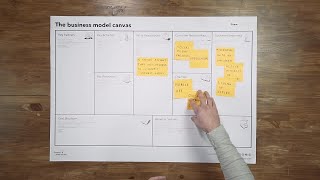
Nick from Board of Innovation walks through the Business Model Canvas, a nine-block tool for mapping and testing your business model. He uses a fitness-linked savings account for millennials as an example, showing how to connect the pieces and test assumptions before you build.
Chapters
Hi, I'm Nick. I'm business designer at Board of Innovation. In this video, I will explain you the business model canvas and how you can use it to iterate on your own business model and how it can help you to communicate better with your own team. The business model canvas is basically one big summary of your full business model. In just nine different components, you can, you can illustrate how one element has an impact on another element of your business model. There are nine different elements, but I'll explain you how it will work, and I will start with one specific example in order to illustrate this. We'll assume we'll have some kind of saving account focusing on interactions with healthness and fitness organizations targeted at millennials. So with that type of service in mind, how will the business model canvas look like? What will it look like? Let's start with the value proposition. So our value proposition is some kind of saving count that ties rewards to customer fitness goals. It's linked to one specific customer segment. In this case, we assume that we will work together with millennials without children, with an active interest in health, living in an urban area, or living in a city. So this is the customer segment we have in mind for this example. Depending on your own business model, you might see that you could have multiple customer segments. And typically what you will see is you have multiple customer segments. You might have multiple value propositions as well. So you might want to cluster them and show them how they relate to one another. Once you have those two on the table, you typically, as a next step, will look at the relationships between them. So how will you bring that value proposition to this specific customer segment? There are two ways to approach this. On one end, you have a more emotional side. On the other end, there's a very functional side to that. So let me show how it works. In order to build up an emotional relationship, we assume we'll work together with influencers, maybe using social media presence in order to do so. So via those channels, we can interact with customers, we can go into, maybe we can resolve specific issues they have. But basically there's an emotional side to this, how we'll link up to our own organization. Then there's a more functional side. How will we bring our products to this customer? In this case, there will be some kind of mobile app. There's a group of online distribution channels to bring this product to this specific customer segment. If you would have a retail business, you might offer retail stores and so on. But this time we we look at a digital service. So a mobile app together with online distribution channels will probably do. So this is how you create value. Then you need to look at the back end of your business model. So what do you need in terms of resources to do so? On one hand, you have key activities and key resources. Let's show you how that would work. So in terms of key resources, we assume here that we have maybe a team of marketing specialists, we need an IT team, maybe, maybe we need license deals on certain software. So there's a whole group of key resources that you will need to create this value proposition for your customers. So what will you do on a day to day basis? That will be your key activities. So there are multiple things you need to do. But let's take one example. For this business model, you need to negotiate deals with wellness providers. So you will need to do that on a continuous, on a day to day basis. So negotiating deals is just one element. This is everything you will do in house. But sometimes you need to work together with external partners as well. So not everything can happen within your own organization. So if those partners are critical, you will list them here as well. So key partners for our business model, of course, we need to link up somehow with a group of wellness providers or fitness providers. Maybe there's certain software that we'll need externally, so certain software providers will be essential for our business model and so on. So you write down all different components of the business model at the top, and then the next step would be to translate everything in the financial side of your business model. So what are different costs and what are the different revenue streams in terms of costs for this specific business model? We assume there will be some I need to invest in human resources, you will need a marketing budget, maybe again license fees. So there will be a whole range of different costs that you need to take into account to bring that business model to market. Then the last component here, how will you make money? Or how do you get a return from your business model? So the revenue streams for this specific example, just to show you one way to do it, we assume that with this service model we can increase the lifetime value of our customers. So for this specific financial institution, we might look at a thousand euro customer lifetime value, maybe that could increase over time. So that's one way to make money or to get a return. The other aspect of this revenue model could focus on an increase in loyalty. So less people will leave the service over time, so less people skip the service altogether. So if we would increase the churn over time, let's say 10% of churn every year, that again will be a positive return for the organization. So of course you can see you can add more revenue streams to that. So this is just a summary of the first indication you have how to make money with your business model. If you together with your team would decide to introduce another revenue stream, you quickly can see how it will impact different elements of your business model. So let's say you introduce a new revenue stream you quickly will see. Maybe for this revenue stream you need to add maybe an additional key partner. And if you work together with that key partner, it could create even a new opportunity to reach out to a new customer segment with a new value proposition. So this business model is never set in stone. So it's typically a fluent summary. So normally you would do, you would look at your business ballpark calculation, you would look at the different business models that you have export and every time when you look at this is how it actually comes all together. Then you'll create a business model canvas. You write down again all the nine fields, see how they interact with each other, and have a discussion with your team to look at what are still the main critical assumptions that you still want to validate. Once you have that in place, you go back to the streets, back to your research, you learn more and, and then again you put your conclusions back on this canvas. Okay, that's the business model canvas. It's a great tool to keep a summary of all the changes that are happening within your business model. Use it with your team to show how one change in your business model affects another component of it. If there are any other questions, feel free to go to bodyvision.com tools we're always available for you, so give it a try and see you later.