Business model innovation basics - Board of Innovation
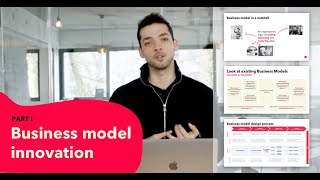
Webinar by Kenan of Board of Innovation introducing business model innovation: why it matters, what a business model is (creating, delivering, capturing value), and an overview of a design process that runs desirability and viability tracks in parallel (discovery, problem fit, solution fit, market fit, scale). Emphasizes that business model ≠ revenue model, and that companies should innovate across all Business Model Canvas elements, not only product or revenue streams.
Chapters
Hey there. I'm Kenan from Board of Innovation and welcome to this webinar on business model innovation. Today we'll be diving into the process of creating business models. What is a business model in the first place? And why should we innovate business models? So let's dive in. So you're on here to learn about business model innovation. But why is business model innovation actually important? Why is it worth even diving into this topic? Well, firstly, I'd like to take a look at this graph with you. This was a study that was done by Autopsy, which is a company that analyzes startup deaths. And they analyzed over 300 startup failures and listed the primary reasons for the failures of these startups. And as you can see from this graph, the two primary reasons for startup failures are the wrong team and wrong business model. As you can see, having the wrong business model accounts for almost 20% of startup failure. So it's obviously, you know, super important when launching a new project within a company or launching your own venture. The importance of business model innovation is also reflected in this book, 10 types of innovation, which where the author really looks at how companies invest in innovation. And when we're talking about investing, the thing that we want to maximize is our roi, our return on investment. So the author looked at how are companies investing money into innovation and what is the ROI of each of these investments. As you can see from this graph, there are three broad categories of innovation, Configuration, offering and experience. Configuration is more on the business model aspect aspect offering is really more on the product or service itself, and experience is really more on the marketing around that company, around that product or service. So we can see here that most companies are investing most of their innovation or most of their resources into innovating on the offering. So they're focusing on creating new features, making the product really cool. And you can see that actually the least amount is being invested into business model innovation. However, if we look at the returns of, you know, investing into these different categories of innovation, we can see that the returns of investing into business model innovation are way higher than investing into the offering. So paradoxically, companies are investing most of their time and resources investing into product innovation, whereas business model innovation actually yields the hot the highest roi. So again, to recap this part, business model innovation is super important because not only is it the main reason why most projects and startups fail, but it's also the main way to maximize your return on investment. If you're looking into how should I invest my time and resources into innovation. So now that we know why business model innovation is important? Let's answer, you know, the obvious question or the seemingly obvious question, what is a business model? So before I actually go into that, I want you to think about this for a second. What is a business model in your terms? How would you define a business model? Now, I hope that you thought about it for a few seconds. And if you're like most people, you'll probably define business model. A business model as a company's way of making money. Now, you're not the only one, because I would argue that 80 to 90% of people define a business model in this way. They only look at it as a way for a company to make money, or it's their way, or it's a company's way of how they define their money making activities. But I'm here, you know, to show you that the business model is not that, you know, the way most people think of business models is actually a revenue model. So revenue model describes how a company makes money through its various revenue streams. And that's not the business model. A revenue model is, is part of the business model, but it's not the entire thing. There's much, much more to a business model. And that's what I want to cover with you guys here, here on this webinar. A business model is actually an organization's way of creating, delivering and capturing value. So there are three key activities within a business model. Creating value, delivering value, and capturing value. So you see that the business model doesn't really revolve around money, it revolves around value. So let's take a look at an example to better understand how a business model works. So if we look at the news industry in the 20th century, how is that done? Well, basically the news industry or a news company, how would they create value? They would have journalists write articles and produce newspapers. How would they deliver this value? They would have these paper boys that would go around delivering these newspapers around neighborhoods. And how would they capture value? Well, they would have companies that would advertise place ads in these newspapers and that's how they would capture the value that they are creating and delivering now. What about in the 21st century? How does the news industry look like today? Well, we can see that it's the exact same three core pillars, creating, delivering, capturing value, but is done in a different way. So rather than having journalists create value, today we create value. We the people who use platforms like Facebook and Google, we are the ones that are creating content. It's being delivered on these platforms, Facebook, Google, Instagram, YouTube, these are all the platforms that are delivering the content we create. And how is that content or that value in the content being captured was being captured through advertisements, through Google Ads, Facebook ads, YouTube ads. So the process is still the same, but obviously it's been updated and innovated in a different way to fit in with the technology of the 21st century. Again, if we look at the example of a grocery store, same same example in the 20th century, you know, grocery store would create value by accumulating all the goods and products from farmers, from butchers, into one location. So they would create value by offering that location. They would deliver value by basically allowing people to come into that location and pick whatever they would want, and they would capture that value at the cash register. Today in the 21st century, again, still the same process, but done in a different way. So companies like HelloFresh and Deliveroo are pretty much revolutionizing the way we get groceries and the way we eat. So, for example, hellofresh, what they do is they create value by creating recipes, and they deliver those recipes to you so you don't have to actually go to a store or physical location. They're actually delivered to you. How do they capture that value? Well, you're no longer paying at a checkout or a cash register. You're oftentimes subscribing to a monthly fee. So again, the process is still the same, creating, delivering, and capturing value, but we can innovate on the ways it's being done. And that's really the point of business model innovation. So again, to really emphasize it's all about value. It's not about money, it's about value. How do we create, deliver, and capture value? Now, when it comes to business modeling, this equation here is extremely important. We have to create more value than we capture, and we have to capture more value than it costs us to deliver that value. A business model will only be sustainable if this equation holds true. And what's interesting is that when we look at business model innovation, we can innovate on each of these aspects. So again, most people, when they think of business modeling, they think of the revenue streams. So they're only going to really focus on how do we capture value, how do we better capitalize on the problem? But business model innovation overall looks at all three of these elements, and it really tries to answer these three questions. How can we better solve the problem? How can we better capitalize on the problem? And how can we be more. More efficient at solving the problem and to put it into more of A contextual perspective. If you look at the business model canvas, we see that there are nine different elements to the business model canvas. And people tend to just focus again, either on innovating the value proposition or innovating the revenue stream, coming up with new ways to create more value through value proposition or coming up with new ways to create revenue streams in that element of the business model canvas. However, there are so many other elements in the business model canvas. So business model innovation is all about challenging all the elements of the business model canvas and not just looking at one or two of them. Because there are a lot of under utilized or under. Yeah, Undervalued elements of the business model canvas that most people aren't looking at. But if you can innovate on those particular elements, you can really create a competitive advantage that's very difficult for other people and other companies to copy. So having covered why business model innovation is important and what a business model is, let's look into the actual process. How do we design a business model knowing that it's all about value? How do we design a process around creating, delivering and capturing value? So the question is, where do we start? Now, I want you to think about that for a second. When you're talking about business modeling, where what is the first point you should always start with. And here's a hint for you guys, you should probably be familiar with this, the three pillars of any business. Desirability, viability, and feasibility. So if you answer desirability, then you are correct. No matter if we're talking about business model innovation or design thinking, we always, always, always have to start with the end user or the end customer. So desirability is still the core of any business model. We're not only looking at viability, you know, it's important, but we always have to start with desirability because if we build something that's viable, again from a business model perspective, but it's something that the end user, end customer, doesn't really want. Well, it doesn't really matter. So always keep this in mind that we still need to focus on desirability throughout the business model innovation process. So here we have the business model design process. Now, this is a process that we at Board of Innovation have designed after working with hundreds of clients all across the world. It's a very thorough process. And today we're gonna just give you an overview of this process. And in later webinars in this series, we're gonna dive into each of these stages and what we specifically do, what tools we use and what techniques we use to really innovate at each stage of this process. Now, before giving you an overview of each stage, I just wanna point out that, that it's important to see that there are two tracks going on at the same time. We have desirability at the top and viability at the bottom. Again, linking back to what I just said, desirability is still the core of business model innovation. So these two tracks are running parallel at the same time. We've noticed that many companies and many startups, what they do is they go through this process only focusing on desirability and coming to a market fit. So they find a product market fit with the solution they've created, but they've completely ignored the business model component. So then they then, once they found the product market fit, focus on the business model. But we've realized that the best way to maximize your resources and your time is to really do it simultaneously. So you should be looking at each stage of the process from a desirability perspective. Are we building something that the user wants? And from a viability perspective, is our business model actually making sense? So that being said, let's go into each stage of this business model design process. The first stage is discovery. So what we want to do in this stage, again on the desirability perspective, is we really want to define the job to be done and map out the customer journey of how that job is being being done on the viability side. So again, focusing more on the business model, we really want to look at the market. We want to do what we call market exploration. And the key question that we want to answer in this part of the process is to what extent is this market even worth entering? So we look at things like the tangible, sorry, the total addressable market, the tam, we look at the competitive landscape because again, if we find, you know, a job to be done and we map out the customer journey and see that there may be potential problems, it's important for us to understand, you know, is this market even big enough to create a solution in? Is it even worth entering this market? So once we've covered the discovery part, we then move on to the problem fit. So we've determined that this is an interesting market to enter. Now let's dive deeper into the problem. So on the desirability perspective, we're identifying and validating customer pains along the journey we've mapped with them. And we're also identifying and validating customer segments using techniques and design thinking, like Personas. But on the viability perspective, in Business model innovation, what we wanna do is we really wanna look into the user problem exploration and value these problems and size them. So. So on the desirability perspective, we've figured out these are pains, but how much money are these pains worth? How much money is being spent on them? How valuable are these pains and is it again, worth it for us to even solve these pains? And that's the key question we want to answer in the business model innovation aspect is which pains should we focus on and which customer segments should we focus on? And this is where we do techniques such as problem sizing to assign values to different customer segments and to different problems in order to prioritize which ones we should focus on. Once we've done the problem fit, we move into the solution fit stage and this is where we begin ideating solutions. We begin evaluating them and we begin uncovering assumptions. But in the first part of solution fit, you know, we really focus on ideation. So on the desirability component, we're ideating multiple concepts, we're writing down the assumptions we need to test from these different concepts. But on the business model side, not only are we ideating, you know, the concept and the product itself, we're also ideating business models as well. And so again, this first part of the solution fit is ideating business models where we use lots of different tools and techniques to come up with as many potential business models we can. Once we've actually ideated a bunch of business models, we're now going to really converge and identify which ones actually make sense. And this is in the evaluation stage of the solution fit. So the key question we want to answer here is to what extent does this business model actually make sense on paper? Because if you can't make it work on paper, it's going to be really difficult to make it work in real life. So at this stage, we're evaluating the business models and we're also uncovering the assumptions that need to be tested in the solution fit. So basically, by the end of this stage in the process, solution fit, we should have ideated many business models, then evaluated which one of them actually makes sense and from the ones that do make sense, which assumptions do we now need to test in the market fit stage? And that brings us to the penultimate stage of the business model design process, which is market fit. Again, from the desirability perspective, at this point, we will have gone through solution fit, so we will have found solution that our customers do value, and it does solve a legitimate pain. So at this point, we will have launched an mvp, we will have gained feedback, you know, from our first users, you know, to improve that mvp. So again, on the desirability perspective, you know, we have something out there in the market that people are using and it's our mvp. But from the viability perspective, again, we will have launched our business model, we will have tested our growth model. And just like we're refining the concept based on user feedback, we're also refining the business model itself. So at this stage of the process, it's really where we're done, you know, doing desk research, you know, where we finished evaluating on paper and now we're really out there in person on the market having real people, real customers, you know, using our product or service. And so we're validating our assumptions in the business model. This is where it's really important again, to be very practical and understand which assumptions are the most risky ones to test first. And so we have various tools and techniques to help you identify how to test assumptions and how to identify which ones are the most important to test. Now, by the time you've gone through this entire process successfully on the desirability perspective, you would have found your product market fit, you've built a solution, you've built a product or service that customers really value. You will have validated the viability perspective completely. So you will have gone through the whole business model process of figuring out whether it's a market to enter, figuring out which problems and customer segments to focus on, identifying viable business models on paper, and then validating those business models through real life interactions, through getting your first customers and your first sales. So at this point, once you've gone through this whole process, you should have a product market fit and a business model fit, and now you're pretty much ready to scale. And this is where it's all about growth, where you flip the switch and, you know, put the pedal to the metal. And obviously this process entails a whole different type of process. But most companies and most startups, you know, fail to even get to this point because they might have a product market fit, but they might not have a business model fit. And that's what we really want to emphasize, that this process of business model innovation, a simultaneous process, you're focusing on what the customer wants, but at the same time focusing on the business model itself throughout the entire process. So that's it for this webinar. I hope you've really enjoyed it. I hope you've gained, you know, a lot of value from this. Keep in mind that business model is not a revenue model. It's not only looking at how you make money. It's really about how do you create value, how do you capture value, and how do you deliver value overall. It's a very holistic view of your business. We'll be doing more webinars in this series, again diving into each stage of the business model design process. So make sure to, you know, stay tuned for the following webinars. Make sure to follow us. And if you want to connect with me personally, you know, you can find me on LinkedIn. If you want to connect with Board of Innovation and you don't want to miss out on the upcoming webinars, make sure to follow us as well on LinkedIn. Feel free to check out our website. You can find lots of tools there. So thank you again for joining this webinar, and I hope to see you on the next one.
More from Zaur






An Immersive Workshop to Calculate the ROI of AI Strategy - AUTONOMOUS session

Predict, Optimize, Decide: Enterprise Decision Making For The Simulation Era - AUTONOMOUS summit


AI Insiders podcast ep. 9 - Not so cookie-cutter: Consumer Choices in the Age of AI

