Business model kit
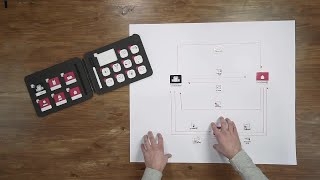
Nick from Board of Innovation walks through the Business model kit, a visual toolkit with stakeholder and value-exchange icons for mapping revenue streams. Six stakeholder types and ten value types (money, data, reputation, service, experience, exposure, credits, and others) let you sketch different business models and iterate quickly.
Chapters
Hi, I'm Nick, business designer at Board of Innovation. In this video, I will explain the business model kit. This is a very easy toolkit to illustrate how value is being exchanged within a business model. So on one hand, you have different stakeholders will be those icons. On the other hand, those stakeholders will exchange value between them. And we can illustrate that with other icons. Those are these small objects. In this video, I'll explain the different icons, how they work, and then I'll show you how it can be used in one specific example. So we use a very simplistic business model here, but it can be also used to map out full ecosystems. Of course, this is not the purpose of this full video to map out a full ecosystem. So we'll keep it simple just with three icons, but you will get the essence of it. So to start from, I'll explain this kit. So on one end we have six different stakeholders. So those square icons will be used to indicate which parties are involved in a business model. To represent your own startup project or your own company, you'll use the black icon. So you will always map out your business model from this central icon first. Then you will create a relationship with different types of other players. So you will have potential clients or partners. So we have companies that can be involved other companies, or maybe end users or families or something like that. So. So we have another icon to illustrate a B2C relationship. Then there are other stakeholders. Depending on the business model you have, you might need different icons, but there's another icon for suppliers. It doesn't mean that you need to illustrate every single supplier that you will work together with, like your web design agency or the people that are cleaning your office. You only want to use that icon if you want to illustrate a key relationship you might have with one specific supplier. Let's say you work together with a big data provider, and that's essential to create a value in your business model. You might want to show that on the table as well. Like, look, we work together with this specific supplier, and that's really innovative or unique in our concept. Then there are two other icons. One to represent nonprofit organizations, so think schools or NGOs or something like that. And then the last one is government. So if you have a relationship with the local government or at the European level or something like that, you. You might want to evolve this icon as well. So between those stakeholders, you will exchange value. You will do that in different ways. So the most straightforward transaction would be you as a company. You give a product or a service and you will give that to a client and they'll pay for that. So typically they will pay with money. So there's an icon for money. Or they might pay with less money. And less money is something very specific here already. It's not when you give, let's say a 5% discount or something like that, but let's say you, instead of an annual subscription on a newspaper, like that would be the normal icon for money. You suddenly start asking money, let's say 10 cents per article or something. It's a radical shift how you change this transaction. In terms of value, you have a radical discount. You go for microtransactions and then you use the less money icon. People can pay with other stuff as well. So to give one example, people can pay with, with data. So instead of paying with money, they exchange profile information or they give access to behavioral data or something like that. So that might be useful. People could pay, or companies could pay with reputation, let's say the value of a brand or something like that. People can pay with, or companies can pay with rights, let's say license fees or IP rights, or they could somehow pay with an experience. So the difference here would be with the service, while service would be a very functional transaction, an experience, that's when you're focused more on the emotional side of anything. So if it's purely a functional transaction, you will use the service icon. If you're focusing more on the experience. Then we go for the experience icon. Then last two objects here, there's an icon for exposure. So every time you have an advertising business model where you're exchanging eyeballs of a certain audience, then you will illustrate that with the exposure icon. And the last one is credits or virtual credits. So that links to business models where you introduce a loyalty card system or even cryptocurrencies. So every time you pay with a non monetary item, this icon could be useful for you. So you have those 10 objects here, you have those six stakeholders and then you can use those icons to map out a basic business model. So let me give you an example here. So assume you're a financial institution and you have a certain customer. So you have this transaction here already. So focusing on this one, you will offer in this case a service, so a mobile app to this customer. They get the service for free. And in exchange they will pay with data. In this example, they will exchange data related to their workouts, their health, when they go to the gym, whether or not you're using a wellness center or something, their food data. So they're exchanging data all related to the domain of health and wellness. So in that case, they get the service for free based on, let's say, how often they go to the gym or what type of food they had or anything. You might get a better service at this financial institution, let's say a better interest rate on your savings account. So customers will get an incentive to have maybe put more savings on this financial institution. So they get an incentive to actually do that. Another part of this business model is focused on the wellness centers. So this customer here, let's say this customer will still go to the gym, so they might pay for that service. They get a service back of going to the gym or going to the wellness center. In order to create value for these centers, they will get certain eyeballs or exposure on the platform or on the mobile app. So they get exposure from the financial institution, maybe in exchange, depending on how the value will be developed, they might need to pay a fee per customer or any other type of advertising metric. So they still might have to pay for this service. While this is just a starting point for the business model, you can introduce new players or new icons on top of this transaction. Let's say you have a first incentive model here. You can elaborate or expand that with. Let's say if you get an incentive here, you get 100 points for going to the gym every single week. Maybe those hundred points can be exchanged at a later moment for a small discount here. So you pay less to go to the gym. Or you can transfer those incentives into your saving account. Let's say per thousand points you get just cashback of €25 or something. So this is just a starting point for brainstorming. This business model kit is not an illustration or not a replacement for a normal business case. Maybe something he will do with Excel later on in the process. For us, this is mainly a brainstorming tool. So we can use those icons to export multiple revenue streams you can use as a communication tool with your team. So they might point out different new revenue streams or inconsistencies in the business model. And the main goal is now to explore multiple variations of this. The main goal is not to just have one business model. By doing this multiple times, you will have multiple variations of the same topic. So it's a great starting point to start any type of business. Business model Brainstorm so this is the business model kit. It's a great tool to do a brainstorm with your team, to use as a communication tool with different colleagues. It's not the main purpose to have the perfect business model yet. So you can have the perfect business model later on. You can finalize it in Excel or anything else. For us, this is a tool to explore the different options when it comes to revenue streams ecosystems. So by exploring multiple options here, you will have more variations, more creativity and and you can make a better selection before continuing to the next step in this process. So this tool is available in a digital format or in a physical format like this. Feel free to go to our website where there are a lot of cases and illustrations of other business models so you can see and get more inspiration from other organizations. You can go to boardinvasion.com tools to download this and plenty of PDFs with examples of other companies, how they make money.
More from Zaur






An Immersive Workshop to Calculate the ROI of AI Strategy - AUTONOMOUS session

Predict, Optimize, Decide: Enterprise Decision Making For The Simulation Era - AUTONOMOUS summit


AI Insiders podcast ep. 9 - Not so cookie-cutter: Consumer Choices in the Age of AI

