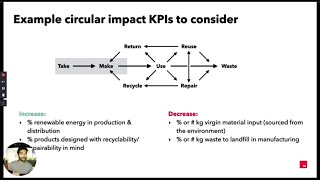
A short talk by Kevin Shahvazi (Circular Economy Innovation Lead, Board of Innovation) explaining how businesses should translate circular economy strategy into tangible KPIs. He maps example KPIs across lifecycle phases — upstream design/take & make, return & recycle, use, reuse & repair, and end-of-life/feedstock — and gives measurable targets and metrics organizations can adapt.
Chapters
Hi, my name is Kevin Shahvazi and I'm the Circular Economy Innovation Lead at the Board of Innovation. And today we're going to be talking about circular impact. What does it mean and how can you measure it for your business? So it goes without saying that a bold, lofty, long term statement is not enough to enact the change to a circular economy. Telling your innovation teams to go circular isn't tangible enough to provide a direction and it can lead to things like dilution of resources or even confusion and several different initiatives that don't work in sync with one another. So it's important to translate your strategy into tangible KPIs and measurable targets and to make this also clear for circular economy and what you expect out of circular economy innovation. What we've done is We've mapped different KPIs that we've seen in the market along different phases of the circular economy lifecycle. These can be inspiration for you to remix and make more detailed to your value chain and to your organization. And feel free to get inspired and let us know how you've used these. So in the take make part really upstream, what's important is to make sure that you're maximizing the amount of renewable energy and the products that you build or source. With recyclable and repairability features in mind. You're looking to decrease the amount of virgin material that you source or that is sourced in your products, both as a percentage or as a total amount, as well as the kilograms that you end up creating in landfill, either from yourself or your supplier moving downstream in the return and recycle. It's all about actually getting as many products back as you can, and that can be from a kilogram, a percentage of your of your installed base or a value perspective as well. And through this you're also looking to increase the purity of what you get back as well. Especially with things like mixed streams of materials. You're looking to try and get that separate and pure so that you can recycle them effectively. Also worth looking at is the availability of these return points for your customers to keep things convenient. That can be something you track and try to increase as well. What we're looking to decrease here is the amount of products that actually end up being discarded, returning to landfill or incineration, the cost of returning this especially for sorting and processing as well. To keep these operations sustainable. In the use phase, we're looking to increase the lifetime of a product in years and its utilization as well. For example, cars are used 5% of the time parked 95% of the time. How can we get that 5% up? Another thing you might look to increase is the number of users that are sharing the same product. That can be challenging this day and age. And it might actually go against your business model as it stands now. So an interesting KPI to look into, what you were looking to decrease here is the depreciation of your product year over year. That goes against the retention of value essential to a circular economy. Idle time and things like energy needed to operate your service or product, environmental emissions and maybe even the total number of products that you have in the field. How might you lower your footprint? There's some creative ways to look at circular economy downstream. You're looking at reuse and repair. So here what's important is increasing the value of your product on the secondary market. And also looking at repairs. Can you increase the number of repairs, the satisfaction consumers have with it, and the availability of spare parts? Of course, to complement this, decreasing the time it takes to repair, the cost, the amount of products that are non repairable and discarded, and the cost of spare parts compared to new. Because that's often an indicator of whether someone will just buy a new product or attempt to repair their existing product downstream. Really, really downstream, when reuse is no longer possible. We're looking at increasing the value of your, let's say output as feedstock to a completely other industry downstream. For example, clothing that can no longer be reused or repaired can turn into input for insulation. And you want to see what is the percentage of your products that can actually be captured as feedstock and what's discarded, what's the value of that feedstock? That's something you want to increase. And to do that and enable that. Getting more information about where your products end up is quite important. Things we're ultimately trying to decrease here is the percentage of products that end up in the landfill, incinerated or discarded back into nature without creating value. So there you have it. These are some example KPIs for you to consider and remix as you see fit for your organization to enable you to have circular impact.