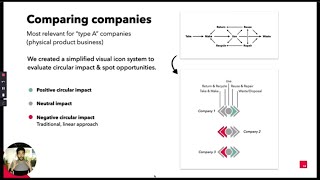
Kevin Chabazi presents a five-part visual tool to rate circular impact across business model, customer, user, upstream, and downstream phases. Mud Jeans scores positive on upstream and repair; fast fashion mostly negative. The tool spots where companies like H&M and bottled water brands can improve through partnerships and recycling programs.
Questions this video answers
Kevin Chabazi, circular economy lead at Board of Innovation.
40% recycled jeans fibers.
18.6 million tons of clothing per year.
Chapters
Hi, my name is Kevin Chabazi and I am the circular economy lead at Board of Innovation. And today we're going to share with you a simple visual tool to help you evaluate where you're making circular economy impact. So this framework builds upon our circular economy life cycle diagram. And what it does is it breaks down the life cycle into five different parts. Your business model, where your customer and user are two upstream phases and two downstream phases. And for each of these phases, you can have a positive circular impact, a neutral impact or a negative circular impact. So a traditional linear impact. And we have some KPIs that can be used as a basis to make this distinction if you're positive or negative, which you can check out in another video. But essentially this, this can help you quickly benchmark where you're performing well and where there might be other opportunities. It's also a very simple rating system that can help you spot opportunities across companies in the same value chain. For example, right here, where you see very active companies performing on the one end who might be able to partner with other companies performing well on the other end. Let's dive right into it. Let's take Mud Jeans as an example. This is an example of a business model that has positive upstream impact as well as impact in reuse and repair. And what Mudge is, is it's a jeans rental or company that also has a vintage sales for used jeans. Why are they positive? Well, from the take make perspective upstream, they use a certified organic cotton as well as 40% recycled jeans fibers in the production of new jeans. Together with their denim manufacturer, they also have a return and recycling program as well where customers can get a discount for sending back used jeans of any brand as well as in the rental cycle. The return is a natural phase. And what they do then is they triage these and work with their denim manufacturer to make sure that the jeans are inputs for future generations of jeans. So they have quite some positive impact upstream. Moving downstream, they have positive impact because they have a secondhand market for the reused genes. That's the sale of their vintage jeans. And they've complemented this with free repair services for those who are renting out the jeans. So quite some positive impact downstream. Let's contrast this with a fast fashion brand which has negative impact almost everywhere in the life cycle. And for argument's sake, let's take a fast fashion brand that's using some sustainable sourcing. So there may be a neutral impact upstream by using some organic and recycled materials. But oftentimes these are very little Percentage wise and don't offset really the high volumes that are being produced internationally. In the usage phase, we know that fast fashion's business model is built upon making clothing that does not last. Actually, there's research to show that a lot of the clothing from fast fashion lasts less than a year. And moving all the way down to the waist phase, 18.6 million tons of clothing ends up in a landfill every year. And that's what we can estimate for this year. And fast fashion has a big role to play in this as well. Looking at the other aspects of the life cycle, it's often not economical to repair or resell fast fashion clothing due to its limited economic value. And of course, the returning of it back to the manufacturer is difficult due to the poor relationship with customers after sales. So this business model has a lot of room for improvement. That's exactly what H and M did in partnership with Iko. So Iko is a recollection solution that exists in a lot of H and M stores where consumers can return garments of bags of garments in exchange for a discount. And what you can see here using the visual system is that creates positive impact in the return recycle part of the lifecycle by giving consumers a channel to return their H and M clothing. And actually the partner triages this clothing for different usages. Could be for down cycling into things like insulation, or it could be to recycle back into clothing. Textiles can also be for reuse and repair, but we estimate that as being very limited due to the secondhand markets and repair of fast fashion clothing being rather limited. But what you can see from this diagram is that from going kind of all red after the take make phase, this partnership with Iko has enabled H and M to make some positive impact on its circular impact. So partnerships are quite essential to build circular economy because it's not easy for a player to kind of man all the bases upstream and downstream. Everyone has suppliers, everyone has customers, and customers are free to do what they will. And creating these partnerships can be a way to actually maximize your impact for the circular economy along the whole value chain. Let's go into a completely different example of bottled water. This is a classical linear product which is made to be used once in a kind of extreme case, made using entirely virgin plastic sources and ends up quite often in landfills and back into nature where it does not degrade for many, many, many years and contaminates oceans. Even in countries with good recycling infrastructures, these return rates and the recycling rates are rather low. And of course, given the design of this product. Reuse and repair are not intended to discourage plastic contamination from second, third, fourth users using a disposable water bottle, one might even exist. If you take a step back, sorry, one might even ask, does this product, should it even exist given how many other reusable solutions there are out there like Dopper, I will contrast that with what Avion, which is a brand of Danone, is doing to eliminate labels from bottles and kind of really, really minimize the use of virgin material. By partnering with Loop Industries, they have created positive impact upstream by sourcing from the economy instead of sourcing from the environment, and have made some impact on return and recycling by collaborating with Veolia. However, the downstream impact remains as it is in the industry and creates a lot of opportunities for improvement. So now you have it. This is a great visual system that you can use to benchmark your business model or to spot opportunities to partner between business models in a value chain. Feel free to sign up to our newsletter to learn more.