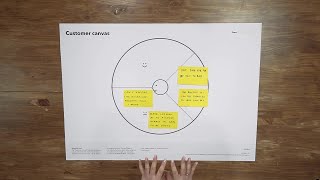
A short video walkthrough by Yinglei (design strategist at Board of Innovation) introducing the Customer Canvas tool. The video explains how to collect customer insights (jobs, pains, gains), demonstrates the tool with an example (millennial customers saving money and wanting to stay healthy), contrasts the Canvas with Personas, and gives practical tips for iterating with further customer conversations.
Chapters
Hi, my name is Yinglei and I'm a design strategist at Board of Innovation. I will walk you through the Customer Canvas tool. So it's a very valuable tool since it's a great starting point to understand your value proposition or to build your value proposition from. And the way we're going to use this tool is very simple. There's three dimensions that you have to fill out as a team. So after you have done your problem exploration, you and your team will have collected a lot of different stories from your customers where you have found out more insights about their needs, their frustrations, aspirations and things that they try to achieve. So the Customer Canvas is a very simplified tool for you to be able to collect all those insightful information about your customers in one spot. So what we usually start from is to list up all the jobs that they're trying to do in their day to day life and then we will be moving on towards the pains, so the states that they're trying to avoid and then moving on towards the positive. So the gains. What are the states that they're trying to achieve and to experience along the way they are trying to do their jobs. To illustrate how to use these tools, let me walk you through a brief example. So let's take the example of a financial institution who is thinking of creating a new value proposition for their target group, the millennials. More specifically, those interested in saving up more money and living a healthier lifestyle. So after me and my team have done our problem exploration, we have identified a couple of few jobs that they are trying to do. So goals that they're trying to achieve on a day to day basis. In our case, our customers told us that they want to save up money for their holiday trip. So it could be a trip to Bali, let's say another job that they are trying to do or goal that they're trying to achieve is to stay healthy so that they can fit feel energized in order to cease each day. We have noticed that often those millennials are quite busy, both professionally as well as in a social occasion. So it's very important for them to feel energized and in order to feel energized, staying healthy is one way in order to get them to reach that goal. A couple of few pains that we notice. So things that they're trying to avoid. So one of them is what came up quite often is that they sense that they feel like they can't afford the exercise program that they would like to enroll themselves in. So that's kind of like more like a money issue. Another pain that popped up is looking at their savings accounts make them feel really, really anxious. So, so they're anxious because they're afraid that once they look at it, it might be empty. Now moving on towards the gains. So things that they're trying to experience. So positive states, in our case, we noticed that achieving their savings goal gives them this sense of achievement and being active with friends is something that would motivate them. So what you notice is that often the pains are not only the states, the negative states that they're trying to avoid. Sometimes these could also be the hindrances on why they can't, or it's very difficult for them to achieve the goals to be done. And while the gains are not only the positive states, but they're also the motivations on why they would like to achieve these goals or the jobs to be done. So a key difference that people often wonder is between the Customer Canvas and the Persona, which is a tool that we walk you through previously. What is actually the key difference? So indeed, there's a few things when walking through this exercise that you feel there's some overlaps. But what's important to understand is that the Persona is a tool that we use for empathy. So it's really about emphasizing the people that we aim to serve and making sure that they're there and present throughout the whole design process as well as during the key decision making moments. While the Customer Canvas is a very simplified tool in order to enable you to communicate mainly on desired outcomes, an amazing factor of this tool is that it will help you to benchmark whether the value proposition that you and your team is about to create or design, whether it's actually meaningful and valuable for your customer. And the way to do it is to ask yourself the question, how is your new value proposition enabling your customers to do the jobs that they're trying to achieve? How is it helping them to avoid or to mitigate for those pains? And how is it trying to add value or enabling them to collect these gains? Have a try and very curious how the process will go for you guys. And remember, just like any tools within the innovation process, it's not a linear process. So during the mapping out of the Customer Canvas, you might realize that there's a couple of few things that you would like to find out more about and you didn't manage to ask them previously. Don't hesitate to book another interview or schedule another conversation. Coffee chat with your customer, collect these insights and map them out for on the Customer Canvas for completion. For more information about the Customer Canvas, feel free to visit our website, boardofinnovation. Com Tools.