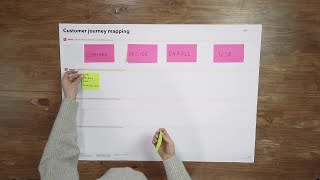
Yinglei, a design strategist at Board of Innovation, walks through a customer journey mapping tool using Millennials choosing a gym as an example. The tool breaks down customer interactions across different sections to help you understand and improve their experience.
Chapters
Hi, my name is Yinglei and I'm a design strategist at Board of Innovation. I will walk you through the customer journey mapping tool. As you can see, this is a very simple and visual tool that will help you and your team to align on the journey that your customer takes in order to interact with your product or your service. So it contains of four different sections. The first one are stages. So there are more generic stages regarding to the journey that you decide to map out. The second one are activities or actions, things that they have to carry out or your customer is carrying out. For each of the phases, feelings is more the emotional curve. It gives you a good understanding on how emotionally your what's the emotional state that your customer goes through during each of the phases while carrying out the different activities, how do they feel but also what are their thoughts and questions that they are sitting on? And last but not least, channels, what are some of the touch points that your customer used in order to carry out the different activities across the different stages? So after you have mapped out the customer journey, what it will give you and your team is a good understanding about the overall journey that your customer walks through and it will help you to understand what were the key moments, how does your customer interact with your product or service and what are the areas of improvements that we can make towards making this journey a much better experience. So I will walk you through how to use this tool through an example and in our example we're following a financial institution who decided to create a new value proposition for their target group, Millennials who want to save up more money and who want to live a healthy lifestyle. During our problem exploration we identified a couple of few interesting journeys that we can map out as a team, going from their sal and their way of deciding for financial institution to join to their journeys regarding to their healthy habits. So for this example we will be mapping out their journey on choosing a gym to participate in. So to start off, try to map out some of the key phases that the customer will have to go through in order to decide and be part of a gym. So in our case, often after having sparked the interest of wanting to do some exercises and have a very convenient place to do it, they will move to the phase of comparison. So that's where they're going to compare the different options that they have at hand while taking into account some of their restrictions like time availability and budget. After having compared, there will be a moment of truth where the customer will decide for the option that he wants. He or she would like to go for once they have made the official commitment. There is also the moment of enrolling actually into the gym space. And after having enrolled, of course it will be followed up with actually participating in it and doing the exercises in order to get yourself fit. So I will not do the deep dive on each of the phases. However, I will do a deep dive on the first phase and the last phase at least for our journey map, just to give you a better example or a better idea on how to use this map together with your team. So during the compare phase, while the customers or those millennials are added, we, a lot of them has shared with us that they will ask friends for suggestions. Actually, millennials are very social and they really rely on their friends and their opinions about things to decide what is most important and what is most relevant for them. Not only that, but they will also try to do desk research by themselves. These days, knowledge and information is just one Google away. So it's also very easy just to do a quick desk research by ourselves in order to understand what are the options there and perhaps find those options that our friends didn't raise themselves. When we were walking through, when they were walking through the journey with us, we found out that having so many options to choose from can be quite overwhelming for them. So it's something that's not being considered as a positive emotion, but rather on the low end. We also noticed that they do value ratings. So for example, having a gym that has A rating of 4.8 out of 5 is considered to be a good thing, which is a criteria that they will use in order to kind of like fill it, fill out their pipeline and try to help themselves to shortlist the options they have. Some of the channels that they use during the phase of comparing is using the WhatsApp. They use WhatsApp as a way to, to connect with their friends and to quickly ask questions on the go. For example, asking for their recommendations on which gym to choose from. But then they will also be relying on Google Reviews, which is again super easy these days. Just using our phone in order to find out more about, okay, what's actually out there that's meeting my availability, my location. But at the same time, how do people perceive that location? Let's move on to the using phase. So once you're using, once they have enrolled and they're actually part of the gym, let's say one of the activities that they have to do is to decide perhaps together with a PT on an exercise routine that they would like to follow up on or try out on. Excitements are especially for the first usage is often combined with a sense of excitement and joy that they're actually in there and they they want to give the most that they can. But after a while what we noticed is that there is motivation is starting to crumble and a lot of them finding it hard to actually find the motivation to keep on going to the gym and keep on using it. So the channels during this phase is the actual physical gym. Some of them use the gym app in order to find out what are the courses that's currently available for the day and that I can sign up for if it's on the day itself. But they also use the newsletter in order to track promotions but also closing hours if there's for example holidays coming up to make sure that they are up to date on the latest information that's relevant for them. So this is the Customer Journey Map and as any tools, it is not a linear process. This tool is usually used after you have conducted the problem exploration, after you have defined the Persona and the customer canvas in order to and once you have done that, you will move to the customer Journey in order to map out the journeys, the various journeys that your Persona or customer goes through in order to make their decisions. And what it does is it gives you a good overview in order to understand all the different stages and activities they go through. And more than that, it gives you a good highlight on okay, what are some of the activities that they're doing that's considered to be more like a pain, so it's kind of a frustration and what can you and your team carry out in order to help them make this journey better? For more information about this tool, please visit boardofinnovation.com tools.