Design Sprint - How does Design Thinking add value to a sprint? (part4)
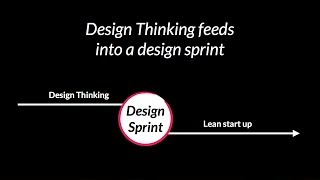
Design thinking reduces innovation risk by starting with user empathy before running a Design Sprint. Talk to about 10 users to find real problems, then assemble a 6-7 person team for a five-day sprint to prototype and test. Google Glass and Post-it notes show what happens when you skip the desirability step.
Questions this video answers
97%
Normally a five-day process.
6–7 people (seven is the maximum recommended).
About 10 people (claimed to surface ~80% of problems).
Chapters
So yes, as DNA explained before, design thinking is very much about designing the right thing. So it's about making sure that what you're putting all of the resources and all of the effort to is actually adding value to your customers. So when you talk about innovation, so I talked about the three steps beforehand, but while going through those three steps, you always need to have three elements in mind. Your innovation needs to be obviously viable for the organization. So you need to make sure that you bring some value to the organization that you're working for. Whether it's data or revenue or a learning process, it can be whatever, but it needs to add to something. On the other hand, of course, you also want it to be desirable. So you want from your customer end side, but also from the people working on the front end of your company. So think about the service providers that are in touch with the end customers, that it's desirable for them so that it's really a pleasure to use. And then finally, of course, it also needs to be feasible. So when you have a new solution in mind, or if you redesign a current one, you have to make sure that you're actually able to make it. And when you actually have a really good innovation is in the middle of those three elements. But now looking at innovation as a whole, where it really originally often was driven from, was from technology. So it was, okay, so what can we build? And then afterwards, people tend to find a market for it. So as Yen Lei explained before, a Google Glass is a very nice example of that. So Google just innovated in terms of technology, then brought it to the market and was hoping that people themselves would find a proper use for that. So even though the idea in itself was great and just to give technology to people to play with, in the end, as we all know, it didn't succeed because we just didn't find a proper use for that. And that is actually something that comes across quite often. So 97% of the innovations that were driven by technology fail because they fail to meet a need of the market. And then the 3% that do, of course we're very excited about it and we're very pleased with them, but you have to be very much aware that it's just an exception. And just to give you some examples of how sometimes just a new technological innovation just by accident meets the need of the customer is, for example, post its. So even though this is not a hardcore technology, the origin of this product, so the sticky notes is that it was actually they were trying to, you know, invent on a new type of glue. But then they actually failed because it didn't stick very well. And hence there was just one creative person that actually thought about the fact that they could use it for a different purpose. So initially it failed, but in the end they did find a purpose for it. But that's just a very big of a coincidence. Just as with YouTube, so known by everyone as a sharing channel for all different types of videos, in its origin it was actually meant as a dating channel. So where you, as you do now with Tinder, you can just easily upload a video of yourself and try to find a partner through that challenge. So even though these are great products, great innovations, they were just a success by accident. And that is something that we actually want to avoid. So we want to de risk the innovation process, as Yin Lei mentioned before, and that is by starting with desirability. So really looking at as our world is evolving and we have new generations, think about the millennials. How can we actually use some of the existing technologies that we have and apply them so that we are actually solving new customer needs? And some of the things that illustrate why this is necessary. And there's a nice book about this which is called Thoughtless Acts from Siri Jain from ideo. And she actually observed how people continuously adapt the world around us because things are just not properly designed or just don't meet our human needs. And that is something that is quite interesting. So if you look for a bat design, one of the key elements that you always find there, if there's a lot of notes on it, so with a lot of labels, you know that this is just not easy to understand for people and they didn't think things through. To give also another example of how we adapt the world around us is what you see on this picture. So this is, this comes from a project that we've done in the pharmaceutical industry and I was doing observational research, so doing contextual interviews with the dispatcher of this organization. And it was about digital transformation. And that is also, I think you can see the necessity of it through the picture. So it was still a lot about paperwork. So they wanted to digitalize that. And while I was observing this lady in her day to day work and then here and there, I was also asking some questions about the things that I have observed. Observed. Yeah, What I noticed then after I think about 20 minutes is the amount of phones that she had on her desk. And as you can see properly, there is five phones that she has on there. So I did ask her about it so what is the purpose of all of those different phones? And then it was meant for, you know, the different, if she needed to call nurses or suppliers, etc. And the reason why I'm pointing this out is that if you do qualitative research more often, it's still done in the way that you invite a customer to your company and you have more of an artificial setting where you ask them some qualitative in depth questions. Whereas what we advise you to do is really to immerse yourself in the world of the end users, go towards their world, observe how they interact, because there might be problems that they're facing which they solve by themselves and therefore they won't tell you about it. But if you observe how they actually manipulate their own working environment, you will learn a lot about the problems that they face and how you as an innovator, as a designer can find a better solution for that. One of the main advantages if you do this user driven innovation is that customers often demand simplification. So when you talk about technology, we like to think about the long spectrum and try to think about all of the different things that they do. But then if you look at the customers, the key elements that they actually demand for are often just very few. So therefore you can actually, by this qualitative research, you can actually get some ingenious and often cheap solutions. So just to give you an example, and I think actually the experiment ran first in the Netherlands, but what they did is that they, when you look at the highways and you have the signs above it with arrows pointing upwards or downwards, what they actually measured was that it was a difference in terms of time, traffic jams of half an hour, when it was going a lot slower, when the arrows were pointing downwards because then people felt like they needed to stop. Whereas if the arrows were pointing upwards, it really gave people the perception of that they were in a flow and then the traffic actually moved a lot smoother. So very simple, very cheap solution, but high impact actually on the traffic jam. And that is something that most of our cities, at least in Europe are struggling with. And that is something that we want to just enforce you, not enforce, but inspire you guys to think about how can we just very creatively, very ingeniously solve a problem from a human's perspective and do it in a very cheap way. Another example that the males under us are probably most familiar with is what they do with this urenoir. I don't know how to say it exactly. I think that's the word that's the word. Okay, good. Well, they add a little fly in there just to make sure that you keep everything clean and that things don't get scattered around. So yeah. So even though I don't know if you've heard a lot about design thinking already, but what we common hear from our clients is that they find it a very fluffy and chaotic approach to innovation. But luckily Stanford D school together with ideo, developed this five step process for it. So it's first you have to empathize with the end users, as I mentioned before. Then from those insights you actually define what the true design challenges and what the vision is for your innovation or redesign. Then you start ideating with that vision in mind. You prototype things and you start testing. So looking back at what Yehi mentioned before about the Design Sprint, you can see that that one is very much focusing on the later three elements of the design thinking process. So it's a lot about ideating, prototyping and testing with end customers. But indeed, if you come across one of those pitfalls that was mentioned before by Yin Lei, we do advise you to think about design thinking, especially about its first two phases, and let that feed into the Design Sprint so that you actually get a better end result of that. So let's look back at. Was this your part? No. Okay, so let's look back at the successes of running Design Sprint and what the common pitfalls are. So as mentioned before, initially what is really key to it is that it's a shortcut on the learning curve. So, so instead of launching something and learning from that point on, you're actually going to prototype and test early on in the process. But in order to benefit from this speed, there needs to be a very clear customer driven scope to it. So when you bring that team of seven people together, you actually really have to know what the problem is from your customers that you're actually trying to solve. So when as explained before, the Design Sprint is very much about designing the things right, you need to make sure that you're actually designing the right thing. So I have an industrial design background, so I often like to refer to things as machines or different motors. So if you could see if you would see the Design Sprint as a machine where different ideas need to go through. Obviously if you just have a whole bunch of ideas that you want to take through the Design Sprint, it will break, it won't work. Even though it's such a sophisticated and very smart process, if you don't feed in the right scope, it will actually won't work. So what we advise you to do is actually to first clarify the scope, really make sure what is key, both in terms of your business, but especially in terms of the customers that you're trying to solve, and then use that during the Design Sprint week. So, and if you do that right, then in the end you will be able to have that minimal viable product concept there, which you can then, through lean startup, actually launch the market in a very fast way. So there's a couple of tools that we have in order to answer those questions of what is truly business critical and which are the problems that allows you to gain the most learnings, and that is, first of all, the design thinking experience experience card. So, based on those three elements that I mentioned before, so how viable is this for the business, desirable for the customer, and feasible from the technology, you have to make sure that you have some key questions answered there before you're actually going to start the Design Sprint. About the desirability, we use the Persona tool, which is the idea that you actually define a customer segment with the similar motivations and needs and you actually translate them into one person, so you give it a specific name, specific age, you really imagine how they would speak, so you write a quote, etc. And from that Persona, you can really always relate to that person while you're going through the Design Sprint. So you can always, if there's a discussion keen, always ask, so what would our Persona like the most? Or find the most important? So the second advantage was about de risking the innovation process. But if you're going to do that, you need to tackle the assumption very early. So even before the start of the Design Sprint, so where you can, of course, we always simulate the fact that you have to involve customers in the process. But in a Design Sprinter, actually they're invited at the very end of the process. So it's when you're actually going to research whether the functionality that you've put in your prototype are desirable. Whereas if you look at the design thinking process as a whole in the empathize phase. Sorry about that, in the empathize phase, you're actually going to look at the desirability of the solution, so of the idea that you have in mind, so you're really trying to understand what the problem is that you're actually trying to solve. Solve. So very different approaches. And just to give you an example of how it can actually help you, I will talk about a case that we've done within the recruitment industry. I have to be relatively vague, unfortunately, because we're Dealing with innovation. But still, I think it's a nice example for you to look at. So initially, when we empathize both with HR professionals, but also with jobs seekers, what we discovered from both end sites is that it's not so much about a job match that you actually are looking for, but more about a company fit. Because companies obviously want people to stay in their company as long as possible and that they also evolve. And that is very similar to what job seekers want, but from these organizations because they were part of a bigger media organization. What their idea was, because we, we co created together with them, was to have a concept which was very much based on the stories that current employees would actually say about their company. But then if we actually went through the testing phase, what we discovered from the HR professionals is that they weren't really looking for all of that content, but they really wanted just a simple application. So just by going through the whole process and even though you had a very good vision in mind during testing and through iterative involvement of customers, you can actually refine it more and it will actually simplify the solution that you have. And therefore you will be able to speed the market a lot faster and also have a save a lot of costs. So an initial event investment in the beginning with empathizing and defining will actually help you to save money in the end. And then another success was indeed the collective intelligence and working across silos. But in order to do so, you really have to have the right team on board. So what we suggest you to do is that throughout the whole design thinking and design sprint phase, you have a core team and a supporting committee. So this is very different from a steering committee. So whereas a steering committee would tell you what to do, in this case, we actually want to empower teams and we want them to actually reach out to the committee and ask for support based on what they've learned from the customers. And then when you talk about the customers that you involve in the enterprise space, you talk a lot about involving field workers and customers. So both the people from your organizations, which are very close to the customers, and the customers themselves. Whereas in the end you would actually go also test with customers, but then you would also involve experts which are related to your prototype and the idea that you have. So for example, if you have an IoT Internet of Things solution, you would actually want to test the concept with an expert within that field. Oh, sorry.
So at the board, all of our webinars, we try to make them as tangible and as concrete to action call to action as possible. So here follows the key takeaways of this webinar. So let's go back to the three questions that we scheduled to to answer you today during this webinar. And then the first question was what is a Design Sprint and what are the advantages? So the Design Sprint is developed by Google Ventures and it is a highly structured process that enable us to translate business or key business critical challenges and questions and transform them into tangible and validated minimum viable products by the end of the process, which is normally a five days process. The key advantages that we see for a Design sprint is that really shortens up the learning cycle by allowing us to gain customer feedback on a very early stage. It de risks the innovation process so you really ensure that you're solving the right issues before you gonna allocate resources and budget to enables cross silo collaborations. And in a nutshell it really helps you to do more and start talking less. So what are some of the common pitfalls that we went through with you based on our experience of running Design sprints in a corporate context? These are a Apply do not apply Design Sprint to design a 360 degrees customer experience. First of all you gotta understand what your priorities are and scope the project appropriately. Then you can run multiple design sprints in order to really develop that 360 degrees customer experience. The second do not is don't go and involve all important stakeholders. The number that we have tested and will Approve is at 6. Seven people within your Design Sprint team is the maximum that will allow you to benefit from the diversity but at the same time it's still small enough in order to keep the working sessions efficient. The third do not is don't run a Design Sprint in early explorative R and D stage. It's really about identifying the key customer needs and knowing what it is before going creating a great piece of technology or product. So the third question that we wanted to reply is how does design thinking adds value to the sprint and to us from our experiences is really through the empathy phase which allows you to define a scope that is validated and rooted within your customer needs or or the people that you're trying to serve. It's about bringing the right team people onto the team before you're going to run the design sprint. And it's about testing out certain assumptions already around the customer needs and insights so you can tackle these on an earlier stage.
So as a final key message with this how to run corporate Design Sprints webinar is that we really want to inspire you to do qualitative user research up front. A design sprint. So where qualitative design research is different from traditional market research is what you see on the slide here. So market research, mostly quantitative research, is very much about getting some facts out of, out of the research. So therefore you need a large amount of participants, obviously. Whereas if you talk about design research, insight research, you can actually go for a lot, a smaller amount of people. So 10 people we would advise you to do, but because you're going into an in depth conversation with them in their own environment, you actually get a hundred insights from that. And it's scientifically proven that in Those amount of 10 people that you actually involve as a sample size to your innovation project, it will actually bring out 80% of the problems that you face. So what we advise you to do is not to do an extensive market research, but just to have small parts of research, 10 people, qualitative research, then start iterating, ideating, prototyping from that and then involving 10 other people. So really go for that ethnographic deep dive where you really are going to understand what it is that your customers need is. So thank you very much for joining us. If you have any questions, we're now available.
More from Zaur






An Immersive Workshop to Calculate the ROI of AI Strategy - AUTONOMOUS session

Predict, Optimize, Decide: Enterprise Decision Making For The Simulation Era - AUTONOMOUS summit


AI Insiders podcast ep. 9 - Not so cookie-cutter: Consumer Choices in the Age of AI

