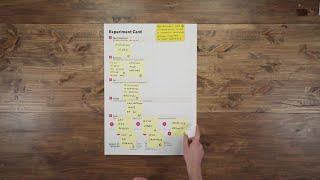
Mike from Board of Innovation walks through the experiment card, a tool that turns your assumptions into testable experiments. It has six fields: experiment type, description, target audience, success criteria, practical steps, and visualization. Start by testing up to five customer-desirability assumptions, like whether a millennial-targeted explainer video hits a 2% conversion rate.
Questions this video answers
2%
Chapters
Hi, I'm Mike, senior innovation consultant at Board of Innovation. I'm going to explain to you the next tool in our process. It's the experiment card. And this is again a really important step to get right in the innovation process. And this typically happens after you've defined your critical assumptions. Once you've done that, you, you then need to figure out how you're actually going to test their assumptions. And this tool really gives you a nice easy structure to follow in order to know what you want to be testing for and how you're going to action it on a project management perspective. So day to day, getting it done, finding out whether you've validated or not. So by this point you should have already used the experimentation validation guide. So you should know what kind of experiments would make sense for the type of assumption that you're testing. Remember, you only want to test five assumptions maximum in your first iteration and they should be focused on customer desirability, only on your initial validation phases. So if you're looking at technical ones or even business model related assumptions, put those to one side for now. You really want to focus on your customer desirability assumptions and then looking at how to invalidate those assumptions. So you want to fail fast and fail early and that's okay, you just pivot your concept, go forward from there. So how does this tool work more concretely? It's split up into six different sections and first of all, you have your type of experiment. So again, you should have had a good look through the validation guide. You should know what type of experiment would make sense for this type of assumption. Then number two, description what needs to be tested and how you will actually do it. So that's a very practical, pragmatic question. Number three, describe the target audience of the experiment. So who's it aimed at specifically to run your experiment with? Number four, describe the result of the experiment. Again, this is really important. How do you know when you've reached success with your experiment? How do you know when that assumption is validated? What evidence are you looking for? Nice and concretely. And then number five, sum up the practicalities. So what do you need to do to action the experiment? Who needs to do what? Where do they need to go? What resources do they need? Think about going from where you are now to completing the experiment and define all the steps that would need to happen. And then very, very, very importantly, we can't ever emphasize this enough. You really need to make it visual, make the experiment visual. It makes it so much easier to communicate. It to other stakeholders, particularly if they're going to be involved in helping you to run the experiment as well. So if it makes it visual, even if it feels really basic, it communicates a lot more information than just another template completed. So I'm going to give you some examples to take forward. So you should have already have your assumptions to test. So your top most critical assumptions. So as an example here, I'm taking this one from your assumption mapper that you used before. So this is the top critical assumption. Millennials are comfortable with a financial institution getting involved in their lifestyle. For instance, you then should have gone through the validation guide, figured out what kind of experiment would make sense, looking at all the different examples that make sense for your type of experiment. And in this case it was decided that an explainer video would make most sense. So yeah, if you look up the video in the booklet, you'll get a lot of context and an example to help you with that, then a description. So what needs to be tested and how? This one will be pushing out a video on social media and there'll be a landing page that would need to appear in order to show the video itself. Then who's it going to be targeted for specifically for the experiment? In this case, it's millennials interested in their health and well being. So there's a very specific target market there. You can then use existing advertising channels to then find those specific people. You're not going to survey everybody. That keeps the budget nice and tight as well. And then success. So how do you know when you're successful? In this case, perhaps you're looking at a conversion rate of say, 2%. Think carefully what makes sense for your specific assumption. But how do you know if this assumption is validated or invalidated? That's very important. And then quickly just jot on post, its what you need to do to make it happen. So in this case you need an advanced budget. You, you need to set up some KPI tracking systems to look at the conversion rate specifically. Then you need to find somebody to make the video. Then you would run the campaign and then you would finally analyze the results. And depending on how those correlate to the conversion rate metric, you will then very easily be able to know whether or not you've validated or invalidated your assumption. And as I said, really importantly, make it visual. So even if it's just a simple diagram like that, when you communicate this to somebody else, it makes it nice and tangible, nice and easy to understand what it is that you're going to be doing some tips and tricks on how to use this one. Again, this is an iterative process. You're not going to get it right first time, but this should be a very practical tool that you all contribute to collectively and then tweak and change. That's why we're using Post. Its obviously to move ideas around nice and easily, so don't be afraid to challenge each other. You need to do an experiment card per assumption, so you could have five experiment cards for each of your assumptions and in some cases you might even have multiple experiments for the same assumption. But try to keep it one experiment per assumption to keep the resources and time and effort needed down to an absolute minimum for your project. And then you'll be running further experiments based upon the results of these. So you'll be analyzing. And if for instance, you didn't get a conversion rate that you would realize that yes, you've invalidated, that's fine, what would you need to do to get further validation? Do you need to run another experiment, define another experiment card, or do you simply need to either kill the project entirely if all of your assumptions are invalidated, or even pivot the concept and go forward in a slightly different direction? Much in the lean startup approach to innovation. So that sums up how to use it. Again, very critical stage to get right. It'll take a few iterations, but persevere with it. It'll give you nice focus to run your experiments and you'll be in a great position going forward from there. If you're interested in more tools and inspiration for innovation, check out boardofinnovation.com tools where we have hundreds of tools free to download and inspire you on your innovation journey.