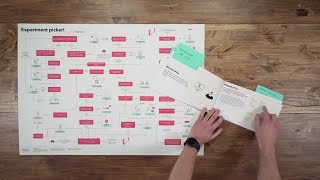
Mike, a Senior Innovation Consultant at Board of Innovation, walks through the validation guide, a tool that uses a decision tree to help teams design experiments that test critical assumptions in innovation projects.
Chapters
Hi, I'm Mike, I'm a Senior Innovation consultant at Board of Innovation. I'm a corporate troublemaker and I go in and help teams to innovate like startups. I'm going to introduce you to a really great tool now called the validation guide and it has an accompanying poster to go with it to help you use it. So why do you use this tool? So once you've defined your critical assumptions and you're now trying to figure out what experiments you need to run in order to validate or hopefully invalidate your critical assumptions as quickly and as cheaply as possible, and this is a tool to help you understand what are the options for doing your assumption validation through your validation options or your experimentation design. So before you build your experiment cards, this is a tool and a process to help you figure out what experiments would make sense to validate your assumptions and which ones wouldn't make sense. So it's a really nice tool, very easy to use and a bit of fun as well. So how do you use it? We have a template first of all for you to use and we have an accompanying validation guide booklet. And I'll explain how the booklet works in a second. First of all, you have a decision tree, so it looks complicated, but once you start using it, it's nice and simple. So you start up here where it says start here and then you answer some basic questions about your project. And as you answer questions you will then land at a certain point that would make sense for your project. Say for this case it would be a bare bones mvp. So what on earth is a bare bones mvp? You then look at the number, so this is number 11, go over to your validation guide and then look up the bare bones mvp and in here it'll give you nice in depth explanation as to what the, the experimentation validation option is. So a description of it, some of the pros, some of the cons, some of the related tools that go with it, how you know when you'd be successful. So the currency, a very important part of your experimentation design, who it's aimed at, so the target audience, the kind of validation that you can do, whether it's an evaluation or whether it's generative and gives you an example of which phase of the innovation process it's most suitable to test. So in this case this is used on the problem validation point of view. And then over on the right hand side you have a good example of a bare bones MVP and what that looks like to really give you some ideas as to what options would make sense for you, your experiment that you need to run for your critical assumptions to test. So really nice and simple to use. So I'll just explain it again. You go through the decision tree, answer questions, and then you'll have some yeses, you'll have some no's, and then you'll eventually end up somewhere. In this case, perhaps you ended up at wizard of Oz number 15. So make a note again of the number and then go over to the validation guide and then look up the wizard of Oz section. Nice explanation of what the tool does, how it works, what the experimentation model would look like. Again, cross check with the pros and cons, make sure it makes sense for the specific assumption that you're testing, and then look at the example to get some inspiration. So the context is really important to understand a previous successful situation where that validation experiment's been running. Some tips and tricks. I would suggest that you go through this in pairs. So answer the questions in pairs. You want to come up with at least five different exit points. So come up with five different numbers. You can take a stack of post its, put it over the top, write down, say number 15 here, and then go through again. And when you keep repeating, you keep finding yourself coming back to the same section or the same endpoint. You know that you've pretty much got the right options. Then refer over to the validation guide booklet, get all the context, understand what's involved, cross check that, make sure that you can actually answer your assumption with that type of experimentation option, and then you can then start looking at designing your experiment, which will be the next piece of your innovation puzzle. Thank you very much. I hope you found that tool useful and explanation. And if you'd like to look at some more tools, get some more inspiration, more guides, more methods, check out boardofinnovation.com tools.