Forever Employable: How To Make Your Career Invincible with Jeff Gothelf & Alexander Osterwalder
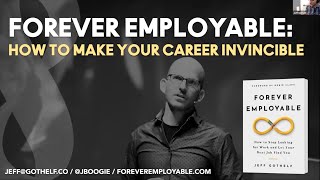
Jeff Gothelf outlines five steps to build a career that survives industry shifts: pick a domain and own it, tell your story widely, teach and speak, give work away to build reach, and reinvent yourself every 18 to 24 months. He frames career management like product development, applying agility to yourself.
Chapters
Okay, fantastic. So let's get started. And I'd like to welcome everyone to today's Strat Chat webinar. Today's session, I'm really excited about it with Jeff Gothel. We're talking about Forever Employable and how to make your career invincible. We often talk about invincible companies and how to future proof your company. So today's conversation is really interesting because it's about how to future proof your career. And so if any time during the session you'd like to make a comment or ask questions again, please use the chat box in Zoom or use the Q and A box. You can also tweet us rategizer using the hashtag strapchat. There's no need for you to take any notes. We're recording this session and we'll be sending you the recording of this webinar in a few days. Also joining us on the call is my colleague and partner, Alex Osterwalder. So we'll be sort of having the conversation and interacting with Jeff. And Jeff is a wonderful thought leader in this business that we're in. He's the author of Lean UX and Sense and Respond. Really, really wonderful books that have been used by loads of teams to drive great innovation practice within their organizations. But today he'll be talking about his new work on how to make yourself Forever Employable, which is the new book that is coming out tomorrow, right? Yeah. And it's about Soon, Soon Come. That's coming out soon. And the conversation is really about how to stop looking for work and let your next job find you. So I'll hand you over to Jeff. Thank you.
My pleasure. Tenday, always good to see you, my friend. Sadly, not in person this time. But they were asking, as you were asking at the beginning, what made us come to this webinar. I typed I just want to hang out with Tendai. So even if it's virtual, that's what I want to do. So thanks so much to you and Alex for hosting me, folks. I can't believe how many of you are here, so I'm just going to get started and dive in. I'm going to tell you a story. A story is based a lot on my life and my experience. And my hope is that you can take away some practical, tactical things from it that will help you build this invincible career that then fuels your ability to become forever employable. So let's start. The story starts on the morning of my 35th birthday. My 35th birthday happened on January 31, 2008. That's the day I turned 35 on that Morning, I woke up in a cold sweat, terrified sweat pouring down my face, like nightmare kind of sweat. And I couldn't for a second figure out why that happened or why that was, because at that point in my life, things were pretty good. This is me at 35. Those are my kids when I was 35. Those two cuties are now teenagers that live in my house on a regular basis. Every day they're here. And everything was going pretty good up until that point. Until 2008, I'd had a pretty good run. Up until that point. I'd started off as a broke musician. I spent years playing piano in a bunch of bands and turning around. And when I got tired of being broke, because trying to be a rock star, trust me, does not pay the bills. When I got tired of being broke, the Internet happened. And the Internet was a blessing for me because it allowed me to get my first real job. Now this, the year we're talking about roughly is 1999, when I, when I was done playing music. And in 1999, if you could spell HTML, you could get a job. And I could do a little bit more than spell it. I could do some markup, I could do some basic graphic design. And. And so shortly after realizing that this is a, this is a good career for me, I joined a company in Richmond, Virginia. I got my first job as a front end designer and developer, which is an exaggerated term back in 1999 at a company called IXL. Now I started doing this work and very shortly thereafter I realized that I was at the kind of at the end of the waterfall process of software development. I was implementing everybody else's requirements down at that point. And I knew that wasn't exactly where I wanted to end up. And so I was handed this book. Now, this book changed my life. This is a book called Information Architecture for the World Wide Web. And it described a set of activities and a new way of working where you organized information upstream. So it moved you up the waterfall, which is how we were working in the 90s and allowed me to have more opportunities to influence the products that I was working on and designing. And so I decided to become an information architecture. That led to a UX design career, interaction design. And I was heading off in this new direction. I was super excited. I was getting a decent paycheck for the first time in my life and I was moving forward and the dot com bubble burst. And all of a sudden there's no jobs, there's no tech companies. And this career that I was heading out on just completely evaporated all of a sudden. And so I found myself bouncing around for a while from job to job to job, just kind of, you know, from one tech job to another as companies evaporated every three or four months. And I ended a little bit of time at aol. I spent a lot of time designing the software that went on these CDs. And if you were in one of the countries that was fortunate enough to receive these CDs, you're welcome for that as well. I ended up moving out west and leading a design team at a company called Web Trends, and then bouncing back. I ended up in New York about 10 years into my professional career as the Director of User experience at a company in New York City called the ladders. Now, 10 years into my career, I found myself in this position. I'd clawed my way up to the middle, right? And this is about the time that I turned 35. And on the morning of my 35th birthday, I was a middle manager at a tech company in New York City. And so I wake up in this cold sweat, sweat dripping down my face. I'm 35 years old. And what I realize is that in five years, I'm going to be old. Now, that's funny. From that side of the 40, 40 looks old. From this side of 40, 40 doesn't look that old from this side of 40. But nevertheless, at 35, I'm looking at five years in the future. I'm saying, I'm going to be 40 years old. I'm going to be overpaid and unemployable. And I'm worried about that because all of these younger, smarter, hungrier, better, and most importantly, cheaper designers are coming after my job. They're coming after it. And they're saying, look, I know what they're making because I'm hiring them for my team, and I know what I'm making. And I'm terrified that in five years, my salary demands are going to be too high and my skills are going to be too low, and I'm never going to be able to find another job. So on the morning of my 35th birthday, I resolved. I made a very strong resolution to myself. And it was this. The resolution was this. I was no longer going to look for jobs, right? That panicky feeling when there's a reorg in your company or there is a shift in the market or some kind of external geopolitical event. We've got to rewrite our CVs. Rewrite our resumes, start sending them out and chasing jobs. I wasn't doing that anymore. Instead, jobs were going to look for me.
Right?
That's the resolution I made on the morning of my 35th birthday. Now I know how you're feeling. Like, wow, Jeff, that's mind blowing. I can't believe you thought of that. That's amazing. Kind of blows your mind, right? Well, right. Brings up some very, very important and very difficult questions right away. Questions that I began, that I immediately had to answer if I was going to make this resolution an actual reality. So, first question was this. If Jobs were going to find me, does anyone know who I am? Right. Who knows about me at all? Does anybody know? Jeff gotthelf. That's my first question. My second question, why would they look for me? What problem do I help people solve that they would come looking for me or someone like me? How would they find me? It's 2008. We've got LinkedIn, we've got Twitter, we've got resources. How are people actually going to find me? And then ultimately, if work is going to find me, what kind of work do I want? Because I don't want just any job coming my way. I want jobs that I like, that are sustainable, that grow me professionally, things that interest me. What kind of work do I actually want? And I had to start answering these questions. And I'd love to pose one of these questions to you, the folks who are here, and I'd love to see your answer in the chat. The question I have for you is, why would jobs look for you? In other words, what problem do you help people solve? If you had to write down, I solved this problem for people, what would you write down? Type that in the chat. Let's see a couple of those responses. And then while we're looking at that, I'd love to pose that question to Tendai and Alex. Tendai, what problem do you help people solve?
Yeah. So these days, people are often looking for me to help them figure out how to get innovation done inside their companies. So they're like, yeah, we get that companies are supposed to innovate, but how do you actually do it? And a lot of the times it's heads of innovation that are needing to influence leaders and having sort of cultural challenges inside their organization. So that's the kind of problem people are often looking for me to help them solve.
Amazing. Alex, what about you? Why did Jobs find you?
When I was young and doing a PhD, I actually decided to own the word business models. It was the beginning of search engine optimization. And I said, I want to own that word. And then, you know, I went on to do everything I could to kind of own that space. And, you know, we wrote the books and everything else is history. So a lot of people come to Strategizer now to me for the topic of business models and invention. Right. So I went for that one word or for what, that one expression?
Yeah, it's right. And that's, that's exactly right. We start to kind of identify these, these slices of the domain that we're in that we want to own. I'm going to talk about that in just a second. And just looking in the chat here, there's so much. I saw one that says I help fix cars and make them go faster. Right. That's fantastic. Right. I build social ventures. You know, somebody says I make toast, that's fantastic. I saw them make toast. But there's a lot of stuff in here, right? As you think about creating this invincible career and become forever employable, this is the first question that you should kind of start to work on yourself. What problem do you help people solve or do you want to help people solve? And look, I've spent the next 10 plus years since my 35th birthday answering that question and in doing so building my platform. And what I've learned is that there are at least five qualities that you need to become forever employable and build that invincible career. And in my experience, they're the five steps that I took to getting there, to becoming that forever employable. And if you add those things up, the bottom line looks like this. You have to treat your career, your professional development as a product or as a business. In the same way that you think about de risking, growing, expanding and investing in your products and your businesses, your career and your professional development have to be thought of in exactly the same way. Let's take a look really quickly at these qualities. First, the five qualities that I've discovered that I believe people need to become forever employable are these five qualities. And I'm going to go through each one of these qualities very quickly and show you from my experience how I came up with them. Now, if these qualities, entrepreneurialism, self confidence, continuous learning, improvement and reinvention. If those sound familiar to you and you build products and services today, they should. Because this sounds like agile, but what it is, it's agility, right? But instead of applying agility to products or services or businesses, you're applying it to yourself, your career and your professional development. Let's talk about Entrepreneurialism. For a second, I had never thought of myself as an entrepreneur. I was never the ideas guy. I was always the execution guy. That came from my father was the same way. He was never the ideas guy, was the execution guy. There's a DNA thing happening there, right? And never really thought of myself as an entrepreneurial person. But when the opportunities came up to take on entrepreneurial ventures, I realized that in the past I had actually done things that were absolutely entrepreneurial. I spent a significant amount of time in my 20s playing in bands. Bands are startups. You get four or five people together, you have a crazy idea, you try to sell the world on it, you invest everything in it. You sleep, eat, breathe this stuff, and you try to build this business around your crazy idea. So I did have entrepreneurial experience to build these music businesses over the course of time, which I didn't realize. I had never thought of myself as an entrepreneur. Self confidence may not come naturally to you, but one of the things that I want you to think about are the unique things that you've done in your lifetime, not just your career, but in your lifetime that were challenging to you, right? And those small wins that you've overcome in your life are unique to you. No one has that story. No one has taken the steps that you've taken. No one has taken that path. And you can use those successes in your path to build that self confidence. In my life, a lot of that self confidence comes from my first job at a university, when I joined the circus. That sounds like a joke, but it's absolutely true. My first gig immediately out of the university was with the Clyde Beatty Coal Brothers Circuits. In fact, that truck in the photo on the left, not the nice pickup truck with the trailer behind it, the semi on the left. I lived in that truck with seven other guys for six months on the road. Now, look, it was an opportunity that came my way. I didn't have any other plans. I was 22 and you know what? I said, what the heck? I jumped in with both feet and gave it a shot. And it was miserable. And I suffered for a bunch of months, but I learned to get over it. And it taught me a lot of self confidence that you can throw yourself into these situations, learn from them and get better. And I have tremendous stories that I could share with you if we had a ton more time about my time there. Continuous learning is so key to become. To building that, to becoming an invincible employee, to building that invincible career, to becoming forever employable, reading, speaking with others, engaging in community Right. It's the only way to progress in your career. What are other people writing? What have people done? How can that save me a couple of steps? What can I use to grow and learn? Always, to always look for the next thing that I need to know to move forward? Absolutely. A key quality of becoming an invincible employee as well as forever employable. The learnings that you pick up can be applied to continuously improve how you do your work. There's a phrase that I love that I learned from watching a TED Talk by Astro Teller. Astro Teller is the guy who runs X, which is a fantastic name. Right. He runs X, which is Alphabet's moonshine factory, Google's parent company where they make self driving cars and Internet balloons. And the phrase that he uses in his TED talk is enthusiastic skepticism. I love that phrase. Enthusiastic skepticism says that I might have a ton of experience and I might have a ton of expertise and I might be very good at the thing that I know how to do, but there is this burning sensation and I'm enthusiastic about finding a better way to do it, about improving myself, always looking for the next best way to do what I do in my career. I'm enthusiastically skeptical about how I teach and how I do my work and how I deliver my content to people. And so one of the ways that I improve continuously is I partner with other instructors, with other consultants, with other teachers. For example, the photo here is from a class I taught in Paris just before the lockdown started with my friend and colleague Jeff Patton. I do a lot of teaching with Jeff Patton because we have complementary ideas, but we teach very differently. And I learn and I get better. And then ultimately it is about reinvention. The things that got you here will not get you there. So if you, if you've succeeded in a certain space, how do you take that success and expand it to the next thing and the next thing and the next thing? For example, one thing that I'm doing in this space is I'm taking the work that I've done around product thinking and I'm applying it to non product teams. I wrote about it in HBR recently. And it's about taking the ideas behind continuous learning and agility and digital transformation and bringing them to human resources and marketing and finance and legal departments that don't normally get that kind of attention from product thinking and design thinking. And so those are the qualities that I've found really help you become forever employable and build that invisible career. And I have a question for you. There's a poll that we put together for you. If you're looking at these qualities, which of these qualities do you think is your strongest quality of these five forever employable qualities? If we could launch the poll, what do you think yours are? Give it a quick vote. Let's see where the results net out.
Yeah.
So vote on the poll. I can see people are typing it in chat, but it'd be great if you can vote on the poll that's popping up in your zoom.
What do you think? What do you think you're best at from these skill sets? And then once we get a bunch of votes in there, Matt, let's close that poll and see what the results are.
Yeah, folks, still voting, but we have self learning in the lead at the moment, which is continuous improvement.
All right, did we get the results in there?
Where did we share the results?
Wow. By far, learning is the strongest quality. Amazing. Yes. It's super interesting. I've done this poll a couple of times now, and self confidence always ranks the lowest. And it's something that I hope that just by listening to this, you get inspired because I guarantee you, you've got valuable things to share and the things that you have to share have not been told because no one has your story. But learning is so key to this. This is such a. Such an interesting result. But regularly I see self confidence, the kind of the lowest one on you. This is something we can definitely work on. Fantastic. So those are the five qualities. Let's talk about the five steps that I took to building a forever employable career for myself. And really this invincible career, what I believe to be an invincible career. Now, these are the five steps that I took. I'm going to go through each one and I'm going to show you examples of each one. Let's start with the first one. This one is called planting a flag. Right. And planting a flag means I'm going to make a decision about a slice of my domain or my industry that I'm going to own. It's where I have my expertise, it's where I have my experience, it's where I have my passion. Kind of like Alex said earlier, he said, look, I business model for me, I'm going to own that. That's where I decided to plant my flag. And the people who have done this, well, you know, right away, for example, I'll throw up some names on the screen, right? So we got our buddy Eric Ries. Right? Where did Eric Ries plant his flag? Eric Ries planted his flag in the lean startup. Right. You know that Eric Ries is the lean startup guy. My friend, Jake Knapp, right? Jake Knapp decided he was going to plant his flag design sprints, right? That's Jake's flag as well. There's a guy in Switzerland, Alex Osterweiler that I heard about. Where did that guy plant his flag? Right? He already gave you the answer a little bit earlier, right? It was business model generation. But you know these folks for the flags that they planted, right? And that's super important to say, look, I'm going to own this slice of content and I'm going to become the expert, the recognized expert, the thought leader. I'm going to establish a personal brand and don't shoot me for saying that phrase around that particular space. Now, for me personally, I planted my flag with Lean UX initially because that was the problem that I was solving. The integration of user experience, design and agile for software development teams. And for me, that's where I planted my flag. So that was. Step number one is planting your flag. Step two is telling your story. Telling your story to anyone, everywhere, all the time. And the goal is to become a storyteller. Now, I know the obstacle that you're thinking about. What unique story do I have? Right? We often get in our own heads and we let doubt take over. Everyone has good experience. She has more to offer than I do. I. My story isn't extraordinary enough to be unique. But again, the best part of your story is not whether or not you've run an ultramarathon or stood on stage in front of 1500 people or whatever it is. It's because you're the only person that has it. Nobody else has it. And you can tell that story that nobody else can. And that's the key, is when you discover that story, you begin to tell it to anyone, everywhere that will listen to it, because that's how you start to expand that flag that you planted. So I decided that Lean UX and Agile UX was going to be my flag. And two and a half years after my 35th birthday, I gave my first talk on Agile and UX at the big Agile conference. This is August 12, 2010. Two and a half years. This stuff takes time, right? A month later, I give the first talk ever on Lean ux. It's in Paris. And then a little later, in March of 2011, I get my really big break. Now Remember, this is three years now since my 35th birthday. I have the first article about Lean UX published on Smashing Magazine. In 2011, Smashing Magazine had a million readers Today they've got way more. This was a massive break for me because this took the conversation that I was having relatively locally, global. Now all of a sudden, we're discussing this idea where I've planted my flag on a much broader scale, which gives me an opportunity to tell my story everywhere. I'm on stages, giving talks, I'm tweeting about this stuff, learning how to tell my story. I'm writing on medium, I'm sharing stuff on LinkedIn. I did a lot of work on Quora at the beginning, particularly as popular posting on Facebook, writing newsletters, anywhere that people would listen. I would tell my story every single channel because it helps me get better at the storytelling. We did stop short of making Lean UX the Musical. That's about where we stopped. But every other channel was viable, right? This is, I think ultimately this was a good call, but we did stop short of Lean UX the musical, thank God. I think that was a good call. But so the question then becomes, okay, great, Jeff, you planted your flag and you're telling your story, but why did your story resonate? I have a pretty good idea why it resonated, and I think this would really help you tell good stories. I was solving a real problem that many people had. Lots of companies were struggling and continue to struggle with Agile and ux. I had real world experience, right? I was not an academic, I was not a consultant. I was a person who was doing this every day. And I could share that experience. And I wasn't sharing just the wins, I was sharing the losses too, right? We tried this and it was a disaster. But here's what we learned from it, and here's what we're going to do differently. And that shows humility. Every single thing that I post online ever has provided tactical and practical advice, including this presentation that you're watching right now. I want you to take away something to help you build that invincible career and become forever employable. And ultimately, this helps build an authentic connection. When you tell stories with these qualities, right? That's what builds it. Now here's the interesting thing. As you start to tell your story, as your message amplifies, as more people are listening, new paths, right? Jobs start coming your way, new paths start to come your way. This was absolutely the case for me. As I'm doing more speaking and more teaching and more coaching about this stuff, I'm doing less and less design work. Now, you might remember from the beginning of the presentation that I was really worried about my design skills atrophying, because all These new and better designers were coming into the market and I was going to be out of a job in five years. Now I'm doing even less and less design work because I'm not doing any design work. I'm doing this. I'm flying around the world teaching and talking and speaking at conferences and doing whatever I can to amplify this flag that I've planted, right? And what turns out to happen is these new paths emerge the more you tell your story. For me, I didn't know this, but it turns out that book publishers go to conferences, they look for the latest topics and who's speaking about them. And at this point, I was one of the main major voices on this particular topic of Lean ux. And they offer you book deals. And so I got offered a book deal after a book publisher and acquisitions editor saw me present at a conference. And I channeled that entrepreneurial spirit that I discovered I had and that self confidence. And I said, what the heck? And I jumped in with both feet and I signed that book contract. Except there was one specific problem about signing that book deal, which was this. I didn't know how to write a book at all. The longest thing I'd ever written online was maybe 500 or 750 words, right? But the goal was to try to figure it out. And so before I continue, I have another question for you as well, and I'd love to see this answer in the chat. What was the last thing someone asked you to do that you didn't know how to do? And then how did you do it? Alex, what about you? What was the last thing someone asked you to do that you didn't know how to do? And then how did you do it?
I'll actually go back to what you said. I didn't know how to write a book either. When I wrote a book, I knew how to write a PhD. But you know, what our publisher told us is, you know, you did everything wrong because we self published, so we did everything wrong, and that's actually why it worked out.
See, sometimes you just got to go your own way with that kind of stuff. That's amazing. Tendaya, what about you? What was the last thing someone asked you to do that you didn't know how to do? How did you do it?
This is my life with Alex Osterwalter. Whenever we're running workshops, you walk up to me and go, in 10 minutes you're going on stage and this topic you're going to cover, I need a break. And then the slides are from 147 to 152, see, in 10 minutes. And then I just sit on my laptop, read the slides, and then jump on stage. And that has happened to me at a couple of workshops in the last couple of weeks.
Yeah, that's amazing, right? And look. And that stuff happens in real life, and that stuff happens all the time, right? And these are the new paths that expose themselves to you. I saw some stuff about podcasting in the chat, you know, building an outbound sales program. I saw. Scroll through. They're scrolling through pretty quickly. These are exactly the new opportunities that come your way. And you might say to yourself, well, okay, you're lucky you got offered a book dealer. You're lucky you get to work with Tendai. Right? Luck is what happens when preparation meets opportunity. And, you know, obviously that's a very famous saying, but. But it's being prepared for these new paths to come and then channeling that self confidence, that entrepreneurial spirit, that reinvention to take advantage of it. So I took that chance and I said, okay, I'm going to write this book, right? It was brutal. It was a brutal process. I struggled with it. It took me two years to finish Lean ux. I churned through three editors, and we had to write the manuscript four times before we got to publish it. And then finally, finally five years, when I was 40, when I was old 40, on my 40th, not long after my 40th birthday, lean UX got published. And that changed everything. So that's step three, right? You're going to plant your flag. You're going to tell your story. You're going to follow the new path. Following the new path, for me meant teaching. And what I found over the years is that I've been saying yes to every teaching opportunity. Teaching gets you feedback on your material. You learn how to improve your storytelling. You understand what's resonating, where it could use updating, where the punchlines land and where they don't, and where there are new opportunities for you to expand your content. And I do. I mean, this is just a handful of stuff that I do. Workshops and conferences, webinars and podcasts and guest articles and interviews. And I just want to be clear, if you do this in house, if you work in house, and you're trying to build this kind of flag, you know, content platform around yourself, there's lots of stuff that you can do in house. You definitely have these opportunities. There is, you know, lunch and learn events and internal conference keynote. You could keynote your internal Conference, write for the corporate blog, do the company podcast, be a corporate presence at industry events, internal trainings. There's lots and lots of stuff that you can do to showcase your expertise and even in house and increase your value to your organization. Now, super quick, before we move on, teaching again for me is the. Is something that I'm surprised if you'd asked me 10 years ago, are you going to be a teacher when you grow up? I said, no way. But I'm so happy that I've become one. But I became it inadvertently. I had no idea that I'd become one. And I do a lot of my teaching in workshops. And I find that workshops tend to be a really great way to exercise your ideas because the more you teach, the better you get at the ideas. Really helps you improve that storytelling. You can generate some revenue with those workshops, which is nice. And it always seems to generate leads for other businesses. Hey, I saw you give that workshop. Can you come give a talk? Hey, can you come and do this in house? And it starts to open up more paths as well. So teaching becomes a natural next step. Now the final step in my career and this thing that I've learned, the most recent thing I've learned in my career, is to give it all away. One of the things that was completely unnatural to me was to do all this work, to create all this content, to test my ideas, to invest incrementally more, from tweet to blog post, to book, to talk, to presentation, based on this evidence that I was getting feedback from the marketplace, and then to just give it away for free. Initially, it didn't make sense to me. What I've learned today is the more you give away, the more it comes back to you, the more opportunities find your way, right? The more jobs find you. And to do that, you've got to make your work and yourself easily findable and accessible. Post your materials, your articles, your webinars, your podcasts, your blog posts on easily findable sites, ideally under your own brand. If you can do that. Right? I've consolidated everything under my website. If you go there, you can watch videos of my talks, and then people watch those videos and then they hire me to give those talks, which never would have seemed obvious to me before, right? Because, hey, you've got the video, Just put it up in the conference room, invite everybody to sit in, and you can watch the talk. And yet they still want you to come in and give the talk or teach the class or do the work. So the more that you can, you can Share your stuff for free. The more comes back. Build your community locally and give back to the community. Local meetups, conferences, businesses, friends and organizations. Ask to speak. Do it for free. Tell your story and build that goodwill. It helps you understand which of your ideas are going to resonate, right? It helps you build evidence for investing in those ideas and not some of your other ideas. And it helps you grow that audience that will support your platform and start to build those opportunities for you to make you forever employable. Now I'm going to wrap this up and I'd love to take your questions after this with a few things to remember. One of the interesting things is that as you begin to achieve some level of success with this, staying relevant in the conversation means staying active in the conversation. You have to have an ongoing presence, the discussions online, in the chats, in the groups, contributing to the bodies of work, providing feedback, sparking discussion, participating in these events, right? The more that you're active, the more you stay relevant, the more you stay top of mind in that place where you planted your flag. I found that as you start to transition from one idea to the next idea, especially as you're thinking about reinvention, give yourself 18 to 24 months to work up to that new topic, to work up to that next thing. For example, I've been targeting doing a lot more work with human resources departments. I don't have any hr credentials, right? 18 months ago I started talking about it, asking questions, meeting folks, injecting myself into conversations and just probing and trying to figure out what the challenges are in those organizations and developing content for them. And as you saw in that HBR piece I showed you earlier, now I'm starting to write about it. That is starting to bear fruit. I'm starting to get invited to HR events and to get more involved in their world. So again, give yourself 18 to 24 months to do that. Finally, look, this is my path. It worked for me. There are lots and lots of other options, but I hope you can pull out some helpful bits from this and move it forward. And there's lots more tips in the book itself. I'm going to close with this with this Bezos quote. As you think about staying forever employable, as you think about building that invincible career, try to stay away from the trendy things. Try to steer away from planting your flag on the trendy things. Processes. Processes will come and go. Tools will come and go. Technology is constantly changing and evolving. As you plant your flag, try to channel this quote from Bezos. Bezos, people always Ask Bezos what's going to change in five years. And Bezos says, I don't worry about what's going to change in five years. I focus on what's not going to change in the next 10 to 20 years. What are people always going to need, what are they always going to want, what's always going to help them? And plant your flag in those ideas, the tools, the methodologies, the names, the processes, the technologies around that, all, all of that will change and it will become something else. Right. But you'll always be able to stay forever employable in that way. And so with that, first of all, I want to say thank you for listening. I hope this was super helpful for you and to Tendai and to Alex for hosting. It looks like there's a ton of questions in the Q and A box and so I'm going to stop sharing my screen. I'm going to drop out of presentation mode and let's chat. Let's see what we've got to talk about. Oh, there's one other thing I wanted to mention to you all. It's this. I'd like to give away a couple copies of the book when it does come out. And so for a chance to win a copy of the book, go to this link. Basically there's a form there and we'll draw a winner from there. You can see it. I just put it in the chat. Okay, so with that, I'm sure we got some questions. It looks like there's a ton in the Q and A box, so thank.
You so much, Jeff. Really, really wonderful. So let's start with the first question that's in the Q and A box, which is, Tenday, are you from Zimbabwe? And the answer is, yes, I am from Zimbabwe. So that's great. But some of the conversations that were happening while you were speaking, Jeff, was people were really commenting around, I don't want to write a book, I'm not interested in writing a book. I don't want to become a coach, I don't want to become a speaker, but I still want to future proof my career and make my career invincible. Right. And so the question is, you know, do you need to, do you need to create content basically to become forever employable? Is there another way to point your flag?
I think you need to make it. I think you need to make your expertise obvious. I think that that's the most generic way for me to say that now I know how to make my expertise obvious by creating content. That's not to say that there Aren't other ways to do that? You know, I think that, you know, you can, you can participate in forums. You. I mean, there's got to be. I mean, I mean, look, there's, there's word of mouth, right? So there are folks I know that have had tremendously successful careers because people have said, she's awesome. I worked with her, you should definitely hire her. Right. And so I think certainly there are qualities that you might want to exhibit at work that will lead to that. But I think relying strictly on that doesn't always generate the best opportunities for you. So there's got to be a way for you to make your expertise public. And so if it's not writing, if it's not speaking, if it's not recording, if it's not creating some kind of visual or authoring a paper or something along those lines, you need to figure out a way to participate in some kind of a community that people understand what you know and what you're good at and what you're passionate about. And those communities exist, and they don't have to be massive communities. Right. There's tons of private slack channels these days that you could participate in, and that's enough. You get 10, 12, 15 people there who really enjoy interacting with you about your, your subject matter expertise. And then at some point, somebody in that group is going to get, hey, I need somebody for this. Oh, I know a person. She's in the chat with me. I'll refer you. Right. So, so, yeah, I don't have a brilliant answer for that, but you've got to externalize that expertise somehow.
Yeah, somehow you got to make yourself visible. I think one of the fundamental questions about becoming forever employable is do people know who I am? And if jobs are going to look for me, how do they look for me? So somehow you got to make your expertise visible.
Yeah.
So another interesting question as well that's being asked, which is a kind of paradoxical one, is if you, if you actually plant your flag, how do you later reinvent yourself?
Yeah, And I'm. So this is really interesting. So I have lived this once and I'm living it again now. So let me, let me do. Let me share my experience and hope that helps. So I planted my flag on Lean ux. Okay. I'm the Lean UX guy forever and ever and ever and ever. Right. And that's great if I want to talk about Lean UX forever and ever and ever. But there's other things I'd like to say. I'm happy to but there are other things I'd like to talk about as well. And so one of the interesting things that came out of being the Lean UX guy and doing a lot of work, especially with my business partner and co author Josh Seiden, is every single time, every single time somebody took a Lean UX class with us or read the book, they would almost, it happens almost on a weekly basis. Somebody reaches out to me and says, hey, listen, I read your book or I took your class or I watched your video. Man, I wish my boss was there. I wish my boss was there. Like, that's, you know, my company doesn't work this way. And that was, that's market, that's evidence. That's market feedback, right? That's, that's customer feedback to me, saying, listen, people love this stuff. They can't implement it. They're struggling to implement it no matter what, no matter what we do. Josh and I saw that as an opportunity to create a conversation with the bosses. And so we decided to call it Sense and Respond. And we began in one of our experiments to test whether or not two designers could write a business book that would reach a business audience was, hey, can we get a publishing deal with one of the business book publishers? And we worked very hard to build a case for that, to write a good proposal, and we landed a publishing deal with HBR Press, with Harvard Business Review Press. And Sense and Respond was born that way. But that, that's, and that was great, right? So that, that kind of was the wedge that opened up the conversation, but it still wasn't enough, right. Because we still were the Lean UX guys in there. And so as you're, as you're having that conversation about the new thing, you've got to give yourself a lengthy on ramp, right? In the presentation, I talked about 18 to 24 months. Absolutely. For Sense and Respond to really become a thing that people came to me about. It took a couple of years, you know, through the production of the book and after the book coming out and moving forward. And now I'm going through the same thing, right? I'm going through the same thing because this the only copy of the book in existence, but soon to be plenty more. Right. This is another shift, right. So I'm the Lean UX guy, hopefully in the Sense and Respond guy. And now I'm trying to be the forever employable guy on top of that. And so that's a big shift. And I've been, I've been building that up over the last few months. And I Expect that to take some time moving forward. Now, when you read the book, you'll see that there's a foot firmly in Lean UX and Sense and Respond and Lean Startup and all that kind of stuff in there. But the application is yourself and your career. So as you start to transition, see what you can leverage from the past to kind of bring people with you to the new thing. Jeff, one of the questions I'd like.
To ask is a couple of people were wondering, oh, applying Lean Startup techniques to career. And you talked about it a little bit.
Right.
And I would give this twist to the question because when I look at your presentation, it seems like, wow, this guy is brilliant. Everything went perfectly fine.
Right?
He's just creative genius. He figured it out and then he did it. Can you tell us maybe that what's always interesting is to see the other side? Because we never say the moments where we looked really stupid and we got it wrong.
Right.
Because kind of planting your flag, trying to get there also means you're gonna look stupid a hundred times until you look smart. Right now you're looking extremely smart. Can you also help us understand that you didn't get everything right from the start?
Yes, yes. It's all this polish. It comes off. Yeah, absolutely. Look, I remember seeing Eric Ries in the early days of Lean Startup give talks and he always referred to that moment that you just described Alex as the montage in the movie. Right. Like creative genius has an idea montage with cool music, awesome thing at the end. Right. But everything in the middle is like glossed over and hand waved. Yeah. I mean, look, there's so many ideas that I floated that failed. There's so many blog posts that went unread. There are so many jobs I applied for I didn't get. There are, you know, pitches to clients that fell flat. There are, gosh, I mean, there are. I've learned so much kind of hands on figuring out how to tell my story stuff. Like, I remember one time years ago, I was starting to give the Lean UX talk. And the Lean UX talk at the time was a direct comparison between waterfall software development and Agile software development. And I was lucky enough to know a couple of people at Foursquare in New York City when Foursquare was really big as kind of when you were doing the check ins and I was the mayor of the deli and you know, the. Whatever it was, you know, and if I go in there and I'm giving this my Lean UX talk, which has been doing really well and Audiences and I didn't bother to check who my audience would be. And I'm getting up there at Foursquare and I'm talking about the difference between waterfall development and agile software development. And everybody at Foursquare was under the age of 25 and they're like, what's waterfall? And I'm like, I got nothing. The whole talk was about like, you know, knocking down waterfall. Like I said, set the whole talk up as like, you know, as basically this is better than that and you don't know what that is. I got nothing. Right. And so, so many stories of like the arrogance of that. Especially when you start to see a little bit of success, you're like, ooh, people like this, I'm just gonna go right in. And. And then you're like, bam, right in the face. And so there's lots of stories like that. I can show you my analytics for my blog, like the ideas that I really love that never got any traction. You know, the business ideas, you know, we try, you know, I built a consulting company in New York with Josh Seiden and Gif Constable. And you know, we had lots of hypotheses that this content marketing work would also generate consulting work as well. It didn't. I mean the project work that we were looking for, the product development work that we were looking for, it didn't. And we loved that hypothesis and we dragged that hypothesis on for a couple of years before we eventually killed it. Right. And so there's tons of that. And you know, I talk about that a little bit in the book, but yeah, those are a couple of examples.
Yeah, fantastic. And I know that in the book as well because I've had a chance to read the early manuscripts of the book. You actually lay out how people can use even like business model type design tools. Like, you know, lay out your hypotheses about your career, actually start testing those and measuring whether or not the things that you think are going to happen are actually going to happen. So it's going to be a wonderful read when people get a chance to look at that.
Yeah, yeah, absolutely. It's worth doubling down on that really quick because, you know, it's interesting. Like we talk a lot, I know I talk a lot about, in my, in my work I talk about outcomes over output. Right. So making the thing versus impacting the behavior of your customers. Right. So impacting the behavior being the measure of success. And to me those that that philosophy is directly applicable to this as well. You can make the blog post, you can make the presentation, you could make the webinar. Right. But if people don't like it, talk about it, come back, sign up for your email newsletter, buy your book, write a review, whatever it is, then it didn't work. Right. And you got to try again.
Yeah, absolutely. Absolutely. So there's a couple of questions that we're getting that are. That are kind of interesting. And let me pose this one to you and see what you think about it. So the question is, does the forever employable sort of approach recognize like some of the gender, you know, like a gender perspective, women at work and in leadership positions and the challenges that, you know, females face in trying to become forever employable? There might be some unique, distinct barriers there that the man had to get over. Is there anything you can speak to?
Look, let's be clear. I'm not qualified to speak on that topic. Right. But let me just say. But I will say this, okay? I think there's a tremendous opportunity for women in these positions, either in. In positions who have overcome some of these obstacles or who are in the process of attempting to overcome some of these obstacles, to use that experience and share their stories and plant their flag there and build that thought leadership and that recognized expertise around that. So there's a tremendous market for that. I mean, there's a tremendous hunger for that. And it's not just other women who would benefit from that. It's everybody who would benefit from that. And so I think there's an opportunity there for sure.
Absolutely. And then the other question we're getting is, you know, somebody really wants to. They're working in a large organization and they want to go out there and plant their flag and talk about the work. But everything they need to do in that company has to get approved by some corporate, you know, lawyer or corporate public relations manager. So, you know, when you're in those circumstances, you know, how do you even start to make yourself visible?
Yeah, it's tough. It's really tough. Yeah, this corpcom units can be a little numbing to say the least. Look, I think you, maybe you ask for. I don't want to get anybody fired. So let me just caveat that first, I think with relatively low risk stuff, you could probably ask for forgiveness rather than permission. You can try to make an explicit ask if your organization doesn't have this kind of role. Like, for example, like Microsoft has had developer evangelists forever. Right. A developer evangelist is essentially a content marketer for Microsoft. Right. It's this person who goes out and speaks at conferences, talks about, you Know the technology and the products and that type of thing. If that role doesn't exist at your company, you might say, listen, I'm uniquely suited for this particular type of role. I know we don't have it now, but here are the benefits that I see. Make a pitch, right? That's your experiment with the company. Your experiment is, I'm going to pitch a job idea to my boss or to my HR department to see what happens. Right. If they want to see examples, you could show a video of a talk you gave in a meetup or a blog post you wrote for yourself. So I think that's an opportunity there. If you try, if you're going through channels, they're up the proper channels and they keep shutting you down. I don't know. I don't know if there's an opportunity. I mean, you could try to do it anonymously, right. And that. That carries its own set of risks with it. But if it's something that you believe that you should be able to do and your organization keeps shutting you down, there's a conflict there that I don't know. The only way to resolve it is maybe to find a new employer, which I recognize is not easy. So.
Absolutely. Thank you. Okay, so one last question, and then we'll bring things up to a close. There's this dilemma that you have, right? Remember you were saying at the beginning, plant your flag. You know, choose the. But then, if I'm going to plant my flag, what kind of jobs do I want? And the question being asked is, how do you mix together, like, what jobs you want versus what the market really needs from you? Right. You know, how do you balance that kind of, you know, that day?
Yeah. So that's super interesting. I'll share another experience that's better than kind of making up hypothetical answers. I'll just share an experience with you. One of the most rewarding consulting gigs I ever got in the last five years was it was with a big bank, a big American bank. I was on campus in the US I was there to do something else, something about Sense and Respond and Lean ux. I was teaching a product discovery course with some product teams, and One of the EVPs was walking through and he knew that I was there doing the work. He was the sponsor. And he looks at me and he goes, you're an agile coach, right? And I was like, sure, I'm an agile coach. I'm not an agile coach. I said, sure, I'm an agile coach. Entrepreneurial spirit, self confidence, continuous learning. I said, sure, I'm an asthma coach. He goes, okay, come with me to this meeting. And so he drags me to this meeting. Turns out the meeting is with the chief HR officer, the CEO of the bank, the chief legal officer, like essentially the C suite of the bank. And he's like, hey, I found our executive Agile coach. I was like, all right, I'm the executive agile coach for the C suite of this bank as of like five minutes ago, which I had no idea doing. Right? And so, and to be clear, I was in over my head. I was unprepared for that call for that meeting, certainly, and generally speaking, unqualified at that time to be in that room with that C suite. But I said yes. And I made the gig what I wanted it to be ultimately because I believed that this was the best service I could provide. This particular client. Right. They want, I think they initially were looking for somebody to come in and literally talk about sprints and stand ups and retrospectives and velocity, and that's not me at all. I went in there and I talked about continuous learning, customer centricity, digital transformation, business agility, outcomes over output, which is the conversation I'm having. Anyway, we just elevated it to their level. And so the lesson here that I take away is as opportunities come to you, see if you can make them into opportunities that make sense for you even if they're not exactly spot on. Sometimes that'll work, sometimes it won't. But if you're interested in the client or the gig and you're interested in the opportunity, there's got to be something that you can inject in there from your expertise to make it more like the gig that you ultimately want and turn it into something, something better. I don't know. It's worked. It's worked sometimes for me.
Great. Now, thank you so much, Jeff, and thank you for the session. It was really wonderful to have you on with us. And of course, we're recording this, so there'll be a live recording this for folks who can also watch at the end. Alex has got something really cool to share, something that we're working on. Strategizer getting ready to offer a virtual masterclass.
Awesome.
Okay, so let me just, let me just show this very quickly. If you're interested in joining our pivot just recently to virtual masterclasses, just go to strategizer.com training and you'll find that, you know, we're trying to make it extremely interactive. And one of the things I think always, you know, in this huge noise environment, noisy environment that differentiation is a big thing. Right. And Jeff, you know, you talking about how you experiment, standing out, I think is actually easier than ever before because there's a lot of the same. Right? So if we want to find our invincible career, if we want to find things that stand out, we need to try, try new things. So join us at the virtual Masterclass if you're interested. This is around the Invincible company. And Jeff, I'll go back to you to maybe hold up your book around what we called for this time, the Invincible Career. So let me stop sharing my screen.
Excellent. One last time. This is the not for resale version, but it's coming, coming out in the next month and you can pre order it on Amazon now. Super excited.
Thank you so much, Jeff. Really inspirational, really inspirational hour. Loads of positive comments. Just people are making really great comments. Thank you. Thank you so much.
Amazing. I had a really great time. Thanks so much for having me, guys.
All right, cool.
Bye, everybody. Bye.
More from Zaur






An Immersive Workshop to Calculate the ROI of AI Strategy - AUTONOMOUS session

Predict, Optimize, Decide: Enterprise Decision Making For The Simulation Era - AUTONOMOUS summit


AI Insiders podcast ep. 9 - Not so cookie-cutter: Consumer Choices in the Age of AI

