Yinglei from Board of Innovation teaches how to write "How Might We" statements for ideation. The three parts are action, subject, and outcome. An example: a bank frames how millennials might save money while gaining wellness and social experiences, keeping the problem specific but solutions wide open.
Chapters
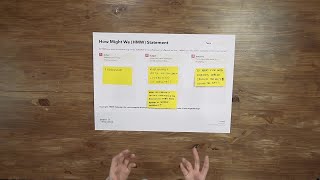
Hi, my name is Yinglei and I'm a design strategist at Board of Innovation. I will be walking you through the How Might We Statement Builder. When teams start to ideate and to come up with new ways on tackling a challenge, they usually start from a point of departure. And that trigger should spark inspiration and creativity amongst the team. Well, the How Might we statement is one of those triggers, and we'll be learning how to build such a statement from scratch through an example case I'll be giving at a later stage. What the How Might we Statement does is it translate a challenge a user need or an interesting user insight that we collected along the problem exploration activity into an opportunity for design by reshaping it into a question and reaffirming that it is possible to come up with new ways on approaching this challenge. In order to walk you through how to use the tool, I'll be giving you a short example. So, in our example case, we're looking at a financial institution who wants to create a new value proposition for the target group of millennials, looking into ways to save up more money and sell staying healthy along the way. So when you look at the problem, the How Might We Statement Builder, it contains of three different sections. The first one is action Describe an activity that you would like to carry out. The second point is the subject. Who's your target group that you would like to create solutions for? And the third point is the outcome. What is it that you would like to achieve by the end? It is very important, however, that you're not too specific on the solution space in your how might we statement. So keeping it broad, but still very specific on the problem space is crucial in order to ensure quality on your How Might we statement. So in our case, the insight that we wanted to work from is knowing that millennials struggle to save up enough money because they tend to splurge a lot during social occasions that happens more spontaneously. So this is an interesting insight that we collected during the problem exploration phase, which also got included into our Persona. Now is our chance to translate that into an opportunity for design. So while trying to build this up, I tried to use those three sections as a way to create a puzzle. So the action that I would like, me and my team got most inspired by, is the idea of encouraging them. And who are we talking about? We're talking about millennials who don't have kids, but who are interested in wellness and into saving more money. And what is the desired outcome that we would like to achieve is to have more fun with friends while saving money along the way. So this is a really good way in order to build the key elements of the how might we statement as a team, it's really important to feel inspired by the how might we statement since that's the point of departure that will spark ideas in you. If you feel that how might we statement triggers instant ideas within you and your team, it basically means that it's fertile enough to get it started and to use that as a starting point for your brainstorm sessions. If, however, you find it's not that inspiring or it's very difficult to come up with new ideas, one way to do it is to come up with new how might we statements using other insights or to simply rephrase it in a more inspiring way. For me, the first version was effective but not inspiring. So one way for me to re frame or retranslate this first version is by restating it as how might we recreate a saving experience for Millennials that's more playful and socially engaging. It gives me a very good understanding about the problems about the problem space that we are exploring, which is redesigning their saving experience. And at the same time it gives me a good direction or indication of the direction of what type of ideas we're looking for. We're looking for ways to make the saving experience more socially engaging and more fun for our target audience. So it's still creating a broad understanding about the solution space without narrowing it down. For example, by stating how might we recreate our website for for the Millennial so that they can save up more money? So then that solution is very much will drive the ideation face. And since it's so narrow, it will also narrow down the amount of ideas and the type of ideas that your team will come up with. So that's definitely a tip for you guys. For your how might we statement, be specific on your problem space. Use all the insights, the user needs and the stories that you have collected to define that problem. State problem space and go broad on the solution space. Make sure it's a good indication on where the ideas should be heading to without dictating what exactly and what kind of solutions you you're aiming to produce. So like any ideation tools, in order to acquaint yourself with this way of working, it's always good to produce as many different high statements as possible amongst your team and then based on the amount of quality, try to shortlist those few sparks a lot of ideas within your team and you understand and you're very sure that it is actually about addressing a challenge that's meaningful for your user. For more information about this tool, please visit boardofinnovation.com tools.