How to Spot Inflection Points In Business Before They Happen with Rita McGrath and Alex Osterwalder
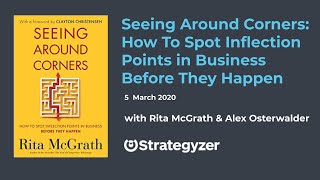
Rita McGrath and Alex Osterwalder explain how to spot inflection points, the moments when a 10x change in what drives business success becomes possible. They outline eight practices including diversity of views, small bets, and getting out of the building, plus tactics like scenario workshops and redesigning incentives to help leaders see shifts before competitors do.
Chapters
Welcome everyone to this week's Strap chat webinar. I really appreciate you all joining. We're in for a really exciting session today. First off, a huge, huge thank you to this week's guest, Rita McGrath for joining us. Thank you so much. Rita is a best selling author, a sought after speaker and a longtime professor of management at Columbia University. Rita's schedule can you describe as pretty hectic. So we're very lucky to have her and her spend some time here today with us to run us through her latest work and her book seeing around how to spot inflection points in business. Other guest is a Strat chat regular. He's the best selling author and co founder of Strategizer, the one and only Alex Osterweiler. Welcome to both of you. Thanks a lot for taking the time today. Really appreciate it. By the way, my name is Matthew Woodward and I'll be your host. So yes, just jumping straight into today's session, so just quick introductions. We'll have just a short section on our upcoming books and the ones we refer to consistently throughout the webinar and then we'll get straight into the juice of the content with Alex and Rita taking the floor. And we'll leave kind of 10 to 15 minutes at the end to answer all of your questions. So if you do have questions, any comments, please put them into the zoom box, into the chat box. I will be triaging them and feeding them to Alex and Rita at the end. So please put them all in there. And so yes, we've done our introduction of guests and just wanted to touch bases on the books before we get started. So a lot of the content today is around Rita's latest work. So Rita, would you like to just give us a short introduct to seeing around corners?
Absolutely. And thank you, Matt. So Seeing Around Corners is about strategic inflection points and it's about how do you see them, how do you decide what to do about them and how do you then bring the organization with you, which is often the hardest part of it if you're in an established company. And it was really inspired by Andy Grove's work from the 1990s and his book Only the Paranoid Survive really looked at being in the midst of an inflection point. You know, the change has happened, you've got to respond, you've got to figure out how to navigate through. And I got very intrigued at, well that, that was terrific. But what happens before that? Like how would you pick up the early warnings, the weak signals of something that was in the works, you know, and what we've learned about inflection points now is they're often in the works for decades before they actually manifest themselves as something that's a reality. I'll give a quick example and then I'll turn over to Alex. So just this past weekend, I was with my dad and we decided to call my brother. And as it happened, we decided to use FaceTime to make that call. So there we are chatting to each other visually, the way that we're talking today. And my dad made a very interesting observation. He said, you know, at the 1962 World's Fair, they were talking. No, 1965 World's Fair, they were talking about, you know, phones where you could see the person on the other end. And it's taken until now for that to be a reality. And I think that's a brilliant example of, you know, the idea has been there forever, but the ecosystem wasn't mature enough to really deliver it until fairly recently.
Great. Thank you so much, Rita, for that introduction. It's a great way to kick off the webinar. I'll quickly go over to Alex. Alex has been also working hard on his latest book. So I'll hand over to him.
Yeah. So just very briefly before we kind of actually combine, I guess, the thinking and the work, which Rita and I like to do a lot. The Invincible Company, coming out on April 14th, we now finished, the manuscript printers are running. I think it's very complementary to Rita's work. They go hand in hand together, the Invincible companies, to a certain extent. Right. How do you work around these inflection points? I think, you know what's really nice is this is a good bundle. So if I may say, you got buy both of these books. One doesn't go without the other. But so when in this book we really tried to show how do you actually how you should manage your organization to stay ahead. Right. No company can be invincible. All you can do is reinvent yourself. So we say Invincible Company. The three characteristics. Number one, they always have an attitude of day one, the parent. Only the perinates survive. Right. They reinvent themselves all the time. It's number one. Number two, we show that the invincible companies, they don't compete just on product services and price. They compete on superior business models. And then the third one, and I think this is going to be a nice topic to discuss with Rita, we say invincible companies increasingly transcend industry boundaries, so they don't compete in one space, which Rita calls arenas. Right. So I'm really looking forward to talking about that. So we show how do you actually start behaving like that to become an invincible company? And I think it's going to be really fun to discuss some of the overlap where Rita's work really focuses a lot and adds to this understanding of how do you create an invincible company? So, looking forward to the chat.
Great. Excellent. Thank you very much, Alex. That actually brings us nicely on to our conversation today. So for those that weren't part of last year's session. So before Rita's book had came out, we had done a webinar to introduce the eight practices that help you see around corners. So this might be a good place to start. So, Alex, Rita, I'll hand over to you both.
Great.
Yeah. So I think we have some topics that we can explore that we didn't explore in the last webinar. I would actually like a weekly webinar with Rita so I can ask her tons of questions. So we already have another one.
This environment where in person meetings are becoming rather scarce. You know, maybe a virtual digital weekly thing would be great.
Exactly. We're gonna kick that off. Right. Since nobody's traveling anymore, we're gonna do our weekly webinars, but just very quickly, maybe to get us started. Rita. So for those who haven't been part of the last webinar, before we move on to other topics, maybe just a quick summary of the eight practices that help you see around corners. Because people loved it. And just for those who haven't been part of the first webinar, you can actually watch it online. Matt will maybe share that link in the chat window. But just to give us a little bit of an overview before we move to different topics.
Sure. So one of the fascinating things about strategic inflection points is that those weak signals, as I mentioned, are often there for quite a long time before they really show up as something that you need to be concerned about. But what I would observe is they don't present themselves neatly at the conference table at corporate headquarters. Right. The weak signals are often out there at the edges. So it's the people who are facing customers, the people who are actually dealing with product, the people sort of 10 layers down in your supply chain. That's where these early warnings tend to appear first. And so one of the chapters in the book is called Snow Melts from the Edges. And the metaphor is really meant to imply that you really need to get out to the edges of your organization if you want to be prepared for whatever the changes are. And interestingly, if you can do that and get that sort of flow of information from the edges of the organization to the corner office, you're much less likely to be taken by surprise than if you're sort of spending your entire day on meetings and so forth. So the eight practices are outlined in the book. I'll just briefly review them here. The first one is to be in direct contact with what's going on and the reality of most large organizations. And I don't know if you found this in your work, Alex, but the farther up you get, the more cut off you are and the more people will, without meaning to, they'll lie to you. You know, they'll present you with data that aren't accurate, they'll cover up mistakes, they'll pretend nothing's wrong. And unless you really personally deliberately go out there and try to really hear what's happening without all the spin and without all the fluff, it's very difficult to get direct content. The second one is really getting diversity in points of view on critical decisions. And you know, it never fails to astonish me that companies who exist to sell products to women have product design teams that are all men or people that are trying serve, you know, very resource constrained communities, drive to work in chauffeured limousines. I mean, it just, I just what? To really get that diversity point of view, I think is really, really important. Allowing small teams to take bets is absolutely critical. I think Amazon would be an example of a company that really gets this very right. Bezos talks about, you know, sometimes you have to try things and fail before you learn what the right answer is. He also has a very famous two pizza rule, which I love, which no team should be bigger than can be adequately fed on two pizzas. So having small teams able to experiment, making some resources available for little bets. This is a concept that Peter Sims developed. And essentially, if you can place enough small bets, your chances of discovering something important just go up exponentially. But you have to figure out some way that someone with an idea can actually do something about it. And a great example of this would be Adobe's Kickbox process, where they actually make an innovation package available to people anywhere in the company. Getting out of the building. This is something that our friend Steve Blanks talks about a lot. He said, you know, there are no answers in the building, you have to get out. So get away from your email, get away from your work schedule and go see what's really going on. Parallel to that is, you know, rewarding the truth, right? Which is in a lot of Organizations, people are just afraid. They're, they're afraid to be honest about what's really going on. And it's counterproductive in the long run. And that applies to leaders too, right? They need to really create the incentives for being out of denial, really confronting reality. And the last piece really comes from science fiction. There's a wonderful writer called William Gibson and he very famously said, you know, the future is already here. It's just not evenly distributed yet. And so the encouragement here is can you go to places where the future already lives? Right. And my favorite example of this is if it's important to your business to know what the 20 year olds of 10 years from now are going to be like, well, guess what, they're all alive and well and living and you can go talk to them because they're all 10 years old today. So what could you learn from talking to a 10 year old? So these are just examples of practices and you can kind of mix and match them and maybe some work better for you than others. But I think it's kind of useful to have a summary of what are some specific things you can do tomorrow that aren't expensive and that could expose you to where the changes are beginning to happen.
So wonderful overview and I recommend everybody. Well, number one, buy read us book to go deeper on these. And then number two, also go back to the, to the other webinar that we did where there's, you know, we spent quite some time digging deeper. So I don't want to go digging in deeper into these because we've discussed it and some who are part, you know, with us again, we don't want to bore them. So even though we could probably go very deep on all of them again. But you know, one of the questions that often comes up, and I get it in a slightly different context, is people ask about timeframes right from the first week signals, you know, when they arrive, until one of these inflection points really happen. And of course it's context specific and different for every industry. That's the usual answer and that's the reality. But are there some patterns that you've seen in terms of timing? You know, are they always very long or have you seen some things happening extremely quickly? Or like Tesla created an inflection point to a certain extent. Right. So what kind of patterns do you see in terms of timing?
I think a lot of it depends on how mature the ecosystem is that the inflection point is going into. So if I go back to the visual phone, you Know, I mean, you needed to have massive amounts of bandwidth, you needed to have a supercomputer in your pocket, you needed to have a platform that you could use in common that both people could, both parties could access. And I mean, there was a lot of sort of infrastructure that had to be in place before an actual visual phone call could be made, even though the idea has been there for decades and decades. So I think the maturity of the ecosystem is a huge determinant of how quickly an inflection point can move or not. And you mentioned Tesla and I think Tesla is a really interesting example because there's a lot of hypothesizing about what Tesla really is. Right. So is it, is it a car company? Sure, you know, by one lens. But is it really a battery energy future of the world's infrastructure kind of company? And I think depending on your perspective, the car company came into being very quickly. The sort of energy infrastructure thing, you know, has yet to be demonstrated. And you know, as an interesting counter. Place, counterpoint to that, I would cite the example of a better place. Do you remember Better place and better place? Instead of having a battery operated car that you would recharge yourself, their concept was you would drive the car around and then when you felt you needed more energy, you would pull over at one of these better place charging stations and they would just give you a new battery. And so the energy storage function was in an actual physical infrastructure and you yourself didn't have to do that. And for a variety of reasons, it never ended up being commercially viable. But it was an interesting alternative business model to use your work to what Tesla's also trying to do.
Yeah, and I was just trying to get back to a movie that I've watched a while ago called General Magic. I don't know if you remember or if you've seen the movie, right?
What a great movie.
So, so that was, you know, they were working on the iPhone if you want, and a couple of those people from the movie, from that team at General Magic ended up on the iPhone team. But so timing is an important component. Right. So one is, okay, we're seeing weak signals, but we might be too early. And that was exactly the case for General Magic. They had the same kind of vision, you could say, or close. And then they were probably too early. I think it was more than just execution challenges. They definitely made some mistakes there, but it was also timing. How does timing fit in this context of inflection points and. And these eight practices? Have you seen some things around that that some companies are better at getting timing right, et cetera, because I think it's a very, very important topic, right?
It's huge. It's huge. So inflection points tend to go through something very similar to the Gartner's hype cycle, right? So you know, somebody first starts talking about oh my God, the Internet's going to change retail and everybody and their brother goes piling into the Internet and we're, you know, we invest millions in websites and dot com addresses and there's just so much hype and then the ecosystem again isn't really ready yet. And so we've over invested too early. Then the whole thing falls apart. Then everybody looks at each other and goes, see, I told you. So that was a stupid idea drawing exactly the wrong lessons. And then the survivors of that shakeout actually start putting together viable business models and workable products. So out of that first.com crash we had Amazon and ebay and companies like that that actually proved you could make money on this thing called the Internet. And of course today, you know, all the, the weight has shifted in the other direction and now nobody can conceive of being in many, many categories without being some kind of e commerce presence. So I think the way that I would think about that is you really have to go back to what's the job that customers are trying to get done, to use Clayton Christensen's famous word. And perhaps a great example of this is how Nike found itself well positioned in the direct to consumer revolution. So back in 1987, executives at Nike had this theory that athletes would like to get feedback about their performance. And so they invented this thing, I think it was called Nike Motion. And it was a thing you strapped, you'll love this as a runner. It was a thing you strapped around your waist. It had little sensors that would point to the ground and then a sort of an ipod like thing that wasn't playing you music, it was just giving you information about how fast you were going and how fast your heart was beating and all that stuff. Now I mean nobody's going to use that unless you're a die hard, you know, athlete, data geek, you're not going to use that as a regular thing. And so that idea kind of went away and they quietly pulled it from the market two years later. But the idea that runners would have this job around how am I running, how am I doing? You know, what's going on? And it crystallized as the next generation concept in about 2004. Yeah, 2004. So many years later, when Apple and the ipod made it possible to carry your entire music collection in this very portable little device. And so Phil Knight called up Steve Jobs and they had a conversation and the two companies figured out how to create a thing called Nike Plus. Now, if you remember back in the day, you didn't sort of stream your data or your music or anything. You had to come home from your run and you'd have your Nike device and you take your dongle and you'd plug it into your computer and it would kind of send the data off to the mothership. But that was a huge hit. And runners started to form running groups and they shared their information and they used it in their medical files. I mean, it just, it really flourished because they had the complete solution to getting a job done, which that first attempt didn't have. You know, it didn't have the technology, it didn't have the ability to do the diagnostics. Well, today Nike is a membership group and it now has something like 135 million members. And it's the cornerstone of Nike's whole direct to consumer. They call it the direct to consumer, direct to consumer assault. I think they called it some very, you know, sort of competitive language. But my point is this, that they didn't overrun what was possible at a given point in time, but they got a complete customer job done. So in many cases, you know, with these things, you're better off getting a small job done really well than you are trying to tackle the whole vision. So to go back to Tesla again, I think one of the things they wrestle with is they're trying to build the whole vision, not. Not serve a smaller niche to start with. And it's pretty bold, you know, but it's certainly they've had their ups and downs in doing that.
Quick question, you know, back maybe to some of the basics some people are asking, I think it's a good question to just define some of the definitions. So Carlos Duran is asking, you know, what is your definition of inflection points? So maybe let's just get that one out of the way for some of the listeners who are new to this webinar, but also to your work. How do you define inflection points?
So an inflection point has arrived when a 10x change in some constraint or metric that determines your business success becomes possible. And why this is so important is any business is born at a specific point in history and, you know, your work on the invincible company is going to be an interesting counterpoint to this. And certain Things are possible and certain things are not. So if you take traditional retail, everything about retail for thousands and thousands of years since human beings have been buying and selling things, has been determined by real estate. Estate, you know, how well you use that physical footprint was everything that determined success. And so all of your metrics were things like inventory turns and same store sales and sales per square meter and that kind of thing. Well, along comes a different way of trading e commerce. And all of those metrics all of a sudden are no longer as strongly predictors of how you're going to succeed as a retailer as they once were. So an inflection point has arrived when some change of, usually it's an external change has invalidated or made less relevant the traditional metrics that you use to predict success in your business. So to take another example, I mean, when YouTube was first commercialized, right, it was a bunch of disgruntled Silicon Valley engineers who were fed up with how hard it was to share video, right. And when YouTube first became possible, right, did media company executives sit back and say, oh my God, this way of distributing media is going to completely destabilize media empires and change the nature of advertising and totally change the democratization of access to video. Did they have any of that in their minds? No, not at all. What was YouTube when it first came out? Cat videos. Right. What was Facebook when it first was launched? It was, you know, ill considered photos of college students with solo cups. You know, and people really didn't take this seriously. And yet, if you think about it, before we had YouTube, Facebook, Amazon web services, those kinds of things, if you wanted to get a video message to millions and millions of people, you had to run a media empire. I mean, you had to be Metro Goldwyn mayor or something, and you had to carry around, you know, reams of film that were huge and heavy and hard to distribute. Today, you know, you've got people making a living making funny YouTube videos in their garages. You've got people making a living shopping and making videos about what they bought. It's, it's wild.
So that is really important, right? The metrics are changing, the game is changing. Now what we see a lot is that there are people in the company that actually understand the shift, but it's rarely at the very top, right? So the question is, so you know, a lot of our listeners are struggling with this. They often ask, well, how do I tell my leadership? And you know, they're making the decisions. I have nothing do to, to say. So what would you tell People in companies that are seeing these inflection points coming, how can they, you know, can they even somehow get the ear of the senior leaders, you know, influence them? Or is this like already a lost battle up front? I mean, from all of the things you have seen, and it can only kind of happen when it's top down. My vision is against the bottom up and top down. But I'd be interested in hearing from you. What can people practically do? Because there's rarely a company where people haven't seen it coming. You know, it's just not always at the top. Right. So what can we do?
So I think the first thing is realize that your message will be amplified to the extent that you're not the only one repeating it. So I think you really need to build an alliance of other people who see the coming as well. And the reason I think that's so important is, you know, it's very easy to dismiss one person's opinion as, oh, he's a crackpot, or they're always saying the sky is falling over there in R and D or whatever. You know, whatever the dismissive thing is. But, you know, and I tell people in my executive programs this a lot, like, if your company believes in you, that's why they paid the money to send you here. If all of you go back with a common perspective that you're much more likely to be heard than if it's just one lonely voice in the wilderness. So that's the first thing. Second thing I think you need to really think about is what's your story? And making a really compelling story that is believable is often much more convincing than, you know, death by PowerPoint slides and so forth. So I'll give you a specific example. I was with a company the other day that, among many other things, makes roofing material and so forth. And, you know, there's the big strategy retreat they're talking about, what's our strategy supposed to be? This and that. And I said, well, have you guys ever considered what would happen to your business if Google decided to get into that line of work and gave the rooms away for free? And the room went completely silent. And I said, you know, that is. I mean, I'm not saying they're going to do it, but think about it. They've got a sidewalk lab subsidiary that does cities and city planning. They make their money on data and geolocation advertising. Everything else is just a bait to get more data. So why wouldn't they? They could. My point is simply not that they would, but that they could if they wanted to pursue a completely different business model to the one that you're in and you guys could just be complete collateral damage. Well, I wasn't like super popular, but it does illustrate that if you get someone outside the immediate organization to sort of share or validate or at least give, give some legitimacy to a point of view that might be a little bit heretical within the organization. Now I'm not saying they should leap out and go, you know, panic. I'm not saying that. What I'm saying is expand your range of, of possibilities. And once you accept that as a possibility, now you can start to give people permission to tell you more about it. Do you see any evidence of this? Have they indicated they're going to do something new? You know, they're building this whole thing in Toronto. What's that business model like, blah, blah, blah. So it just, it opens up a line of inquiry which, you know, while you're still healthy. And I think this is the problem when you're in a deep, dark rut, it's very difficult to be playful and to think about these things and to entertain different ideas. You're in wartime at that point and, and it's hard to be open, broad minded at that moment.
Yeah. So Marco Parillio asked the question that goes in the same direction. Right. And to a certain extent you answered part of it, but I want to dig a little bit deeper. He asks, how do you motivate an incumbent to invest into future business models? The first signals are still years away before disrupting incumbents. So obviously leadership has a very short term kind of agenda just to stay alive and the board doesn't or the investors don't fire them. But I'd be interested and I'll frame it in an interesting way, I think. What can our participants today, you know, do to, you know, hire you? If they would try to get you to convince their leadership, what would you tell them? Like how would you. Because it's often external people that get a better ear than the internal people. Right. So as the internal, the internal question, pretty hard to do. But now they bring you in, what would your argument be? How are you going to get the leadership to change? I know you're really good at it, so I'm curious, you know, if you can give some of those away. When you walk into a room with these leaders and you're, you know, you're straightforward, you're not going to hide the truth. And so what would you tell them? Hey, you have to invest in the future, how do you, how do you deliver that message?
So a very typical way that I would do that is using a framework from the book. And you can think of it almost like a scenario planning light. Almost. I say let's take two major uncertainties that are facing your context in some way. And so I'll give one that I wrote up actually in my most recent newsletter. So I was looking at the question of fast fashion. And, you know, we all know fast fashion is an ecological and workforce disaster, and yet it's driven, its popularity has been driven by a lot of forces. So on the one hand, let's say fast fashion continues to be the dominant model or not, you know, maybe we have a backlash and all the fast fashion people sort of give way to companies who say, oh, I'm proud to be wearing the same outfit 365 days a year. So that would be one level of uncertainty. And the other level of uncertainty would be the distribution model. So is it going to be conventional retail the way it is right now? So fast fashion people and used clothing people are starting to partner with department stores, or is it going to be direct to consumer, where, you know, we're going to have that retail layer melt away and it's going to go straight there. Now, if you juxtapose those two conditions, what you get is four future possibilities. And that, I think is the first step. It's kind of like my discussion with the roofing people. The first step in opening their minds is most senior leadership teams are focused on one point of view about the future. And so what this forces you to do is say, well, let's consider four possibilities. And I'm not making predictions here. What I'm trying to do is just open your mind to those possibilities. So let's take the case of fast fashion gives way to a reuse, recycle, more sustainable model. And we're gonna, but we're gonna keep kind of retail stores. Well, who's gonna win in that scenario? Well, companies like Goodwill, you know, who, who are going to be the dominant players. But if they're going to be really successful, right, they need to have more of an omnichannel offer. They need to have different ways of customer. They need to reposition the way they. That their brand is positioned to be part of this trend. And so what I would do with the senior leadership team is I would go through each of those four scenarios, and here's where it gets really interesting. So each of those scenarios has a relevant time. I call it a time Zero event. So something like a headline in a newspaper that signifies the inflection has arrived. And I try to say, let's be as vivid and imaginative as we can about what that headline would be. And then what we do is we say, okay, before that could happen happen, let's go backward in time and let's look for the evidence that would tell us whether this is more or less likely to be happening. And I actually do that with senior teams. So it's not me telling them, it's them telling themselves. Well, here's what I observed and a lot of times in the room, they haven't really ever had that conversation. So. And one person will say, wow, you know, I was, I was at the Goodwill in California and this is what I observed. Or, wow, you know, I read this newspaper article, which is actually true that 48% of shoppers now have at least bought one used item in a retail environment. And so once you start to pull that data, what starts to emerge is a picture of what could be. And that's where you want to get them to. And then post that first meeting. What I would typically do is assign them to have somebody watch these indicators and see whether they're getting stronger or whether they're not.
I love that. I mean, one of the things we do that goes in that direction is sometimes we design a workshop where a group of leaders have to try to destroy the company's business model. You use all of their energy, right? That's a phenomenal thing to do. And then all of a sudden they realize, oh, this is not years out. This could happen very soon. And usually that unlocks such an energy in the company. And we've seen some companies completely, you know, shift their, their kind of focus and say they're still going to manage the core, which we call exploit, right? But they're all of a sudden going to invest in a very different way in innovation. It's very fascinating to watch.
Another exercise I do sometimes is something I borrowed from my colleagues at a company called Solve Next, and it's called Brand Takeover. So I was doing a lot of work with a big consumer branded company and their very proud of their brands and the world's in their brand. And I said, well, let's assume Nike bought you. What would they stop? What would you stop doing? What would you start doing? And if they increased your marketing budget by 10 times, what would you do with the money? And just being able to think, oh, I'm not company A anymore, now I'm Nike. It's like A completely different way.
Working with constraints. Right. Trigger questions that get them to think outside of their daily kind of management, because that's not what they're paid to think for right now. Often maybe we could say if they were paid the right way, they might make it there.
Something on that front which I think is super important. If you look at how Nadella has changed the way executives at Microsoft get paid, this is fascinating to me. So half of their pay, half of their comp comes from performance metrics. So sales and ROI and blah, blah, blah, you know, all that stuff. The other half comes from leading indicator metrics. He calls those power metrics. And believe me, if half of your compensation is going to come from how well you're looking after the future, you're going to be a lot more interested.
In looking after the future that drives the behavior. Right. We can design the behavior. Right. And I think that's what was amazing about that turnaround. Satya Nadella, you know, there was deliberate redesign of the culture. Let's take a very concrete example here. So Junaid Haq, obviously I'm going to pronounce the name wrong, but he was asking, you know, what would you say the challenges for companies like Nestle and Unilever? And the reason I like this question is because we're taking one industry. And that maybe brings us to one of the interesting questions, should we even still ask ourselves, you know, talk about industries makes less and less sense. Right. So if we take Nestle and Unilever, you know, Schneider calls you Rita and brings you in, maybe already did, I don't know. But let's say he calls you and does the right move. I'm going to bring in Rita McGrath. So what are you going to, you know, from your perspective, say, I think these are the big challenges for your industry?
Well, you know, where you would start in an ideal world is I would start by mapping their portfolio. And I know you and I have very complementary portfolio models because until you know where you are, it's very difficult to know where you want to be going. Then what I would do is look at are they making appropriate investments across that portfolio. So there's obviously keeping the core healthy and happy, and that's job one. You can't afford to do anything else if you don't do that well. But then there's what one of my colleagues calls near field investments, or you can think of them as the next generation core, which are perhaps 18 to 24 months out, but which are showing strong promising signs. They're beginning of Their growth curve and so forth. And those could be in house or those could be acquisitions. Coca Cola for example, has done a fantastic job of kind of getting these new businesses that are ripe for growth and then using Coke scale and marketing genius to really, really help them achieve their full potential. And so I think those near field things are the ones that are most interesting for senior leaders because they're often under resourced, you know, they're kind of there and we know they're there, but we're not really putting the energy behind them. Where if we really did it could be an 18 month to 24 month win, then you've got the options. And the options are kind of like the Nike motion thing. You know, it's a small investment, it's experimental, it's more or less to learn. It's like R and D, right? So step one is what have you got? Step two is are you appropriately resourcing the things you've already got? Then step three would be where are you going to place your new bets? And you know, there are a couple of ways of centering a company. So Jeff Bezos very famously talks about being the most customer centric company on the planet. And that's, and you know, his position is as long as I'm lightning focused on the customer, I won't go too far wrong. But there are other ways of doing it. Some companies, and I would say Unilever, maybe one, are very, are very capability focused. Sorry, knocked something over there, we can still hear you. Some companies are capability focused which is, you know, over many, many decades we've built up a know how wisdom, deep understanding of what's going on either in science or customers or in the case of Nestle or Unilever, food technology, environmental sustainability, safety, whatever those things are. And then the question becomes, well, where in the world are those capabilities relevant? So that would be more of a capability out into the world kind of view. And so there are a number of different ways of centering a company. Companies that follow that second path would, would be companies, I would say Unilever is probably one Corning, W.L. gore, you know, companies that are really innovative but more on the kind of science, materials capability part of the life versus a company like an Amazon that, you know, it's certainly got a lot of very powerful capabilities, but it's always in the service of their customer vision.
And one thing I'd like to hear your opinion on is often we'd say, you know, Unilever and Nestle are in the same industry, but you Know, I think, personally, I think the notion of industry is a little bit passe. You know, 1985, five forces, like the world is, that's over. So you talk about arenas rather than industries. Maybe you can tell us a little bit about the term arenas and you talk about it in, in your new book, because I think that's an incredibly relevant shift. We take a. We use a different word for very similar phenomena transcending industry boundaries. And that is something I think is very, very poorly understood still. Not just by senior leaders, by almost everybody I meet. They don't realize how much we're breaking out of industry boundaries. So maybe you can enlighten us a little bit on that topic.
I'm sure you get this question all the time. Have you ever worked in our industry? Do you have relevant industry knowledge? Have you? And I'm almost like, you know, you guys can do that. You do your industry better than I do. You know what? I'm here to bring you a fresh perspective. So an arena represents a pot of addressable resources of some kind that you are going to contest with others trying to contest for those same resources. Now, those resources could be financial, they could be time, they could be talent. But there's some pot of resources which is finite, that you are mobilizing your organization to compete against. So let's take a concrete example. Netflix, for example, has been completely blunt about this. They've said our competition is anybody else that you would spend disposable time with. Right. So our competition is not other media companies. I mean, sure, it is on one hand, but, but it's taking a walk. It's, it's having a beer with your friends. It's, you know, playing the piano. I mean, whatever it is that you're spending your disposable time on, we want more of that. And if you frame it that way now, your business strategy as Netflix is radically different than if you're saying our competition's Disney or ESPN or whatever. You're going to look at it a really different way. So I think it's important to be clear on what it is you're contesting and what you'll find when you start to really dig under that is a lot of really counterintuitive notions. So if I take household spending, for example, so you know, you're, if you sell to consumers, you're always in competition for household spending. But you need to really get into that consumer's head to realize what are the trade offs they're making. And one important trade off in the last 10 years has been households are putting more and more resources into Internet to the home connectivity, supercomputers in your pocket than they are into clothing or automobiles or travel or eating out or anything else. So if you don't understand that, you know, if you're a restaurant, you're actually competing, you know, with Internet usage, with being connected. Right. Another big kind of idea is let's say you're a restaurant. Something like, I can't remember the statistic off the top of my head, but something like 62% of all meals prepared in a restaurant today are actually not served in that restaurant. They're going into a box and being sent to people's homes. Well, if you're a restaurateur, my guess is you did not get into that business to fry apple eggs and stuff. You got into it to be hospitable and to invite people into your environment to create a great place. Now you're just serving, you know, cardboard boxes. I mean, that's just not so interesting. And yet this sort of drive towards convenience and not spending time and spending more time on your phone than perhaps sitting at a restaurant actually talking to someone. I mean, you need to really understand those things if you're going to understand what arena you're competing in.
And there are some great examples, right, of companies that transformed, you know, they really, from one to another. Netflix, we can always kind of find the argument that, okay, that's a young company, it's easy for them. But my favorite example at the moment is Ping an transformed from a banking and insurance conglomerate to becoming a tech company that built the largest health platform on the planet with Good doctor didn't come from Novartis or Roche. That just blows me away. So companies that understand arenas, and not startups, but established companies that understand arenas, they compete in a completely different way and they will automatically break out of those industry boundaries. So there's a huge opportunity actually. Right. So it's going to be interesting to see. I want to go to a little bit of the how to. So there's one question, Anonymous. So didn't want it, but actually it's a very straightforward, good question. You know, how do you, how do you fund these kind of explorations and understanding weak signals? So the anonymous attendee is asking, do you think VC funding, et cetera, is a good way, an indicator that enables you to kind of spot inflection points? I think we have very complementary views on that. It's a very, very interesting question because typically corporations have done some corporate venture capital, but that hasn't really worked. What's your view on the VC funding within established companies?
Well, there's two kinds, right? So there's the VC funds that are there to make money. You know, it's just a diversified investment. And then there are the ones that are so called strategic, that are there for more exploration and so forth. Couple of observations I would make about corporate venture capital. Like in general, the people running those corporate venture capital shops are usually not as experienced as the ones that do this and as a profession. And when they get good enough to be as experienced as the ones that do this for a profession, they're driving around in their Toyota Prius, is looking at the guy next to them, it's pulling up in his Maserati, and you know, pretty soon you get the idea that maybe, maybe there's more reward to be had on the outside world. So I think there's a kind of a professional almost mismatch there. Now that much being said, I have seen corporate venture capital used very effectively when it's part of a broader toolkit of how the organization is looking externally. The other thing I would observe is venture capital right now has lost its mind. And I attribute this partly to income inequality. You know, there's only so many yachts you can buy, there's only so many apartments you can purchase and live in. And so a lot of that money is going into investment. And in a zero rate interest rate investment, you know, just crazy money going into these businesses. And so, you know, one of my issues when corporations try to play that same game is if you don't really have a good feel for what you're evaluating, you can get sucked into this myopia that all the private investors are in, which is just way too much money going after assets that aren't all that sensible. And I think you and I share this view. Entrepreneurship 101 is you have an idea, you find product market fit and then you figure out how to scale it. Well, we have this entire generation of businesses that go straight from having an idea to scaling. They haven't figured out how to find profitable product market fit and they're getting funded. And what's concerning to me is it distorts the whole venture capital kind of idea. So to me, a healthy way in a large established company would look is you'll probably have some money for venture capital. You'll have something like Adobe's Kickbox where you can fund small bets by internal people that want to try something out. You might do some joint venturing around a Common theme. In other words, you'll have a number of different ways that you're exploring the edges of your organization to see what's actually going on out there.
Right. And one of the things I'd add to what you were saying is that you have the. As one of the eight practices is the small bets. And that is the principle of venture capital. When you don't do it right, you might actually that's happening in venture capital right now. We're making big bets on, you know, without having the evidence that supports the bet. Right. And that's falling apart. Which is the good news.
I mean it fascinates me that big data and data based decision making has found its way into so many corners of our economy and VC is still. Who do you know? He's a good guy. Oh yeah, I worked with him four companies ago. He's terrific. I mean it's all this kind of word of mouth, evidence free stuff and I really, I wouldn't be surprised if somebody kind of sort of steps back and says what you know, and we'll stop seeing so much of this sort of sort of personality driven almost investing in things that the arithmetic doesn't add up.
And we're trying to actually disrupt some of that with the innovation metrics that we put together. So we want to be more data driven and I do believe over time, once we have enough data, you know, AI and all that will come in because we see so many innovation teams. There are actually patterns that you can detect. You can't predict the future. No chance, too many variables. We're talking social sciences. But there are a couple of things that I think will happen. There's an interesting question again, anonymous attendee. Is it realistic for companies to be able to see these inflection points on their own or do they need help from outside consultants or. I think what I would add this is my part to the question. You know, investing in startups or different kinds of ways to not do everything yourself. Right. Because some you can do yourself. There is legitimate option is always acquisitions, very small, very big. But you know, what do you kind of see as the ways of doing it is there doing it yourself works best or doing everything outside works best. The reality is going to be a mix. Right. But what kind of patterns do you see? What kind of things can companies do to not do everything on their own? Sure.
I think the biggest risk that most established companies face is that their focus of attention is inward, not outward. So I mean I was at a meeting with a very large company not Too long ago. And first of all, There were like 42 people in this meeting. It was ridiculous. And they were talking about innovation, of all things. And I know it was just absurd, but if I had to like parse the minutes spent in this hour long meeting, probably 45 minutes was spent on themselves. You know, oh, this is how we do things. This is what we're good at. This is what the customer and, you know, maybe 15 minutes was spent on. Here's what a customer said, here's a new technology, here's something. So I think the focus really needs to be as external as you can. And then there's lots of vehicles for doing that. So some people, I mean, I'll take Corning again, as in a company that I just really, really admire, they manage a lot of it themselves. And the reason they do that is their business strategies. They need to be 10 years ahead of their customers. And so an outside perspective isn't really going to help them in terms of telling them what to do because they are at the cutting edge. So other companies should go to Corning and ask what they're looking at. So in a case like that, I don't think a lot of outside consultants or whatever is going to be all that help. Now in another case where, you know, let me see if I can pick an example, something like a discount furniture store, right, where we've had the same model for 30 years, you know, we make furniture at a good price, we do a lot of TV advertising. Customers come in the shop and they buy. A company like that is likely to be very operationally focused and very internally organized and could really benefit. I think from an external perspective saying, here's what's going on with millennials and here's what's going on with new household formation, here's what's going on with apartment sizes and that kind of thing. So I think it's a function of, kind of where your center of gravity is as a firm as to how external you want to go.
So we've been talking quite a bit about established big companies. That's your clients, our clients, right? But I'll take kind of Tom Peters perspective here where he says, stop talking about those huge giants. Talk about the medium size or small companies. I do think it's a relevant question. And I know we have quite a mix of an audience where we have the whole range, right, from startups all the way to people who want to create a startup to the biggest corporations on the planet in our audience. So I want to just take a quick detour to SMEs and maybe smaller companies, you know, is these eight practices. If I see them, you know, the first reaction we often get from people is, oh, but that's just for big companies. 8 practices. How can I do that? You know, we're a company with, you know, 6,600 or so people. What would your recommendation be to smaller organizations? Because they're definitely, you know, affected by inflection points as much, if not even more sometimes. So what's your recommendation there for somebody who's not already a corporate giant? Does it hold the part?
I don't think it's all that different. And you know, it's similar to if you take our portfolio theories and ours are pretty close to one another, I think. I mean, I do it for myself. Like once a year I really sit down and I say, what am I working on? That's sort of part of my existing wheelhouse. What am I doing that could be important for the future and what are my options? And so just as an example, you know, clearly teaching in person classes at Columbia Business School is something that's important today, it's probably going to be important tomorrow. But I would be a fool if I wasn't paying attention to alternative delivery vehicles. I recently did a thing with holographs that was super cool. That was amazing. But you know, those, those to me are like options, the robot options, holographs interacting in false time. I don't know, you know, I mean, it is not inconceivable to have a virtual reality machine. And if you set up the context right, I mean, imagine going to a Regis or Wework type office where you and your counterparts are at other ends of a digital spectrum and you could be enjoying a real beer, not just a virtual beer together. You know, I mean, that's not completely inconceivable even with today's technology. So I think to come back to the question of small and medium sized enterprises, there are some advantages. A smaller enterprise, it's not a megalithic corporation, usually has a lot less trouble with silos and with people being unwilling to share information than a larger company. Information tends to flow more readily. People tend to have more personal relationships and that, that's, I think, a big advantage in a big company. You can, you can get lost. I mean, I remember back in the day somebody who was working on an innovation at General Electric, as it happened to be said to me, oh, my job is I come to work and fight hard every day to become a rounding error at the General Electric Corporation. So, you know, I think it's a lot easier to get people's ears, to get attention, to get airtime in a somewhat more small organization. In the startup organizations that all happens magically. And the critical moment, and I know you've thought about this a lot, is once you get to a certain scale and size where all of a sudden not everybody knows everything that's going on because not everybody's in the same space, that's when you have to start putting in place processes and systems to counter for that. So I don't think it's different in sort of theory, I think it's just different in how it gets expressed.
And I like what you said about the mindset, right? If you're one person, 10 people, you know, 100,000, first and foremost it's taking some time to reflect on that. And it doesn't have to be, you know, a month workshop or it's the attitude do we spend some time. And here I do want to actually refer to something I use I stole from you, but I reference you which is how much time does the CEO or you know, anybody in the leadership spend on innovation? If there is no time, guess what? Nobody's going to think about these inflection points, right? So I use that as a nice metric and I tell everybody and recently. What was that? Three weeks ago I was with one of the biggest banks in Europe, had this CEO in front of me and I said, you know, I use this metric if you don't spend certain amount of time. And I was clearly saying 40% innovation is not going to happen. And that stuck with him is something he discussed later on and is it 20, is it 80%? Doesn't matter. But it's the mindset, right? And that's the same in very large or very small organizations. You need to think about actively about the future.
And you know, there's this mythology we have that small companies are immune to bureaucracy. I'm sorry, I have seen 35 person organizations that were as bureaucratic as Deutsche Bank. I mean really.
Thanks for pointing out our German neighbors. I'm happy with that. You would have said, you know, UBS or Credit very quickly before we wrap up. But I do think we should acknowledge the question. I know it's been a question that probably been beaten dead quite a lot, but it's this whole idea Thiago Santos is asking how do you align senior leaders, their tenure and job and betting on longer term things when their whole kind of not just remuneration but also incentives by the stock market and the boards and so on is to actually avoid risk and not make long term bets. So just a quick maybe last answer for this very big question, like what can we do today? And almost think it's more interesting to maybe take some cases that you've seen where CEOs have successfully moved towards a longer term perspective. Because a lot of people are saying, I can't, I can't, I can't. But there are some, Paul Polman would be a great example who've taken the long game. Right. So can you maybe give a couple of examples of people who you've seen have done that or how they've done it, maybe without mentioning names. So that would be a really interesting.
So I think it is a myth that what's in the long term interest of the shareholders is not in the interest of the company. And we've seen this over and over again. So if you are a purely financially motivated short term investor, you're an activist or you're a hedge fund, or you're a private equity firm, then your goal is to get in there, extract as much cash as possible and get out. You are not a long term investor in the company. If you are a long term investor in the company, what is good for the long term is obviously better for you. And this is a point that, you know, Larry Fink from BlackRock makes, which is, you know, we've got pension funds with 30 year expirations and liabilities. I can't have companies that are brilliant for two years and then fall apart. So I think there's, there's this mythology about the short term player and between you and me and the wall, I honestly believe a lot of that is just a cover. If you look at how executives are compensated and you look at their ability, at least in the US to do unlimited stock buybacks, which pumps up the stock price and a lot of their compensation comes from that same stock price. It is a pure cover up for I will make more money if I make short term oriented decisions. That, I mean, that's not a politically correct way to say it, but that's what they're telling you. I don't believe in that. So what my colleagues and I have come up with as a kind of a countermeasure, and this is Alex Van Putten, who's a good friend of mine, long term collaborator. We call it the imagination premium. And without going into the math, I'm happy to send anybody that wants a link to this, but basically you can divide the cash flows of A company into cash flow due to operations versus cash flow due to prospects for long term growth. And then if you divide those numbers into a company's market cap, you get a metric we call the Imagination Premium. And what we've discovered is too low. And the shark sense blood in the water. You know, GE's for example, when we did it, which is about a year ago, was 0.49. If you take value of growth divided by value of operations was 0.49, Tesla's is like 5. I mean, it's all imagination premium, right? So Elon Musk has one bad press conference and his market cap drops by $6 billion. So what we're arguing is that you can judge do you have a growth story and how well are you telling your growth story by where that imagination premium is. And if it's too, if it's high, right, you're being priced to have very high expectations and you as a leader need to deliver to that. If it's too low, it's a strong signal from the market. They don't believe your growth story or you haven't got one, or you haven't delivered on the one you've been telling them. And so what we're hoping is that as it gets more accepted that this Imagination premium, which is perfectly objective measures, it's not, you know, smoke and mirrors, very simple calculations, that this could actually provide some ammunition to boards and executive teams to say, hey, you know, the market is telling us they want more attention on growth, or the market is telling us we think our growth story is really great, so we need to make sure it happens. You know, I think it's a very nice counterbalance to some of these other metrics. But I honestly do think a lot of this short termism is just an excuse.
And I think it'd be great if Matt can send the pointer to that afterwards when we send the recording. And I also want to point to something you quickly briefly mentioned. Rita, your newsletter is spectacular. So I recommend you get Rita every, you know, regularly to talk about these things. I can't believe the time is already over. Looking at my watch. What? It's over. I have to hand over to Matt again. This is amazing. So thank you, Rita. Every time. And again, I think it should be a monthly thing with Rita.
You know, let's do one where we talk about your book and I'll do the interviewing. How about that?
Oh, I love that. That's perfect.
Okay, we'll change roles.
Matt, let's wrap it up. And I will definitely look forward to the interviewing that you'll do.
Amazing. Thank you so much Rita and Alex. Wow. I got a lot of value from that session. I hope all of you did too. I tried my best to kind of sift through the comments and pick out your best questions so we've done the best we can in time frame that we've had to answer your questions so that's great. Just a quick note that we will obviously upload this webinar to our YouTube channel and it will be posted on our blog within the next couple of days. So a big thanks again to Rita and Alex for joining us today. What a pleasure and what an amazing session and thank you to the entire Strategizer community that took the time to invest in their learning and join us today. So thank you very much everyone and have a great rest of your day.
Thank you. Thank you Matt. Thank you Rita. Bye bye everybody. Thanks everybody for joining.
Bye everyone.
It.
More from Zaur






An Immersive Workshop to Calculate the ROI of AI Strategy - AUTONOMOUS session

Predict, Optimize, Decide: Enterprise Decision Making For The Simulation Era - AUTONOMOUS summit


AI Insiders podcast ep. 9 - Not so cookie-cutter: Consumer Choices in the Age of AI

