Ideate like an expert - Board of Innovation
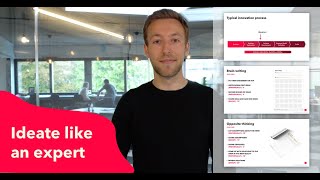
Webinar by Francis (Board of Innovation) explaining when and how to run ideation sessions within the innovation process. Covers prerequisites (scoping/problem exploration), participant mix and size, logistics and materials, four creativity rules (no bad ideas; capture everything; be visual; hybrid brainstorming; quantity over quality), two core exercises (brainwriting and opposite thinking), convergence techniques (idea shopping cart, concept cards, speed‑dating), plus facilitation tips (warmups, follow‑up plan, feedback). Emphasizes ideation as part of solution development and the need to validate desirability, feasibility and viability after ideation.
Chapters
Hi there. I'm Francis with Board of Innovation, and in this webinar, I'd like to tell you when you should use ideation in the innovation process. I'd like to show you what you need in order to run your own ideation session. And finally, I'd like to share some of my favorite tools and facilitation tips so you can ideate like an expert. So let's dive right in. We've all heard that ideas are basically worthless by themselves, and in ideation, we just come up with a lot of ideas, right? Well, it is true that in ideation we do come up with a lot of ideas, but you shouldn't see those ideas as a random ID generator that just spits out wordless ideas like a barcode reader for scheduling parties. So at Board of Innovation, we see ideation as the process of forming ideas and concepts in order to solve problems. So this means that the goal of an ideation session isn't to come up with as many ideas as possible, but rather to find a single best solution to satisfy unmet customer needs. And this goal of satisfying unmet customer needs is important to focus on because often people assume that the innovation process starts with generating a lot of ideas and coming up with new solutions. In fact, at Board of Innovation, we think that ideation is only the start of what we call solution development. And there's actually two phases that come before this step. They are scoping and problem exploration. And. And this is where you find a problem worth solving and where you define your unmet customer needs. So without problem exploration, your ideation session will miss its impact and it will just be ideation theater. So for this webinar, we'll assume that we'll have gone through problem exploration and we'll have find a problem worth solving. Also note that the innovation process isn't a linear process. So yes, we do go to problem exploration first and then solution development and so on, but we're continuously validating, so we're checking for desirability, feasibility, and viability. So now that you know when to run an ideation session, let's look at what you need in order to do it first. Who should participate? Well, basically anyone can and should participate in an ideation workshop. So that's teams from engineering, hr, analytics, legal. Because one of the key takeaways from this webinar is that you can apply these learnings to your daily work life. But if you want to gain real impact from your ideation session, and you're learning it basically as part of your Ideation process, you should focus on one thing, and that is the innovation process. And ideation workshops as well work best when they're run by a multidisciplinary team. So it's important that you have commercial profiles as well as technical profiles in your workshop. Make sure you have a good gender balance in there as well. And make sure that you have people from different business units, because then your ideas will be the most diverse. So how many people should participate? Well, we've run ideation workshops from as little as two people to as many as 100, but as a rule of thumb, I'd say go for between six and 25 participants. You don't want to go for less than six participants because it will have been a lot of work for not that many ideas in return. Also know that you get more ideas the more participants you have, but the workshop becomes more complex to run as well. So as a rule of thumb, go for one experienced facilitator for every 15 participants. If you go for more than six participants as well, make sure you split up the groups. We tend to make groups of around five people, so five or six people per group. Lastly, what materials will you need to run your own ideation session? Well, first, you'll need a workspace that sparks creativity. And you'll be tempted to do this in a conference room, but please don't, because a conference room doesn't spark creativity. It will be too small to run the session well because the facilitators need to move around, but the teams also need to have their separate space and table. Then secondly, you'll need enough food and drinks for the participants because nothing stops ideation faster than participants that are hungry and just want their coffee break. And then lastly, you'll need materials such as Post Its markers, tools which you can find on our website for free, and some painters tape so you can stick up the posters on the wall. So, on to the best part. Now I'll share some of my favorite tools and facilitation tips. Make sure you grab a marker and some Post Its so you can follow along with the exercises. I filled them out with examples already, but you can pause the video and think of your own ideas before you start. It's important to explain four creativity rules to your participants so you'll get the most out of your ideation session and you will get less pushback on the innovation process. So first, there are no bad ideas. So ideation is about forming ideas and concepts to solve a problem. So first, forming ideas. Here, there's no room for judgment. Yet you can do this by telling your participants to adopt a yes and mindset instead of a yes but mindset. So what I mean by this is for example a participant replies yes but that won't work or yes but we don't have the budget for this. When you notice that people start saying this, stop them and remind them that there are no bad ideas and the time for judgment will come later so they should leave their bad ideas at the door. Second rule capture everything. So the participants will be coming up with a lot of ideas. If no one writes them down, they will be lost a couple of extra write down one ID per post it so that makes it easier to share the ideas and move them around. Secondly, use a marker instead of a pen because this will force the participants to be concise in their message and also make it more clear when you take a picture of the tools later on because pen isn't visible on post it. And then lastly, be visual. So in a room full of written post its we see that the ideas that get picked most often are the ones that have a sketch on them. So if your participants want their ideas to be picked, tell them to sketch them out. Also it makes the ideas more concise, so really push them for visual sketching. Third rule Go for Hybrid brainstorming so there's this misconception that ideation should be done by group brainstorming. And actually this is a very bad way to do it because group brainstorming leads to group thinking. Often you'll have a loud person or just a very senior person who shares an idea and then the rest of the participants jump on that train of thought and continue with that idea. They get limited in their other ideas. So what you should do instead is go for hybrid brainstorming. And in hybrid brainstorming, everyone brainstorms individually first and then shares out their ideas. And when they share out their ideas, others can build on it. So you have the best of both worlds. If you go for hybrid brainstorming, always make sure that you have enough time left over for group discussion because otherwise you'll just have run an individual brainstorming session. Last rule go for quantity over quality. You want to get out as many ideas as possible so we'll worry about selecting the better ideas later on. So like I've explained earlier, we'll assume for this webinar that we'll already have gone through problem exploration that we'll have find a problem worth solving. When we found that we typically like to frame that challenge as a how might we statement. So a how might we statement is something like how might we encourage city residents to register to vote? We do this because a how might we statement makes the challenge action oriented. It assumes many ways to solve the problem, and it assumes that we're in it together. So it makes a challenge collaborative. In our example case, we're looking at a financial institution who wants to create a new value proposition for millennials who are looking at ways to save more and be healthy at the same time. So we frame that as a how might we statement and it goes something like how might we recreate a savings experience for health conscious millennials that is more playful and socially engaging? So this is a good how might we statement because the problem space is defined, but the solution space is open. So a bad how my tweet statement would have been how might we recreate savings experience for millennials by creating an app. Because then the solution space will also have been defined and there's actually no reason to run an ideation session. So now that we have our challenge, we're ready to dive in. I've brought two tools with me today and you can find even more on our website. I always like to start with brainwriting first because it's an easy tool for the participants to get and it also demonstrates hybrid brainstorming really well. So it's the ideal tool to start off with. Also because it gets out all of the ideas that the participants already have into their head. It works like this. First everyone writes down all of the ideas they already have in mind. Then others start building on it to generate even more ideas. Be really strict on enforcing the no bad ideas rule. So no saying how would that work? Ban that and point out that they should adopt a yes and mindset. So we have a template that you can use in order to do this. You can find it on our website, but you can also use a big piece of paper to to run this exercise. It works just as well. So keep in mind that we have a how might we statement that we're working with. And first give a poster to every participant and then ask the participants to write down this how might we statement on top of their poster. So how might we recreate a savings experience for health conscious millennials that's more playful and socially engaging? We're going for hybrid brainstorming. So for five minutes, ask everyone to come up with as many ideas as they can, write them down on post its and put them right in front of them. So for example, a branded fitness center exclusive for account holders or challenging your friends to their fitness goals, or maybe Even automatically saving 10% of the cost of unhealthy purchases. Then, when you finish the first round, everyone passes on their poster to their neighbor, looks at the ideas that their neighbors have written down, and then builds on those ideas also individually. So in this case, the branded fitness centers might make me think of having wellness coaches in branches during certain hours. And challenging your friends makes me think of an app that links my savings account to wellness goals. Then, in the end, after going through a couple of individual rounds, you can have a group discussion about certain ideas that are a bit unclear and build on them even more. So to recap, put your how might we statement on top of the do a couple individual rounds of writing down ideas and building on ideas of your neighbors, and finally have a group discussion where you share ideas and add new ones. Okay, so on to the second exercise. This one's really powerful and a lot of fun, but it's a bit harder to pull off. Actually, it's one of my favorite exercises, and it's called Opposite thinking. There's a nice quote that a colleague of mine uses that says assumptions are the windows to our world. So if we challenge them and create an alternative scenario, we might trigger creativity and come up with a lot of new ideas that we would never had before. So an example of this is elevators. For example, elevators, I assume are big metal cabins that travel up and down and are pulled up by a rope, right? Well, actually, Theisen Krupp challenged these assumptions and said, well, what if they weren't pulled up by a rope? So they created this idea where instead of rope, the elevators work with magnetic levitation like they use in high speed trains. So this lets the elevator's car travel in multiple directions and even pass each other within a shaft. So by assuming the opposite to be true, elevators don't need a rope in order to function. They came up with a very new, innovative idea. So for this, we have a template that you can download on our website as well. But if you don't have this, just take a big piece of paper and divide it into three columns because that's all we'll need. So again, keep in mind our how might we statement. So it works like this. You start with the first column and here you list all of the assumptions that you have about the concept or the how might we statement. Then in the second column you describe the opposite of this assumption, and in the third column you come up with new ideas for a world in which its opposite is true. So you'll first want to list all of the assumptions that you're having because you'll be in a mindset of thinking about constraints. And then you want to break out of these constraints by coming up with opposites and solutions. So there's a couple ways to come up with opposites. You can 10x it and make the assumption really ridiculous. You can remove the assumption altogether, or you can swap it out for something else. I'll show you what I mean by going through this example. First, it's important to always put up the how might we statement on top of the poster. Then looking at this how might we statement, we'll come up with assumptions. So in this case, millennials want to be healthy. It's an assumption that we have. Or another assumption is millennials want to save money. So now that we have all of our assumptions, we'll come up with some opposites. So in this case, it could be wellness is the only reason to exist. Or even millennials think that it's cool to be unhealthy. For the second assumption, we can come up with the opposite that millennials want to spend money instead of saving it. Or we could even say that instead of saving money, millennials want to save memories. So now that we have our opposites, it's time to come up with some solutions. So maybe pause the video and try to come up with some solutions of your own. In this case, a solution could be a savings account that automatically redirects savings to health purchases. Or a solution for the second opposite could be to block the purchase of unhealthy products. In the second case, we could partner up with wellness providers to provide special offers. Or we could create a platform to save videos of wellness experiences. So let's recap. First, put up your howmy statement on top of the poster and list all of the assumptions that you have about this. How my tweet statement do this individually first and then share all the assumptions in the group. Then define opposites. Do this individually and just put it up on the poster and then come up with solutions. So also individually first and then review all of these solutions in group so you can make this part of the ideation session. Take as long as you need so that you have enough ideas to move forward with. We have dozens of tools available on our website. I've listed two Analogy Thinking and Brainstorm cards. I personally really like those, so definitely check those out. Okay, so now we have all of these ideas. But remember, the goal wasn't to come up with as many ideas as possible, but actually to find a single best solution to satisfy customer needs. So what we've done by now is we've diverged and created a lot of choice. So the room should look like chaos. It should be filled with loads of post its everywhere. But now it's time to converge and make choices so that we have a single concept at the end of the day to move forward with. So there's lots of ways to do this, but the one that I like best is the idea shopping cart. We do have a tool for this as well which you can find on our website. It's a piece of A4 paper that will act as each participant's personal shopping cart. So the idea is that everyone looks at all of the post its that are up on the walls and picks those ideas that they like best. They should copy these ideas and put them on the idea shopping cart. Make sure that they don't steal the ideas because then no one else can take the same idea. Remember that we're working with this how might we statement. It's important to reiterate this every time you're using a new tool. So let's say this is my personal ID shopping cart. I really like the idea of a branded fitness center automatically saving 10% of unhealthy purchases. I really like the app idea as well. And there's three others that I also really liked. So now that every participant has a short list of six ideas that they really like, you can steer them again in the direction of the ideas that you want to have at the end of the session. So if you really want radical ideas, you should tell them to only move the radical ideas forward. Or you could have other criteria. Just make sure you tell them. Now in my case, I really like the idea of the branded fitness center. I like the idea of challenging my friends to their fitness goals. And I like the idea of a savings account linking savings to wellness goals. So now that each team member has selected the ideas that they like best, it's time to make the ideas more tangible. So posted ideas inevitably get lost or we just forget the concept behind the idea because we wrote it down so concisely. So we always make sure to boil down the hundreds of ideas and insights that we have into a few concept cards, usually one or maybe two per participant. So we have a tool for this as well. You can get it on our website and we use this to get clarity on our target customer, the opportunity and the offering. So let's fill one in together. Always make sure that you put the title of your concept on top so so that it's easy for others to reference to the idea. In this case, I call this concept Healthy Savings. It is for millennials without children that are interested in wellness who have the problem of not being able to save enough money and not sticking to their health goals. What we'll offer is a savings account linking savings to wellness goals. For example, we might give them a higher interest rate if they achieve certain wellness goals. Then we write down some first ideas to see results. So in this case, it might decrease churn or it might increase the lifetime value of each customer to a thousand euros. Then indicate whether or not this is a safe or radical idea. And then lastly, it's important to draw and sketch the idea to make it more tangible and make it easier for people to see what you mean. After every participant has worked out their favorite ideas into concept cards, it's time to do a final sharing round. So again, there's multiple ways to do this, but I like to do this speed dating style. So you ask the participants to team up one on one, share their idea in a minute, a minute and a half, and then the other person does the same. You can also get some feedback from the other person. Then you move on to another team member until you've done the full round and you've seen all of the concepts. Then you discuss in group which concept to move forward. So now you have a concept card, which is the final outcome of this ideation session. Let me finally share three tips and tricks to make sure that your session will be a success. First, make sure you keep the energy high throughout the workshop so that you'll get most out of the session. Because once people are bored, the quality and the quantity of the ideas will suffer. To keep energy levels high, we like to do warm ups after every break. There's tons of warm ups to use, but here's two that I like best. So first there's Top Gun, where you ask every participant to fold a paper airplane and throw it at the monitor where you can maybe put up a big dartboard and the person that gets closest to the bullseye wins. To make it a bit more difficult, you can ask the participants to team up and everyone can only use one hand to fold the paper airplane. The second warm up that I really like is to do a rock, paper, scissors tournament where everyone pairs up, plays rock, paper, scissors, and then the winner finds another winner to play against, but the loser cheers for the person that he lost to. So in the end you'll have two people playing rock, paper, Scissors where all the other participants will be cheering them on. It's a great exercise. It might feel awkward in the beginning, but trust me, it's worth it to keep the energy levels high. So secondly, ensure that you have follow up for your ideation session. So running an ideation session with, for example, 20 people comes at a huge opportunity cost. So make sure you always know what will happen next with the ideas that you generate. So the questions you should be asking yourselves why are we doing this? How will we take this forward? And what is your role in taking this forward? So if you don't have an answer to these questions, you shouldn't be running an ideation workshop yet. Because there's no better way for killing innovation in a company as doing ideation workshops without follow up. Because it'll just be innovation theatre since the participants will be coming up with ideas without real impact since they won't be taken forward. Also know that a plan for follow up doesn't mean that you're obliged to take one of the ideas forward. Just be really clear as to why you're not taking them forward. For example, there's not enough budget to realize one of the ideas. Or maybe all the ideas just really suck. Then lastly, ask for feedback. So this is really easy. Just put up a slide that says I liked and I wish and ask the participants to write on one post it what they liked about the workshop and on another how they wish the workshop would be done in the future. So now you're at the end of your ideation workshop and you have a concept ready to take forward. Let me show you some of the next steps. So remember that I told you that ideation comes at the beginning of solution development. The next steps you'll take are defining some of the features of your concept, listing all of the assumptions that you have about those features and your concept as a whole. You'll prioritize all of your assumptions so that you know which are the most important to test. And you'll test those assumptions by creating experiments and prototypes. So that's it for this webinar. I hope you learned a lot. You feel like you can ideate like an expert and you're confident enough to run your own ideation workshop. Keep in mind that we have a lot of information about ideation and the innovation process as a whole available on our website, and that you can download all the tools that you saw here today for free so that you can use them in your own workshops. So if you have any suggestions, questions or feedback about this webinar do feel free to reach out to me personally on LinkedIn, and I'll be very happy to help you.
More from Zaur






An Immersive Workshop to Calculate the ROI of AI Strategy - AUTONOMOUS session

Predict, Optimize, Decide: Enterprise Decision Making For The Simulation Era - AUTONOMOUS summit


AI Insiders podcast ep. 9 - Not so cookie-cutter: Consumer Choices in the Age of AI

