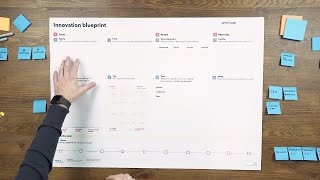
This content was created by Zaur AI. This content was uploaded by Zaur AI. This is a YouTube video titled "Innovation Blueprint" created on April 26, 2019, explaining the innovation blueprint by Vincent from Board of Innovation. The video discusses structuring key elements of innovation activities, including scope, people, resources, and action plans, using an innovation accelerator as an example.
Chapters
Hi, I'm Vincent from Board of Innovation, and in this video I'll explain the innovation blueprint. We've noticed that it's hard for innovation teams to structure the key elements of an innovation activity on one single tool. So people don't really know on how to compare one versus the other. So this tool will help you to ask the key questions and identify the key elements for the right innovation activity or program. The tool basically contains four key elements. The scope of your innovation activity, the people who will run the activity, the resources you need to do it, and finally the action plan to make it happen. I'll dive into the different questions, basically nine simple questions in a second. And I'll do that by using a general example of an innovation accelerator. So in order to shape the focus of that accelerator, you need to ask nine questions. The first question, a part of the scope of the innovation blueprint is the results. What do you expect as results from the innovation accelerator? In this case, it could be the launch of new ventures or the return on investment on these innovation activities within the next three years. The second question you should ask yourself is, what horizon of innovation do we focus upon? Is it incremental, adjacent or radical innovation? We could say that in this case it's Horizon 2 innovation, or where we focus on adjacent markets but radically new offers. Then we need to set out clear KPIs. A general example of KPIs could be the amount of ventures you launch or the amount of customers each of the ventures has. The final element of the scope of the innovation activity is the type of innovation. In this case, we're talking about an internal accelerator. So it's good to mark it out on the innovation matrix. Next up is the people who will run these activities. It's clear to identify clear roles on who does what in the coordination of an activity. So what we do here is we identify first what is the operating model. And there's four types. You could have a disconnected activity, an internal activity, a separated activity, or an integrated activity. In this case, we're talking about a separated activity because it's connected to a certain business unit, but it's positioned slightly outside of the core business. So that's why we say it's a separated business outside of the core. The next question is the team who will run it. There's three sorts. The first one is the sponsor who pays for it. Then you have the lead or the owner of the program. And finally the team. The starting point is the sponsor who pays the activity. It could be the CEO The CIO or whomever that owns the budget. Then we have the person who runs the program. This is or could be the innovation manager. And finally we have the team that will execute and work on the innovation accelerator on a day to day business. And there we have venture leads that can do this. Next up is the resources, the resources you need to make the accelerator into a success. The first question is what funding do you need? How much budget do you need to run this accelerator? You could say that, for example, a budget of about 100k per startup would do the job to be able to help them out and move forward. The next question is what assets should you provide to the accelerator? And very often an innovation lab or creative space on which these internal ventures can work will help as well. Final stop is the action plan. How do you turn this into actions? So you need to have a clear structure on what steps each venture will go through. So in an internal accelerator you start with a launch. So a kickoff moment where all teams come together and get a clear playbook and roadmap for the coming months. Then we have the next step which is the problem fit. The teams need to show what problems they've solved for specific customers. In the next gate you have the solution fit teams need to clarify what solution they've came up with to solve those specific problems to then end up with a shark tank. An investment pitch towards the sponsor and the owner of the program to get investment to continue to the next phase. That next phase is generally market fit or market validation. This is a summary of the innovation blueprint. I'm sure it will help you out to structure each element of the activities. If you have any questions, feel free to reach out. Make sure to download the tool on our website or boardofinnovation.com tools and you'll definitely find more interesting stuff regarding innovation strategy and others on the website. So if you have any further questions, feel free to reach out and I'll be happy to help. Bye.