Innovation Insiders podcast ep. 2 - Nespresso: coffee as a force for good
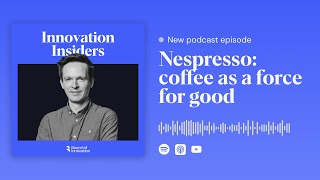
Transcript of an Innovation Insiders podcast episode interviewing Stefan Simersna (Global Innovation & Insights, Nespresso). Conversation covers: how Nespresso runs innovation (test concepts in executional context, balance novelty vs. consumer overload, own product+channels), regional prioritization and consumer segmentation, Nespresso's history and platform differences (Original vs. Vertuo, carafe capability), current pilots and cautious adoption of AI (verbatim analysis, translation/dubbing, ideation support), and sustainability efforts (AAA farmer program, B Corp certification, paper compostable capsule pilot in France/Switzerland). Practical advice: stay connected to consumers and use human+AI collaboration.
Chapters
Welcome to Innovation Insiders. In this podcast, we offer a peek behind the curtains of some of the world's most ambitious businesses. We'll dive into the heart of innovation and AI in about 20 minutes, we'll cover some of the strategies and stories that drive these industry giants forward. I'm your host, Vincent. I'm here with Stefan Simersna. Stefan is a part of the global innovation and insights team at Nespresso. He has more than a decade of experience at Nestle and Nespresso and he's truly passionate about coffee. And yeah, curious to know, is there anything that I forgot to mention? No.
Thank you, Vincent, for having me on this podcast. I'm very pleased to have this chat with you. Yeah, you said it. I mean, I'm very passionate about the category I'm working in, trying to be as knowledgeable about the coffee in general. The coffee category have the chance to be surrounded by one of the leading coffee experts. You know, in the category, we have an amazing expertise internally at Nespresso with truly passionate people around coffee. So people that have like a roaster in their garage and they roast for leisure during the weekend and they will tell you on Monday how it was like roasting their own beans in their garage. So we have this type of crazy people that are really bringing you into their world. And I had the chance to pass a few certifications around barista, being a barista dealing with different type of coffee machines. So, yeah, I'm very passionate about the category I'm in.
Awesome. I'm jealous on those roasting machines. You've been in innovation for many years and you've seen many teams and leaders. You're likely seeing some challenges down the road as well. I'm curious to know what would be your advice to innovation leaders.
Yeah, so it's interesting because, I mean, it's been a bit of a journey, I think also for us in terms of how we make our innovation happen. And I think if you're making innovation in a very well defined executional journey, I would not say it's easy. But you don't have to bother too much about the execution because you know how things will be executed. I think the difficult part we've been seeing over the past years trying to bring another level of innovation also to our customers is how we make sure that even when we test concepts, we are already thinking about how it will be communicated and executed also on our different channels. For consumers, it's an advantage, advantage, I would say, to be a D2C or direct to consumer company. Because obviously we control our own channels and we can decide, you know, how we want to expose, communicate our innovations to consumers. But there's also a challenge in terms of putting everyone on the table and making sure that, yeah, even when we work on the innovation, we make sure that we make space and we will communicate in the right way to our consumers. So that's something we've been very, very much focused on in the past two is making sure that we test as much as we can our innovation in context, making sure that we already inject elements of execution, be it on the communication side or even how it will appear on our PLP coffee page in our boutiques, so that we learn actually already at this stage of the concept phase on how it will be executed. And actually it will help us also define how much we can execute it. Well, because there's a challenge here. There's one part about having a super nice and appealing concept that will tick all the boxes in terms of concepts, success that we know in terms of uniqueness, purchase intents, appeal, those type of things. But there's something that we need to anticipate in terms of, okay, but if things are executed in this way, will it still be appealing to you? And that's quite often this part that we miss when we are at a certain stage for the innovation pipeline.
Yeah, you said many interesting things. On one hand, making sure that it's appealing to the customers is extremely important. Of course. And actually, what you mentioned on the idea that you own both the product and the channel is a very unique position which allows you to do a lot of. A lot of things that others can't. But it does also actually imply that there might be more complexities and you need to think through much more than potentially others that would just sell through retailers, etc.
So one challenge, for instance, that we have is that since we are very passionate coffee people, we always want to bring more and more new varieties to our consumers because there's so much to bring in terms of different profiles, taste, profile, varieties, flavored in the category. But we know that there's a certain limit to which we can bring all those novelties to our channels. And this is always a kind of tension, I would say, that we have between bringing a lot of new products to excite our consumers, but being mindful that we cannot come with five new coffees at the same time for our consumers, because they also need to get used to those new coffees.
Yeah, of course. And is that in general something you see, that there's a Big difference between being a leader in a space versus when you would be like a challenger. In the past, Nespresso was a challenger that really came up with a disruptive new idea. Today you're really a leader in the market. Do you see any difference with dealing with innovation in that sense?
Yeah, so it's true that I was not there actually at the time, but when Nespresso arrived, I would say it arrived in 1986. Actually the company was founded in 1986. We tend to forget about that because we think it's still a very new company. But you know, 1996 was the first time that Eric Favre launched the first Nespresso machine. And I would say the company really took off in the early 2000 years. Really at the beginning, 2000, 2001 was really the growth of the company. And it really disrupt, I would say, the way people were making coffee at home. Suddenly you could have a very qualitative cup of coff in a very convenient way at the touch of a button, pressing one button and then you got the quality that you had out of home suddenly at home. So it was indeed very much disruptive. And I would say that at the time the idea was more to make this innovation more available to more people. And it was basically having this espresso quality available to more people in the world. Then as the system was growing and penetration and more and more people added at the idea was also how we target different needs also in the category and we can bring also novelties excitements to consumer on this base of having what defines the Nespresso system and what are the benefits of the Nespresso system? Again, taste, consistent quality, convenience, design, many elements, but still being on trends and be able to capture what are the new ways of drinking coffee for people and you know, drinking, making recipes with different type of milks. So dairy meals, but obviously non dairy milk is a big trend in our category. Flavored coffees is also something very big that we've been investing a lot in, especially on our virtuous system. Different ways also of drinking coffee from again where we were born, very short espresso coffee. Very close to the Italian way of drinking coffee. Where the inspiration actually came to the founder of Nespresso when he and his wife, who was Italian, actually were in Rome. And he wanted to bring this Italian quality to more people in terms of espresso making at home. But now with the Vertuo system, we have something also that enables people to make much more different coffee sizes up to a carafe. I Mean, with the Vertuo system today you can make a shareable carafe at home with just one capsule. So we really try to push and extend in different ways of preparing coffee, be it in terms of sizes, but also in terms of ingredients that you add to your coffee.
Yeah, that's it. We have a virtual here at the office and it's something that I love. The carafe is actually definitely something that I really enjoy myself as well.
Still quite unknown by consumers, but try it out and you'll see it's quite amazing.
Just like the barista coffee, the frother is actually something that I really love as well. But besides from that, I think you've mentioned so many things that Nespresso could do. But I think a big challenge is also in prioritizing what to do. So what do you believe are the most important factors to prioritize innovation initiatives when you have so many options in front of you?
Yeah, that's true. So I think there are two things that we have to take into account is, I mean, what needs to be there for our biggest markets and I mean today for Nespresso, beyond big European markets, big coffee markets in Europe, like France, Germany, Italy, Spain, the big traditional coffee market. We have also a lot of opportunities in the US where we've been a challenger. Actually, back to your previous question, I mean, we been challenging our biggest competitor there. So it's also how you grow there and you make things that are relevant also for people in the US or in Canada, let's say North America. And also coffee also in Asia is a different game. Last year we've seen that. It was the first year actually in our UNA SO Usage and Attitude survey that cold coffee was becoming the dominant way of drinking coffee in Korea, for instance, and it's the first market globally where cold coffee, you know, surpace, you say in English, hot coffee. So definitely a big challenge also for us in how we answer to consumer needs there and how we prioritize innovation that makes sense for consumers there. So, yeah, how you create, there's a lot of opportunities. I would say, to your point, coffee is a very dynamic category. So there's a lot of of things we could do then how you prioritize. I think you need to be true to your ambition as a brand, how you want to be positioned, but where you want to bring your brand, and if you use that lens, it should help selecting what should be your priority. Then obviously it's your ambition. I mean, where do you want to go as a brand on which part of the business you want to focus on. And then I think you have a certain, you have to check what type of of profiles of coffee drinkers you're going to attract and be true to that type of coffee drinker targets that you want to be after in terms of needs and potential new ways of drinking coffee. And that should help you also determine on which type of innovation you want to focus on.
Yeah, no, that's super important. Both from a segmentation and a regional standpoint, understanding where you take inspiration from and who you're targeting as the end customer is super important. On that note, actually, the other day I saw you experimenting with live dubbing of Korean interviews with AI. Super nice to see that. And how much do you use AI for innovation today?
Actually, that's a good question. I think we are all in our basement those days piloting AI as much as we can as soon as there's a new release trying to use it and pilots trial and error a lot with the tool. So I think when we started the innovation process for the year, there was kind of no AI application. And as the year was passing by, we had many, many opportunities to pilot different usage of AI. So there's still a lot that we are trying to learn on what can AI bring to the innovation process at this stage, I would say, and that's, I mean what you read more and more around how to interact with AI is that it's your super clever intern in terms of how you need to talk to him or her. I don't know what we should say or to it. But yeah, so for me it's like a very clever intern that you can use to help you on some tasks. Obviously I think in terms of analysis of verbatim teams, the more the tool will be able to digest a bigger volume of verbatims that we can collect through surveys. It will be amazing at consolidating different theme subjects that are the most present in your verbatims that you collect. And I would say yeah, there's a lot to do around AI. I have to say I'm still cautious, I would say in terms of how much it can bring to creativity by itself. I think it's a nice partner to foster your creativity, but I don't think you should expect the tool to just be creative by itself and come up with very creative concepts. I think we still have some space as human to be around and to guide the tool in the right way. You can try, but if you ask the tool to just generate super creative concept out of the blue it won't bring you something that creative right now. So yeah, I think there are a lot of things we can do again around translating, dealing with high volume, being a coach, I use it on a daily basis just in terms of coaching advice. I'm doing this, what would you do if you were me? And yeah, it keeps fueling you with new ideas. So I think in that sense it's helpful for the innovation. But yeah, I mean, probably we still don't know how we will use it next year if you ask me. How do you plan to use it next year? Probably we don't know. And as a team, as a CMI team also, we try to, yeah, every day we try to ping pong, you know, what have you seen, what have you used, have you used the tool? What were the prompts that you've used? We try to also train ourselves to be like a prompt engineer for what it means, but prompt expert. So yeah, I think you have to keep training yourself and be very open, very curious on a daily basis and grabs any opportunity to pilot the tool and see if it can be beneficial to any of the innovation stages.
Exactly. You said it very well. It's like human plus AI. So it's not either or. And you started with the idea of like it's your intern, it can help us forward. But I love that you also mentioned that it's also the other way around that you use it to get some advice and to get some perspectives. So it's also helping us to potentially be better at what we do and to potentially better understand our customers. So no, I love that. Maybe switching gears to another topic of sustainability. I think we're both very passionate about sustainability and coffee of course, but you're even certified as a B Corp leader. And I think Nespresso also recently launched its compostable capsules and is working a lot on its sustainability. Curious to get your perspective on sustainability and sustainability at Nespresso.
Yeah, so sustainability has always been a very big topic at Nespresso. I mean since I joined, it's been a very big focus, at least internally in terms of how people are aware about what we do in the fields. The big program we've put in place years ago, which is called the AAA program, which is actually recognized by all our peers in the coffee industry as one of the most advanced coffee program that any company has in terms of working with farmers, the agronomists we have in the field, the long term relationship we have with more than 100,000 farmers that have been continuously working with Nespresso also for the quality of the relationship we had with them, but also because we pay a premium in the category that is not quite often discussed. But actually the price premium that you pay also for an espresso capsule is also justified by the price premium that is paid in the end to farmers. So there's been a very long term program in place. And having worked also a lot around sustainability at Nespresso, I was able to work with also very passionate people. You know, on top of the one I was mentioning before roasting, we also have people that are very passionate about, you know, being on the field, working with farmers and how you. Because that's also where most of the differentiation is happening. I mean, how much you are able to get qualitative coffee beans and how much it impacts the taste, you know, that you will get to consumers in the end. So we've invested a lot also because we knew that this is where we could make a difference and bring this consistent quality to our consumers. So I was able to work with a lot of people around where sustainability is going, what we should do. And I was actually part of the group that brought on a regular basis the topic of B Corp and B Corp certification. So I was very happy that at some point we got traction also internally and also from the management to become a B Corp certified company, also as a way to assess and testify, you know, about a lot of great efforts we've been putting in place over the years. So it's a bit of the symbol of all these efforts that we've been doing. So that's more on the B Corp side. And yeah, there's, I mean, to exemplify, I would say, the fact that I was truly believing in the power of being a B Corp. I did some B Corp leader certification which was amazing in terms of experience. So that's more on the B Corp side. And obviously we've launched, as you've mentioned, the paper compostable capsule recently in France and Switzerland, which was a big project. Actually it's been a three year project that we initiated doing a lot of research around what does it mean to bring actually a brand new material and a brand new experience also for consumers. Moving. It's a kind of evolution also because that's what we've been seeing is that you want to give more choices to people in terms of type of capsules they want to use with their machine. So you still have a lot of people that know the benefits of aluminum, how much it can preserve your coffee, the aesthetic also to A certain point that it brings to your kitchen, the fact that it's also a colorful product that brings also this more lifestyle part to your coffee experience. And again, how much it can really well protect your coffee. But we know that in terms of end of life, a lot of people wanted an alternative at some point to aluminium because we know that we've put in place the recycling program and there's many now opportunities for nespresso consumers to recycle their aluminum capsule. But still we knew that some people, maybe it was too big effort for them to use the recycling bin. So that's why we've been working a lot to find another way for people to deal with the end of life of their capsule. And that's where the compostable capsule I think can play a role, offering for some an easier way of disposing their capsule with their own compost. Compost. So actually now I'm using both at home. I have the Vertuo system for my big cups in the morning and for all my espresso, I have an original machine with paper capsule. And yeah, it's great to be able to balance a bit between the two system depending on the occasions.
I love it. Awesome. Well, I think we're near the end of this episode, so maybe I'd love to end with a question on what is your one thing that you've learned in your experience and your journey in innovation that you might want to share with other innovation leaders?
Yeah, so I think there's a lot of connection and regular connection you can make with consumers that are very valuable to your innovation journey. So don't be afraid to challenge your ideas. Confront with confront. You see, maybe confronting is not the right word, but get in touch with consumers at a lot of stages during the innovation process because that's where you will make sure that you're still answering to the right, right needs, issues, pain points, jobs to be done for consumers and not being a bit in your golden tower and trying to make up for yourself what you're trying to solve as an issue. I've seen that a lot in some innovation processes where you go to an innovation brainstorming session and there's a lot of super shiny PowerPoints and billboards around trends, understands where consumers are going. But there's nothing that will replace interacting live with consumers, empathizing with consumers, getting real connections, hearing consumers and really trying to grasp what you're trying to bring to them and what's the added value you are trying to bring to them with your innovation. So really those connects. Being in touch with consumers I think is something that we kind of tend to forget sometimes because of a certain process that doesn't allow us to really get in touch with them. And really when I mean getting in touch is not just having an ID screener with a big panel that you will not know, but I mean really getting in touch. Meeting them, hearing them, seeing them, I think is key in your innovation process because the story and the the learnings and how you will infuse, if I can say the learnings and make them yours will be much more powerful than any type of trend presentation report that you can read. So I would really encourage people to do that.
Awesome. Thanks so much Stefan.
Thank you.
Really enjoyed this conversation and definitely see you soon. Thank you for tuning into another episode of Innovation Insiders. We hope today's conversation sparks your ambition to push the boundaries of what's possible. This podcast is an initiative of Board of Innovation. If you enjoyed today's episode, don't forget to subscribe, rate or leave a review. Your feedback keeps us inspired and motivated to bring you more insights. Sites.
More from Zaur






An Immersive Workshop to Calculate the ROI of AI Strategy - AUTONOMOUS session

Predict, Optimize, Decide: Enterprise Decision Making For The Simulation Era - AUTONOMOUS summit


AI Insiders podcast ep. 9 - Not so cookie-cutter: Consumer Choices in the Age of AI

