Innovation Insiders podcast ep. 3 - Innovation, AI, and the Power of Asking the Right Questions
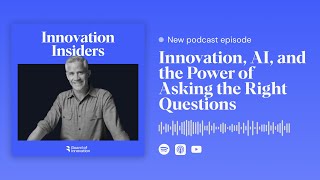
Podcast conversation (Innovation Insiders, recorded March 6, 2024) between Vincent and Sean McDowell (SVP of Innovation at Herman Miller) about Sean’s career in industrial design, how design and innovation function inside corporations, the role and risks of AI in design, team composition, and the value of setting audacious goals (BHAGs) illustrated by Nike’s project to break the two‑hour marathon. Emphasis on asking the right questions, consumer‑centric research, diverse teams, and using AI as a tool that amplifies ideation but requires human judgment.
Chapters
Welcome to Innovation Insiders. I'm here with Sean McDowell. Sean's the SVP of Innovation at Herman Miller. He's previously been Creative Director at Nike for more than 20 years as a VP of Running and VP of Design, Innovation and Sustainability for Commverse. He's been the Creative Director of the Olympic Games in Beijing and has received over 50 US design patents. And just like me, he's an industrial designer. I'm excited to have you here, Sean Vincent.
Thanks for having me. Yeah, really excited to be here and talk a little bit about innovation, process and artificial intelligence. Awesome.
Let's maybe begin where it all started. You graduated as an industrial designer at Carnegie Mellon University. How has this shaped this throughout your career in life?
Yeah, I absolutely loved my education at Carnegie Mellon. I studied industrial design. I had a minor in psychology, and I think when I look back, it really gave me a strong foundation in problem solving. That was sort of the number one thing. And I think I've used that sort of for my whole career of just asking the right questions, trying to be very consumer centric, make sure that we're solving the right problems and getting to good solutions. Awesome.
And how do you think the role of design and innovation inside corporates has changed over time?
Yeah, I think it's been amazing to sort of see it over the last 30 years, both in the corporate side as well as on the consulting side. I started my career as a consultant for Daedalus Design and the last four years I've done consulting. And I think what consulting does is it brings you that fresh perspective. And most corporate environments have sort of brought design and innovation in house. So you get up the learning curve very quickly and you get quick answers, but maybe you lose that fresh perspective sometimes. And so I think a combination of corporate designers as well as consultancies helps get you the best results.
Awesome. And what do you think actually sets companies apart when it comes to design and innovation?
I think what I've noticed the most is the culture itself. You know, there are some cultures like Nike and Apple that were sort of built on innovation and it's baked into the DNA. And almost everybody who comes and works there wants to push the boundaries. And then there are other companies Maybe that are 100 years old, and it's a little bit harder to get that breakthrough innovation. You just naturally get more conservative over time. And so it's a bigger lift to try and get those really new innovative ideas.
Yeah, and I like that. I think the culture and DNA of an organization really makes or breaks innovation and you can see that in the end product, but also when you look at the internal culture of a company, and we've been talking about AI innovation the other day, and what do you see as potential? The biggest risks when it comes down to AI?
Yeah, risks, but also maybe the potential as well. I mean, I think the way I look at it is it's another tool in the toolbox, and it's actually a very powerful tool. It's still in its infancy, so we're still sort of learning how we want to use it. Of course, there are a lot of risks, especially on the design and innovation side, because AI is going out and sort of patrolling the world. If you're not careful, it can be picking up things and giving you things that are either incorrect answers or stealing from someone else's body of work. And that's probably my biggest fear, is that it's doing the wrong things for us. But if you use it wisely, I think it's a powerful tool.
Awesome. And what have you seen to be the most useful use case thus far when you think about AI and how have you used it most successfully?
Yeah, I mean, it certainly helps with some of the language programs are pretty amazing right now. So a chatgpt can help with writing a contract or getting the right language that you want together pretty quickly and efficiently. So that saves a lot of time for a designer like me that doesn't spend their life inside of the contract world. I'm also on the creative side. I think we're doing a pretty good job of looking at AI and seeing what it can provide for us. Somebody drew this analogy for me the other day, and I absolutely love it. Having AI is like having 100 interns. If you give them really clear direction, they can actually come through for you. But if you're not giving them clear direction, they will run and they will come back. And sometimes those answers will come back correct, and sometimes those answers will come back incorrect. It's like an intern who's just not that knowledgeable yet. So if you use it wisely, if you give it really crystal clear direction, you can get some great results.
Awesome. And you've hinted at this already, that actually it might require some sort of an organizational change. And maybe based on that, how do you think companies and innovation teams should organize themselves to maximize the use or.
The value of AI or even potentially governments? I mean, I think there are times that governments can come in and actually help with some of the tools and mechanisms for some of those corporate governances. Certainly on everyone's biggest fear. Who's watched a science fiction movie of AI taking over the planet. I think they could actually help us with some of those things. But I think when it comes to internal, we use it sometimes in just a brainstorming creative session, because those hundred interns, they can pump out a lot of interesting ideas. Some of them are trashy ideas and some are really good ideas. But you use that as sort of a springboard to then help your design team either think differently or get new insights.
Okay. So in some way you provide it with direction, then it does the heavy lift of coming up with ideas, and then afterwards, you use the human brain power again to evaluate those results.
That's right. And you'll have to go into all of the technical drawings and specifications and things that AI is not great at today in some cases, but then also your brand language and your visual and what do you want to do and how do you hit the price point? All of those things, I think, are better done by the design team.
Okay. And maybe building on that.
How do.
You see the new role of a designer or the innovation team, knowing that the innovation process has changed?
Yeah. From my perspective, a lot will still be the same. Start with the consumer, do a lot of heavy lifting and interviews. AI can sometimes help with a larger reach, connecting with more consumers potentially. But I think that's a really critical part. And I would never give up something like a focus group where you and I would be talking about a problem that you might be having and those pain points and how we can come up with solutions for you that me is the most critical, then that can give you sort of a template for how to ask those questions to AI. And so some of that upfront work, but then all of the engineering and processing and development and manufacturing, all of that sort of stays pretty much the same as what we had before.
Okay. And maybe if we would look ahead at five to 10 years from now, where would you see the future of innovation? What things will have changed the most, and maybe things that might have been impacted by AI, but maybe other forces as well. Curious to know your perspective. Right.
And when I look back, sort of over this 35 year journey of me being a designer, I think just really the speed has increased and computer power has given us the ability to increase that speed. Everything was sort of sketched by hand and talked about with individuals. Now, you know, I did, when I was consulting, I did a focus group with. It was a sailing product and we were trying to make improvements there. And I was able to work with the world's best sailors from across the world. So people from New Zealand and Australia were calling into this zoom call. People from Brazil and Greece, you know, excellent sailors from all around the world were able to come in to have one virtual, you know, two hour focus group meeting that never would have happened before. And so the ability to reach, just because of the computing power is much better than me going down to my local sailing club and talking to some folks there.
Yeah, absolutely. I love that how, in a way, AI is helping to save time on certain parts so you can spend more time on maybe the human aspects, the empathy building and a thorough understanding of a challenge.
Right, exactly right, exactly right. That's why I kind of don't think creative direction or necessarily design is going to change that much. You still really need that part, somebody who's very good at curating, giving that direction and then still sort of building that product. But we'll have to sort of see how technology changes. I've been amazed with how fast it's moving.
Okay, maybe on the design side and on the innovation team side, what are the characteristics of folks that you'd be looking for when you're shaping a team in that new setup that you have? In the innovation landscape used by AI, how do you look at team members and what are you looking for in profiles?
Well, the first thing that I look for is strong, diverse teams. I've found over the years, when you have people that have different worldviews, different opinions, boy, you have the best, most robust conversations. Right? You know, someone's from Europe, someone's from South America, someone's from Korea. You mix everybody together. They all have grown up with a different perspective. So now they're asking different, unique questions from different angles.
And.
And you get some of the best results. And so I think that that is only going to kind of continue to expand.
You have a pretty international background as well, right from the career all over the world and the Beijing Olympics. So curious to know more on how that potentially has shaped your career as well.
Yeah, I was born in Tokyo, Japan, which was a really great experience for me. I lived there for a while. So in many ways I was an outlier. I was a minority. I was somebody who didn't fit in with the rest of the class. And then, yeah, grew up in upstate New York and spent time in Pittsburgh, spent time on the West Coast. The Olympics in Beijing was incredible. And so that was sort of a three year journey of getting to know athletes from all over the world. 208 countries for all 28 sports. And that was absolutely incredible foundation of listening to the world. And you had a really clear mandate, which was win gold medals, which, if you can get a design problem that is that crystal clear, you're going to. You're going to come up with some great results.
It's amazing how such an ambition can shape a product strategy. How you have to. It's not easy to take such a big ambition and turn that into a product category. Um, yeah. Curious to know maybe on. If you're looking at the. Yeah, there's a lot of future designers, future innovation executives as well that work in large organizations. What would be your. Your advice based on all the learnings that you have compiled over the years?
Yeah, I would say keep asking questions. I. I think that that becomes really one of the best things that you can do. Keep that growth mindset, ask a lot of questions, bring your passion and heart and energy and excitement to the table every day, but be open that you might be right, you might be wrong, and that curiosity leads to some of the best solutions. I'll tell you by some of the mistakes that I've made over the years where I'm locked in and I'm positive that I am 100% right and I don't listen to anybody and I force something through. Those are the projects that have not worked at all. The ones that have worked the best is when you're listening to all voices in the room and you're really trying to improve every single angle that they're bringing to the table. That's when it works.
I really like that. What are you doing to create such an environment for the people inside the organization?
Well, one, I like to set the tone myself, so I follow this Socratic method of asking questions to the team, and it really is a discussion and a dialogue, you know, and part of it is me having that growth mindset too. Like, I'm not an expert in what you are doing. So help me become an expert. You know, that curiosity. Both of my parents were teachers, they were professors. And so this continuous learning has sort of been ingrained in me in a really long time. And by asking those questions, you unearth really unique solutions. And I think that that's what's led to a lot of these patents over the years, is because you're able to come up with novel solutions or unique solutions because you're curious.
Sean, in a previous conversation, you've mentioned that setting a big, hairy, audacious goal is definitely something that you see as a centerpiece for success. Could you Tell me a little more about that.
Yeah, I think it's one of the hardest things for companies to do, but if you can do it, it's amazing. When I was in Nike running, we did this. We were coming up to an innovation review and we had to have a breakthrough. So our team got around and said, let's set one of these bhags big, hairy, audacious goals. What would that be? And we decided that we wanted to try and break the two hour marathon by setting a crystal clear target like that. It started to change all of our innovation approach. You could get 40 or 50 people on board to that same vision and you start to come up with questions that are different. Instead of trying to sell the most popular shoe in the world, you start with no. We're trying to help Illud Kipchoge break two hours. What is an energy return system look like? How can you give him 11% energy return? The world record at the time was 2 hours, 2 minutes, 38 seconds. So we're like within striking distance. If you had a 4% improvement, you would get it. All right, so now how do I get 4% improvement? 4% improvement is actually a quarter inch per stride. That's not that bad. That's not that hard. So what energy return system would get me a quarter inch? All right, we have a new foam. It's really expensive, it's hard to use, but it's bouncy and it gives you great energy return. Well, our goal is to set the two hour marathon, not worry about price. So now we're going to create something. Maybe you put a carbon fiber plate into that throws you forward a little bit more, maybe use a little bit more aerodynamics. Maybe you start to set up an event where you're breaking wind for Iliud Kipchoge, so he's got some pacers helping him with that race. Maybe you have a Tesla that's projecting a green line on the ground in front of him. That is exactly two hours. So he is getting constant feedback on how am I doing? Am I on track? By doing all of that, we came up with the vaporfly, which wound up being one of the most successful programs we'd ever done in Nike running. And we changed sort of our marathons from we were about number eight in marathon placements. We went to number one just with that one program.
This is so impressive that you can set such a goal and then really drive the motivation. Let's really make everything happen in order to achieve that. So super inspiring.
Yeah, big hairy audacious goal and then break it down into digestible chunks so that you can solve each one of those things. All of those steps add up to a thousand mile journey.
I think everybody still remembers that moment when he achieved the world record. So it's amazing to see all the effort that's going into in the background as well to make this happen. Amazing. I love that and I'm definitely going to take that with me and would love to definitely thank you for the amazing conversation that we had. It's really good to get a view on how you deal with innovation and all the amazing things that you've made happen and looking forward to continuing the conversation.
No, it sounds great. Yeah, Vincent, thanks so much for having me on. I know last time you had asked me to like looking back on my career, what would maybe some of those final pieces of advice be? And my number one thing would be try and enjoy life as much as you can. You know, enjoy the journey. This is a fun job. What we get to do every day. You know, designing is pretty incredible. You get to change people's lives for the better. And I wish I could go back and just tell myself that everything's gonna be okay, it's gonna work out, you're gonna be successful, you're gonna have some hits, you're gonna have some misses. It's not the end of the world if something doesn't connect. But if you bring your part and you bring your passion every day and you try your hardest, really good things are going to happen.
Amazing. I love that. Thanks so much and really look forward to following your journey ahead.
Yeah, thanks, Vincent. We'll talk to you more soon.
Thank you for tuning into another episode of Innovation Insiders. We hope today's conversation sparks your ambition to push the boundaries of what's possible. This podcast is an initiative of Board of Innovation. If you enjoyed today's episode, don't forget to subscribe, rate or leave a review. Your feedback keeps us inspired and motivated to bring you more insights.
More from Zaur






An Immersive Workshop to Calculate the ROI of AI Strategy - AUTONOMOUS session

Predict, Optimize, Decide: Enterprise Decision Making For The Simulation Era - AUTONOMOUS summit


AI Insiders podcast ep. 9 - Not so cookie-cutter: Consumer Choices in the Age of AI

