Innovation Insiders podcast ep. 4 - Ulrike Tagscherer: Redefining Robotics at KUKA
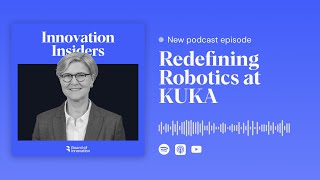
Podcast interview (Innovation Insiders ep.4) with Ulrike Tagscherer, KUKA's Chief Innovation Officer. Ulrike describes her path from Fraunhofer research and business development to innovation roles at KUKA, emphasizing the need for separate 'explore' and 'exploit' spaces in large corporations, the importance of psychological safety, and transparent communication when stopping projects. She discusses AI's accelerating role in robotics (no-code robotics, software-hardware integration), expects more mobile and widely-deployed robotic systems, and highlights regional differences learned in China—particularly faster testing and business-model-focused innovation. Ulrike also stresses diversity's positive effect on innovation, leadership adaptability across cultures, and KUKA's push for circularity by requiring sustainability considerations in innovation projects. She closes with advice for innovators: choose supportive culture, find like-minded peers, and never stop learning.
Chapters
Welcome to Innovation Insiders. I'm here with Ulrike Teicherer. She's the Chief Innovation Officer at Kuka, a global leader in robotics and automation. In her role, she spearheads the development of innovation solutions beyond the core business of Kuka. And with her extensive experience, she plays a pivotal role in guiding Kuka through the future of automation. Thanks for joining this episode. Ulrike, I'm curious to know, how did you come to this role as CIO at Kuka?
Thank you, Vincent. Thank you for the invitation first and I'm happy to talk. So I started my innovation journey very early in my career, but more from a practical side without even realizing how much I learned. I think because I started as a business development manager for all Asian countries for Fraunhofer Society in Germany. And some people might know Fraunhofer, not everybody. This is Europe's leading organization for applied research. So they do collaborate with industry and they are responsible in Germany to bring new technologies into the market. So find potential customers who then commercialize the technologies they develop. So I, I became an expert basically in innovation and technology transfer, but also about what people need to be innovative. So I did abt for quite a while and then I entered the space of innovation research. I joined one of the Fraunhofer Institutes for Systems and Innovation Research and became an innovation researcher. And that was just, it was mind blowing because I suddenly could connect so many things, the theory and the practice. I had both experiences. Yeah. So I did that for seven years and I did it in China. So I became an expert on the Chinese innovation system as well, which was an intriguing time. China developing really fast, really quick. And then when I returned I was spearheading a department for Business Model Innovation and from there I really wanted to go out and work in industry. And this is then how I found my role at Kuka.
Amazing. Yeah. It's such a front running industry, the robotics and automation space. So I can't imagine what you're all dealing with. I think as that cio, you're leading the global development of the innovation portfolio. It's mostly focused on non core business for Kuka. Could you share a little more about some of the most significant challenges potentially you faced in developing and managing an innovation portfolio like this?
Yeah, I think one of the biggest challenges is to have a space where things are different. I mean, if you work for such, I think for all large corporations, they have become large because they can deliver pretty well. So they're very focused on today, on serving their customers, delivering best in Class products and solutions. And very often I see that there is not much space for the new stuff. And people have the tendency to measure the new things, the new ideas with the same KPIs or measurements. They measure the running business. And so I was probably the first challenge we had to overcome that we had to create that space and that I think a general understanding across the whole organization that as a company we need both spaces. And in the past I think we are really successful because we started small too at one point of time and there was just a lot of great people. But once you pack everything in that delivery mode, of course then there's not much space left for these kind of people that we still had. So everything I think started with transparent communication about the projects, about the state, about what we do, what we don't do, why we do, why we don't do it. And I remember actually the calls I got when we first published in the company Wide Net that we had stopped an innovation project. So people would really, they wouldn't talk to me about ideas or anything, but they would pick up the phone telling me that this was absolutely wrong and it was the wrong message. And a proud company like ours can't admit that we stopped something, but that gave us the chance to talk about it. So there was a start of a communication that we had. And so that's ongoing. I think that's a challenge you always have. But we also train a lot of people. We train our leaders, we train our employees, and we train all the innovation teams in understanding that difference. And we have used explore and exploit. I mean there are many, many ways to categorize innovation. But for us that proved to be the best way that people can remember. They can. I guess most people, you can now ask is this for explore or for exploit? And explore is the non core business. Right? And so they can, okay, yeah, I understand that belongs here or it belongs there. So it helps being clear on what you're trying to achieve and what you're not trying to achieve. And then let's say what we do, what we learned over the years now is that probably the biggest, the most important challenge you have to overcome is psychological safety. Whatever you do, whatever you communicate, whatever you do in beautiful spaces or whatever, it won't work if you don't have a culture where people feel safe to try out that new stuff. So now we spend more time in figuring out how to create that safe space for people and also train again here the top management who are part of the decision making that they are conscious about the importance of that safe space. And it doesn't mean that we. I don't know, that we don't say or we are not clear. We are very clear and we still stop most of our projects, honestly, but we do it in a way that we don't harm that safe space.
And you highlight a very important thing, the idea of transformation, like new technologies, new innovations, it's all change. And therefore it's extremely important to provide that frame of reference for people. And I think building on that, I think AI is even accelerating that change. And especially given some of the latest releases of, for example, AI chips, specifically for the robotics industry, it's accelerating faster than ever before. And I'm curious to know on how you think that the, that the. How do you think that the future of robotics is changing, driven by AI?
I think that the change is really probably beyond our imagination or beyond the imagination of most people. There might be. I think all this topic of no code robotics. I think right now programming a robot is still something. People come to us for two weeks and learn how to do that. So right now you can't. The connection between the software and the hardware is still a challenge. And I think that there we will see a bigger change than people expect it ever before. But for me, sometimes it's because I don't have that glass bulb, you know, and say, this is where robotics is going to go. For me, it's far more important than to have a culture and to create an environment in the company where we can react to the changes, where we are lean, where we are fast, where we don't have to follow our standard quality checks for everything that we try out. I mean, once we deliver, yes, of course, but let's be fast and easy and lean in, trying out all these new things and then be ready to throw it away in six months because there's a new version and whatever comes along and to maintain that energy, that culture, that agility in the people without losing your quality in delivery. You know, we don't want to change that for sure, but we want to have people who are able to accept the change, to fall in love with that they don't know, basically.
Yeah, yeah, I think that's absolutely true. The idea of feeling comfortable with that change and therefore it gives you some comfort of delivering the quality that you're expected to deliver, but also be comfortable in that change is happening over and over again, maybe transitioning into that new space that we're going into. I think, as I've said, AI is really influencing our lives. And there's a lot of questions about this on where it's heading yet. What we see as well, and we've been talking about it for quite a bit as well, is that we're moving into a more autonomous world. But I'm very curious to get your perspective on how do you envision the future of human and robot collaboration, for.
Example, I think that a lot of boundaries that we still have, they will vanish. I believe that also probably the definition of a robot as having at least how many four X's that might, I think for companies like us that might be important, but for everybody out there, they call every automated moving system probably a robot in the future. And if, if you apply that broad vision, I'm pretty sure that I will far, there will be far more interaction between humans and machines in the future, I think there. And it might not start in Germany, so I guess there are other countries, cultures who are far more open to test and develop these things. But I'm pretty sure that we will see much, much more of that. And not only the, our industrial robots being, or our cobots being closer with the human. I think there will be many, many different types of systems that support humans. So I mean, there are a lot of dull, dangerous and dirty tasks that nobody wants to do. And sometimes they need to be able to be around other people. Sometimes, I don't know, they can do a dirty job, dangerous job during night. We wouldn't care about human robot collaboration. You know, the robot can run while we are not there, but in other cases that needs to be around humans without harming the human. But I truly believe so for me also these systems, they will become more mobile. They won't be.
What do you mean specifically with that?
Mobile in the sense of having wheels, of going around, being around you more than today. I mean, the majority of our robots today are bolted into the ground, they are stationary. And I think that is something that we definitely see because also our customers, they need more flexibility. They change their production much faster or will change their productions much faster than these days. So also the systems they use will be, need to be more flexible. And for that you probably don't want to bolt them to the ground anymore. But I also see, as I said, robots that probably don't even exist today or solutions, robotic solutions that we don't see that will be around us more often.
Yeah, you see a lot of the humanoid robots releases even this week, a lot of talk about that. But I fully agree that probably we haven't Seen yet what the future of robotics in automation will look like. Maybe a follow up question on what you've mentioned earlier on the regional differences. For example, I think you've lived for a long time in China. How has your global perspective changed your view on innovation? And do you see any differences globally? Globally based on your personal experiences living in China?
Yeah, I think I do. I kind of came to acknowledge that faster testing versus the German engineering way of thinking about innovation, mostly as technology in Germany, I mean, go out and talk about innovation and people, I guess 90% of them think about a new technology. And for me, innovation now is something new, whatever it is that you manage to sell successfully in the market. So it needs to be a business, not a technology. And the business needs to be new. If you have like electric cars, I mean, invention is very, very old. The innovation that they really get adopted into the market, that's just a few years old. So that difference, that was something where I found also my Chinese research colleagues, they were not so much holding on to only technology. They had a much broader view of on innovation. And also they were pretty, pretty good in business model innovation. So that's something I came, I really came to love in China during my time. Because sometimes you can use something that's there, but you sell it in a different way with a different value proposition or to a different customer, and you change more the business side of it than the technology side of it. And now I feel that I can play around with both. I don't care so much whether it's a new technology, new business model or a new process. Innovation. Let's look at it. Do we benefit from them? Do we have customers who need it? These are the questions that are relevant. But I think it changed my view on technology only.
Okay. And maybe expanding that to leadership in general. Do you. Does your approach to leadership differ across cultures or business contexts?
Let me think a little bit. I think, I assume I don't approach leadership differently. Seeing the person, seeing the human first and listening to the needs of a person I talk to, I think that remains similar no matter where I am, culturally or regionally. Also my attitude to be a servant leaders for people, for employees, to allow them to give the best to our company, to their work, that remains the same as well. If you then go down a little bit, I think the difference is a little more subtle. It's more about when to say or do what and how to do it. It's a little bit more, let's say what I say or don't. Say and how I say something, am I really blunt, direct, or do I pack the same information into a little bit more politeness or a different structure? That's definitely that I adjust according to where I or whether I feel that hierarchy is important or not. Also depends on the culture and the region where I am. And as I have led not only Chinese or German teams, but really teams from very, very different cultures, it has given me some understanding. But I still think that I'm still learning. And I usually try to look into the face of the person talk to or I deal with and if they look a little bit startled, I always ask did I do something, you know, that was that you did not like or expected? I heard your feelings and I learned that people are very open usually to help me understand what in their context was off or not. So I'm still learning here. I think that's, that's an ever everlasting task.
But I think even within that context, you've really acted as a change ambassador. On the topic of diversity, equality, inclusion. Has your personal leadership philosophy influenced your approach to innovation or organizational growth?
I'm not sure whether the understanding of the importance of diversity, equality and inclusion for innovation and organizational growth has influenced my personal leadership philosophy more than the other way around. Let me explain that a little bit. I think in my early career my leadership style was maybe more influenced by my own personal journey, but when I was working as an innovation researcher, I was fascinated by, by the fact that even on the national level, innovation results of diverse teams groups are so much better than of homogeneous people and groups that I had just like no way of not going into fostering diversity, inclusion and equity. And I think that's it. That was like the thing. Once you understand it and once you have the facts and the figures there, it's not about your personal feelings anymore, it's a fact. Now what do I do? I act upon it. So I feel it's more the other way around, to be honest.
Awesome. Great. Yeah, it's very inspiring. I think we've covered a lot about leadership, about the topic of technology changes in AI, but I think it's sustainability is obviously something that's really impacting everyone's lives as well. And I think you've been working on embedding sustainability or circularity in Kuka and how do you see that these things will change the industry of Kuka in the future?
I think you see behind me the ones who watch the we did run two years ago, we ran a large innovation challenge about circular economy that was globally. Every business segment of KUKA participated and that was like, it was like a nucleus of now a lot of different initiatives in different departments also going their own way. It's not everything ended up in the business innovation part, but it's also in the daily business. People are now far more aware about the topic. They come up with different new solutions. So that's one side. The other side is that we have actually made it mandatory for all our innovation projects to give an answer to circularity. So we have special sessions with the teams where they try and think about whatever they had in mind. Can we make it even more circular? Can we make it more sustainable? What would it need? What would it cost? It doesn't mean that we always implement the most circular version, but we spend time and effort and money and resources for trying to move forward here to be a front runner. Now you also asked about how will it change industry right now. What we often hear is that, that it's stronger at the consumer side. I have an example. We had an innovation project dealing with heat reuse from production and our team went out to other production companies, especially in Europe, and they came back, let's say, a little bit frustrated because the production people, they all said generally really interested. That's a great topic and one day we will have to deal with it. But right now I need to ensure that my production is running. We have the war, we have the chip crisis. So I'm just. Everything I need to focus on is make my production run. Come back later. And they then talked to sustainability people and they said, yeah, yeah, yeah, we love it. That's a great thing. Yeah, ye, we hear, yeah, but no budget. There won't be any budget, you know, to kind of then invest and buy something like that. So we ended up stopping that product as well. So in the B2B, I see a little bit of maybe sometimes also an overload, you know, the challenges. And if it's not really forced, then it's a topic people have to send back. Yet I do believe that this will be one of the game changers for companies. I think there is no way out. If we don't do it on our own, governments will probably force us even more than they do today. And I believe that we need innovation to solve the problems we have. I think, I'm pretty sure that we won't solve it in the same way that we created them. We will need new technologies, new ways of collaboration. We need new things. We need innovation in the end to solve it. And I believe that Those companies who are ahead, if it's only one step, it's enough. But you have to be ahead a little bit of the majority to win here. And I truly believe the ones who invest now and go into that direction, they will be doing this.
Great. Awesome. With that, I would love to transition. Maybe in the final question, do you have any advice for fellow innovators around there? What would you tell them?
My first advice for an innovator, not an innovation manager like me, but really a person who wants to, has the ideas and wants to create that new thing. I would really look for a company and an environment that has a good innovation culture because otherwise you might quickly burn out. I think that's an experience a lot of innovators have made. I just had a call last week with a person in a company who was invited to bring change, but nobody else in the company wants to change and he's like completely wasted. It's really sad. So I think that's something I would pay attention. Watch out. Whether the company can nurture your ideas at least for a bit, or if they want to kill it the moment your idea is voiced. That's something I would look for. The second thing I would look for is try to find like minded people in the place you are. If that's at work or outside work, I wouldn't mind. But find, try to find people who have the same fun with new stuff, who like that phase where you don't know exactly what the outcome will be, who can deal with that insecurity or with the risk that's involved in innovation. Because I think that mutual support and seeing that others have the same topics that you have, that keeps people going, that keeps innovators going, it motivates them to also find people with a like minded mindset. And the third thing, and that's probably a little bit surprising for some it's that never stop learning advice. Because if you practice that and if you also. For me that also involves a very good, a feedback culture so that you reassess what you've done. If you presented an idea to a top manager, she didn't fall in love with it. Go back and analyze it, think what did I think? What happens? Why didn't it happen? What can I change? So how can I do that better the next time that continuously improving also the way you go about innovation because then whatever it is that you have, you have a higher potential to be successful. So I think that's working on yourself. Never stop learning that. I would tell young people it's a good thing to do. Good investment in yourself.
Amazing. Thanks for joining us and we'll definitely follow your work throughout.
Thanks a lot, Vincent.
Thank you for tuning into another episode of Innovation Insiders. We hope today's conversation sparks your ambition to push the boundaries of what's possible. This podcast is an initiative of Board of Innovation. If you enjoyed today's episode, don't forget to subscribe, rate or leave like a a review. Your feedback keeps us inspired and motivated to bring you more insights.
More from Zaur






An Immersive Workshop to Calculate the ROI of AI Strategy - AUTONOMOUS session

Predict, Optimize, Decide: Enterprise Decision Making For The Simulation Era - AUTONOMOUS summit


AI Insiders podcast ep. 9 - Not so cookie-cutter: Consumer Choices in the Age of AI

