Innovation Insiders podcast ep. 5 - Mar Serra: from idea to fork in months
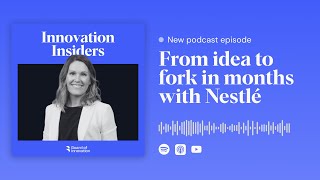
Mar Serra runs Nestlé's R&D accelerator, which gets products from idea to market in months by starting with consumer problems and testing MVPs on actual shelves. The team balances speed with food safety, uses AI and digital tools, and builds an entrepreneurial mindset across the company.
Chapters
Welcome to Innovation Insiders. I'm here with Mar Serra. She's the head of the RD accelerator team at Neste Research in lausanne. With over 15 years of experience leading innovation and technical teams in the food industry, she really stands at the forefront of food tech and nutritional science. And having had the pleasure to work with her for several years, it's super exciting to have you here in the podcast, Mar.
Thank you. Thank you so much for having me.
Awesome. So let's kick it off straight away with first question. Could you describe the main objective of the Nestle R and D accelerator and how it fits into the broader innovation strategy of a food giant like Nestle?
Sure. So in the accelerator we have mainly two pillars, I would say. So the first and most obvious is like bring innovation faster to market, which we are very passionate about. But then also we play this role of really developing entrepreneurial and agile innovation mindset as well for all of our employees. And you know, so in general what we do is the risk innovation opportunities in white spaces, areas where we maybe are not playing today. And you know, that results maybe in product launches, but also sometimes it helps only to inspire the strategy and be able to refine the strategy for the longer term.
Okay, and could you walk me through some of the process of how you translate those, let's say, disruptive food science and nutrition into consumer products in just a few months?
So we use several agile methodologies, but all in all, what was very new when we started in the accelerator is really starting with the problem. Right? It's all about having science and technology at the core. But first of all you need to start what is the problem that you're trying to solve? Is it an important problem for the consumers? What are their pain points? So we start really with these problem and then using digital tools and agile methodology. Then we spend a good amount of time on this, what we call the discovery phase, which is identifying the problem and then co creating with consumers potential. What would be the best, let's say value proposition. And that's, that's where the magic of translation happens. Right. When we are co creating we go to search what science do we have that is proprietary and protected and how can that serve to solve a particular pain point. And then our program doesn't stop here, right. It still goes into putting the product into shelf. So that's, I would say the second part of all of our projects which is much more executional in terms of producing the product and really discussing with customers to put the product on shelf.
Yeah, it's nice I've seen it several times, and it's really nice to see that you can really turn science into opportunities that fast. And I think the idea of making sure that the scientific discoveries that you have really turn into commercial launches in the end is something that's extremely powerful. Um, and yeah, it's something that obviously it's. It's. It sounds easier said than done. So I wonder, have you seen some. Some big challenges in accelerating the development of some solutions? And could you tell me a bit more about what was the hardest part of setting up this. This process?
So, as you say, it's. It's extremely rewarding when you see the science or that technology that has been cooking for years. Right. And then finally coming to life in a product that is really making someone's life better. That's extremely rewarding. And this last strategy was saying really producing and putting the product to sell to shelf or into a web shop. This is really our secret sauce in the program. Right. And of course, it brings much more value than testing only digitally, because it's what we call the moment of truth. It's really consumer behavior. Will people pick the product and pay for it or not? Right. So it's extremely valuable in terms of learnings when it comes to challenges. Of course, that means that all the products, even if we go very fast, they have to be food safety compliant. They need to be regulatory compliant. So these are big challenges that we overcome, of course, by leveraging our expertise. We have amazing experts in the company that are very dedicated and passionate about what we do, so they help tremendously. But that's something that. It's hard sometimes to find the right balance of speed. But of course, we cannot compromise quality and food safety. I would say that's one of the challenges. And then the other is if you think about the science that we bring to life, sometimes it's very complex science. And translating that very quickly in. In something that consumers can understand and is playing consumer language is also probably a big challenge. But what really makes the difference on being differentiated in the market. Right. But doing that fast and not being able to retest things a lot, sometimes it can be a challenge as well.
Yeah, of course. And these challenges only get more difficult when you're such a global company. Right. You test the science in one region, but the response of consumers in one region versus the other might differ as well, as the science might not be as popular or as relevant in another region.
Absolutely. I mean, as you say, this is definitely a challenge. What I would say it's really an advantage on the way our company is organized is that we are very big, but we are very well connected. So we have arms in every region, if you will, and we have contact with the local regulatory teams or quality teams or commercial teams. So this collaborative culture is very much in our DNA and that allows us to operate in a global scale. Otherwise it would be probably impossible.
Yeah. It's nice to see that you've really opened several centers all around the world with the same principles. And knowing that everybody's connected really helps, of course, to share learnings and maybe even transfer one science from one region to the other.
Exactly, exactly. We operate really as a network. Yeah.
Awesome. And can you maybe share a success story of a product that came out of the accelerator that you're really proud of?
Sure. I would say one recent example that I'm very proud of, a project that we had in Lausanne was our first like digital product. Right. So as a food and beverage company, we are very focused on food and beverage as part of our value propositions. But we have to embrace digital. We have to embrace that consumers expect more than just a product. So last year we embarked on this project that was really related to, to well being and gut health and we were able to complement that with a digital service. It was the first time that we had to learn really with our resources how can we come up with a digital mvp? So we definitely have some expertise, but it was new to us to do it in such a quick turnaround. And it was very rewarding to see that. Yeah, that was also put in shop desk. So we saw how many people would come to that website and leverage this service and get educated and so on. And it was. The numbers were really, really good. And now this digital product is being scaled. So that's something I'm very proud about because it's really moving the needle to more360, let's say value propositions. And then I think in general it's not such a concrete example, but that's what I said before. We have a lot of cases of projects we've worked on that maybe doesn't translate in an immediate launch because we work on these further goals. If you, if you say if you win. But, but really we've been able to inspire the strategy. Right. So with the results out of the test that we've done, our business partners could refine their strategies on particular territories and be much more, much more targeted. And I think that is something I'm proud of because this is what it's all about. Right. Of Making more robust and more strategic business plans for. For higher impact.
Yeah, it's not only about the product itself, although it always starts from a scientific discovery. The business model and the way on how you go to market is equally important.
Exactly.
And I've seen it that you've done. There's some work that has happened elsewhere as well within Nestle where you've really work on all the different channels from vending machines in store, testing online, but even through social media to really find to a B test at first. So just to really see what's the best approach to approach our customers and to see what works best, but as well to uncover new business models or channels that you can reach out to consumers for the actual launch.
That's right. And that's what I was saying. This is our secret sauce because when you put the product in the market, you can decide which type of stores, how many, you can explore new channels. So as I mentioned before, there are some challenges that come with it, but the learnings you can get to really de risk your real launch where you're going to put much more resources behind, it's priceless.
Maybe taking a step back on the first parts of the innovation process, how do you ensure that innovations from accelerators continue to meet the needs of consumers as they change rapidly? And they also, for example, there's this big say do gap between what consumers will tell they like, but will they actually buy this? So curious to know a bit more about how you, how you really make sure that the products really meet those new consumer needs.
So in our projects we really start, as I say, with the problem. But then to understand the problem, the best way is to get closer to the consumer. Right. So for us, one way to to stay relevant is really always send the polls. Right. So we always have to go where the consumer is. And that means interviewing them and understanding them and spending time with them, doing merchants with them. And then further along the journey is really having this co creation process, right? So it's not that, okay, we get insights and then in our office we come up with a potential solution, right? There is this constant feedback loop and this co creation process where we kind of gain and reassure ourselves, okay, we are tracking in the right direction, but then the ultimate moment of truth is when you put it out there to buy. And yeah, either it's in the web shop or in the store. Like we have many different ways that we still get in contact with consumers. So we combine a lot of qualitative with quantitative data that we get to make sure. That, that, yeah. That we are staying relevant because in the end we know, yeah, it's not so much how many units we buy, for example, but really understanding are we making it better than anyone else that is being there or than the current solutions they are using. Right. And if we can crack that, even if we have to pivot, then still we know we are in the right direction and then we have some chances to succeed. But yeah, overall is really staying close to the consumer. The teams travel a significant amount to be in the market and to be close to consumers.
Yeah. And it's really not theory. That's the beauty of it. It's not just doing research and then defining a Persona and then doing everything based on that. It's about getting the consumer really into the room and talking to them and getting feedback in the early stages and later stages. So it's really nice to see that it's done even within such a short amount of time and maybe transitioning into the evolution of where such accelerators go to. Could you. Do you see a role of new emerging technologies, for example, like AI in developing new food solutions?
So I mean, we live in the era of technology and I don't think you can work on innovation and avoid technology. Right. So yes, we leverage technology significantly from digital that allows us to reach many, many consumers to. Yeah, we are exploring, of course, what can AI really help us accelerate or be more efficient on. And in all the aspects, I mean, there is the power on understanding the consumer and gaining the insights, but there is also a lot of technologies on product design or packaging design that these are also very lengthy projects with a lot of variables. So there is quite a lot of opportunity there. So yeah, definitely, we are constantly exploring what's available. For some areas, we develop the technology ourselves. So that's how we embrace digital. On being more innovative on the way we do some of our core, let's say areas of product development and more technical areas. And we partner with other. With other partners that have the expertise more on the. On the front end.
It's nice to see that through the use of technology you've been able to speed up the innovation process as well, not only by time boxing it, but also by using technologies to reach out fast to consumers. But I strongly believe that AI can really be. Can accelerate even further from customer discovery and understanding all the way to new designs.
Absolutely, absolutely. Yeah.
And maybe with that, like if we bring it back to the product itself, like also on the technological side, there's continuously new scientific discoveries, but it's Hard to prioritize what science to use or what technology to really focus on. How do you prioritize such things?
So we have quite a robust process around what does the accelerator work on. Right. So as I said, it has a very specific role to play into acceleration, into accelerating innovation into the market. And that's why we work very, very close with our strategy teams to make sure that we are in the right direction. Right. So we have specific areas that are identified that as a group we want to go after and then we have very strategic and intentional discussions on how should we split the efforts. And so some centers will go more into more immediate innovation and then to us they will come when it comes to really, okay, how can we play in that space in a very differentiated way, really exploring new health benefits or things that require much more science discovery, but also clinical data or you name it. Right. So, but it's, it's very important for us, it's mandatory for us to, to, to make sure we are aligned with the strategies so that we are working in the right territories. Because in the end also we, I mean we have multimillion dollar brands and we want to evolve that brand in the right direction. Right. So it's not that we love our brands, we don't want to create 50 new brands. Right. So it's about innovation within, within our, within our territories. And that's why also it's very important that we discuss with our strategy partners which are the brands that we see fitting better in this type of territories and that we want to explore in detail.
And if, and if you would look at the whole process. It's, it's, we've discussed the more technical side I guess, but in the end it's also a people business. I think it's interesting to see that very often the team starts from a scientific team like food science experts. Yet there's a lot of diverse profiles involved as well, from marketing all the way to different parts of the business. How do you make sure that you attract the right talent but also motivate those cross functional teams to achieve an objective that is actually like often hard to achieve in such a short amount of time?
Yeah, very good question. It's. Look, innovation is not for everyone, right? That's, that's clear. And I think innovators or entrepreneurs, they, they are almost a space, a bit of on, on its own. Right. So you need to have incredible passion and resilience to, to thrive in that environment. Right. And, and I mean I'm extremely grateful for, for my team of we call them innovation coaches or venture builders. Right. So they are tremendously entrepreneurial and brilliant and, and they really have a lot of energy to, to motivate the teams. But in the end, what we have observed is that, I mean, this type of trades, they don't come only from people working in innovation. We have very entrepreneurial people in quality and regulatory. Right. In the end, when they have the right, you know, they are compelled with the vision of, yeah, I really want to be a change maker and help bring this innovation. They innovate. The motivation almost happens naturally. Right. So we take a lot of care of our culture because we know it's a lot of work. But I would say we don't deal so much with demotivated people. I mean, they just want to be part of it. Right. And as I said, it's not for everyone, but we are open to any employee and whoever wants to come and has the right trades, they will thrive in our environment.
Okay, how did you end up in the innovation side and accelerator side?
So, good question. So I spent the last 10 years working in innovation, but more on the operation side. So I was more bringing the products to life. Right. So either in local market roles or more regional roles. So it was much more the executional part. So I knew how that part works very, very well. And then for me, coming to the accelerator was like, okay, I want to really get into doing the same, executing and bringing it to life, but maybe working on spaces that are less obvious for our brands. So I'm a scientist as background and I turn into more operations and business. And yeah, being back in Nestle Research in Lausanne, it made me realize how much I love science. Right. So it's kind of bringing the best of two worlds and really cool science and technology coupled with good execution and solid business plan. So for me, it's a perfect environment.
Awesome. And maybe as a final question, do you have any advice on what you would give to innovation executives to look at how they can launch such initiatives in their organizations?
So in our experience, or in my experience, the beauty of the accelerator is that it's the safest and the cheapest way to experiment and de risk your innovation. Right. So you can play with brands, you can play with different formats, different communication, different pricing. So this is you. You don't have that in the regular business world where either you launch or you don't launch. Right. It's. You just have these two options. We work in a space that while we test everything in real market conditions, it's still very, very controlled. So it's very low risk for our brands. So I would say anyone that is considering to set this up, I would recommend really they go for it because it's these very low risk, very low resource, both people and also financial compared to what it means bringing it in the regular, let's say innovation engines in the company that are also very necessary. But when you want to discover a space where you're not yet playing and you don't even know which brand you're going to use or how you're going to sell, the learnings you get through a setup like that are priceless. So that would be the advice. And I think the other thing I would say is that you have to be patient, right? Because if you want to work on disruptive innovations, this is not the same as running a core business in an established brand or established channels. That's always the right balance of building the knowledge and the reassurance that you can win in the market. But it might take some time to see the results you want to see. You have to be a bit patient.
Awesome. Thanks. I think it's really impressive what you've built and always been super excited to be part of it for some parts and love to follow your work in the future. And thanks for joining the episode.
Thank you so much. Thank you so much.
Thank you for tuning into another episode of Innovation Insiders. We hope today's conversation sparks your ambition to push the boundaries of what's possible. This podcast is an initiative of Board of Innovation. If you enjoyed today's episode, don't forget to subscribe, rate or leave a review. Your feedback keeps us inspired and motivated to bring you more insights.
More from Zaur






An Immersive Workshop to Calculate the ROI of AI Strategy - AUTONOMOUS session

Predict, Optimize, Decide: Enterprise Decision Making For The Simulation Era - AUTONOMOUS summit


AI Insiders podcast ep. 9 - Not so cookie-cutter: Consumer Choices in the Age of AI

