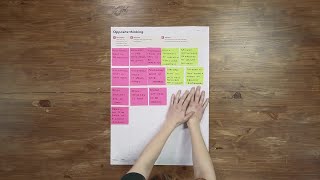
Claire from Board of Innovation teaches opposite thinking, a three-step ideation tool: list your assumptions, flip them to opposites, then generate solutions from those flips. She walks through examples like healthcare payment models and diagonal elevators to show how the method works.
Chapters
Hi, I'm Claire, a consultant here at Board of Innovation. And today we're going to talk about opposite thinking, one of my favorite tools in solution development. Opposite thinking is nice because it actually creates a structured approach to help us really expand our worldview and come up with some very radical ideas. It may feel a little hard at first, but once you get it, you. You can really get going with it. So we like to say that actually assumptions are windows to the world. We accept a lot of things as status quo, and in fact, if we were to change them or maybe create an alternative scenario that can actually really help us be triggered to create some innovative ideas. I'll give you an example. So right now, in the Western world, we accept as status quo that whenever you're sick, you have to pay a lot of money to actually become healthy. Well, on the opposite side of the world, in China, for example, doctors are actually seen as their job to keep you healthy. So you actually pay them when you're healthy, and when you're sick, they actually don't get paid. That's one interesting way that you can imagine opposite thinking helping us here. We see this happening even with the assumption that elevators actually have to go up and down. We're seeing innovations where now there are elevators being created that can go even potentially diagonally or horizontally, changing the entire way we think about constructing buildings. So pretty cool. And if someone had just questioned that assumption earlier, we'd actually be able to come up with ideas like that even sooner. So we're going to do a bit of that today. The way the tool works is that there are three parts. So first starts with our assumptions. So we actually list out our assumptions vertically. The second part is the opposites or alternatives, where we actually list out the alternatives of the current assumption. And the third part is actually the ideation piece where we come up with solutions and in our solution development to the opposite. And I'll show you with an example. So say we were to start out with actually listing out our assumptions. So that's the first step here, our first assumption about our how might we statement. So we are trying to create a saving experience for millennials who are actually trying to be more healthy, live healthier lives. We might assume that millennials want to be healthy in the first place. Now maybe they actually don't. We're also assuming that millennials want to save money. We talk about it within our group more and we say, hmm, well, also being healthy, that has a cost. That's an assumption. And finally, money has to be saved. In a savings account. These are all assumptions that we know to be true today. And in fact, these are four. But there's actually a lot more assumptions out there. And in a group, you can talk about this and discuss together. This is really nice to do up on the wall with everyone standing around it and really discussing and adding. So now that you have the assumptions listed out, we go on to the second phase, where we actually get into the alternatives or the opposites. We like to say there's a couple different rules of thumb when you think about your opposites. You can try to 10x something, so make it even bigger. You can remove something critical, you can flip something around, and it really depends on the limits of your imagination. So you're really describing an alternate universe. So, for example, millennials want to be healthy. A potential opposite or alternative of that is actually everyone only has wellness as the only reason to exist. So actually really taking it 10x. So wanting to be healthy is one thing, but making that the only reason for living, that's a whole other world. Or you could even say, on the flip side, millennials actually think it's cool to be unhealthy. So that would actually flip everything around for us. Let's go to the second one. Millennials want to save money. In fact, an opposite of that could be millennials want to spend money. Of course, that's a one on one opposite. We could also flip around a resource. So millennials want to actually save memories. I know, kind of strange, but bear with me. We could also say, for instance, for being healthy has a cost. Being healthy, of course, is free. So that's the straightforward opposite. And money has to be in a savings account. You could actually say that actually for this one, being healthy as a cost. You could say people get paid to be healthy. So this is how we kind of do this start of the activity. And now we get to the fun part. So everything has been done together, but we get into the fun part where we do it by ourselves for our solution. This part is about the individual brainstorming, and then we'll end up doing our sharing afterward. So what we do in the third phase is we look actually at the opposites and we imagine, okay, if this opposite existed for us in the world, what would be some solutions? So if we lived, for instance, in a world where millennials think it's cool to be unhealthy, what kind of solution might exist? Well, maybe actually being uncool to be healthy. If it's cool to be unhealthy, maybe we could actually it's a little bit like taboo. So maybe there's some sort of blocking purchases of unhealthy items, and that's actually because it's sort of like dangerous to be unhealthy. Or we could say that if wellness is the only reason to exist, maybe we automatically redirect our savings to health purchases and that's just standard for everyone, not just millennials. Or we could say that in a world where millennials want to spend or or millennials want to save memories, we could say, well, if millennials want to spend, maybe we could partner with all wellness providers for discounts, or maybe partner with every company for wellness discounts. Or if millennials want to save memories, that might trigger some sort of platform that actually could save photos and videos of perhaps wellness experiences, among others. So these ideas are still within the realm of what we're trying to solve, but they're just also taking this twist of thinking about a different reality, and that can sometimes really help us break out of if we feel like we have too many const. I would say this tool is one of my favorites. It's definitely worth a little bit of effort to try to understand and get used to it, and I would really recommend you giving it a try. Alright, well, that's it for this opposite thinking. Good luck. And if you want to know more, Please go to boardofinnovation.com Tools to find out more about this tool and other tools that we have.