Persona
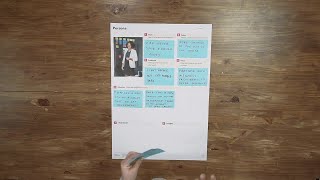
Yinglei walks through an 8-segment persona template that design teams use to build fictional customer characters. The segments cover pains, gains, problems, needs, and insights. The example follows a millennial struggling to save money while affording gym memberships and resisting social spending.
Chapters
Hi, my name is Yinglei and I'm a design strategist at Board of Innovation. I'll be walking you through the tool called Persona. So Personas are fictional characters that we create in order to keep the target audience that we want to serve in mind. So once you have created it, it's been used in order to take part in the whole decision making process, but also design process. From the start until the end, whenever there is any doubts on what we actually should go for, it's always important for the team to kind of highlight and ask themselves a question. What would our Persona prefer? So as you can see, the tool itself consists of eight different segments and I'll be walking you through all those segments later on with an example. So what we always try to start off with is a visual image. What they say is pictures says more than a thousand words. So having a visual image of the person that represents your Persona allows you to better connect with them. Also on an emotional level, the first part is after you have done your problem exploration, what were some of the pains that you actually managed to identify throughout the different interviews? Pains are the emotional state. So it's kind of like fears, frustrations or obstacles, goals that they have met. Sometimes the customer are able to express their pains to us, but more often than not is actually something that we would derive based on the stories that they have told us. Next to that are the gains. So what are the needs, what are their wants, and what are the things that they're trying to achieve? So mainly aspirations. The third point is the problem. So what are some of the obstacles that they faced along the way? And usually the difference between pains and problems is that pains is more emotional, while problems are something more concrete, a more tangible experience. And the customer often have more are much more verbal about the problems that they face rather than the emotional pains that they actually went through. And four is just first couple of few ideas on how you could potentially help them to bypass the problems that they have mentioned. So remember, during this section, we're still trying to define the target group that we want to serve. But number four, the section four gives you a first opportunity or space to air out some of the potential ideas you and your team are sitting on. However, I'd like to encourage you not to get stuck with your idea, since at a later stage you will be going through various brainstorming exercises to open up the new pathways on how to tackle the challenge. So just write them down, but don't get too attached to them. Situations are mainly stories that the Users have shared. One of the key thing during this situation is to be able to back up the pains, the gains and the problems that you identified while doing the interviews with the users, with the stories that you have heard. So you ensure that it's not your own assumptions or your own conclusions that have defined those sections, but is actually coming from and originating from the customers you interacted with. Once that has been done, what we'd like to ask you is to kind of like flip all these pains and the stories into some of the real needs. What are the things that they're trying to do and trying to achieve? And next to that, the last section are insights. The difference between needs and insights is that insight is more like an educational guess that you're trying to make on why that need occurs from the first place. So all these sections will become probably more clear after I walk you through the template using a example. So in our example, we are following a financial institution who wants to create a new value proposition for their target audience, which are the millennials that are interested in saving up more money and living a healthy lifestyle. So based on all the interviews that we have done during the problem exploration phase, a couple of few things arise that we would like to collect on our Persona and remind ourselves about. So we keep all those factors into account throughout the rest of the process. One of the pains that that was clear is that they never save enough money. If they set up a goal, it's never there. It's very difficult for them to kind of like achieve these goals or it's definitely not a habit again or something that they're trying to achieve is that by the end of the month they would expect to be able to save up more, more money than what they're doing at the at this point. A clear problem that was also shared with us is that they can't afford gym memberships. It's just at the moment out of their reach because they have other things to spend on and they just simply don't find a means in order to. In order to be able to cover for the expenses around the gym. Some of the first ideas that one of our team members came up with is what if we could partner up with a wellness provider in order to be able to offer gym discounts to our customers. So it's a good idea, but we'll just leave it like that for now and focus on filling in the rest of the Persona template. Some of the stories that we have heard in order to back up those identified pains, gains and problems is for Example, one of them shared with us that opening a new savings account just in order to get the headphones was something very interesting for them. So while some financial institutions offer you a lump sum of money when you sign up with them, that certain that financial institution would give you a gift in headphones. And it happened to be something that she was really interested in. The other story that we got is that once they have received €200 of saving on my car insurance, and that was all because they had an account already existing with that financial institution. And it was something that the customer really appreciated. And another story was that the person subscribed once to the gym, but they quit after a couple of few months. So it was kind of interesting to hear further what are the stories. And in that case, it was mainly the financial aspect of the gym. So they just realized simply that this is an ongoing expense that at the moment, they just simply cannot afford. So based on the stories that we have heard and collected from our customers, one of the real needs that we managed to identify and that they all had in common was that there was need to help them in order to reach their financial goals of saving. And the insight, which is more like an educational guess based on that need, is that one of the reasons they can't save up enough money is because they splurge during social occasions. So we noticed that a lot of those millennials, although saying that they don't have enough money to be able to save it into their savings account or use it for their gym memberships, they still use the same amount of money social occasions with their friends. So that's mainly where the money goes. So it could be very interesting to kind of like explore what we can do and what opportunities for design we can come up with using this potential insight. So just like any tools, the Persona is not a linear process. If you managed, you. If you identify, for example, a couple of few pains or gains and, and you realize, oh, there is no story to back it up, it might be worthwhile to double validate that by just having or scheduling another interview with some of the customers, just to be able to make sure that what you're sharing on your Persona truly came from the customer or is derived from the stories that they have shared. Sometimes what we notice is that a Persona, having them as a poster is not enough to keep the customer in mind. So one of the tricks I like to apply, especially coaching a group of six people, is to invite one of the team members to wear the hat of the Persona. So that person let's say his name is Tom. No longer is Tom for the upcoming one hour, but he becomes Sophia, our Persona, so that he really embodies the voice of Sophia and making sure that Sofia is actually in the room when we're continuing our creative process. If you would like to hear more about the Persona tool or learn more about it more, please visit boardofinnovation.com tools.
More from Zaur






An Immersive Workshop to Calculate the ROI of AI Strategy - AUTONOMOUS session

Predict, Optimize, Decide: Enterprise Decision Making For The Simulation Era - AUTONOMOUS summit


AI Insiders podcast ep. 9 - Not so cookie-cutter: Consumer Choices in the Age of AI

