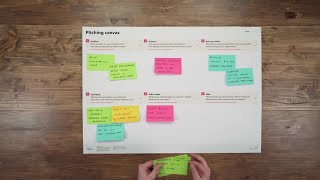
Eva from Board of Innovation walks through the pitching canvas, a one-page framework with five blocks: Problem, Solution, Value, Credibility, and Call-to-action. She shows how to allocate time to each section and works through an example product combining savings and health for millennials.
Chapters
Hi, I'm Eva from Board of Innovation. I'm a business designer. So I help corporates create new businesses, new services. What does this mean? That there's a lot of pitching involved to convince those stakeholders, to convince those investors to get funding. But pitching is not always as easy. So that's why we're here, and that's why we're going to discuss the pitching canvas. The pitching canvas is based on the five building blocks of a pitch and helps you to structure all your information in one canvas. What are the five building blocks of a pitch? First of all, you have the problem. So what's the problem that you're trying to solve? And if you have that defined very clearly, how are you going to solve it? What's your solution? If you have a problem and a solution, you're going to look at the value. So how are you going to create value with this? This is often also what people are most interested in. This is often also where people stop. But if you want to increase the success rate of your pitch, you need to take it further. You need to add the fourth building block being credibility. Why should the audience believe you? What did you do in terms to validate that your solution will work? And then finally, call to action or next steps. If your audience is enthusiastic but they don't know what's next, you'll have a false start. If you want to get more information about these five building blocks, you can go to our video on the pitching checklist, where I be a bit more elaborate on it. But now let's focus on the pitching canvas. So here you can see the canvas with the five building blocks and the sixth one, what is this? This is basically you preparing for Q and A. You always know that there's Devil's advocate in the audience. So what will he or she ask? How can you prepare for the difficult questions? So this is where we left some space for you to prepare. What you will also notice on the pitching canvas is these little dots. They are actually meant to put your timing on it. Often a pitch will take about 10 minutes, with 10 minutes for Q and A. If that is the case, you put two minutes per building block. If it's longer or shorter, you put a different number. This helps you to understand how much information you actually can put into this pitch. Great. Now let's look at an example to go through the pitching canvas. So in our example, we are still working with our millennials. And what's the problem that we really saw with these millennials? Well, first of all, they're not that good at saving. With all these fun activities around us, the money doesn't stay in the pocket. What else did we notice? We saw that actually they have difficulties with reaching their health and wellness goals. So we said, ok, let's do something with it. Let's add solution. Create a saving account that helps you to save and to be healthy. Wonderful. How are we going to make money with that? Well, first of all, we want to reduce churn among this segment by 10% with offering this. And next to that, we also want to increase the lifetime value of a millennial customer from thousand euros. Ok great, we have a problem. A solution value. Now what did we do to actually validate all of this and to build this credibility? Well, we did a lot of user research. So in our pitch we will show what we have done. But what we will also show and which is very powerful in a pitch is to show what is invalidated. So what didn't work? In our case, we had a comparing feature that people could compare with their friends. But we saw that it didn't get any traction on our landing page experiment with our value proposition, we had a conversion rate of 2%. So by this we also see, okay, it's worth pursuing. So what is now the next step or call to action? We want to build first MVP prototype. Next to that we will also need to have budget for a team of four people that work on it full time. So quite a challenge. I'm ready for it. Last thing to do is Q and A. What are things that I need to have with me for possible questions? Well, of course I will have all the information about the experiments that I ran. So how many people were converted, what was the contact list that we had? But I will also focus on more information about my segment, what they do, how they live. So now you have everything you need to create a killer pitch. A final tip if you want to use this canvas with your team is to use hybrid brainstorming. What is hybrid brainstorming? Hybrid brainstorming is first thinking about what you would mention in all of these building blocks, putting it on a post it and then putting it on the wall. After that everyone has their input on the wall. You can start discussing. By that you will see whether you are aligned because you're a team, you're working together, but you want to see whether everyone is hearing and seeing the same things also depending on the phase of your product. So are you in the problem exploration phase or are you really already in the go to market phase? You will focus more on one building block over the other. So take that in mind. If you want to have more information about this pitch canvas, you can go to our website, Board of Innovation Tools, where you can download the tool and read more information about it. So all there is to do now for me is to say good luck, and I'm very certain that you're going to do just great.