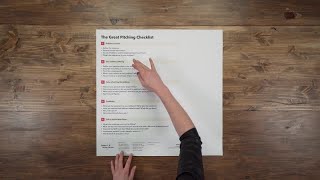
Eva from World of Innovation walks through five building blocks for pitches: problem, solution, value, credibility, and next steps. She uses a savings and health product for millennials as an example, showing how to fill each block with market numbers, validation experiments, and a clear ask.
Chapters
Hi, I'm Eva from World of Innovation. I'm a business designer. So that means I'm helping organizations to build new businesses and services. When you're doing that, there is a lot of pitching involved to stakeholders or investors to get funding. So that's why we will tackle the Great Pitching Checklist. The Great Pitching Checklist is meant to give you all the information that you need to look up or need to have at hand when creating or building a pitch. This will help you to have a really solid story and to convince anyone in the room. So before we dive into the checklist, I first want to talk to you about the five building blocks of a pitch. When we're doing a pitch, there's this structure, and if you follow it, success guaranteed. So what's the first thing to start with? What's the first building block of the pitch? Of course, it's the problem to solve. What is the problem that we are solving? For which market are we solving it? Is it large enough? Is there a pain? Only if we have that very clear, we can go to our solution or our offering. So which solution are you bringing to solve this problem? Make sure to explain your solution in a very clear and simple way so that anyone in the room can immediately understand what you're creating. If you have this problem with that solution, it's time to talk about money. How will you create value for the market? This is something your audience will be very interested in. It can either be in increasing revenue, decreasing cost, or increasing customer satisfaction. Great, we have a problem, a solution, the value. And this is often where people stop. However, we want to take it a step further, because how will these people in the room know that you're actually speaking the truth? And this is where building block number four comes into place. That is credibility. With credibility, you show which experiments that you ran, which validations that you have, and how do you know that people actually want to have your product or are willing to pay for your product or service? Very important. Next to that, your team can also be a form of credibility with their expertise or their previous experience. Then the final building block, that's the next step or the call to action. Often, if your audience is very enthusiastic but they don't know what's next, you will have a false start. And we don't want that. So in the next step, you can talk about your roadmap. So what will you do tomorrow? What will you do in a year? What does success look like on the long run? And you can also be bold and take this time to ask questions. So if you want to build that better mvp, do you need more money? Ask for it. Do you need more resources? Be bold. So this is really your time to ask for whatever you need. Let's now make it a bit more concrete. So here we have the entire pitching checklist with per building block, a couple of examples of certain things that you might need to check or need to know before building your pitch. We are going to have a very concrete example, so that's maybe easier for you to understand which type of information is necessary with which type of building block. So previously, we identified the need to save and to be healthy with a group of millennials. So these millennials said that, okay, they want to save, they want to be healthy, but they're not always doing it. Another really important information is about the markets. So we see that these millennials, 30% of them, already have a gym subscription in the EU. So that shows us that there's a willingness to pay to be healthy. A final insight from our many, many interviews was that the healthy lifestyle is not only associated with just being healthy, but also with status. So that's a really interesting insight for us. So which solution do we have in order to tap into this market with these needs? It is, yes, a saving account that helps you save and be healthy. Isn't that just wonderful? So what's the value of this solution? Well, therefore, we used ballpark figures, another tool that you could find on our website. With these ballpark figures, we define our market. And when you're defining your market, make sure that you don't go in too big numbers. Try to get concrete and be realistic. So in this example, we used France. So we said, okay, In France, there's 5 million millennials. We will target 5% of that, which is 250,000 millennials. And of this 250,000 millennials, we aim to get 20% as our customers. Now, what's the value of these customers? In financial institutions, we see that a lifetime value of a customer actually is accounted to a thousand euros. So there we have all the information to really calculate the value of our solution. Great. But why should you believe me? Why is this true? We did a landing page experiment with our value proposition. And in that landing page experiment, we actually saw that there was a conversion rate of 2%. This indicates already that there's a need or there's an interest in what we are offering. Good. So what are the next steps now? Well, we want to take this experiment further and build a first MVP and test this with customers of course we will need some budget for that. So in this call to action, this is what I would focus on. Great. So now we had the explanation of the great Pitching checklist. We had an example. So now you have everything you need to be equipped and go make a wonderful pitch. A pitch that will convince about anyone. If you want to have more information about this tool, you can go to our website Board of Innovation Tools and find everything you need about this great Pitching checklist. I already wish you a lot of success and I'm certain that you are going to do just great success.