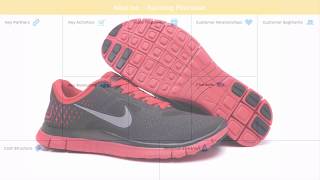
Zaur AI walks through Nike's shoe business model and shows how Flyknit, a machine-knitted upper, could triple profit margins. The original model made $380M on $3B revenue across 52,000 retailers. Applying Flyknit more broadly in the model pushes profit to 3.7 times higher.
Questions this video answers
52,000 retailers
Approximately US$50 per shoe
About US$3 billion
About US$380 million
3.7 times more profit
Chapters
In this activity we're going to play with the numbers, but for existing business models. Remember we said we could play with the numbers to improve existing business models or we could play with the numbers for new business models to figure out the best opportunities. So here we're going to focus on the existing business model of a company that you certainly know, which is called Nike. And we're going to focus on their business model for running shoes and how they changed it substantially. So let's look at the business model for running shoes. They sell running shoes through distributors to global retailers and for that they get a whole sales fee, about approximately $50 per shoe. On the backstage they have to do a couple of things. Obviously a lot of R and D demand creation, supply chain management and manufacturing and distribution. In terms of key resources, they build on their magnificent brand and they have a lot of patents that they can build on. Key partners are manufacturing contractors, supply chain management, and of course the athletes that we all know and admire like Michael Jordan, Tiger Woods, Kobe Bryant and so on. That gives us the cost structure, research and development, cost of sales, selling and admin, and promotion and advertising. And we're going to focus on the cost of sales. So if we look at the numbers here in Strategizer, well, there are 52,000 retailers around the world that sell for Nike. That gives us a revenue stream of about US$3 billion. And on the backstage we have all the costs. So this gives us a profit of about $380 million just for the running shoes. Now Nike changed something substantially to increase this profit. But let's look at the existing business model. It's really based on low cost manufacturing with a lot of manual labor in low cost countries like China, Cambodia and Vietnam. But they changed this with the flyknit technology. So Nike calls this micro level precision engineering. And it's pretty spectacular because with proprietary software they instruct a knitting machine to knit the entire upper part of a shoe in a single piece that's then attached to the tongue and the sole. Wow, that changes the game. No more need for those big factories with manual labor. So what does this mean for the business model? With the Flyknit running shoe they can substantially change manufacturing and that will dramatically decrease the cost of sales. That's a game changer. Now let's look at the business model here, which Mark Parker, Nike CEO says this is a complete game changer because this could really change the way they work. They could manufacture their shoes anywhere in the world. So let's look at the business model again with Strategizer. What changes? So basically it changes the cost of sales. They split their cost in two. So in terms of profit, the profit is much, much higher now because they figured out a way to substantially change their cost structure. That means 3 times 7 more profit. 3.7 times more profit. That is amazing. So imagine if Nike used this technology for their other shoes. Their company would become substantially more profitable. Wow. Are you going to play with the numbers next time you prototype an idea? I think it's fun and gives you great results.