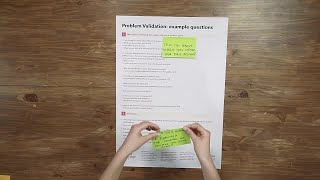
Yinglei from Board of Innovation shows how to run customer interviews that actually work. Start with broad questions about real moments, then dig into decisions and feelings. The key: you talk 20%, they talk 80%.
Chapters
Hi, my name is Yinglei, I'm a design strategist at Board of Innovation. Today I will walk you through the Problem Exploration Tool. Whenever you start a project and you have defined your challenge, the next step is to better understand your customers and one way to do it is to step into it interview with them. While the Problem Exploration Tool is right here in order to help you and guide you step by step, what are the key questions you have to address in order to build understanding about the people you aim to serve? As you can see on your template, which I hope you have right now close by you, the Problem Exploration sheet is built up in two sections. First section are template questions that you can use in order to build a conversation with your customer, while the second section is there to help you understand some key tips and tricks on how to run an interview. Don't worry, I will walk you through both sections through an example. So let's take for our example a financial institution who is looking into how to build a new value proposition for a target group. And that target group are millennials who are looking into ways to save more but also to live more healthy. So in this case we want to find out more about their saving behaviors but also their healthy habits. So one way of doing it is that we can start the conversation by asking a more broad question such as tell me about an experience. When was the last time you opened your savings account? So that's a very broad question and the customer can tell you a lot about the experience and how it has been for them. What are some frustrations that emerged during that experience? But also what are the things that went well as a follow up question? So for you to start diving a bit deeper into the conversation, you could ask, for example, walk me through the journey of how you decided on choosing that certain bank. This is a really good follow up question in case you are interested to find out more about their decision making process. Another question that you can ask is what is your relationship towards saving? So as you can see you have done a buildup from going more broad to a more narrowed down a more narrowed area that you actually are curious about. And this is a really good way since users are not always used to talk about their saving behaviors. So having a build up during your conversation is your approach to help them get comfortable in order to talk about that topic. So your ending question could be what's your relationship with saving? How often do you save? And most importantly to find out what are their aspirations behind savings? Why do you save? What are the goals you try to achieve next to that. In our example, we're very curious to find out more about their relationship with health and well being and if they have any routines related to that. So a more explorative question to kick off the conversation with could be what do you do in order to stay healthy? And there it's a very broad question since it opens up a lot of lanes where the customer can take you. They can talk about their diet, maybe some exercises that they do it, how they do it, do they like to do it alone or do they prefer in a more social context? And based on all the stories that they share with you, you can do a deep dive into the specific stories you find very interesting or it's very related and relevant to the challenge that your project team has decided to work on. So in our case, I'm very interested to hear a bit more about their habits regarding to exercising. So a follow up question for me to ask could be, could you share with me when was the last time you did exercise? The reason why I asked for a last a lost time experience is because one, it's very recent and second of all, it's always good to have a conversation about a tangible experience that they have gone through because there you can then start creating more poking questions to really better understand the emotional journey that they went through. What were the thoughts, what were the questions that they asked themselves? So you really talk from a tangible and real experience from the user. Another question that I was curious to find out more is what are the underlying reasons that they chose certain kind of exercises? So in my case it could be just ask them, okay, could you walk me through why did you choose that certain exercise? And in the case that they actually share with me that they joined a gym, I could ask them why was the reason that you actually chose for that certain gym membership? So besides the questions and this problem exploration tool will guide you through how exactly to tackle it, from broad to more narrowed down, I'd like to share a couple of few tips. So based on my experience as a person who does a lot of user research, one of the key elements that I noticed is that people feel more comfortable to talk. So that includes us as interviewers. So what I would like to give you as a tip is to apply the 20:80 rule. So instead of you just talking a lot, try to encourage yourself to talk and ask questions more specifically for 20% of the time and the other remaining 80% of the time, you should allow the customer to talk and to share their experiences. Because that's the only way for you to actually better understand your customers by getting and collecting a lot of stories that they're willing to share with you. Remember, just like any step within the process, problem exploration is not a linear process. It might be that your team come together, go through all the stories that you have collected from your customers and realize that there's additional aspects that you would like to find out more about and that you didn't got the chance to kind of like do the deep dive in during the previous round. So it's really important for you to kind of like schedule the time and have the time to be able to go back to your customers maybe schedule some interviews with some new customers that falls within your target group and to explore those new areas that you didn't discover initially. So if you want to find out more about this tool just visit boardofinnovation.com tools there you will find more information about all the tools that we have in place.