Reinvent Your Corporate Innovation Strategy 2020
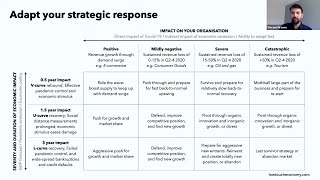
Webinar (Mark Millian moderating) with Vincent Piren (CEO, Board of Innovation) about how corporate innovation strategy should adapt to COVID‑19 and the emerging 'low touch economy'. Piren presents a strategic framework tying pandemic severity/duration to organizational impact, four innovation responses (external vs internal; short vs long term), and actionable tools (innovation blueprint) to prioritize initiatives, measure impact, and iteratively reposition organizations.
Chapters
Good afternoon. Good afternoon everybody. Good morning for some of you. Good evening, thanks for joining and welcome to this session with Vincent Pidan. My name is Mark Millian, partner at Hype Corporate Partners and I will moderate this session. First of all, let me apologize in advance because we have to be strict in time management because we have many sessions together. So I have to be to stick to the schedule and so I apologize for that. So let me start introducing Vincent. Vincent Piren. Vincent is CEO and partner at Board of Innovation. He helps big corporations to navigate fundamental shifts. It means big changes, big challenges. They have offices in New York, Antwerp and Singapore working with big corporations clients like General Electric, Novartis, Novartis Senior TD Bank, Danone and many others. And related to COVID 19, I would like to highlight that they created a low touch economy report that has been adopted by several big corporations to respond to COVID19 to build a long term strategy. It's a kind of how to navigate to the world after COVID 19. So it's very, I think it's very interesting. Regarding today's session, reinvent your innovation strategy. Vincent will talk about the need that corporations have to prove the value of innovation. Especially these days. It's important. Vincent will give all of us through learnings and tools that can help to increase the impact of the innovation efforts. And he will also share with us these tools to be applied to our organizations. So after his presentation we will have 20 minutes, questions and answers. You can place your questions in the chat box and then Vincent, thank you very much for being here and with your head whenever you want. Thank you.
Thank you for the introduction, Mark. I'm super excited to meet you all here today in this webinar on reinventing your innovation strategy. I'll jump into it right away so that we can start with the material. So I'm Vincent as Markset Partner and CEO Board of Innovation US and I'm super happy to guide you through today's presentation on innovation strategy. Maybe a bit of background about Board of Innovation. Board of Innovation was founded actually about a decade ago in the midst of the great financial crisis. And it was founded with the mission in mind that we want to inspire 100 million people to innovate for a better tomorrow. That's the very reason why we're open source as an organization and our insights and tools we create are publicly available on our website. And I'm very happy to share the insights of today with you as well. What we do on a day to day basis is shaping non obvious strategies and building New businesses for Fortune 500 companies. And a lot of those insights, as well as obvious aspects elements will come in through today's session. So what's the agenda for today for the next 20 minutes and 45 minutes overall with Q and A? Is that first of all innovation in a low touch economy? What is the role of innovation in that setup? Then second, what's the corporate strategic response in this scenario? What are actionable innovation strategies within that context? And then finally some Q and A. So that's the presentation for today. If you have any questions, please feel free to share them via the chat function so that we will take those questions at the end of the presentation and Mark will moderate those. All right, so obviously I think most of you today are in a situation of forced isolation or social distancing. And a scenario like this, as what we've seen several years ago on BBC is something that I've personally encountered several times already as well. And our working assumption is that those will go up and down for the coming one and a half year. And because of that we'll see a lot of changes in human behavior in the way on how we shop, how we work, and also how companies innovate. And because of the fact that it will take a longer time than just a few months, we think that those habits will sustain and that we will have drastical changes in society and again, how organizations operate. So that's why we created this perception and this report on the low touch economy. And obviously that has an impact on innovation. So in short, the context for this presentation is what is the response from innovation teams in that setting and how can you reinvent your innovation strategy? What many of us hope to see is that all the restrictions of social distancing, hygiene precautions, travel restrictions and limited large gatherings is something that is of short time frames. But what we believe is that actually this is something that will have ups and downs and that will be a continuous process that we will experience. Final point to this is that if you want to know more about this, we have the report, as Mark shared about this, so feel free to download it for free and have a look on what we believe the role of innovation could be within that context. What I would like to do next is actually to dive into the corporate strategic response. So what is the response to organizations if we take that as a given? So that strategic response? Two questions that pop up when we see this situation with COVID 19 is that actually is it a 6 months or an 18 months problem on one hand, and second, how will it Impact innovation. What we did is we've built a very basic strategic framework that can help you to actually define the strategic response of your organization. And as innovation managers, you're often asked to advise the core of the organization in this role. So that's why we've created this framework and I'll explain it in a minute. So on one hand we're looking at the severity and duration of the economical impact overall, the macroeconomic impact and the influence on controlling the pandemic. So basically it's the severity and duration of the economic impact where we have three different types of potential scenarios. A V curve, a U curve or an L curve, where in a V curve we have an effective pandemic control and economic stimulus. So again, an environment where innovation can thrive again after about half a year. Whereas in a more pessimistic scenario we have a longer term recession where there's a failed pandemic control and widespread bankruptcies. What we see on the other hand is that the impact on organizations can vary as well. Not only on the direct due to COVID 19, but also the indirect impact of the economic recession and on the other hand, the ability of your organization to act fast. So if we take that into account, we have three, four different types of organizational setups where there's a positive impact on your organization for going through the complete right hand side on catastrophic. Maybe prior to explaining this and diving a bit deeper on this framework, we'd love to raise the question in the chat function to understand. What do you believe is the most realistic scenario for your organization? Positive, mildly negative, severe or more catastrophic? All right, All right. There's a lot of responses coming in. Maybe Mark, can you share an overall perception on this? What do you see? Is it mostly positive or more on the other hand, I think you're still on mute.
Sorry. Yes, yes, I had the micro disconnected.
So.
So there are many of severe impacts and some good, some positive. But I would say that the situation is really bad in general.
I would say okay, yeah. And that's something that actually is in line with what we see for a lot of organizations is that there's actually quite a severe impact. And what our expectation is that most organizations will not be able to push through this crisis as we did in 2008. So this is definitely a different scenario because the difference being that in 2009 it was a financial crisis having an effect on the real economy and a lot of the organizations managed by re budgeting and monitoring their PNLs and basically the way forward, while the current situation is extremely different from 2008 because right now it's a starting point. For now, it's not a starting point from a financial aspect, but it's actually a deliberate shutdown of the economy to save lives, which is obviously a completely different scenario. And it has drastic impact not only on the economical, but also on a societal level. That being said, I'll share the complete framework with you. So with the two perspectives on severity and duration of the macroeconomic impact and the impact on your organization on top, you get a high level starting point for a strategy on each of those scenarios. So what's important for you to do is at the start take that look at where you believe your organization fits within this framework. And to give you some examples, some obvious examples, if you look at some digital broadcasting services like Zoom, they are clearly experiencing a positive revenue growth due to demand surge. You see the same thing happening in E commerce. And if we believe that, for this example, I took the scenario of a shorter term V curve, but obviously we don't know. So potentially it could be a longer term impact as well. But just to give you the example of the the framework, what's clearly the action for them is boost supply to keep up with the demand surge. So they're doing everything they can to keep up with security measures to keep up with all the technical issues. On the other hand, you see organizations in the travel industry having a catastrophic impact where they have revenue losses of more than 50% in the coming quarters. And what we can see is that a large part of the business needs to prepare for a restart since most of the organization is basically shut down and large unemployment is happening. So as a final point for this framework, definitely we will share all this material, including the frameworks, after this presentation. But what's important is if you use the framework notes that this strategic response also depends on financial strength, competitive position and industry attractivity. So definitely take that in mind when using a framework like this. Let's dive into the next part, which is your actionable innovation strategy. So if we take this strategic response and we bring that down to the role of innovation, we need to look into it and understand what is the role of that innovation team and innovation strategy. What we've seen is that there's a lot of research supporting that companies that invest in innovation and R and D during times of recession actually outperform other organizations during the recession as well as afterwards. So this is definitely an important thing to know is that although it is obviously every recession has a different impact, we do see that there's a positive impact on. Yeah, if you are actually continuing the investment or even increasing the investment in R and D. Maybe a quick poll in the prior to doing the poll I'll do a quick presentation. But what I would like to know is actually what is the role of innovation? What could be the role of the innovation team in your point of view? I'll start with some comparisons on what that role could actually look like. There's two simple comparisons. On one hand, the focus should innovation teams work on and invest in external innovations or would it be more focused on internal innovations? And on the other hand, would the investments that need to be done in innovation and mid to long term growth opportunities be lower or higher? So that's a question that obviously many of us have these days. And that's why this framework is something that can help you to make that decision. So what we see is that if you compare those two parameters you get a matrix, a two by two matrix. That brings us to four quadrants and those four quadrants help us to define four types of responses for innovation teams. On one hand you have the organizations that focus on external innovation. So more hunting profiles that want to co create business, acquire businesses by investing money in startups typically to get to build opportunities outside of the core of the business or to connect with other organizations. And then you have the organizations that are focusing on the internal side of the innovation teams and there they want to transform the organization to work remotely or to really develop new services from the inside out. Prior to explaining some our point of views or our perception on this, what do you believe is the role of innovation? Is it more externally oriented these days or is it more externally oriented?
First answers, say external. Both, Both external factors I believe more external internally. Currently equator for external. Both. Both supporting. Both internal. More external but increasingly internal. Traditional internal. Increasingly externally internal. 60% here with numbers external hospital.
All right, that's great. So I think it's quite balanced. Also a lot of responses. So that's really nice to see. I think the answer is highly dependent on the industry that you're at and also the financial position that you have. So do you have the ability to invest or not? What we see is that first of all the industry that you are in has a high impact. You can see that actually the characteristics and the impact of the low touch economy are different from tourism and hospitality up until the pharmacy industry. It's a completely different dynamic and therefore we need to take that into account when making decisions. One of the patterns that we do see Is actually that for example on the external level of innovation, is that on a global scale there is actually a decline in CBC backed funding over the past quarter. So obviously there's been impact on innovation overall. But we see that this is research by CV Insights that actually shows that the corporate participation in external startups and external ventures actually decreased with 13% over the past quarter. Which is an indicator that at least for the short run, in the short response these activities are put on hold. But I can imagine that once there's more clarity on these potential exit strategies, that it could actually potentially become quite an interesting time to do those investments. On the other hand, if you look at the more internal side of innovation, what we've seen and learned from past recessions is that actually organizations, certain organizations are successfully switching from defense to offence. So what these organizations do is not only limiting expenses and limiting costs, but actually taking the time to invest more. For example, Sanofi invested quite a lot of. They basically doubled their investment almost in 2000 to actually outperform peers in the several years afterwards, including the financial recession that came afterwards as well. Alibaba.
Vincent, Excuse me, two minutes left.
Perfect. I will speed up the presentation. You've. You'll see that Alibaba and other organizations actually have gotten quite a positive response from the SARS epidemic. That actually was a lift off for them to grow their organization over the past two years. Let's dive into the action plan. Once you have defined the role and the positioning that you want to do for your organization, you can define actual actions for the innovation teams. This is a tool that we've developed that can help you to do that. Once you've identified where you're hunting or an experimenting profile, you can identify actions. What we see is that if we map organizations like Google, they have a broad portfolio of activities that they do, mainly focused on external innovation so far. But actually when we watch the news, we notice that they're launching new initiatives more collaborative. For example, Apple and Google teaming up to create COVID 19 tracing apps. But on the other hand also internal Covid teams to respond into core business functions inside the organization. So what you see is that organizations are shifting their strategy according to this, their innovation strategy and activities according to this. As a final part, what I'll explain is the action plan. So once you have identify those initiatives, it's important to map down and summarize what you want to achieve with them. So there's tools like the innovation Blueprint that actually help you to compare and detail what you expect as an outcome from each of those initiatives. It has many components, from identifying the KPIs up until defining dedicated budgets and defined returns on investments. And it's a tool that you can definitely use for yourself as well to create a simplified overview of all your innovation activities. It has four main components, but I won't dive into detail on this one. You can download the tool on the website or just reach out to me if you want to know more. Final part of this presentation is actually on how you can act as an innovation team in a traditional role. You would say that you have to think long term in order to understand what's coming, but obviously in the current time we need to do more of an iterative way of developing a strategy. So what my three suggestions would be is first of all define the position and strategic response for your whole organization at first, then map and prioritize your innovation activities through the use of tools like this. And finally build an action plan to measure the impact and reevaluate on a continuing basis. So that's the presentation for today. If you want to have any support in doing this for your organization. Happy to jump into a call later on to answer any of your questions about this, but let's first start into the open conversation and would love to hear your thoughts and questions.
Thank you Vincent. So we'll start this question and share session just to pass the first one that has been very fast saying why not reinvent the term innovation and its role so it works again.
Yeah, yeah, I think definitely. You're definitely right. I think the role of innovation is absolutely redefined in this low touch economy. So it does make sense to rethink what the role of innovation could be. And as board of Innovation what we see is that we see more of a growth in terms of the application of innovation in the core business as opposed to or at least using core assets and applying it on a more strategic level as opposed to the original, more experimenter type of role of innovation.
So if you can please post your questions in the chat, I will pass them to Vincent. Meanwhile, I have one question because you said that people is more receptive to change, which is very good for some corporations that had part of the team which was reluctant. But the issue is how to finance that change. Because the companies that are more affected because the situation are the ones that need the biggest change, the biggest effort. But then it's the ones that say the financial situation can be critical. So it's going to appear different ways of financing that through different approaches. What do you Think about that.
Yeah, I agree that it's definitely a different scenario for organizations in different financial positions. One of the key things that I believe is important and that's also why in this presentation I started with that more corporate strategy framework, is that in order to create opportunities for growth you need to look at your core organization. Because simply put, if you start an innovation activity right now and you will not survive as an organization for the coming 12 months. Yeah, it doesn't really make sense to invest in innovation. So I totally agree that actually you should look at the core portfolio of activities, portfolio of products, look at the ones that are creating the best return and then free up some resources to invest in innovation in the areas where you believe the growth in a low touch economy will happen. So reorganizing your portfolio in order to free up financial resources is definitely a recommendation that I would have because otherwise it will not be possible to sustain that investment.
Thank you. There is another question which is very related. Do you think that large corporates will cut their innovation budget the upcoming months? You already said part of that. How to avoid that or to help them to continue innovate despite the crisis?
Yes, I do think that there is going to be an impact on the innovation budget. I think overall all budgets are being re evaluated. So I think innovation is definitely one of the budgets that is there as well. And since the return on investment of innovation is on a longer term horizon, there might even be more budget cuts in the areas of innovation than in other fields. So what's important to see is that on one hand it's. I can assume it will happen and it's already happening in many organizations. What's important to see is that what is the new role of innovation and how can actually innovation play a role on a strategic level to reposition the organization and to prepare the organization. Not to think about only the short term, about how to respond in the coming six months, but actually clarifying to the upper management that actually innovation can play a big role in the low touch economy, basically the society in the next 18 months from now.
Thank you. And then do you think that governmental financial capital injections or loans are in the way of innovation will support that will help.
Sorry, can you rephrase that question?
The financing coming from the government that will support corporations to keep innovating even without the financial that they would need. So it will be the role of governments in that sense.
I think there's an important role for governance in my opinion. You can also see that there's a lot of Differences in different countries around the globe. And I think there is an important role from the government to actually support organizations in continuing to invest in innovation. So I think for example, scenarios like in the Netherlands or in the US where there was an investment from the government into actually supporting organizations to keep employees inside the organization, helping them to stay active as opposed to reducing the amount of employees in the organization is definitely an important one. Allowing the organization to actually act and to re design the role of internal employees.
And in that sense the culture of innovation is going to be key in order to probably there will not be budget for contracting many services outside. So people will have to be more entrepreneurial in the corporations. So how can we implement this culture of innovation in corporations in order to work differently than today?
I think by itself the social distancing and remote work is already creating change in behavior. So I think just a context by itself of remote working and digital is already helping organizations to do a digital transformation in a way. On the other hand, the supporting people in empowering them with examples and success cases of how other organizations are doing this is definitely an important aspect as well. And finally in my opinion also clarifying the longer term perspective. So what you believe is the role of the organization or the role of innovation to create growth after this, after this short term impact is quite important as well. So I would say being positive by looking outside and showing examples of successful organizations how they're responding. Second, empowering people to apply it and do it themselves and then creating a perspective on the impact of your organization and sharing what you believe, turning transforming from defense to actually offense and clarifying what you believe and driving towards the growth of your organization.
Thank you. So Albert is asking that if management could realize the importance of innovation and digital transformation with the COVID outbreak.
Sorry, could you rephrase?
Management could realize the importance of innovation and digital transformation with the COVID outbreak. So if the management will change their mind related with innovation and digital transformation.
I do think so. I think the organizations that have invested in digital transformations and have developed an agile culture will probably have an advantage in comparison to others. Just because flexibility and remote working and digital collaboration are actually one of the key drivers of any transformation in any organization at the moment. So I think it is quite obvious that this is something that will hopefully positively impact the perception on the value of innovation.
Okay. And then talking about the origins of innovation that we had a very short term innovation in order to be more competitive and then long term innovation to change the business or the or the market that we are facing. So the change that companies, many of them are facing is a big change, It's a long term change. But in that situation, how can we measure the impact or even how can we ask for a budget for that? Because should we ask budget year by year, should we think in a long term project transformation? But we have still many uncertainties on the table to manage and to manage expectations of management, even investors.
I agree. And I think at this stage the uncertainty makes it quite hard to get dedicated resources and to create a plan for the coming three years. So the typical response that I would have to that is actually define a role. Ideally you can create that into your organization, but I think it's not easy and almost impossible at these days. So therefore figuring out what the role of innovation can be on the short run at first, so supporting the COVID response team, taking certain initiatives and accelerating the go to market, trying to get first short term return or impact from initiatives that you already had in your pipeline would be key. And then second, so basically proving the value and then second building a clear plan on how you are going to bring value in that low touch economy. So making a plan for the long run, but focusing on getting impact from innovation in the short run, that would be my advice.
Okay. And somebody else have more questions for Vincent. If not, I keep going. Assuming, assuming a company continues to invest in innovation, how would you maximize market feedback and validation considering that customers might be focused on their core to survive?
So to rephrase that question, so basically how you incorporate market feedback, translating a.
Question, which is assuming a company continues to invest in innovation, how would you maximize market feedback and validation considering that customers might be focused on their core to survive?
Yeah, I think it's crucial and I think the biggest mistake that could could happen is not incorporating market feedback. So my suggestion there would be what we typically do with go to market tracks that we do for several organizations is actually using the digital channels that we have today to actually increase the amount of customer validation. So through the use of digital channels, you can actually get in touch with much more and larger quantities of consumers, both our customers in a B2B setting. So doing it more iteratively and in larger quantities would be my suggestion. Because you want to get actual feedback on what customers are. Is it actually a problem that is worth solving or is it something that is just in number five of the priorities list, especially since the priorities of consumers have changed, as you said, Mark.
I see. And one final question, at least from my side is when watching to your matrix for Managing the situation with COVID 19 there are big changes in terms of the organization and the decision making process at big corporations takes some time to make some big decisions in terms of a strategy or markets to markets to focus. And some of them when you are in a positive situation and when you want to capture all of the value immediately how will change the decision process for because the companies need to shift very fast. Faster than ever positioning.
Yeah, I agree. So what's the key thing that you want to. No, sorry, could you rephrase the question?
Yes, the decision. Decision making process has to be more agile because the market is changing so fast. But change it too much and we need to reposition immediately because if not we don't have enough time to get that new position.
Yeah, exactly. So I think the answer to that question is the Building a framework for your organization to look at the long term is a starting point. But continuously looking back and seeing whether or not you need to adopt your approach within that framework is quite important. So what do you believe that you will Are you in the defend mode or are you in the offend mode is the starting point. And then continuously re evaluating whether your financial position and your industry and your your overall success rate is positive or negative will help you to make and to change your strategy. So shorter iterative strategy exercises is what I would recommend in this case.
It's time is running up. But I have one last question I would like to take which comes from Ramon Goma saying what is your forecast in which sector or industries will have in the mid long term an exceptional or unexpected transformation due to the present crisis?
That's a good question. I think the industries that will have quite a big impact today already is clearly the E commerce and retail industry. So there's quite a big shift in what's happening there as well as industries like cpg. So consumer packaged goods, this is completely changing because of the society is changing, people are more distant and purchasing behavior is changing. So that's one of the industries that is definitely impacted. What you can definitely take into mind as well is that actually the adoption curve of new products and services is increasing. So for example the adoption of digital services, digital platforms, e commerce, etc. Is rising and steeper than ever before and you see that in different areas. So overall you can take that as one of the drivers why consumer based products are actually going to be transformed quite radically in the short run. In the longer run I believe health services transforming towards more digital oriented services is definitely there as well.
Thank you. I'm really sorry, but time is up. So, Vincent, would you like to share a few closing words?
Well, I think from my end I would like to say this is definitely something that I'm super happy to support you with in the future as well. If you want to know more about, on one hand, innovation strategies and download some of the tools that you've seen today, feel free to go to our website and download tools there or dive into the Low Touch economy report or some of the tools that we've created for that area. So feel free to reach out on LinkedIn if you cannot find what you're looking for or if you have a specific question on how this could impact your organization. Always happy to jump into a conversation.
Thank you Vincent and thank you all for your active participation. And please keep enjoying the event and also invite you to join the next round. There are many interesting sessions. So thank you very much to all and bye bye. Keep in touch. Thank you.
Bye bye. Bye bye.
Thank you, Vincent.
More from Zaur






An Immersive Workshop to Calculate the ROI of AI Strategy - AUTONOMOUS session

Predict, Optimize, Decide: Enterprise Decision Making For The Simulation Era - AUTONOMOUS summit


AI Insiders podcast ep. 9 - Not so cookie-cutter: Consumer Choices in the Age of AI

