Run your own innovation strategy sprints - Board of Innovation
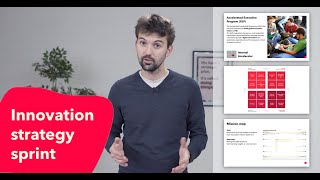
This transcript is a webinar by Vincent from Board of Innovation describing their five-day Innovation Strategy Sprint: a compressed process to define an innovation mission, design and prioritize innovation activities, validate with stakeholders, and secure executive commitment and KPIs. The video explains the goals and daily agenda (Day 1: mission synthesis from interviews; Day 2: map and select activities via an Innovation Matrix; Day 3: stakeholder validation; Day 4: detail activities using an Innovation Blueprint; Day 5: executive pitch and commitment). It also walks through three practical tools (Innovation Mission Map, Innovation Matrix with four archetypes and 16 activities, and Innovation Blueprint with scope, people, resources, and action plan).
Chapters
Hi, I'm Vincent from Board of Innovation and in this video I'll explain everything about the innovation Strategy Sprint. The Innovation Strategy Sprint is a short and intense way to help you to shape your innovation strategy so you can focus your efforts on activities that matter the most. Board of Innovation is an international innovation agency with offices in the US and Europe. And and we basically support large organizations, often Fortune 500 companies, in designing and executing innovation strategies. You can see some of our references below. So what's this webinar all about? There's basically three key things. Why should you care? How can you do it yourself? And what tools can you use? If you want more information about each of the steps or the different tools, feel free to visit boardofinnovation.com sprint. You'll find all information out there as well. So, first stop, why? Well, we've noticed that innovation is very hard to structure. Innovation is often compared to a rainforest where innovation activities happen everywhere around the organization at any time. Whereas executives often ask innovation to be more structured, they want to apply traditional methodologies just like normal crops, in order to be able to control innovation. And this is something that's very hard. So that's why we've set out some clear outcomes that we want to achieve with this Innovation Strategy Sprint. The goal for you is to have a clear innovation mission, an aligned portfolio of innovation activities, and a clear commitment towards clear KPIs. So an innovation strategy definition is, in our opinion, an innovation strategy is a commitment to a common innovation mission and a set of structured activities in order to support the growth of the organization. You can basically summarize it in three key elements. Define design and decide. Before those three elements you can have a discover and afterwards a doing phase. So let's dive deeper in those different phases. So how can you actually do an Innovation Strategy Sprint? Well, traditional strategy is often a very lengthy process split up in different phases across many weeks or even months. And out of the experience that we had with doing different innovation strategy exercises, we noticed that we want to put more emphasis on actually doing rather than designing the strategy itself. So this allows you to get way more learnings out of experimentation and doing than actually planning and eventually noticing that it's not aligned with the actual activities. So the Innovation Strategy Sprint is a very short five day activity that helps you to execute faster. So what are the different elements of a sprint? Well, you have the defined stage, the design stage and the decide stage. And at the end of the week we iterate on the design and the decide stage. So in Short on day one, you'll identify your mission. Day two, you'll identify the key activities that you want to execute. Day three, you validate your activities and your mission with some key stakeholders. On the fourth day, you select and detail out each of the activities that you've prioritized. And finally, you have top executives validating and committing to everything that's been done in the previous days. So let's dive deeper in each of the different days. Day one is the define stage. So the goal of this stage is to summarize insights from interviews and craft an innovation mission statement. How do you do this? Well, it's basically by talking to executives, to anyone in the organization, people involved in executing innovation towards people managing or sponsoring innovation. So try to get an overview of anyone that is involved in innovation itself. You can summarize these insights in one day. So in the first day, if you didn't do some intake with some key stakeholders yet, but make sure to do that to then in the end of the morning to summarize your insights on a mission map, I'll explain you what the mission map is in the end of this presentation. In the afternoon, you can actually take those insights and turn them into an innovation mission statement. Herefore, you can also use the Innovation Map. So the mission map has actually the goal to summarize your key insights of your different interviews with all those stakeholders into a clear innovation mission statement. And the approach and the reason why we created this tool is pretty simple. It helps you to ask the right questions. On the other hand, once you've asked all those questions, you'll be able to summarize the most important elements into one simple overview and one innovation mission statement. There's more information about this tool and a step by step overview at the end of this video, but also in different videos on the website. The next step, Day two is the Design day. The goal of this day is to create a clear overview of current and future activities related to innovation. The way on how you can do this is by organizing group sessions with key stakeholders. Basically in the morning you want to map out the current activities, what have you been doing over the past years? And in the afternoon you want to select the activities that you think will be the essential elements to actually execute on the new mission that you've created in the first day. A tool that you can use for this is the Innovation Matrix. The Innovation Matrix allows you to structure and compare innovation activities within large organizations. As mentioned before, it works in two phases. The first phase is mapping the current activities what have you been doing so far? And the second stage is taking a new innovation matrix and mapping out what you think is essential in order to execute on your innovation mission statement. More information about this tool as well. At the end of this webinar on day three, you'll decide you'll invite key stakeholders to get feedback on the mission and activities that you've identified. How does this work? It basically works as in a simple pitch where you explain whatever you've done so far to executives and get their feedback. So this is something that can be done in, let's say, half a day where you explain your mission and activities and afterwards you validate and prioritize them. It's important to invite stakeholders from various parts of the organization. At this stage. Innovation on itself is not good enough. You need to have strategy or business involved as well and hr. On the fourth day, we'll do a first iteration on the design stage. The goal is to create a structured overview of key elements to execute on those different innovation efforts. This is typically a work session where different people from the innovation team come together and do in the morning a deep dive on each selected activity and basically a group review on each one of those. In the afternoon, you'll take the time to finalize a pitch presentation so that you are ready for the final and fifth day. The way on how you can do that deep dive on each activity is by using a tool like the Innovation Blueprint. Let's take a look at the Innovation Blueprint. The goal of this tool is basically to create a structured overview of the key elements of an innovation activity. So it summarizes four essential blocks of an innovation activity in one canvas. This allows you to compare, for example, an innovation accelerator with a community of practice. So this is a simple way to say these are all the building blocks of a proper innovation activity. Then we come down to the final day. The fifth day is the moment where you make the final decision and you commit towards going forward. The goal is to create commitments to a clear innovation mission and KPIs. You really want to go ahead on a portfolio of activities that you've identified in this sprint so that you can start executing. The approach that you take here is to do a pitch for executives. So you need to have the top of the organization involved because they will also be supporting or sponsoring these activities. The agenda is simple. In the morning, you pitch, you gather feedback and you start doing so. This is the overview of the innovation strategy sprint. And again, the key reason why we've shaped this is because we want to help you to create a clear innovation mission, an aligned portfolio of activities, and a commitment to clear KPIs. So now we come down to the final part of this webinar. An explanation or a step by step guide to each of the three tools that I've explained. You can find more information about each of those tools on the website. Let's start with the Innovation Mission Map. As I've explained before, the Innovation Mission Map summarizes your key insights from different interviews with different stakeholders into one clear Innovation Mission statement. The essence of the tool is to ask the right questions and to summarize them, because otherwise, very often, interviews go in all directions and you're not able to summarize what you've actually learned. And you need those insights in order to shape that mission. Let's take a deeper look. The Innovation Mission Map is split up in two main parts. You have the drivers and you have the mission statement itself. The drivers can be split up in external and internal drivers. What we mean with drivers is basically the drivers why you want to create this innovation Mission. Why do you want to change? Why does your organization want to grow or change its activities? So if you look at the external drivers, the first section explains opportunities. So what we want you to do is to ask all the different stakeholders that you interview about several specific questions. In this case, for example, what technologies could support the growth of your organization? Or what new markets could you enter? Other questions you need to ask are what could disrupt you in the coming five years? Or what could challenge you already in the next years? So the goal is that by asking these questions, you get a first overview of the drivers, the external drivers that might change the market that you operate in today. On the other hand, you also need to take a look at the internal drivers. Why is your organization interested in changing based on your corporate strategy or based on the role of innovation? The corporate strategy obviously influences the innovation strategy. So that's why you need to ask questions like what is the long term strategy of the company? And also what is the short term, meaning the next year strategy of the company? Finally, it's important to understand the role of innovation today. For example, questions could be like, what is the central role of innovation? And what is the decentral role of innovation? So those four blocks allow you to get a better view on the external and internal drivers on why you create an innovation mission statement. Once you have all that information, we can zoom in on the centerpiece of this tool, which is actually the innovation Mission. The Innovation Mission contains out of two parts. The overall mission, which is a one sentence description on what you actually want to achieve, and three key metrics that summarize the objectives of this mission or KPIs, let's say. So there's more information about this tool in a separate video on the website, but again, feel free to reach out to us if you have any questions or on the use of this tool, or if you have difficulties with using the tool yourself. Let's jump to the next tool, the Innovation Matrix. We've developed the Innovation Matrix because of this simple sentence, which is basically the essence of strategy is choosing what not to do. You want to focus your efforts on what matters most. So that's why we've developed the Innovation Matrix, which basically allows you to structure and compare different initiatives within a large organization. You basically apply it in two parts. You map out the current activities, what have you been doing so far over the past years, and where do you want to go to in the future. Let's take a deeper look at the tool itself. The tool structures different innovation activities based on two parameters. The first parameter is the focus. Are you focusing on internal assets or external assets? Are you focusing on people first or business first? The second parameter is the investment level. Are you investing a lot in this activity or are you investing a lower amount? You could also compare it with, is this a bottom up or top down initiative? If we look at these two parameters, we can identify four types of organizations. The first type of organization is an explorer. They have an external focus and they do first lower investments. They're basically exploring what's out there and they want to discover connections with the outside world. The second type is the hunter. They hunt for new business. They really look for other parties, other organizations, other startups or corporates to work with, to acquire or to invest in to really get business going straight away. The fourth type is the experimenter. They have a more people focused and internal focused scope and they go for a lower investment at first. So they just want to spark the interest and learn new methodologies and learn new behaviors to then finally come with the building type, which is a type of organization that wants to do innovation activities from the inside out and that literally wants to transform the full organization. So these four archetypes have sub activities underneath. So if we zoom in on the full matrix, we can identify 16 different activities that make most sense for each of those types. This is what it looks like. So let's take a deeper look on each of those different activities. The first four activities are the ones from the explorer type. The first activity is a co creation session. A co creation session is a short ideation with customers or partners to turn mutual problems into ideas. A second activity for an explorer are a co experimentation track. Often the next step after a co creation where you do a joint test between two or more organizations to validate the solution fit of an idea. Another activity you could do is to actually go out and scout startups that you actually think that are relevant for your organization. You want to validate the potential and engage with their founding members. If this is something that works for you, you can also start with an external incubator. And the external incubator is basically a program that supports the validation of early stage external startups. So you can see two types of activities. You have co creation and you have the actual scouting. So joint efforts or actually externally looking for what's out there. The second cluster of activities are the hunters. So the hunters again have four activities that they could do. The first one is a co development track. This aims to validate the market fit of ventures done by two or more organizations. So it's important that you do basically do validation with joint efforts from two partners. If this works out, it often turns into a structured partnership. A structural partnership is a formal collaboration between two companies with the aim to launch multiple joint ventures. Licensing is often something that can be seen as a part of this as well. Another activity is the external accelerator. This is often an environment where you can support the growth and evaluate the value of external scale ups. And finally you have a venture fund. A venture fund invests in external opportunities that could create the growth outside of the core of your organization. So now we've covered the two external focused types of types. So let's go to the right side of the innovation matrix. Then we start with the experimenter. The experimenter has four different activities, starting with a design sprint. A design sprint is a short track to answer business questions through through designing, prototyping and testing with customers. On the other hand you have internal incubators, incubators basically separate intrapreneurs, entrepreneurs within a large organization to go outside of the organization and to validate the solution fit of their ideas. You also have innovation trainings which, which is generally a short track where you want to grow the knowledge and interest of employees. And finally, when employees are interested or they understand a certain methodology, you can actually help them to build a community of practice. This is often a voluntary army. That's some sort of a community that has cross functional capabilities and have become some sort of innovation Ambassadors. So from understanding they actually become a community of voluntary enthusiasts or ambassadors. The last type is the builder. The builder has again four different activities. So an internal accelerator is a virtual space to grow internal startups outside of the core organization. Whereas an innovation lab is a separate entity that actually hosts internal ventures with very high potential before they are profitable. So a lab is literally the space on where it's basically the area where very important or interesting ventures can actually have the space to grow before they are profitable. Then we have the center of Excellence, which is a formal group of experts that coordinate innovation activities to embed innovation in the organization. This is often the next step after a community of practice. And then finally we have an innovation transformation, which is a team generally in the center of the organization. And they represent some sort of the innovation leaders responsible for knowledge development and the transformation of the organization towards innovation. So with this information and with this matrix, we were able to map out different organizations and create some sort of cases on how different organizations and corporates structure innovation. What's interesting to see is that we can identify different patterns. For example, and this is something that's also confirmed by CB Insights, is that actually companies are generally 2.8% or 2.8 times more likely to build than to buy. So organizations are typically focusing on building rather than hunting. On the other hand, we've also noticed that the overall maturity of innovation is growing, so more hunters and builders are rising. Also, within different industries you see different patterns. For example, in healthcare, most companies have a mature hunting capability, but actually struggle with building in house innovation capabilities. In the financial industry, we see that this industry grew through building in house capabilities, but that today the focus is often shifting towards more hunting capabilities. Let's dive into the final step, the Innovation Blueprint. The Innovation Blueprint is a structured overview of key elements of an innovation activity. What we want to do is to structure and summarize the four essential blocks of a successful innovation activity into one canvas. Let's zoom in on the tool. So the Innovation Blueprint is structured in four essential elements. As I've explained before. The first one is a scope. What are the results and KPIs you want to achieve with this activity? And what is the horizons? Is it incremental, adjacent or radical innovation and the type of innovation or innovation activity you want to do? The second part is who will actually execute this initiative? You need to identify the governance and the team that will execute it. And finally we have the resources. You need funding or location or different assets to support the activity. To be Successful. Finally, once you've identified each of those different blocks, you can build a plan with clear milestones on how you can measure the success of this activity. Let's zoom in on each of the different parts. If we look at the scope, there's four elements to fill out. The first one is what results do you want to achieve? The second one is what type of horizons do you want to focus upon? Can you, for example, map out some example cases or projects that you've been doing over the past years and see whether they fit within this program? The third element is the KPIs. How will you measure the success of this activity? And finally, if we look at the innovation matrix, what type of activity is this? Then we move on to the next two blocks. In terms of people you want to understand, how are you going to govern this activity? What is basically the operating model? Is it a disconnected activity? Meaning is it completely outside of the organization? Is it an internal activity? Are you going to host this activity inside one business unit? Is it a separated activity? Is it slightly disconnected from the organization? But still there's some reporting structures that go to the center of the company? And finally, is it an integrated activity? Which means is it, for example, center of Excellence, which actually supports all the different business units? Then we call this an integrated activity. Then the next question is the team who will manage and execute the initiative. It's important to also identify the time that they should dedicate, because that's important to tell to them to know what they can expect in terms of time investment. There's three types of team members. You have a sponsor, you have a lead or owner of the program, and you have a team. Then we have the resources, aside from the scope and the people. You need additional resources, right? You need funding. So clarify the budget that you have available to execute on the program. And finally, what additional assets do you need? This could be, for example, a CO working space or a a lab that you need. This can be any type of assets that you need to execute on a program. Finally, we zoom in on the action plan. The last step of this blueprint is focused on going towards actions as quick as possible. So what you see here is a timeline on which you can identify the different phases that an activity will go through so that you're sure that you can measure the success of this program at any stage or at any given time. Make sure to go to boardofinnovation.com tools. You can download this and many other tools for free on the website if you have any questions. Feel free to reach out. We're happy to help.
More from Zaur






An Immersive Workshop to Calculate the ROI of AI Strategy - AUTONOMOUS session

Predict, Optimize, Decide: Enterprise Decision Making For The Simulation Era - AUTONOMOUS summit


AI Insiders podcast ep. 9 - Not so cookie-cutter: Consumer Choices in the Age of AI

