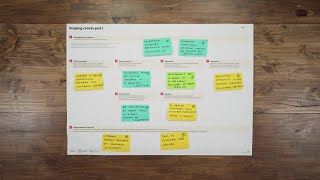
Mike from Board of Innovation walks through the scoping canvas, an eight-section tool that teams use at the start of an innovation project to align on the challenge, target market, assumptions, and success criteria. The canvas stays live and gets iterated as the project moves forward, helping teams focus scope within their time and resources.
Chapters
Hi, I'm Mike. I'm a senior innovation consultant at Board of Innovation. I come from a design, business and innovation background and I help corporates to really speed up their innovation process as fast as possible in lots of different ways. Okay, so moving on to the scoping canvas. This is a really important tool to align your teams at the beginning of a innovation cycle or before you've really begun the work and got into the. Into the hard work. Why should you use this tool? It really aligns the teams on the strategic intent of the project, gives you an overview of what you need to include all the critical aspects before the project starts, helps you highlight some of the pitfalls, some of the potential problems you might face, and really make sure everybody is on the same page, quite literally before you get stuck into the project. So how do you use the tool? First of all, you need to look at your challenge. This can typically be a how might we statement challenge, or perhaps you've been given a scoping topic from a strategic point of view. First thing to do is to define what your how might we challenge or your topic area is for your. For your project and to make sure that it's narrow enough and not too broad to give you a correct scoping. So you don't want something that allows you to do everything. It needs to be realistic within the time and the resources that you have to execute your project. Secondly, after that, you want to look at why this challenge, why are you actually looking at this? Again, this relates more to the strategy side of things. You need to clearly define what it is you're doing and why it is you're doing. Why is this the right team and what are the strategic intent behind and driving it. So spend five or ten minutes taking a look at this. I suggest you work individually first of all, and then work together as a team and challenge each other on what you've come up with. And then you can add and remove items as you go forward. Next on the list, number three is who do you want to create value for? So if you have an idea of your target market segment, it's a very good idea to define that already. Again, that gives you some more specific inputs. So it means that you're not trying to address everybody. You're going to have limited time and resources, so make sure you define those early on. Then you want to look at the current situation. So what is the as is situation at this point? This could be some customer journey information, perhaps some Personas, maybe you've even gone out and hopefully spoken to some customers at this point, make sure you write down what you know already. Are there any pains, any problems existing already? Are there any alternatives as well? So very important to define that early on. Then on to number five, this is your critical assumptions. Maybe you already have some assumptions or some hypothesis that you know that you will need need to test or perhaps you've already tested already. So again, any information around assumptions that you have at this point is a very good idea to define it. And again, this will be updated as you go through into your experiment design phase. But any early signs for that is a really good idea as well. Then number six, nice and open. Are there any open questions that you have at this point? Are there any big unknown unknowns that you have that you will need to be researching into as you go forward? Again, it's very critical to get these out now. Then you'll know before they arrive that you need to address them as you go forward. And again, make sure you update this template as you go forward. Don't just do it once and then forget about it. It should be up on a wall in the project room so you can update it and see where you're at as you know more as you go through the project. Number seven is goals and successes. So how do you actually know when you're successful? When do you know when you need to stop? Every project has a limited scope, time, budget, resources. Your project will be no different. So really define now and update when success is met and when you can stop and say that you've done a good job and that you can move on to the next project. And then finally number eight, are there any existing initiatives that already been taken place? Have you already worked in this domain area? Is there existing data that you can build on? Again, looking at assumptions that may already be validated, customer data, Persona data, have a quick list down of resources or areas in which you might be able to build on other people's research done already. So define those as your final steps. Once you've done that, you'll be in a very good position as a project team to then move forward into the innovation process and you can update this as you go along. Some tips and tricks as already mentioned, make sure you keep updating this poster and this template. It shouldn't be a static thing that you just do once. You need to think about it continually as you go forward. As you know more, make sure you update it. It'll really align the teams. If the scope changes in a project, this is the place to update it and you'll all be aligned on the same page. Make sure that you challenge each other on the inputs. Sometimes hierarchy within the groups can mean that other people have more weight to their arguments or their post. Its in this case. But feel free to really challenge them and make sure that you are really moving in the right direction. If you don't agree with something, that's absolutely fine to challenge it. You have a nice open platform in which to do that, so you making sure that you really do have the correct scope and you set yourselves up for maximum success. Thank you for listening. And don't forget to check out the Board of innovation website www.boardofinnovation.com tools where we have a whole bunch more tools ready for you to help you in your innovation process.