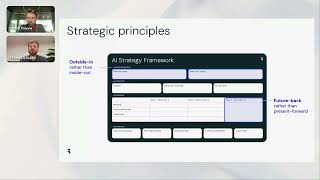
A framework for building real AI strategy, not just collecting use cases. Start outside-in from market changes, then future-back from your desired end state. Four steps: diagnose AI drivers, define your role, create a roadmap, enable capabilities.
Chapters
So when we think about AI strategy, let's first get something off the table. So AI strategy is not a sum of use cases. And we see that all too often that a roadmap consists of crowdsourced or bottom up sourced use cases from existing functions, existing teams, and they then get prioritized and roadmaped. And that is the AI strategy. That is an AI roadmap, but in our minds, not a strategy. So what is a strategy for us at least is a coherent blueprint of how to win in an AI native world. So if we unpack that for a minute, it starts with forming an idea, a vision of what that AI native world is in your industry, how your consumers will change, how market dynamics will change in your industry, then creating a coherent blueprint of how to win in that world, what role you want to play within that, and then from that, building a roadmap and a plan towards that. So if we work through this step by step, this is the AI strategy framework that we use in our work, which starts with the AI market drivers at the top, the elements of the AI strategy itself, the AI roadmap, and then the AI enablers. But I'll quickly take you through all of them. Before that, just wanted to highlight two important principles for us. And the first one being that this is an outside in approach. So we see a lot of strategies starting from the current way of working and adopting an inside out approach. So we deliberately start from what are the AI market drivers, what will change in your industry because of AI, what won't change, and then using that as an outside in view to form your strategy against. And then the second principle which is super important is a future back approach. So rather than a present forward approach, where again you start from the current way of working and just deploying AI into that current way of working, is that you imagine what the new system would be in that wave three for your function, for your company, or whatever the context is that you're operating in, and then working backwards from that, so that each step you take in wave one and wave two builds up towards the vision of wave three, rather than just optimizing the current way of working, which might completely be irrelevant in one or two years from now. So an outside in view and a future back approach do strategy.