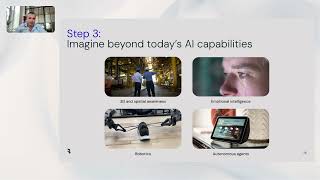
This is a spoken presentation about setting innovation strategy using a "future-back" mindset. The speaker recommends hunting for maximum complexity (e.g., hospitals), targeting previously impossible problems (e.g., peer-to-peer car sharing), imagining future AI capabilities (3D/spatial awareness, emotional intelligence, robotics), and designing AI-native operating models that reframe human/agent roles and automate tedious tasks (e.g., museum archivism).
Chapters
So the first step we talked about was hunting for maximum complexity. So thinking about where in your industry are there problems that can't be solved just because there are so many people, interactions and stakeholders, all the coordination, where has there been issues in prediction and just data overload? And then where are there tasks in your business that have been incredibly hard to automate? So one of the areas we've seen a lot of innovation and interest among clients actually is in things like hospitals. So they're massively complex systems. You have so many different types of people, so many different types of institutions, partners, pieces of equipment and such high safety needs. And so it's thinking about like, what's the hospital or what's the most complex place within your business that you could look for. The second thing is looking at things that were previously impossible, that people have tried a bunch of times. This is really about finding the things where they were just hurdles to make things happen that seemed strategically good but were just super difficult. Take the example of peer to peer car sharing. There have been a bunch of companies that have tried this over the years and none of them have really managed to make the economics work. There's all sorts of issues in terms of how do you verify people, how do you know if there have been damages, just managing all the cost of the business. And there's a few different steps in that process that you can see. Things like identity verification, things like actually logging when a car has been returned, that actually using generative AI, you could imagine how you could actually reduce the costs for running that type of business. So I don't know if anyone's going to try it again. We'll see. Maybe people are burned. The next thing is actually imagining beyond today's AI capabilities. So obviously we all know it's, it's pretty astounding what can be done by some of the latest AI tools and feel like every week something comes out that's new, there's some new models, some new capability, and there's all sorts of stuff coming down the pipeline. I think it's really important just to think about how early we are in this journey. Imagine a few years from now, and I'm not going to say how many years, but a few you could have models that would actually have 3D and spatial awareness so they'd be able to understand what's going on around them in a room, in a factory, in a stadium. So imagine what could you do if that was possible. The second thing is people always say, oh well, AI can't really think and Understand emotions. I think actually a lot of the research is showing that it was getting much better and better. And actually a lot of people actually aren't that emotionally intelligent too, so I think it's worth keeping in mind. But a lot of the research shows that in the future AI actually will be emotionally intelligent, maybe more so than humans, who knows? And we'll be able to understand sentiments and we'll be able to convey sentiments itself too. Robotics is a huge topic. Obviously a lot of what we're looking at in generative AI today is really operating in what we'd call the knowledge realm, right? So it's text, it's videos, it's image, it's generate a PowerPoint, all these kinds of things. It's just like digital stuff, but in a software realm. The next wave we see is actually that generative AI will be shifting into the physical realm from the knowledge realm, so getting into manual work, but also day to day tasks. This is a Google DeepMind robot here, which is learning to tie shoelaces, something that was previously impossible and is actually quite astounding if you think about the complexity of that task. It's the type of thing that people always said robots wouldn't be able to do, and now they're doing it. And then the last thing is just thinking about everything through an autonomous lens. This is actually quite simple. So if you think about the idea of like a smart home device, I would always be talking to it, right? I would say Alexa or Siri, can you do this? Can you do that? I think the mindset shift really is that we need to start thinking about, start thinking about basically what happens if they talk to you, what happens if they're instructing you, what happens if they're prompting you and reframing your role from being a user to a participant in a system. Maybe I'm going to get home and Alexa is going to say, hey, Jeff, you haven't taken your shoes off, you're making a mess. Whatever it might be thinking about ways in which agents are actually thinking and acting on behalf of you, hopefully, but actually instructing you rather than you instructing them. And so it kind of turns on its head the idea of everyone needs to be a prompt engineer because maybe they're going to be prompt engineering you in the future. And then the last one is thinking about imagining your AI native operating model. So I think often this comes down to, once you have an innovation in mind, what's the best way to operate that and how can you, what impact does that mean on the roles you need and the ways of working and how humans work with agents and all that kind of stuff. But if you think about this as a tool for ideation, often it starts with, where are the biggest opportunities to save time and money? And what are the most tedious tasks that no one actually enjoys doing, but actually have to happen? So if you think about the world of museum archivism, archivists, archives in museums, I was talking to a friend recently who works for a museum, and a lot of museums have had a lot of issues recently with staff stealing stuff, because a lot of the stuff is actually not cataloged properly, it's not secured. And the reason for that is because nobody wants to do that work. Nobody actually wants to catalog these things. It's super boring. And a lot of the people who work in the archives, they're kind of not interested in doing rote manual work and they're not willing to pay people to do that. So it's things like that. If you could imagine how you could actually automate or semi automate some of that process, that would actually be a good way of figuring out some ways into what an AI native operating model will be.