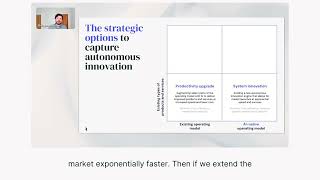
Speaker argues AI is far more than incremental productivity: it enables reimagining operating models and products. He presents a 2D strategic framework (vertical: what is delivered to market; horizontal: how it is produced) describing four options: 1) leverage AI to improve existing products and operating models (productivity/cost efficiency); 2) redesign the operating model for "system innovation" or AI-native innovation engines to enable exponential speed-to-market; 3) create AI-native products/services within current operating models to improve customer experience and drive revenue; and 4) pursue breakthrough innovation that combines new AI-native products with new operating models to potentially create or redefine industries. He recommends a deliberate portfolio approach across all four options rather than a single focus.
Chapters
AI is not about writing our emails a bit faster or a bit better. It's going to be about completely reimagining the world that we live in, as well as how we operate within that as a business, as well as each of ourselves as individuals within that. So within that strategic framing, I want to take you to what we see as the strategic options to capture the opportunity of autonomous innovation. Beyond looking at efficiency gains and productivity gains, I want to take you to this overview which will list on the vertical axis what we deliver to the market, so the products, services, experiences that we deliver to the market, and on the horizontal axis how we get to make them, and basically the operating model that underpins them. Splitting that out in a bit more detail. Detail starting on the vertical axis with leveraging AI for the existing types of products and services and operating that within the existing operating model. I would say that's generally where most of the current focus and investment is going into, which is productivity upgrades to either existing products or the existing operating model, with the key targeted benefits being cost efficiency. While there is obviously value in doing that, we want to expand the horizon and we think that's by no means unlocking all of the value that AI and autonomous offers. So on the side of the how we are organized, we think the discussion should be much more around envisioning what the AI native operating model for innovation is in the future. What we would call system innovation. How can we envision a new autonomous innovation engine that allows for market launches at exponential speed and success? What if, for example, in consumer goods we could go from identifying a new trend to having a new product launched in just five days rather than two years? We will never get to such a future operating model if that was something that we wanted to build by optimizing the existing parts in the current process, doing insights slightly faster, generating concepts with the help of GPT, etc. You will need to rethink the entire operating model, including sourcing production, go to market, etc. The the key benefits here being cost efficiency, driving revenue growth, but also especially market entry philosophy of being to market exponentially faster. Then if we extend the horizons on what we deliver to market, I think the interesting opportunity is to envision what the innovative native products and services could be if you were to think from a blank sheet of paper and what they would be in your industry. So we're talking about product innovation, launching AI products and services that would deliver a better customer experience, but that would still run within the current operating model. And if we were to combine both and be even bolder. We would be looking at breakthrough innovation, which is launching entirely new AI native products and services operated by a new operating model that would disrupt existing market paradigms entirely. So the key benefits here being that they would either be industry creating or industry redefining, and obviously being focused on revenue growth rather than cost efficiency. So within this overview and the four strategic options that we see to capture autonomous innovation, there is no right or wrong. I'm not advocating to just focus on both one of the four the advice is to build a deliberate portfolio approach across all four to have a clear vision on the future and then build that portfolio around that.