Surviving the Pandemic: How to innovate in one of the hardest hit industries
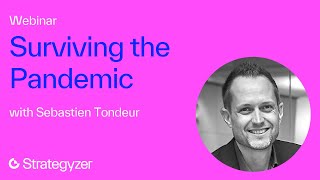
Webinar-style interview (Jan 20, 2022) with Alex Osterwalder and Sebastian Tondure (CEO of MCI Group) about how an events company navigated and innovated during the COVID-19 pandemic. Core themes: exploit vs explore portfolio thinking, early crisis priorities (team communication, preserving cash), creating a separate accelerator/holding entity to enable experimentation, business-model shifts (commission → fee/time, owning productions), and cultural approaches to failure (iterate, destigmatize). Practical advice centers on disciplined communication, freeing CEO time for exploration, and lean validation before scaling.
Questions this video answers
January 20, 2022
Sebastian Tondure, CEO of MCI Group
MBA from Northeastern University (Boston, USA).
Presence in 31 countries and turnover of 434 million (currency implied CHF/euros—source lists 434 million).
Chapters
A quick kind of introduction or reminder for some of you who know our tools to put the framing in Exploit explore. Exploit meaning managing the existing exploration, looking at the future and then talking with seb, we'll see how do you actually manage these two things in a pandemic through a crisis? So for those of you who've been following us, obviously Strategizer is very well known for this exploration part. How do I come up with new business models, new value propositions and test them? That's how any idea starts, it's how any startup starts, it's how any innovation in an established company starts. But then of course, once you've proven that this idea works, you start to scale it, to grow it and it becomes an established business. And once you are an established business and we'll get back to this theme, we've had this theme with Hubert Jolie, we'll talk about this with, with Seb as well. Well, the challenge is it's not enough to manage what you have and then how do you explore at the same time and even more when you're in a crisis, do you have any capacity to explore? You might remember, for those of you been with us with, in the webinar with Hubert Jolie, he said, well, you know, the beginning, when they started the turnaround, it was all fixing the exploit engine and only then starting to explore again. Right. So there's some priorities you need to set. Now one tool we came up with to help with this thinking around exploit explore is the portfolio map. So just quickly introduce this and we might get back to it when we talk about exploit explore and managing through a crisis with seb. So when we look at the businesses that we have, business units, products, we look at on the one hand side, the return could be margins, could be revenues, could be profits. You choose. Right? That's the financial part. Easy. But then of course we need to look at death and disruption risk. So any business, when it starts, it's a small fragile plant and of course we want to grow it so it becomes an established business. But now if you're in the travel industry or the events business and the pandemic hits, it's not just that the disruption risk gets bigger, it actually is real and there so revenues will go down. So how do you fix this and make it go back up here? So you need to manage your existing businesses in particular, thinking ahead, some disruptions can be avoided when you reinvent yourself early enough with the pandemic a little bit more difficult because it's a one in 100 year event right now. That's one part of what you do as a leader. The other part, and I think we'll be able to talk about this a little bit as well, is exploration where you don't look at the existing revenue, you look at the potential that an idea has expected return. Oh, this is an idea that could make a lot of money or is this an idea that is really small? You need to look at that, but you need to make sure you don't believe your vision, that you realize you need to test it. That's why we bring in the second type of risk, which is the innovation risk. So we need to accept that when we start with an idea, it might actually be just a hallucination and we need to test it so it looks great on paper, great in the spreadsheet. We need to make sure that it's not a hallucination. So we test it. Reality hits. We're able to reduce the risk by testing, adapting and iterating and making sure that the potential is big enough until we transfer it to the exploit business. So big topic, exploit explore and a very challenging topic when you are in a crisis. When a pandemic hits, can you explore why you're fixing the exploit engine? Is that maybe that burning platform, even a accelerator innovation? We'll get back to that.
So we're going to move on to the next section now. This is the Invincible leader of the month and I'm very pleased to be announcing that this is. There we go. There's the man himself. I'd like to do a bit more of a formal introduction for you if you don't mind. Sebastian Tondure is the Chief Executive Officer of mci. He holds an MBA from Northeastern University in Boston, usa. Under his leadership as MCI Group is now gone from a Swiss organization to a global organization with a presence in 31 countries, making it one of the biggest event groups worldwide. With the turnover 434 million. When not working alongside his MCI team, he spends time with his family and enjoys trekking and trail running in the mountains. He's in the right place now and he even climbed Mount Kilimanjaro and has done the well known Patrull des Glaciers. I'm sorry, my French is very bad.
You got to work on your French a bit over there.
Massively so. Welcome and thank you. It's an honor to present you as the invincible leader of the month.
Excellent. So Seb, thanks for joining us. And you know you started out in the event business. Your business has grown beyond that. But when the pandemic hit, and that must have been a pretty big shock, right? It's a one in a 100 year kind of thing happening and affecting your industries. What were the first thoughts that went through your head when such a big thing hits?
You know when it hit, it's what happened is the answer I always gave to the question, what would keep you awake at night? And I said, you know, really nothing except it would be forbidden to meet physically. And I never really thought it would ever happen. I, I was floored. And I never thought that socially we would accept in the world to be in a lockdown situation. So a lot of my principles were also shaken.
Wow. Your wildest nightmare becomes reality. What's the first thing you do as a leader in this kind of situation?
I mean, the first thing for me it was very, very quick. It was, it's teamwork, like gathered with the team and talk, talk, talk. That's really what we did. We gathered with the management team, we shared our feelings, our emotions. How does it make you feel? Not what's the business going to do, but how do you feel about this? What are your beliefs? So it was not really about data, I would say it was about beliefs. We really spent a lot of time and then we created a sequence to make sure it was not only the management team but, but then, you know, the top leadership team and then the entire company. So we created a cycle of communication with everybody. Very interactive, any, you know, chat rooms, et cetera. So every month, you know, top leadership, top 30, and then entire company, so realm cycles. So there was predictability in the communication cycles in the company.
Did you get any sleep at that time? Because you just said it's one of your like, you know, worst nightmares keeping you up at night. So how long did it take, would you say, from the beginning when the pandemic hit, where you say there was some stability again in your organization?
I don't think the stability still today. Yeah, but what happened there was three months, I would say, where we just, you know, had to face the brutal facts, you know, as it says in one of my favorite books. And we had, we had to have everybody realize that, that we had, you know, there's going to be massive change. So we communicated lot on that. So we created a little bit of a, of a system. We called it survive, reset, thrive. And we always came back to those words. But we did openly say it's a survive situation. To create that context, it was really necessary. But then we said, but what Happens after. That's normal. Right. It's. It's part of the process. After the survive, you get into a reset. Yeah. Based on the new context. And then, you know, if we're right, we'll thrive. We're not there yet. Right. So survive is done, but the reset phase is definitely not done.
Before we get kind of looking forwards, would you say? So one of the things, you know, we work on innovation with companies around the world, and one of the things we say, well, when the crisis hits, it's almost too late.
Right.
Because it's preparation. How much would you say, you know, of what you've done before this pandemic that helped you better navigate, you know, or was it like, there's nothing we could have done before, Nothing that we've done before helped us actually get through this? How much is the before important or it doesn't matter because it's so new as a situation.
So I go with soft and hard elements on the soft side to continue on. The first story I shared, the first feedback is the communication. I mean, it's the culture in the company, the closeness, the open book, the transparency, the camaraderie, the collaboration spirit that we have in the company. When I write my business plan or vision document, I prefer to call it, I do it. I go to every office, I do workshops. So this connectivity is essential to start with. And then on the hard side, we just had to think not about performance, but more about how do we guarantee survival. So, you know, I remember just as a, I think an easy example, I remember, I don't know who told me that, but one day I read or someone told me, you know, always go to banks and ask for a lot of money when things are good, because when things are bad, they don't help you with money. So we've always done that. So one of our first reactions, so we could draw on all those line and have a massive amount of cash, which gives some stability. So that's just one example on the. On the hard side. Yeah.
It's interesting, right? Because it was when the pandemic started after the first year, a lot of leaders were surprised that, oh, you know, working from home doesn't work because they never built that trust with their employees. So it's almost like you can't afford anymore to not build that trust and that stability upfront to be ready for a completely unstable situation. So it seems like that factor culture helped you get through this.
Huge.
Huge. And something people underestimate, though. Somebody was mentioning in the chat here, the medical Model is stop the bleeding, resuscitate the patient, rehab and restore to pre acute state. Right. So the patient was probably suffering quite a bit during the pandemic. So now one of the things I'm curious about is this has been going on for a while and as you said, there's no stability yet. But as a leader going through this, you know, fixing the core engine or keeping the patient alive, do you have any time to think about the future and innovation or is there no more space? I guess at the beginning there wasn't. But was there a moment where you came back to, okay, now I need to think about the future.
So I would say really, you know, the first three months, you know, your horizon just comes like really, really, really close and you're just looking, you know, in front of your shoes and you have a compass and it's changing and you're going like this. But you know, it's not my personality to, you know, to stay in the negative mode, I mean, or to even be in the negative mode. It's just my style. So quickly after three months I went on total offense. Total offense. I mean, we had the vision document, we knew we just did work in 2019 on the fourth industrial revolution. So we thought things will change. And we had all those conversations with everybody and we used also as a context that the future would be Vuca, right? Vuca World. So volatile, uncertain, ambiguous and complex. Complex and ambiguous. So we could build on all these things. See, we told you we had those chats before. So there's a huge element of context to build upon. I forgot, I forgot. In the floor now where we were.
No, but it's excellent. Right? So again, back to. There was so much you've done before and you know, one thing is just reminded, you got the title of the entrepreneur of the year in Switzerland. So you're an entrepreneurial CEO, so not an entrepreneur in the sense of startup. But you're managing an established company with hundreds of people and if you don't have that mindset, you're probably not going to be ready when there's a crisis to actually do that. So what happened?
I was saying it was very short term, but very quickly when I went on the offense, that's where I was talking about the offense. After about three months, really hard on the offense. I'm very aggressive. I was doing speeches like, yeah, you know, let's go. And there was a lot of suffering like you were saying in the teams. And so it's kind of a lot of suffering. And then the CEO is coming and being so positive and. But it's just my personality, so I could not change it. So I stayed true to my beliefs. And there was what, what I was. The essence of my content was that even in this situation, there's a lot of exploitation to do. Even with, Even in this situation, even with our existing skills, because what is our business? Yes, we bring people together, but our job is not to book planes, trains and hotels. When a client has a challenge and they come to us, it's a team of strategic planners, specialists of marketing and communication that develop a strategy for the client and an idea. And now when all the physical element, the physicality of what we were doing has disappeared, what was left is that we are a creative hot shop. And we had to rebuild the future models of communication and engagement between companies and their audiences. So we focused on that and we exploited and we invented all the models. And like you're still exploring also here. It's not all done. We really. It's new territory. It's Christoph Columbus, you know, we're crossing the Atlantic and there's going to be. There's an uncertain. We don't know what we're going to discover.
But it's amazing that you've done this during the pandemic, right? So one of the shifts you've done is from towards MCI Group, which is a collection of companies, right. So, you know, we looked at the portfolio concept exploit, explore. Is that something that applies that you say, okay, we have some companies in the MCI Group really go on to managing the existing. And we're starting to have some more in the exploration part.
So it's interesting when you're asking the questions, I was thinking, I know he's going to ask me the question. And really what we did is for some reason we were of course very in the exploit mode because we have some growth with the current business. But we tried some stuff through the years, but now in this, what has happened is we had some issues with reputation. Sometimes when you have something going well, you say, oh, we're going to start something. And I don't like to close an idea because, you know, it doesn't look good, it's not success story, you know, all of that. So what we did, and that's about a year after, but of course it was all the preparation. But a year after the pandemic, we, we decided to start a neutral entity. So in our architecture, in our portfolio, we created a holding identity. So MCI Group, that was the owner of mci, the agency it's like there's Coke and the Coca Cola company. So we have MCI and MCI Group and here we have also Logos, Doria and some different eight other companies. But this company became the accelerator, the startup engine. Because here it's okay, I can fail, I can start and close companies. But I have more of a problem with a company where, you know, big pharma companies are my clients with long term contracts and they're going to read that I failed or I lost money. I felt bad about that. But now I have my neutral identity that we can play and it can be understandable by the market that we might close some startups.
It's a huge issue, right. Because a lot of the clients we work with, the first thing is oh, but the impact on brand.
Right.
If it doesn't seem serious or I'm launching something that's not finished, but there's no way around it.
Right.
Because otherwise you can't explore. So it's this tension between I don't want to fail, I don't want my teams to feel it's going to look bad. But in innovation in entrepreneurship there is no, it's just, it's inevitable. You adapt your dap.
And there's also the business model of exploitation because in our business model of exploitation, in the one we put in place, we own companies 100%. Yeah, but in the, in the exploit. Yes. And in the exploration we started to take minority positions. But because I created this extra entity here, I could do that. But it was not in the business model of the agency, but it's the business model in the accelerator company. So it helped me a lot and it made it readable also to the teams. So now proactively they're calling me because if somebody has an idea, but that idea doesn't fit with mci, the event agency, because it might be a tech for streaming, but now it fits in the identity I created on top. It fits. So they me and say hey, here it fits, I have an idea.
Yeah. So it blossomed and that's a huge issue. Right. So we see this a lot that you know, a company has existing business units or companies and then people come with a different idea. And you know the famous example is always Amazon Web Services that didn't fit any of the PNLs of the business. Right. So you have to create that entity. What did you do to make this clear to the rest of the company that that's the entity where we explore? Because it's not always obvious. Right. And I guess Innovators will gravitate towards that. But you'll also have a lot of people saying, why are we doing that? Like we have enough to fix. So how do you communicate that?
Say it, say it again and say it again and say it again and ask questions and have the door open and answer questions. I answered, you know, in my town Halls in 2020, 2021, I've answered up to 100 questions per town. I made a point to answer to everybody. So, you know, once or twice I had to take maybe 20 questions in writing, answered to everybody. I never left a single question unanswered. So a lot of communication. Basically that's how I do it. So everybody understands and teamwork. I don't. It's not, you know, me in a corner coming back, hey, I have a new idea and let's all execute now. I know what you think. And we do pre workshops and we test and we share the story.
So there's one question that came up here, interesting in Bogdan, in the chat asks, you know, we've been in survival mode or, you know, in particular, you and your arena, you've been in survival mode now for quite some time. What implications do you see on the culture, the longer term?
So this is, it's a very good question because this was, you know, if I go to the end of the end, I think in general what I got as a feedback is finally we took strong decision because we have to reset the business for survival. Yeah, finally we did this. It's about time. Oh, it's exactly the right next step. So I got a lot of positive. It was like kind of, it's interesting was even a relief. It was like, we are, it was an opportunity to show we are living our culture.
Yeah, yeah.
So it was actually an opportunity I think we will have. I have a better business now than.
Before that's smaller from nightmare to better business, but smaller. Right. But you might grow. So one of the things that, that is a very well known fact that you grow stronger from a pandemic. So those that survive. Right. Which you're part of, actually grow stronger. So the foundation not done yet. Of course, knowing you, I'm pretty sure you're going to be pretty well off. So now, just when we come back to innovation and exploration, while you're still, as you said, the crisis is not over, the pandemic's not over. What do you see as the main kind of challenges for you as a leader to keep that entrepreneurial spark alive for new ideas? What are you doing today during the pandemic during still managing that crisis, to make sure you're exploring new things because it's very easy to say, you know, focus only on fixing and staying alive, but you seem to go beyond what are the key things you're doing.
I would say, you know, the big challenge right now is since we are kind of in between, you know, maybe again a growth phase and before it's, to be honest, it's resources because. And we learned, you know, through your lessons and some others that we don't need to put millions to start an idea you can do it with. Not much. But we sometimes we don't even have that not much right now. Yeah, because, you know, we had to take tough decisions. So we kind of just in this between. And we have to go really like, lean. Yeah, very lean. And sometimes it requires a bit of acceleration. So what we're doing is so, you know, again, what, you know, some learnings I've had is we're going to see a lot of clients before setting up the legal entity. We go and see clients and we try to win the first business so we have everything ready. But we try to win the first business before we go to the next phase.
And.
And yeah, it's extra time, but that we have a little bit of. But financial resources.
It's still tough. To a certain extent, it actually pushes you to do the right thing because premature scaling is very easy when you have a lot of money. Right. And there's some venture capitalists. Vinod Costa likes to say that when a team gets too much money, they're actually at risk of failing because they're going to spend it on building something that maybe nobody wants. You're just saying, right, because we had fewer resources.
Healthy. It's really healthy. I'll never forget.
You'll never forget. So what gets you most excited about the coming months ahead as a leader in this phase where the pandemic's not quite over, people, the restrictions got bigger. What gets you excited? What keeps you positive during this pretty difficult kind of period to navigate?
I'm focused on execution now. We've done two phases of reset between exploiting with the new context or different businesses creating the infrastructure for new ideas. You know, continue to reinforce our culture. Now it's execution time. You know, it's also sometimes stop thinking. And so now it's a phase of the execution. We'll talk in a year. We're going to learn a lot of stuff, but it's really execution right now. Like, you know, this beginning of the year Excellent.
This is the Hot or not. And just to set the scene for this, for those of you that, and you haven't, haven't experienced it yet. Hot or not was inspired by Gary Vaynerchuk's YouTube channel. He talks about this idea of underrated or overrated, you know, like one or the other. And so what we've done is got this concept of hot or not. And we've got, we'll present some topics, some concepts themselves, and we will then ask Alex and Sebastian whether they think they're hot, they're good or they're not, they're not so good. So we could create some tensions, some contrasting opinions here. And I asked that all of you also share your opinions. The first topic that we have in the Hot or not kind of discussion is exploring during a crisis. Is this hot or not? Five people have gone. Is that five. No, one person has gone straight in with hot. I'm interested to know. Sebastian, Sebastian, do you want to jump in on this one and say, do you think exploring during a crisis is hot or not?
I mean, for me, it's the most important period to explore because the context is changing, you know, And I remember the first time I went to a conference on entrepreneurship, they said, what's an entrepreneur? And they said, I mean, it applies to anybody who's creative. It's basically, it's like looking in the sky. You see stars, but you can see shapes out of all the stars. So during a crisis you have so many new data points, it's so enriching to feed your vision abilities. So for me, it's explore is high.
Excellent. So I think we're not going to, gonna get any tension on this one. I mean, from my perspective, the, the exploration is, is key. I, I would kind of just bring it back also to Hubert Jolie. Right. There's certain things you need to fix first, and you mentioned it before. So when in a crisis, explore is essential, but you can't explore yourself out of, you know, when your core business is already pretty substantial. Would you agree with that?
I mean, I mean, I think it's phases. So, you know, it's kind of. You probably have to have a week of execution and exploiting and then. But it's a discipline, right. Those white spaces in the agenda may be in this crisis. And I think the discipline is key that I believe in disciplined execution as also famous book talks about. So create maybe those white space where, say today. Now I'm going to go for. I did that. I went for walks.
Yeah.
And stopped Working sometimes on purpose. I went for a walk, you know, and for two hours and I said now I'm going to stop working. I'm going to think, yeah, you know, that's how I did it personally. During the intense period, went for walks.
I want to bring up a more general question related to Exploit Explore. Not just crisis, but so there are two models. One is where the CEO spends time on both there's almost schizophrenic, right? Because in Exploit you managing the existing then explore you vision. So doing both is one model. The other model is you put somebody in place like with the example I like is Pingan. They put in place Jessica Tan as a co CEO. So how difficult is it for you to switch modes? Because once you have to be the entrepreneurial CEO and then you have to be the execution CEO, almost a coo. So that switch is not so easy. Right.
So we went quickly around this new structure that I created. The group and the agency brands and the the exploration entity. I did nominate a chief strategy officer on the MCI agency side to take over the exploitation. So the idea, the exploitation. So I free myself for this exploration.
Yeah.
So my job is has to be for me about being the leader of the incubator, the accelerator program and going and exploring the new ideas to help them come to fruition. And the teams are amazing, they know what they have to do, they have great idea and in the explore there's also innovation. In the exploit there's also innovation and they're great at it. So I did that step also of freeing some of my time for the exploration.
What amount of time would you say that you spent on innovation then? Because Alex Austin talks about the Rita McGrath test. Are you spending 24 hours? Are CEOs spending 20 to 40% of their time on innovation? What percentage would you say?
No, I don't know. I would like to say 100% because I'm thinking all the time and I don't do timesheets. I don't have that segregation of time like that. So I put spaces, but I don't calculate. It's not the thing I've done. But I'm always thinking of new ideas. I mean this is a crazy machine.
And that's key, right? Having a company that is in an industry or arena that's still suffering, nevertheless, you're already thinking about the next wave.
Or I die also. I mean we have to put the context, right? I know it survive. So my mind is going very fast. I have teams, I love them. I like to Work with them. I mean, I believe in this sector, so it's find a way. So we were looking at path and.
Trying stuff and you become very digital as well in the process.
Yeah, we've definitely got a kind of more innovation. Lot of innovators on this call because like I wouldn't have expected to see 43 go with hot and only 6 go with not. I was expecting more on the not side. So this is very, very interesting. Next one, let's see if we can get it working. Yes. So business model innovation, hot or not? I think we were too soft on these artist.
Right. Yeah, I'll go first on this one. We're pushing this because it's such a huge opportunity and most companies not looking at business model innovation. Right. They're all into product and technology, which may or may not be a driver of business model innovation, but it's a completely underrated opportunity. So I think there's huge potential there.
But this is big on our radar. So in two different ways. So the first one is I'm really doing a little bit a very simplistic image. But let's say we come from. We're professional service firm, so there's also limited. We sell time basically. So we have to this limited business model. I think innovation we can do. But what happened is historically we were. Our revenue were coming from commissions on purchases. And with what happened now, and I saw there was some question, are you going hybrid, live, etc. That's not the point. These are just channels. I'm helping clients to communicate with their audiences or market the product. Whether I'm going to use a live event, a digital strategy, a video, it doesn't matter anymore. That's how we've transformed. So that means now all of a sudden the client went from, you know, paying us through commission, so not necessarily having a view on our income to charging time. And that was a major hurdle because now you're going to clients and have my consultants and I'm saying it's 3,000 Swiss francs a day or a thousand or 5,000, you know, depending on the profile and the complexity with the client. And they had a hard time to see that a lot of our clients. But it's what we were making before. I'm not making more money or less money than before. So that was a huge.
That was a.
We're still going through that. So that was the first business model innovation and another one that we started with the group. It's to actually own some of our own productions. So that was something we're exploring, we're not finished yet. But we've done a few execute. We've executed a few investments in owning our own. So events, for example.
How much courage does it take to do this kind of business model innovation? Because you're going into much more uncertain territory. Right.
It's, it's difficult because it's habits that you have to change and it's also difficult because of the client side. So again, I go to a client and says I'd like to buy based on this buying grid.
Yeah.
I mean when we were moving from we were preferred vendors for a lot of clients to produce live events and now there's a digital. The grid doesn't fit. It's not the same resources. So we had to. It was tough discussions. And you talking, we work for Fortune 1000 companies. I mean their procurement department, it's modelized like, you know, in software and et cetera. So you cannot answer. And some places, we got even kicked out of some client locations. But I mean, within 10, 20, 30 days, they call us back and say, okay, no, okay, we got it. We were wrong. We. Because it went quickly in this period, went quickly to the assumption that a software was doing the job by itself. Yeah, but it was not the case. You need content, you need speaker coaching, you don't interact the same way digitally.
And so on and so on.
So it's, it's, it's, it's very difficult.
I love that, that what you were just saying that the purchasing department as the killer of business model innovation, you're facing that all the time. Sometimes it's actually at the expense of what would be the right thing for the client because they have their grids of buying one.
I can see this one's an interesting. We've got 46 for hot, a few in between. We only had one person saying not. But then someone continued listening to you and still went. Not just a few seconds ago, but no big surprises there. That absolutely the majority are saying that it's hot. The last one that we have for you is encouraging failure. This one's a little bit more. Could be not so clear cut. I'm excited to see what you think of this one. I don't know, Sebastian, would you like to go on this one first?
It's, I mean, in the phrasing, you know, in the black and white phrasing, you know, encouraging failure. It's something I have a problem because I'm. Well, I want to encourage success.
Right.
Success.
Right.
That's why we framed it like that.
Because it provokes it, and it's tough to talk about failure. I would say we. I have some room for improvement, to find the right path around failure. So we deal with failure, I think, in our company, but in closed doors, like between the parties and not in public. So we face the brutal facts. We have the talks, we debrief and absolutely believe in second or third or fourth chances. And then if it was, of course, everybody together, then it's everybody, success or not. But I would say it's less public than success. But I think we address it, work for some improvement. I think we need to improve.
But definitely I'll go. I'll be provocative on this one. I'll say not, and I'll tell you the reason why, but just on purpose. But a lot of people actually take that, right? And they say, alex, don't speak about failure. Stop speak about learning. And then, you know, I say, well, look, failure. And I'll frame it differently. We don't want to encourage failure. So back to your point. What we want to encourage is experimentation. But we need to destigmatize failure, Right? So we don't encourage failure, but we need to destigmatize it, which is a different. Different framing because, yeah, go ahead and fail. Right? Experiment and fail. No, go ahead and experiment and you will fail and you adapt. Right. So the framing is actually important. We don't want to encourage failure. It's always painful, but there are processes to use failure. Right.
David Bland nicely talks about on the Testing Business Ideas masterclass, this idea of it's not necessarily about learning. It's more about progress as well, which I found, which I really liked is as a comment as well there. So we can, we can see here. Oh, have we covered. Yeah, we covered both of you, Right?
Yeah. Yeah. I think what's. What's interesting is we, you know, we were both. Because there's this backlash against failure, and I think it's. It's right, but it's also wrong. So a lot of people say, don't talk about failure. So we don't want to encourage failure, but we can't. We have to talk about it. And destigmatizing, I think, is the best way probably to frame it. How do you do that, actually, at. @ MCI Group? So failure is okay. It's not encouraged, but it's absolutely okay because it's part of exploration.
I mean, you know, I would say, you know, if somebody would ask me about, you know, in the comment about failure. It all depends, you know, did you take A calculated risk or did you do something that was, you know, out of even know, any logic, you know? So that's maybe the difference between a failure and stupidity. Maybe.
Yeah.
Right. Is that calculated risk?
Making calculated risks.
That's what I try. That's the word I use. Always calculated risk. Make that your floor is kind of, you know where it is, Your floor. Right. So that's what we try to. Yeah, that's what I use.
People are asking, Nicola is asking about lessons learned, any lessons learned regarding the topic of failure, because the big one, and I think the CEO has such an influence when it comes to this topic of failure. Typically, Jeff Bezos likes to say Amazon, when he was still CEO, he said Amazon is the best place in the world to fail. So he wasn't encouraging it, but he said it's okay. So any lessons learned for you regarding this topic of failure?
I'll come back. I'm big on communication, so it's debrief with your team, the people you trust, and you can have feedback. So that's how we do it. And we try to improve the next time. That's for me, make it normal. Yeah, yeah. Always try to improve. You know, I would say I probably. I mean, for sure, I do mistakes every day, like everybody, but then it's how you can rebuild. And in our culture, we have a culture of transparency and of communication, so it's okay. So we share a lot. We would like, we tell each other about, you know, if something, oh, you know, didn't sit well with me. The word you chose didn't sit well with me. You know, next time be careful because you mentioned this name, but you forgot. Forgot this name. So, you know, I'm like, yes, you're right. And we try to talk about it. Really, it's important for us.
There's one lesson I would add to the mix, which is making the distinction between you call it stupid failure. This operational failure is not a good thing. That's why the blanco encouraged failure makes no sense. Right. So there's operational failure and there's experimentation failure. And they're two different things. So I think that a culture around what failure means and which one is a calculated bet and which one is pure stupidity. I think that culture we need to.
Create what I created recently, as you were talking, we were working on an idea around the blockchain. And I think now we are at our probably seventh or eighth iteration with that person who brought me the idea. And at the beginning I said, we're going to have many iterations. So I don't know, because it was not a failure. So present to me. So I don't like it or I like it. This is my feedback. But I always said, okay, improve next month and every month and improve. We're not ready yet. Now, we did, you know, a client presentation just before Christmas for the first time. We're not there yet, but it's in a way, it's failure in a way. Yeah, because we. We're not there yet, but it's exactly iteration. So that's how I framed it. Like, let's do the word I use is iterations. And the iterations until it gets to love that.
Because when you're managing prototyping and iteration is not.
And talking about iteration, progress, learning, this is the perfect moment to ask for your feedback on the session. We haven't quite finished though. We're still going to do a couple more things. But one feedback question that we've got, the Sean Ellis test is if you hadn't participated in this month's Strat chat, you'd be very disappointed, somewhat disappointed, not disappointed or well, I wouldn't have wasted my time. If you could let us know that really helps us. If you've got any suggestions as well for how we could improve, please let us know in the chat and also let us know if there's anything that you particularly liked from the session in the chat so that we can learn from this as well, both quantitatively and qualitatively. Pierre, in questions asked, I feel like the explore phase is heavily focused on designing and validating with iterative minimum viable products proposition value and that the rest of the business model designing and validating is the pivot between the explore and the exploit. Bloy. Am I wrong?
Yeah, I think it's the minimal viable product is one type of experiment and it's definitely not one you start with. Right. The first one is understanding customer jobs, pains and gains is like, you know, Seb was talking about, okay, the channels is how you're going to deliver this. But first you need to understand what are customers really struggling with. And a lot of experimentations around that. And then a lot of experimentation is the business model. How am I going to make more money from it than I spend? I think it's clearly when we start from the start with teams, we get them to think business model. How big is this opportunity if we had a subscription model or this or that, Then you ask, okay, what needs to be true for this to work? Get your hypothesis, you go and test your hypothesis and then there's a phase where you transfer if you have enough evidence. So there's a clear kind of distinction between Explore exploit. But there is a moment in Explore where, okay, you're going to launch it, you can make some money, and then it's scaling and then that's a fluid kind of transition. But MVP is one type of experiment and it's often misused as the first one should not be. Don't start testing by building. Right. First, understand the customer.
That's what we did with our blockchain idea. I tried to follow everything you teach us and it's what we did. We Talked. This is PowerPoints, and we tried with trusted clients.
Exactly. And then the MVP will come later when you have enough evidence that you're on the right path.
Just in terms of the feedback for this session. Nice comment from Nuno. He thinks that something really important, he or she thinks something important to work on is my French. So I'll be working on my French.
That was probably pointed out as one of the failures, that it's absolutely okay exploration of Nick's friendship.
So we've got one or two minutes left. I think it'd be nice, maybe if we could leave it for one kind of lesson or one piece of advice to leave people with. Alex, Seb, one or both of you, Would you like to share something just to. Just to leave with people that can really help them with innovation, going forward with innovation?
I mean, I don't want to give an advice.
No.
It's just my experience and everybody has their own adventures. So I just, you know, I want to be always careful with that. But around innovation, I mean, for me, I know I'll share a little bit. What we said today, it helped me to create an entity that's dedicated to exploring. It helped me in my situation, in my world, in my history and my context. It helped me. So because I have the. I really make a difference between the two.
Yeah. And I think that's, you know, I'll just build on that. I think what we've seen is when you give innovation power. So here you have SEB as the CEO, spending. He said 100% is always in your mind. That's when innovation gets taken seriously. Let's say you're an innovator, you're not the leader. You're on an innovation team. If your leaders don't give innovation power, change the company, because it's not going to happen. So you need a CEO that spends time on innovation. If innovation has no power, it's not going to happen. You better change jobs. Unless you're the leader, then you should take the time for it. Brilliant.
Thank you very much both. And just to finish off, if you're interested in the virtual bootcamp, check that out on the website. We'll share a link afterwards. I've already shared it in the chat, but I'll share it again in the email afterwards. Also, we've got the coffee chat happening on the 27th of January, so you can sign up for that if you'd like to find out more. And lastly, we've also got our Building Invincible companies. We'll go into a lot more detail of kind of topics that we've covered today on the February 8th to the February 10th. And if you want to get a 10% discount, you can use join us webinar 10 as well. So that's not too bad. We'll leave it there. Oh, one last point is we've got a fantastic YouTube channel that we don't talk about enough. And if you'd like to find out more free content there, I really highly recommend checking that out. We've got lots of great videos there as well. And then if you want to know about what's happening in the next webinar, there'll be one coming soon. If you go to strategizer.comwebinars, you'll be able to register to get notified when we run our next one. So I think that's pretty much it from us. Thank you so much everybody for joining. I think there's nothing else left to say but au revoir.
Oh my God. Thanks.
See you.
More from Zaur






An Immersive Workshop to Calculate the ROI of AI Strategy - AUTONOMOUS session

Predict, Optimize, Decide: Enterprise Decision Making For The Simulation Era - AUTONOMOUS summit


AI Insiders podcast ep. 9 - Not so cookie-cutter: Consumer Choices in the Age of AI

