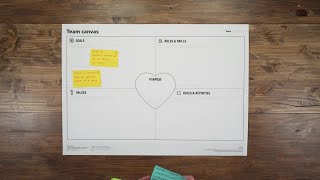
Mike from Board of Innovation walks through the Team Canvas, a kickoff tool that aligns team goals, individual learning goals, skills, values, and operations. Use it at project start to confirm everyone's motivated, has complementary skills, and shares the same values before diving into innovation work.
Chapters
Hi, I'm Mike. I'm a Senior Innovation Consultant at Board of Innovation and I help corporates move across design, business and innovation and help them through the process and speeding up as we go along. I'm going to introduce you to the Team Canvas. This is another tool that's very useful at the early stages of a project, so it goes quite hand in hand with the scoping canvas that you should have already completed or are about to complete. So, so this tool is split up into five different sections and really the goal of this template is to align the teams and the skills, the values and the expectations to make sure again that you're all aligned, have the same common vision and that you're working together in an optimal way before you go into the innovation process itself. So how to use this template? First of all, you want to look at your goals as a team. So think about a bit like you did in your scoping canvas. What are the strategic goals that you're looking at? What does success look like when you finally achieved it? So have a good think about that as a team. These should be feasible and they should be measurable and they should be time bounded. So that'll give you some, again, some scope for the project. Next, looking at the individual personal goals of the team. It's not just about the team as a whole, but maybe there are some learning objectives for individual team members as well. So make sure you have a think per person, which goals you're looking to achieve personally. And really remember to have in mind that this tool is designed to make sure that you have the right team assembled. So the more information you can have on the goals on a team level and individual level, the better. And one of the main reasons that teams and innovations actually fail is because they don't actually have the right team, they don't have the right motivations. So make sure you get this right early on in your innovation project. Next one is looking at the roles and the skills. So think about what skills do you have again, individually, what are you bringing to the team? What is your unique value as a team member that you're bringing, what are you specifically good at and what can you contribute? So think individually again. So write your name down and write down what you're good at and what value you're bringing to the team. Next on the list is your values. So what do you stand for as a group? It's important to try and think not just in terms of execution of another project, but what values are underpinning what it is you're doing what are your guiding principles and what is the core value of the team and make sure you're all aligned on that. So maybe it's being entrepreneurial or maybe it's helping others. Whatever it is, make sure you define it at the beginning of the project. Because if you don't have alignment, maybe you don't have the right team and that's really the goal of the tool itself, then moving on to roles and activities. So this is more on a operational project level. So what are you actually going to be doing as a team day by day, week by week? What kind of knowledge transfer moments do you want? Maybe there's going to be some weekly stand up meetings, maybe you're going to use Slack instead of email to increase knowledge transfer between the team. So what are you going to do day to day and how are you going to align the team on that? So really this should be used in a kickoff moment. So you've just started your project, you scoped the project and now you want to kick off it and make sure that you have the right team and the right skills together and then finally think about your purpose as a team. Is there a higher purpose that you're doing this? Is it just another project that you're executing or do you have some kind of core belief and purpose driving it? In this case, it might be coming up with solutions to bring value to millennials to help them live healthier lifestyles, for instance. But be very clear and concrete on that and the purpose should emerge once you've filled out all the other different sections on the tool. So again, once you've used this tips and tricks, it's really designed to help you figure out what skills you might not have in your team and to give you a moment to self reflect and possibly even change team members as well. You really need to make sure you have a complementary set of skills. Maybe you have some duplicate skills. Again, you could look at switching out other people or getting them to agree to align on a different role within the group, but once you've done this, you'll be in a very strong position to really start diving into your project and going through the innovation process with the right team. If you'd like some more tips and tools, feel free to check out boardofinnovation.com tools and and you'll find a whole ton of tools there to help you as you go through your innovation cycle. Thanks a lot.