The CEO's job in innovation
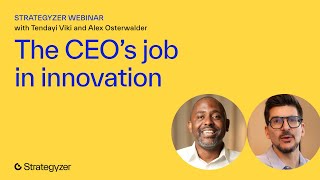
Webinar (hosts: Nick) featuring Alex Osterwalder and Tendai Viki on the CEO's role in innovation. Key recommendations: CEOs should treat innovation as a profession (understand exploration vs. exploitation, encourage experimentation and productive failure, hire and nurture innovation talent), build organizational design and power for innovation leaders (give them authority, protect them, embed innovation in leadership forums), and lead portfolio management (create a growth board, require evidence-based investment decisions, maintain a healthy kill rate). Practical metrics/programs referenced: Innovation Confidence Project scorecard / confidence score, and a suggested CEO time commitment (≥40%).
Chapters
3, 2, 1. Welcome everybody. It's an absolute pleasure. Let's move on to welcome you to the CEO's job in innovation. Very much looking forward to this webinar and I'm very pleased to say we've got Alex Ostevalder and Tendai Vicky joining us as well, thought leaders and authors and CEO of Strategizer, partner at Strategizer, of course, authors. Alex is author of the Strategizer series. We've got Tendai's books there as well. I think the question on everyone's mind is when are they going to do a collaboration and when are we going to see both of them in one book? That's the question we want to know the answer to. But until then, what I want to talk about is. Oh, Tendai, do you want to jump in on that one before we, before we move on?
I've been begging Alex for a collaboration. He just keeps saying no. So somebody's audience is going to have to help me.
I'm sure it will come soon. Alex is keeping tight. Lipped on it I can see.
Well, let's let Dendai deliver the Pirates in the Navy masterclass first before we go work on it.
Exactly. Perfect segue. There's just a quick announcement that I want to share that this is the Pirates in the Navy virtual masterclass that's coming to Strategizer. It's a fantastic new virtual masterclass led by Tendai from September 18th to the 20th. And you can actually get a 10% discount plus you can get the early bird discount if you buy now and if you use the code that you can see on screen now. Tendai, do you want to share a little bit about it before we get into it?
Yeah. No. We've been doing a lot of work of course, as a company helping people know exactly what they need to do in terms of driving innovation, testing ideas, designing ideas, running experiments. Now we, and then we also know what kind of organization we need to have in place, right, to have an invincible company. So now we're going to dive deep into like what are the actual activities that you need to do from day one to day 100? What is the step by step process you need to follow to build that repeatable innovation culture process, build relationships within the organization to drive, to drive innovation. So it's a very practical, hands on, pretty much revealing our secrets, right, of what we do when we work with companies, but now sharing it with everyone so they can also do it as well.
Brilliant. Thank you, Tenday. And as we said if you want to get a 10% discount, you can do that using the thank you webinars 10 code. And we'll send that in the email afterwards as well in case you miss it now. So that's one thing, one quick announcement. The other one is, before we jump onto the agenda, is the Innovation Confidence Project scorecard. I know this one is particularly close to Alex's heart. Alex, is there anything you want to say about this one?
Yeah, I'm, I'm pretty excited about Innovation Metrics. And here we're refining the Strategizer Innovation Metrics to simplify it to one score for each project you're working on in order to understand your confidence, investing in it and scaling it. Right. So reducing the score to one number to get confident about investing in a project or not. And we're actually, you know, recruiting companies to join this project so they share the costs for each company. It's a $40,000 ticket to join. With that, we can share the costs among different companies because a pretty substantial project.
So if you'd like to learn more.
Anybody wants to get in touch, just write to. Yeah, sales strategizer.com thanks, Nick, for surrounding that.
Now, let's into the agenda. There are four main parts to today's session. The first part is we're going to go into exploring your CEO's current involvement in innovation. Always good to start there, looking at where, how we're doing so far. We're going to have a little bit of fun with the hot or not, get a little bit, hopefully not too confrontational, but see some different perspectives on some innovation topics. And then we're going to move into the main like meat and potatoes of the session or like vegetarian sausages part, the session, if you're that way inclined. That's the CEOs Jobs and Innovation. So we're going to be pulling apart three main jobs that the CEO needs to be doing. And then hopefully we've got time. We'll wrap up with a couple of questions. So hope that sounds good. If it does, we'll get into it. Now, the question that we've got is how is your CEO involved in innovation today? Now, you can answer multiple. You can have multiple options here and we're going to go through these now. So the first one is they are not substantially involved in innovation. They give innovation legitimacy and power. They make innovation an agenda point at leadership meetings. They set publicly visible targets for innovation. They are deeply involved in developing the innovation ecosystem. Six, they provide clear innovation guidance. Seven, they regularly meet innovation Leaders and eight, they pick the ideas we invest in. Okay, let's. We've already got a few people answering there. I can see we've got six answers already for the first one. What are you seeing there? Any comments already, Tendai? Alex?
Yeah, it's fascinating. I can see there's a surprisingly a big number of giving innovation legitimacy and power. But of course strategic guidance is like maybe the lowest selected. There's two people, which is really hard to innovate if you don't really know exactly what the strategic goals for innovation are within the organization.
What's positive is the number seven. Right. They regularly meet innovation leaders, so that's a good one. That stands out. And then the number two, which we still see is pretty rare. Right. They give innovation legitimacy and power. Let's see if we're aligned on that when we talk about it, what we mean with legitimacy and power. But that's, that's good news. Right. So the second one is good news and the seventh one is good news. The eighth one is really bad news.
Really bad news. Yeah, I was about to say that.
Yeah.
Like they pick the ideas we invest in. They're not supposed to be picking the winning ideas on day one. Creating the context.
The number one is also not very encouraging. Right. So one of the things we'll see is we believe if the CEO is not substantially involved innovation, then that company will not be able to innovate beyond efficiency, innovation and R D stuff. But that's just a rule of thumb, unfortunately. We don't yet have the, we don't yet have the, you know, academic kind of data on that. We should, we should find some academic partner that would do that research. Right.
But it's also, you know, just a lived experience.
Right.
The more high level commitments you have from the in a C level leadership, the more things move easier within an organization.
And we'll get back to that when we talk about the CEO's job and innovation. Right.
Hot or not. There you go. You've got it right there. Excellent. Hot or not. Okay, so the first topic is CEOs picking the ideas. And if you're not familiar with this one, you need to decide hot or not. Do you think it's a good thing? Do you think it's a bad thing? We've got it on a scale so you can go from one being, nah, it's not a good thing to hot. Yeah, it's definitely a good thing. So CEOs picking the ideas already. I can see that. We've got 17 people in there. And at the moment it's around, it's moving closer to not, but it's pretty even.
Steven.
About halfway at the moment.
2.3.
Slowly moving towards the left, not to the right. Tende, I'd like to bring you in on this. What do you think? Hot or not? CEOs picking the ideas.
It feels like it's hot at the beginning because you get access to resources and things like that, but it's not hot at all. Like it's. You don't want to be the CEO's pet innovation project. That's the first thing. Second thing is the CEO cannot pick the winning idea. Right? It's impossible for them to know what's going to be the most successful idea when it comes to innovation. If the CEO is successfully picking the winning ideas, then, then it's very likely that all of those are efficiency innovations, just improving the corpus.
And I think the bigger risk here is that when it's not an efficiency innovation and the CEO picks the idea, well, guess what? Nobody's going to tell the CEO your baby's ugly. So what happens is the thing goes on. Nobody dares to kill that project or even to show bad stuff because the CEO is going to say, no, no, you're just doing it wrong. So this really bad idea, and we know that from the data from venture capital, like even venture capitalists can't pick the best ideas. That's their job, right? So you know what, Even the best CEOs won't be able to do that. And then the thing is. Yeah, but what about Steve Jobs? Well, number one, most of us are not Steve Jobs. And guess what? Steve Jobs has a lot of failures under his belt. And he got a lot more humble over time. And he actually at Apple, you always had concurring, you had competing projects. So it wasn't about picking the winners alone, but just to finalize the last one. We think it's an extremely bad idea. So we have a very strong conviction on that innovation guidance. The direction is fine, but picking the idea is a, is a recipe for disaster. We're very clear that with TIB.
Exactly.
At least 50% of the CEOs time is spent on innovation. This is hot. I'm surprised. I'm really surprised people think this is not hard. So, so this is interesting, right, because you can say the CEO can't pick the winning idea and then say the CEO should spend at least 50% of his time on innovation. So that can create some kind of like, what are we talking about? And that's exactly what today's session is.
About right now as excellent. Right. Because we do have a very strong conviction that the very least 40% more even better. And you know, we used to see that with Brackendarrel at CEO. He just changed jobs to go to a 10 times bigger company to do the same thing, to turn around the company. But when the CEO spends time on innovation, it happens. And we'll see today that we don't mean picking ideas, but building the system, the engine and supporting that engine. That's the job. And you can't do that job if you're not 40% involved. At least 40%.
At least 40%. Yeah.
Um, so Steve Ballmer is a great CEO. Hot or not. Alex, do you want to go first on this one?
Yeah. Well, we should put was because he's not CEO anymore, he's now owner of a basketball club. That's another whole story that Tendai and I think would passively talk about.
He's really bad at that too.
So was he a great CEO? I'd actually say, well, it depends.
Right.
He was a great CEO. If you look at increasing profits and milking a cow, then maybe when it comes to culture, different thing. Right. He was very hard driving CEO had really, really hard tactics that you might not believe in. But in terms of financial results, world class. But then of course, you know, he missed out on every single innovation you can miss out on. Exactly. I think and I is probably in agreement with me.
No, I completely agree with you. And just to paraphrase what Alan Wang is saying in the chat, they're good at exploitation, not great at exploration. That's the definition of like Steve Ball as a CEO. Absolutely.
And then Satya Nadella took over. Right. And to, to Steve Ballmer's credit, like he chose Sachin Adela. So let's also be clear that that was, that's a strong merit. Of course it's a bit frustrating when the, when then the, the, the, the shares go up. When you retire as a CEO, you know that you're not the favorite of the stock market. But that's what happened in Satya Nadella really fundamentally turn around the company. Great CEO to learn from, to see what he achieved. And the big lesson is same people, same company. That's the one I would like. CEOs still do have a strong influence, even if it's always a team effort, still has a big, big weight to carry.
And really this is what the topic of the whole session is today. So I think it leads us on really nicely to this next section we can see here. We're going to be talking about the CEO's jobs. Put an extra S in there in innovation to talk through. What are those main jobs? And of course we've got Alex and Tendai, they're going to talk us through what they are.
We're going to keep it interactive because you can win a strategizer ebook of your choice. We're going to have questions after each one of these sections. We're going to split into three sections and what we mean here is what does the CEO spend time on? So we do like to say explicitly and officially with CEOs in the room. So sometimes you cannot, you can create some tension mentioned there that CEOs need to spend at least 40% of their time on innovation. Question is what? Today we're addressing the what. So you know, we used to get off the hook with it with a tweetable thing. Now we're going to tell you what we believe, what our conviction is from what we've learned working with world class companies around the world. The first one is actually pretty straightforward and simple, but not so much because that's not necessarily the case today. Number one is the CEO needs to treat innovation as a profession and make that explicit to the company. And we're going to show you three things related to that. So the very first job in this, you know, treated as a profession is deeply understand innovation exploration as opposed to managing the core. So many CEOs have grown up, if you want in exploits and they're really good at it or pretty good at it. And they don't necessarily really understand innovation because when we say innovation, a lot of people think R and D, but R and D is feasibility. Can we build it? It's technology, it's product we're talking about. Innovation is business, R and D. So what does it mean to fundamentally understand that every innovation starts with an idea. Small ones, big ones, new business, smalls, new product, efficiency, innovation. You search for a business model that can work. We're talking product opportunities, technology opportunities, or a value proposition that can work, or just a solution to a problem. Then once we figured out if that can work, that's when we scale and manage three phases. Search, scale, manage. Those worlds are very, very different. And that's what. Who was it who mentioned this already? I think Alan right in, in the chat. There's a difference between exploit and explore. And Steve Ballmer was a world class exploit CEO. Again we can debate about the company culture that was there, but he did grow the Profits. But here's the thing and we talk about this a lot. So I'm going to go pretty quick. You can look at other webinars to understand what we're talking about here. Deeply understanding means uncertainty here is lower. We can write business plans to manage the existing uncertainty is very high in innovation. Business plans should be banned. Some CEOs still ask for business plans or business cases. No, it's about testing and iterating. Throwing away your business case every day at the beginning and every week later on means investments change. Here you make large bets in exploit after deep analysis and a convincing case. On the left hand side, we should not pick the winners. We invest in small initial bets. We'll see the portfolio approach. We only invest in those follow up investments that show evidence and the leadership changes, questions and decisions are different. On the right hand side you ask on time, on budget. On the left hand side you ask what did we learn? Should we continue iterate or kill the project? No zombie projects. If you understand this fundamental different, you'll understand how innovation works. This world is not the same as this world. It's not a value judgment. It's just very different. And the CEOs we talk to, once we frame it like this, they start to understand. Tenna, anything you want to add? Because we had this conversation about exploit explore and you said, well, it's kind of basic, right? But we realized for most CEOs and senior leaders, this isn't. This is something that puts boundaries around what they weren't able to express.
Exactly. I'm always surprised by how this lands. When we're talking to corporate leaders. They actually find this really interesting because it really gives them a framework for making decisions and also really starting to make decisions about how to professionalize that and how to hire the right people and how to put in place the right processes. Once you understand that you need to be world class in these two different worlds, it gives you the right frame of mind for starting to think about the work that you need to do.
It defines everything from organizational design to processes, KPIs and decision making. And the big one that we started to just use recently is this is not just where innovation lives. Every leader needs to be able to toggle between these two approaches. You might be working on a supply chain project, you know, one moment, 10 minutes later you're meeting the innovation team. You need to have a different mindset. So as a leader, you need to toggle. And leaders who understand that, they really do that. Which brings us to the second topic. Cheerleading A culture of experimentation where failure is accepted. It's not the goal, but it's accepted as an inevitable part of innovation. So once you understand innovation, you understand what we mean with accepting failure, embracing failure, making it part of the managed process. And the best, you know, way to kind of show that is when Jebes was still CEO at Amazon, he was a real cheerleader of this culture of experimentation and failure, as opposed to not failing when you build a warehouse. So let's quickly listen to Jeff Bezos frame this culture of experimentation.
To know.
Oops, I went too fast because I wanted to get out of the way.
To know where if you already know it's going to work, it's not an experiment. And only through experimentation can you get real invention. The most important inventions come from trial and error with lots of failure. And the failure is critical and it's also embarrassing. That's why people, when we're kissed, we always are doing child error and we're never embarrassed. You watch a little toddler, then they will try for hours to put a square peg in a round hole, and it never works, but doesn't keep them from trying. And they try things like that and that's how they learn. And we all have that when we're little. And then as we get older, somehow we get in our grooves. We have a set of expertise and skills. It's kind of comfort zone. And you have to constantly push yourself to say, no, I don't care about failure. In fact, if you're not, I say, at Amazon, we have to grow the size of our failures. As the size of our company grows, we have to make bigger and bigger failures because otherwise none of our failures will be needle movers. And so I would see it as a very bad sign over the long run if Amazon wasn't making larger and larger failures. And if you do that all along the way, that is going to protect you from ever having to make that big kind of Hail Mary. Bet that you sometimes see companies make right before they fail and go out.
Of, okay, so that's a big thing, right? Because sometimes, actually quite often we hear people say, Alex Tendai, don't talk about failure, talk about learning. Well, when you do that, you actually still stigmatize failure. So embracing failure or productive failure in the right place, saying this is normal, it's part of the process, and we know how to manage it. That is key. Tenda, you've seen this video the first time, right? So what were your thoughts?
Yeah, I saw the early snippet of it and then As I watched the remainder of it in preparation for this webinar, I was really struck by the notion that if you don't actually increase the size of your failures, it's really hard to increase the size of your successes. And I think the hardest thing in every organization is everybody's trying to put their best foot forward. So every time I'm coaching CEOs or talking to leaders, I'm like, they need to start getting mad about the wrong. They get mad about the wrong things and then you start getting mad about the right things. And the advice is get angry at teams that keep going when they know the idea is not going to work and celebrate teams that don't keep going when they know the idea is not going to work. And then that starts to create a nice culture of alignment there.
That's a big idea. Right. I like how you framed it.
Right.
You should not accept that teams go forward when the project is broken. Right. When there's no evidence. And we've seen ample evidence of that. Right. You know, million dollar projects that are still alive and they shouldn't. Brings me to the last one. When you accept innovation as a profession, you won't just put in place processes and metrics and the culture. You're going to attract and nourish the best innovation talent. Because you understand that innovation is different from managing a business. It's fundamentally different. The phase from zero to a couple of million and from a couple of million to a lot of millions towards managing a business unit. These are three different phases. And once you understand that, you will try to attract the right talent. This is not the case in many companies today yet. Right. Every company has innovators, but we don't nourish that talent. And even worse, we don't attract really experienced innovation leader. It's something that's pretty rare. I don't know, Tenda, have you seen companies really starting to search for innovation talent in particular in terms of innovation leaders? Maybe, you know, doers.
Yeah. So it's gonna happen. Half some companies are really starting to search for the talent and they're finding it hard. Right. It's not easy talent to actually find and put in place. And in other organizations they're just like, yeah, get such and such who's really good at these things and get them to run, get them to run innovation. I think the recognition of innovation as a profession and trying to build a real function where people have the right skills to drive that particular function within the organization is not something that's yet fully accepted in the organization, it's something that's important, but from a function perspective, it's really like a sideshow. So there's still a bit of a disconnect there between what leaders are saying and then acting out.
Great. That brings us to our first question. Quiz questions. Two questions per big category of job. This was innovation as a profession. And Nick is going to show us the quiz and we're going to have one winner for all three rounds. So let's see if you want to play menti code. 740-6785.
Yeah, you need to join this one because you're going to win an ebook from Strategizer of your choice. So you get to choose exactly what we send you. So if there's been a Strategizer book you've been wanting, this is the time to try and win it. So please join the Join the quiz via the mentee there.
And sorry to ask Tendai, I actually don't know if Pirates in the Navy exists as an ebook.
Right, it does, yeah. So you can also have that one if. If that's what you want.
Exactly. A lot of Dr. Vicky fans, actually, in the women.
Thank you, Dr. Osnaldo.
So we've got 37 people ready. This is for your chance to win an ebook, a Strategizer book, or one of Tendai's books. So make sure you jump in if you haven't yet. 38. I'm going to give you another 10 seconds and then we're going to go for it. Six questions. So it's a great opportunity. Code. Thanks, Alan, for putting the code in. 740-6785. 39 players. 5, 4, 3, 2. Oh. 41. Excellent. We're gonna go for it. Now.
Is there a way to maximize your screen so we're a little bit sure. Which is on. You can make products that delight customers and still fail.
Is that true or false?
Yes. Well, not. Yes or no. I'm not giving an answer. I'm just saying is it true or false? Like don't be swaying answers here.
Yeah, everyone is question. I'm gonna let Tendai answer. Answer this.
So this is definitely true. You can make stuff that makes customers happy and still fail because you still need to figure out the business model. Right. Or like Alan Sugar likes to say, or the Steve Blank was saying that, Alex, that you can give away five, ten dollars for five bucks and people will be really happy with that, but you're not going to have a business.
Right.
So. Yeah, absolutely.
And that's, that's the Venture funded model of the, you know, the last 10 years. No, some of that. Right. And we're back to bit normal. The thing I'd really like to emphasize as well is there's a lot of, a lot, a lot of focus on product market fit, but then not more. Right. So it's not wrong to get to product market fit. Of course you need to. It's kind of obvious. But there's way too little thinking on business model fit as well. So we'd add that. And the more you think of it from the beginning, the more likely you are actually to succeed.
Exactly.
Hopefully people can see on screen better now as well.
Yeah, exactly. So if you can go to the next question.
So great ideas, the foundation of innovation, success. True or false.
I can feel this is going to be a controversial one in the chat. People love ideas. The more points you get, the faster your answer. Right?
Exactly. Yes. Oh, exactly, yes. And so this one is yours, Alex. This is a major pet peeve of yours. I'll just be quiet in my corner here.
So look. And you can argue. Yeah, great ideas. Great ideas don't actually matter that much because a lot of the successes you can see started with a completely different idea. I mean take even things like Slack, right. Slack was not the idea that the companies had in mind. The founders had in mind. They kind of end up with that as a complete side project that they were working on. So I think we overestimate ideas at the expense of understanding. It's the process of iterating ideas until you find a value proposition that customers care about and a business model that can scale. Does it matter? Kind of the big picture direction, often you know that you're working towards, ah, one stop, you know, banking solution or so if you're in banking, of course, like that is so obvious. The question is, how do you turn that into a real value proposition and real business model so ideas are free. I think I can speak for you as well, Tenda. You'll chime in. They're pretty worthless. Like that's the easiest part is like 2% of the work to come up with a great idea, Right?
Exactly. And there's some of the CEOs that I've worked with, I think, I think I've said this before. Like one level kept saying to the team, I only want 10x ideas. If you don't have 10x ideas, don't come to me. And I had to sort of challenge them and go, you won't even know what a 10x idea looks like on day one. And so it's really hard to sort of just have ideas. There are, they're, they're, they're an, an ingredient, but they're not the foundation for success. The foundation for success is then the process of navigating that idea through testing and iterating towards something that creates value.
Let's see who's leading. Just a quick intermediate report. We want to know who's leading. It's not the winner. Halftime report.
Let's have a look. Let's have a look. We're getting to it now. I'm just going to put myself so on full screen. Are you ready for this? Let's see. Leaderboard, Top of the leaderboard. So far we've got. Yes, it's Thomas Ogie. Ogie. I said your name correctly, but you haven't won yet. That's question two of six. We've got four more questions. So Ryan can catch up with a chance as well. Everybody is so far.
Thomas has a target on his back now. Okay.
All right, cool. Thanks, Nick. I'll, I'll, I'll take it from here. So the second job for the CEO, and when Alex and I were preparing this, we, we kind of. We thought that we would start with this because we really fundamentally believe that this has become the most important job for the CEO at the moment. The conversations we used to have before around trying to convince organizations that they need to innovate, those are becoming less and less, but making sure that we put the right organizational design in place to foster the culture of innovation. This has become really fundamentally critical for companies to be able to drive innovation within their organizations. So what does that mean when we say put the right organization in place?
Right.
Well, what that means is the first thing is you have to hire competent innovation leadership, but normally hire the leadership, but also give it power within the organization. So when you think about a lot of the organizational designs that we see out there in the world, you can see that the innovator often sits in the bottom corner of the organization. Down here, they're called head of innovation, but they report to the chief marketing officer, who then reports to the CEO. And so this particular innovator does not, or this particular leader does not have a lot of power within the organization. But this organizational structure that you're looking at here is the structure that they set up at Ping an, where when they appointed the innovation leadership, they actually made them co CEO to the CEO Peter Ma. So you had Jessica Tan over here and Peter Ma over there, and that's like the highest level where you usually find that, you know, that's the highest level we've ever seen an innovation leader get placed. What we typically see is they're somewhere on the same level in the C suite and they report directly to the CEO. That's the structure that we found of works. So it's really important that we make sure that we give innovation, we hire the right talent, and we put them in the right position to win. Alex, any thoughts about this?
Yeah, just because we have this question a lot people say, oh, you guys are always putting up, you know, stuff for large companies. In a smaller company, it'd just be the CEO focusing 100 on innovation and the COO focusing on exploit.
Right.
So you will adapt the organizational structure to the size and then this can take different forms as well. CEO does 40% and then you have, you know, the Innovator 100 reporting to the, the CEO who does 40%. So what we want to say is just power is what, what matters here. And that's the same for small companies and in small companies, usually easier because the CEO does believe in innovation and makes it happen. Guess why? Because they have the power. So we need to create that same kind of power structure in, in, in larger organizations where I think it's harder actually than in smaller ones.
Yeah, I mean, I gave a keynote at an HR Awards conference, and when I was done with the keynote, one of the ladies attending was like, thank you for that, because I just made a decision that we were going to move the Chief Innovation Officer from the C level down to reporting to the cto. So they were going to take them down a notch and give them less power and resource, while at the same time strategically claiming that innovation is the most important thing for that organization. So that's really important in terms of building organizational design. The next thing that I think CEOs should be doing is making sure that they protect the innovation leaders back. Because if you don't protect the innovation leaders back in conflicts with other functions, then again, that's, that's to degrade the power and influence that that individual has. A lot of these debates are around resource allocation and access to resource and access to time and access to the company brand. I think somebody at the beginning of this, of this webinar made to mention that one of the jobs of CEO is to help allocate capital to the business models and then building capabilities once, you know, these ideas have been tested in the, in the market. And protecting the innovation leaders back when this comes up is really important. And you need to do that in a way that encourages collaborations with key functions and other business unit leaders. So if we, if we go back to this, one of the ways that you could probably make this work is, you know, maybe have a chief internal ambassador that builds a bridge between these two functions within the organization. If the CEO appoints that person, that person can be a great help. But the CEO themselves can also make the intervention that actually supports the chief entrepreneur. Alex, any comments there and any observations?
Yeah, just one of the things that you and I actually discussed about the chief internal ambassador, which is a political job of building the bridges. Well, we made the decision that the chief entrepreneur or head of innovation is actually that job. So we moved that up, that kind of ambassador job, being an ambassador for innovation. So head of innovation often is not about doing the innovation part. It's about creating alliances. And without the backing of the CEO, you're dead. You can't create alliances without power and the backing of the CEO. So we actually moved that thing up more to the left. And you can't do that job without the backing of the CEO. Right. Call yourself a rebel. Not going to work. You can get killed.
Yeah. I was once in an organization where the person I was working for was driving innovation within the organization and they were consistently having conflicts with other with other colleagues at the C level. And so there was a moment when a direct report of one of the colleagues who was at C level complained about the work we were doing to the C level leader, and the C level leader complained to the CEO. When word came back and the innovator was getting put under pressure, the innovator asked the CEO to say, well, this particular colleague is defending someone and you're putting me under pressure. I would hope you would protect me. And CEO just say to the colleague, listen, if you can't build relationships with other people, maybe you should leave. And that was the moment that she realized that this is not going to be a situation where the CEO has got her back. And, you know, a couple of months later, she was actually gone from the organization. So it was really important to build these relationships right out.
Just very quick in the chat, Juliana raised a very important point. So while the CEO has the innovation leaders back, the board needs to have the CEOs back to work. Spot on. And it's probably one of the biggest challenges today because we do CEOs backing innovation leaders, we still don't necessarily see boards of directors, not the executive board, but board of directors supporting really fully and even hiring great entrepreneurial CEO. So spot on. Juliana.
Yeah, no, absolutely. And then finally, one of the things that the CEO needs to do to make sure that innovation is consistently spoken about at the highest levels is to put innovation in the topic across all key meetings and to do this again and again and again, not just as a, as a, as a one off. And that forces people to put the right metrics in place and so start to see what's actually happening in terms of portfolio management and all these other things. And so I think those are the three key things that we would say around building the right organizational design. So I'll hand you back over to Nick to do the next two questions in this competition for winning an ebook that we're running.
Get ready everybody, because this is now continued. It's not the last, it's not the last lap, but it's an important middle section here. So question three and four.
Hunting, Hunting down Thomas. Yeah.
Yep. Let's see if we can catch up. Can we? Is anybody ready to catch up with Thomas? Let's see. So we've got 48 players ready and we're going to start now. So innovation leaders need to be young entrepreneurial talent that is untainted by corporate experience. True or false?
This one. To see what people think.
People have answered. Still a few left, but I'm, I'm.
Pretty sure the, this is going to clash with the reality. People are going to admit what it shouldn't be.
But there you go.
Great.
That's really great.
Wow.
The audience really gets it. That's amazing. They, they chose false. That's the correct answer. Absolutely.
Yeah. And that's one of the things, right, that CEOs who don't really get it, they're not going to put, and they're, they're not going to find experienced leaders. And so while we put this a little bit, you know, as an extreme case, we still don't see that many CEOs who go and hunt down corporate innovation leaders who've done this a couple of times to hire them. That is not something we see on a regular basis yet.
The best way for innovation teams to succeed is to be embedded in the core business, separated from the core business. Or both.
How can it be both? Aren't those like opposing ideas, Alex?
Well, is it isn't innovation, you know, holding two conflicting ideas in your head?
It's also a sign of intelligence, apparently. And you can see the majority of people chose both there. So, so that, and that makes sense because that is, that is, that is really true. You do need world class practices from, for Explorer that are distinct from what we used to run the core business. But you need to build a bridge between what innovation does and the core business so that the innovators can have access to all the benefits of being inside a large company, like access to sales channels, access to customers, access to branding and marketing. So even though those two things can be separate in terms of how they function, you still need that collaboration between those two things. So that's how you can hold those two opposing thoughts in your mind.
What I like is that Tendai Alex, you're being compared with rock stars by Stanislavs. He's saying, one of the best seminars in my life. You guys are rock stars. There you go.
We're not done yet. So I'm not taking that compliment until the very end.
The thing that people really want to know is this Thomas still on top? That's the question. Come on, let's find out.
Oh, wow.
Nice work, Thomas. You're feeling, you must be feeling confident right there on top. Let us know in the chat how you feel.
I'm starting to suspect that Thomas is Nick's friend and he got the questions in advance. I'm good. All right, cool. Over to you, Alex for the last section.
Yeah. If anyone wants the answers pre webinar, they can be bought for a certain.
Price in Moldova, right?
In Moldova, yeah.
Okay, so last piece here is the CEO and the executive team, but in particular the CEO really needs to lead portfolio management. And we'll get into what this means. Right. So a lot of the topics you already know from our webinars, from our books, but we're really specifically designing it around the CEO's job now. And the first one related to this is designing a growth board that makes sense in your context. That means the leaders who are going to make decisions where to allocate capital in exploration. And that doesn't mean picking just the ideas based on their opinions. The CEO needs to enforce evidence based investments. So you pick the people who are going to, you know, be the right ones to make the decisions and you're going to enforce evidence based investments. Now the, the modularity of who goes into this growth board depends a bit on the context. If you really want ideas to land in the exploit portfolio, you're going to use business leaders from the exploit portfolio. If you're really looking at breakthrough transformative ideas, you're going to have a slightly more aggressive kind of growth board with people who understand the outside world, maybe the technologies that going on. Maybe you'll have a corporate venture capitalist, you have outside VCs and entrepreneurs. So the composition depends. But most important is that you actually pick that growth board. And Tennite, you've been involved in handling and designing some of those growth boards. Maybe you want to.
Yeah, no, yeah, no. It's a very interesting challenge because part of it is like, like the growth board unlearning the habits of decision making they've always had when they're demanding business plans. So that's kind of part of what they need to do. And then always facilitating them and giving them tools to make sure they're asking the right questions at the right time and making the right decisions at the right time. And also just having the right charter where people are actually attending and making the decisions. And also, you know, being able to influence resource allocation. So we don't want the growth board to have people that make decisions that then need to be signed off by somebody else, because then they're not really influencing the allocation of resource to these teams. So all of those things are things that I've experienced in this world.
And one of the things you say a lot, Tendai, is that homeless ideas in the portfolio tend to stay homeless. So if you don't get leaders from the business units involved, not in picking the ideas and driving the content too much, but in just keeping them aware and giving actually the teams time to join on that, you're not going to have a landing pad because there is no such thing as a handover. People always ask, oh, can you explain the handover? If you work with handovers, you can be very sure that, you know, innovation projects are going to die. Right? So you need to create that landing pad for the teams to succeed in the future. Okay, second one, enforce a healthy kill rate. And as our friend from Bosch, Uwe Kirchner, who built the business model accelerator there, would say successfully retire. So one of the things we still see a lot are zombie projects, projects with no evidence that continue to exist and get funding. So when we say innovation, we actually mean a funnel where you have a portfolio where you start with a large number of ideas. And that needs to be, depending on the context, right? Could be 1050. A Bosch was 200. And then you kill, you successfully retire. We would say something like a healthy kill rate is 50%. Could be more aggressive, could be 70%. You only invest in those teams that show evidence. The other ones are retired. Those go into the validation programs. Again, you retire 30% of the projects, those that don't have strongest evidence. So the growth board, which we defined before in Invests in teams that show evidence for the business model. Same thing all the way to the end until you have a couple that make it to the exploit portfolio, which could land within a business unit or could be an entirely new P L. So what we do like to say a lot is you need a healthy kill rate. What I like to say a lot is if you condemn the teams to succeed because there's no visible kill rate, teams feel like they have to succeed. What are they going to do? They're going to play it safe. You will never get breakthrough innovation. I have CEOs asking me, Alex, I'm not getting breakthrough innovation. What do I need to do? My first question is what's your kill rate? How many out of 10 projects, how many succeed? And if they say, well what are you asking? All 10. Right then I already know you're condemning the teams to succeed.
Exactly. Just like what Noel is saying. It's a funnel, not a tunnel. In a tunnel everything goes and comes out the other side in a funnel. That is not the case, but yeah, exactly. Well Peter, so lots of ideas are also required at the early stages in order for you to find something great at the end.
And you might have. Exactly. Before this you could have an idea funnel that goes into some projects. We actually like everybody to be able to to start. That's a bit of our conviction with Tendai. So last one, big one, establish an evidence based decision making versus opinion based where the person with the most beautiful, the fattest business card actually gets to make the decisions. No, it's evidence based. So you need to require the teams to pitch evidence and you actually need to get the growth board to decide based on evidence. So big one here is we believe and this is where the metrics come together. That's why we created the Innovation project scorecard and that's why we're simplifying it down to the confidence score. So at every stage the team actually knows. What kind of evidence do I need to present after the discovery phase? What kind of evidence do I need to to present after the validation phase? What do I need to present after the acceleration phase? And the growth board knows exactly what evidence to look out for. So everybody's aligned. Not just saying, oh, I love this idea. No, of course it needs to be a strategic fit. But at the end of the day, what matters more is that strategic fit accompanied by evidence. Anything you would want to add to this last point?
Denmark I think this is a really great one for dealing with that idea that we were talking about earlier on. Where we saying the CEO can't pick the ideas that people work on because again, making evidence based decisions means that this is the context in which the best ideas emerge. And what the CEOs should be enforcing is this process, not whether or not people are working on ideas that they personally think they should be working on. So the fidelity of this process, how well teams are gathering evidence, how well other leaders on the boards are making decisions using evidence, this is really what the CEO's role is. And that's the best way to build an innovation culture.
Excellent. Really the system, right? Building the system based on evidence based investments in portfolios. Nick, over to you. Last one here for the quiz.
Yeah, we can see that now. Perfect leaderboard. Thomas, you're still on top. Two more questions. Let's go. Go, go, go, go.
So much competition I can see in the chat.
Large initial investments in an innovation project increase the likelihood of big returns. True or false.
This is a good one. There's actually a famous VC that has a comment on this. Vinod Koshna has a beautiful video on this one.
All right, let's see what happens.
3, 2, 1. False. 36. I got it right. 7 got it wrong. Okay, Alex, you wanted to say something about this one?
Well, my question I always ask is what happens when you give a team a lot of money? What do they do? They build the thing. They build the thing and you maximize the risk of not being able to pivot anymore. So large initial investments actually decrease the likelihood of succeeding because you're not going to be able to iterate and learn. So I mean, good examples of this is, you know, Flow TV of Qualcomm. It's a better place. It's, there's just tons of them. Quibi. Right. So it's, it's something that, that doesn't intuitively make sense. We think more money is better. Actually, it's worse in terms of, you know, getting people to test and iterate fast.
Okay, this is the time that people are waiting for. They want to know who's going to win this. So this is one last question to go. Yeah, this is our last question. Question six of six. Come on everybody. Let's see if we can catch up with Thomas. This is for, as we said, an ebook of your choice from Strategize for Tendai's books. So let's see, 47 people. Let's do this. Concentrate everybody, let's do it. Answer fast to get more points in an innovation portfolio, less than 10% of the project projects will drive the majority of the returns.
True or.
Or false. God. There's some fast answers there already. Like, mo. Like a lot of people asking. The first two seconds, they were like, boom. Ready?
Exactly.
This was an easy one. This was an easy one.
Yeah. That is true.
32 got it right. 9 got it wrong. Okay, so let's.
This is true. So let's just see the winners, because Alex already showed.
You just want to see the winners.
Should we just do this? Should we do it? I'm sweating.
I'm sweating. I don't know who's.
Yeah.
Peter's heart rate's up. Come on, leaderboard. Let's do it. Did I catch up?
There we go. Thomas.
That's amazing. Congratulations.
That was intense.
That was good. Thank you, everybody.
I think it's just, again, emphasizing that the CEO has got a really significant role to play in this. If they buy into this and they drive this, it's more likely to stick.
Insight.
Again, for those that missed it at the beginning, we've got the Pirates in the Navy Virtual Masterclass that Tendai is going to be hosting. And as we said, again, you can get a 10% discount by using the code. Thank you. Webinars 10. And actually, at the moment, if you buy it right now, you also get the early bird price. So you'll be getting quite a significant discount on top of that price. And this is the first time this has been done, so it's super exciting. And I really recommend that you check that one out so you can go on the website strategize.com training to access that. Any. Any comments on that you want to add, Tendai? Alex?
No, no. No extra comments. But if you buy now, you get to get a discount on the discount.
Which is pretty cool.
And I think it's the first time we're actually, you know, doing a virtual Masterclass or Masterclass with Tendai. So I really think this is a fresh new content you should. You should take advantage of.
Definitely. And we've got some older but still amazing content as well with Alex with the Building Invincible Companies Virtual Masterclass that's later on in the year. If you'd like to sign up for that. We've also got a 10% discount code that you can use. The same one that works for the Pirates in the Navy, one you can use for the Building and municipal companies. And again, we've got the testing business ideas Virtual Masterclass with David Bland, 10-17-19th. And you can use the code there as well. And strategizer.com training to check that out. If you'd like to get in touch about the Innovation Confidence Project scorecard. You can get in touch via salestrategizer.com we can help your organization with that. If you also, you're an innovation coach and you'd like to join our Innovation Coach community, you can do that on the website@stragize.com forward slash, the coach community too.
I just want to make a comment, actually. What I realize is we do not have a summarizing slide. So actually this could be a good thing to make a one pager. We're going to volunteer Jacob from our team that we would love to see a one pager with the CEO's job in innovation. Right. Because what we realized is we've been talking about the 40% a lot, but then we kind of left those, you know, that comment and the CEOs in the dark, like, what do I do now? So a lot of CEOs, you know, they don't actually know and it's not because they're not smart. But, you know, it hasn't been distilled down to what does the CEO actually need to do. And one of the things I think Peter Hutchison has put up like, okay, well, how do we make innovation safe? And these things that we did outline make innovation safe and reliable? Right? The reliable process. I always like to say you get the innovation, you get the CEO thing, right. Everything else gets relatively easy again, depending on the organizational context.
I want to end it on a high. I think that was a great comment in the chat from Noel and he said, do you remember what he said? I'm going to end on that one. And remember your innovation portfolio, it's a funnel, not a tunnel. So thanks, Noel Silverman for that. That was my highlight. So I think we're going to leave it there. Unless Tender Alex can top that highlight.
No, not at all. Thank you.
Thank you so much. Thank you so much, Alex. Thank you so much. Tenday. Thank you all of you for joining the session. We look forward to seeing you next time, which is actually on Thursday the 26th. So you can go to strategizer.com forward/webinars to get notified when that's up and you can register for for it. So thank you everybody. It's been an absolute pleasure. Take care and we'll see you next time. Have a great rest of your day. Morning, afternoon, evening. Take care. See ya everybody. Bye bye, bye, bye bye.
More from Zaur






An Immersive Workshop to Calculate the ROI of AI Strategy - AUTONOMOUS session

Predict, Optimize, Decide: Enterprise Decision Making For The Simulation Era - AUTONOMOUS summit


AI Insiders podcast ep. 9 - Not so cookie-cutter: Consumer Choices in the Age of AI

