The Invincible Company - Ask Me Anything Session with Alex Osterwalder and Yves Pigneur
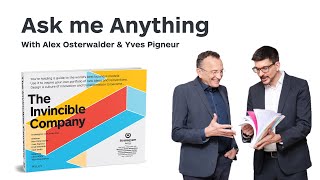
Alex Osterwalder and Yves Pigneur discuss how companies balance exploration and exploitation, covering three types of innovation: efficiency, sustaining, and transformative. They walk through the Business Model Canvas, Value Proposition Canvas, and hypothesis-led experiments for testing ideas, plus portfolio management and metrics that actually work.
Chapters
Welcome, everyone, to Ask Me Anything with Alex Osterwalder and Yves Pinar. Today we will have the opportunity to answer your questions about the book the Invincible, the latest in the Strategizer series. My name is Gabrielle Roy. Everybody calls me Gab. I've been with Strategizer for the last two years, taking care of the marketing operations. I want to start by thanking everybody for all the questions you've asked us. We've received more than 300 questions and as you might understand, we won't get the chance to answer all of those questions. But we violated a couple of questions that were really great. And at the end of the session, we will do a rapid fire for the most asked topics. This session is sponsored by our virtual masterclass on Building Invincible Companies. If you have a paper and a pen, now would be the time for you to take note of the discount code that you have on the top right of your screen right there. It's starting in a little bit more than a week from now, on October 6 to 8, it's going to be a session with Alex Osterwalder, Yves Pinar and Lucy Luo, which are three of the collaborators on writing the Invincible Company. So don't forget to check this out. All of the topics we're going to be covering today are going to be covered in depth with a strategic perspective during the Building Invincible Companies workshop. So without further ado, I'm going to introduce our two guest speakers for today. We have Alex Osterwalder, which probably everybody knows on this call, and also Yves Pinar. They've worked together. I was just asking Alex. They've worked together for the last 20 years on so many things. The business model canvas, the five books that we've written since. And it's really an honor and a pleasure to be emceeing this session with them. So I'll just give it up to you and we can get this started.
Thanks, Gam. Good. So I'm for once not in my little studio because I'm on the road at the moment. So from my improvised kind of setup from a co working space in Switzerland, we can actually relatively freely travel. We selected a couple of questions. So actually Lucy and Gab selected a couple of questions for us. So we'll go through some of them. But if you want to go deeper on some of the explanations that Eve and I will give, just type into the chat window. But we won't have obviously the time to go through the 300. So first question we selected was how can explore and exploit Coexist in corporate environment. And oftentimes exploration is being measured like exploitation. So for some of you this might sound a little bit like Chinese, but that's kind of how we divide the world. In established companies, from small to big, anything beyond the startup, you actually have two worlds, right? You have the business of managing your existing business models and value propositions. That might be 1, that might be 10 depending on the size of your company. And you have the exploration kind of, let's call this maybe invention, entrepreneurship, intrapreneurship of finding actually ideas that can work. Ideas are free, but we need to iterate them, right? And managing is maybe a little bit more of a linear process where we have little uncertainty. We know the customers, we know the value propositions. Exploration is a very iterative kind of activity where we have no clue what's going to work. So we need to test, experiment a lot. So these are the two worlds and it's not that one is more important than the other. They need to coexist. So that's how we kind of define the two worlds with very different cultures, very different metrics, etc. But now let's just do a little experiment and ask ourselves here in this poll, which words actually characterize the this exploration? So more of the testing ideas, adapting them until we find a great value proposition and business model. Which words do you think characterize exploration? So Gab, if you can throw up our first poll, we'll actually see this multiple choice. Which one of these words do you think characterize exploration? This entrepreneurial innovation, part of the organization. So please vote. And once Gab, you kind of see that we're up to a good, decent amount, I'll ask you to kind of share the poll results. Right? So one of the things we try to do at the masterclass, you'll see another activity we don't just try to do polls is one of the things we do, but we make it very interactive and we get people to do things. So at the end we'll show you, we do these letter exercises. So here first, Paul, let's see. Okay. Uncertainty, of course, I mentioned it. Right? Big one, predictability. Some people put that in there. I think innovation, not so predictable. Business plan. Interesting. I think the business plan is the enemy of innovation actually because you plan something that you can't plan per se, risk taking. Good one, of course, then search. Right. Searching for the right business models and value propositions. Okay, so pretty good feel planning. You know, we could argue what kind of planning, but if we go a little bit deeper and just ask ourselves how these two worlds are different. So again, they're not. It's not that one is better than the other. You need both. So in terms of focus, the right hand side is on efficiency and managing what we have. The left hand side is about inventing the new, new value propositions, new business models, et cetera. Uncertainty relatively low on the right hand side because we know the customers, we know the value propositions, we know the supply chains. On the left hand side, potentially we know nothing. Right. When we go into a new area, potentially we know some things, but there is uncertainty, which also means the financial philosophy is very different. On the right hand side we expect a predicted return. We invest 100, we expect 120 back. On the left hand side it's more of a venture style, venture capital style investment like in startups where we invest in 10 ideas and we know that only one is going to be really big. Maybe four are going to have some success, but five are completely going to bomb. So it's a different kind of investment philosophy and the culture and processes obviously kind of getting towards what somebody was asking there. We have more linear execution and the KPIs here are very different from the KPIs over here where it's really about iteration, experimentation. Here we measure the reduction of risk and uncertainty. I'll get to that in a second. And the last one, and this is what the whole masterclass is going to be about. Skills and people, you know, experience. Here's about management. Business management is very different in terms of skills and experience than exploration, innovation, entrepreneurship. So every company we believe actually has the right people, but we don't necessarily give them the right process and they don't necessarily have the right kind of skills or over time, right. They have to accumulate them, they have the talent. The innovation talent is never a problem, ideas are never a problem, but actually the people skills. So just to kind of finish this one off and then Eve might jump in with a couple additions. The question was also around metrics. So on the left hand side when we explore, we basically go from idea, we try to go towards a real business, right? Something that could really work. Let's call it a 10 million business. Or if we're bigger, it could be 100 million or billion dollar business if you're the size of Nestle for example. What we actually need to admit that if we're truly innovating, we have no clue if the idea is going to work. So uncertainty and risk is very high. We need to be honest we do not know if it's going to work. But what we do know is that we need to reduce risk and uncertainty. And to do that, we will invest in small experiments. First experiment might be talking to people. Second experiment, when we learned, oh, this was wrong, not a good idea, we just learned, this is bad, we shouldn't do this. We adapt the idea. We might make a PDF document of how our product could look like the spec sheet. This is the performance of my service. People still don't like it. I learned again what I shouldn't do. And then maybe I start to learn enough to invest in technology. So you basically invest more the more you reduce risk. So the KPIs here are not, are we on budget and are we on time? It's did we reduce the risk? Are we getting closer from idea to real business? So we need to measure something different. This is what we call the strategizer innovation metrics. And you'll learn a little bit about this and how to do this in the masterclass as well. So that's in itself a whole kind of topic that we will address. Eve, anything to add to the couple of points here.
This stage, we will come back on some issues.
Okay, so that was kind of the exploit explorer. One of the other things just to keep in mind, which we really need to emphasize, is that when people say everybody needs to be an innovator, well, let's be a bit careful. Let's break it down into three different types of innovation. And here we build on Clay Christensen's work, one of the great thinkers of our times who just passed away recently. He talks about three types of innovation. We slightly adapted our definitions. We have efficiency innovation, which is about improving the processes of an existing business model, improving, refining the value propositions. This is mainly about doing better what we already do, and that's important. But if this is all we do, we're actually going to more efficiently die. So it's not enough. So we need to add two other types of innovation. Sustaining innovation, which is about replacing and extending value propositions, maybe adding new channels, digital transformation, new geographies. So we're going to sustain our existing business model. If we build cars, a new car model is going to replace the old car model. So again, that's one extension. Usually the business model is pretty similar. That's probably not going to give us breakthrough growth. The breakthrough growth comes from transformative innovation where we're adding new business models, completely new growth engines, which may or may not cannibalize. I think it's One of the myths that everything new needs to cannibalize the old, that's not the case. So if we make this a little bit more concrete and we take Amazon, the first one here at Amazon in terms of efficiency innovation would be robotics, artificial intelligence, blockchain. To improve the existing warehousing infrastructure. You can use very complex technology, but the rest of the uncertainty is relatively low. We know the customers, it's not going to change. We know the channels, it's just in quotes, the warehouses. If we take sustaining innovation, we could put the Kindle here, it's just about selling books. But in the digital age, transformative innovation, actually Amazon has been very good at it. And the one that's most popular, widest known is Amazon Web Services, which became the most profitable kind of in terms of size, also of part of Amazon. It's not the biggest business at Amazon, but it's definitely the one with the biggest profit margins. Right. So again, I want to emphasize that it's not about doing one or the other. You need to make a strategic decision if you're going to invest just in efficiency innovation, just in efficiency and sustaining innovation, or if you're also going to invest in transformative innovation. And the challenge is most companies do this and because it's about all these complex technologies, they actually think they're inventing the future. But the reality is they're improving the existing. And while their business model is dying, they haven't invested in the real future. And that's what we're really going to talk about is this third kind of pillar. How do you do this more transformative innovation while you're also doing this over here? So that's kind of the, the playground that we're thinking about. So just to kind of summarize, left hand side exploration, right hand side is more growing and exploitation on the left hand side. Very messy kind of process where we need KPIs to manage the exploration. And in that kind of exploration we use different tools like the business model, canvas, value proposition, canvas and process. Okay. Anything to add at this stage, Yves? Anything that came up in the chats?
Yeah, I think so far so good.
Yeah. Okay, so next question. And somebody's talking about the Horizon model. We could say there's some overlap between Horizon 1, 2 and 3. We like to class it, make it a little bit more explicit. What do we mean with Horizon 1? But you could use that kind of approach as well.
Just maybe. Alex, short question. Transformative innovation is horizontally, growth innovation is incremental. And is Horizon one just Maybe, Yeah, correct.
So that's how I would look at it, that if we take these three here that we came up with, the very right hand side would be Horizon one and then the very left hand side would be Horizon three, Right? So that's Horizon one, Horizon two, more Horizon three. In reality, the world is not so easy sometimes to define because sometimes you might start with the Horizon 1 project and all of a sudden it turns into a breakthrough project. So guess what? Amazon Web Services actually came from an internal project which was actually Horizon one. And then all of a sudden there was an opportunity for Horizon 3. So it's not so easy to neatly classify them. But it's a good question.
Alex, the last one I have trouble understanding difference between R and D research and development. And.
Yeah, good one. So if we take this here, you could say that we're actually investing. If we're Amazon, we're investing. And that was a bit messy. Mostly R and D is about doing this and doing this. So growth and transformation doesn't necessarily come from R and D. The way maybe to best talk about this is today in most companies, research and development is really more kind of on the. Let me just get this one going on the right hand side to improve the existing products and services that we have now. Value creation could, may or may not come from rd. Let me give you an example that my favorite example and Eve will say, not again. Nintendo Wii, when they launched it, it was actually technologically off the shelf technology. So compared to competitors, it was inferior and inferior game console. Okay, so there wasn't that much R and D. There were no new patents like with the Sony PlayStation 2 or so or with the Xbox. It was off the shelf technology. The real value came from a great value proposition from an underserved market. So what we like to say is over here you have business R and D, which is about finding great business R and D, which is about finding great new value propositions, great new business models which may or may not build on technology. Could be right. Sometimes technology is a key driver, sometimes it's not. But they're not the same thing. This is technology R and D and this is business R and D, which is really about testing value propositions and business models. Anything to add to that one, Eve? Okay, so next question. How to create a roadmap or a visual with all the steps going from the business model canvas, passing by the value proposition canvas in the testing tools, etc. I would like a way to see or understand the big picture. So maximum Marchandella I probably pronounced that wrong. That's okay. Is that what Swiss German would pronounce that? So we tried to visualize that. But let's do a little quick activity, a quick poll just to understand, because I think this question also reflects a little bit experience or newness to the Strategizer tool. So just to give us a sense, how familiar are you with Strategizer tools? So that goes way beyond the business model canvas. So we're at book four now. If you have all four books, you can maybe go on the last one. I apply and teach design and testing tools. Who knows? So just vote. How familiar are you? How experienced are you with the Strategizer tools? Not just familiar, but how much have you used them in the field? And then we'll answer the question. If we get enough votes, will answer the question. Okay, so yeah, we have a 30% relatively new. Some have some experience. We have some people who could actually give the answers today. That would be good. Then even I would lean back. So nice mix. Okay, so now let's go into. And there were a couple of questions. We'll get back to that. Do you know a company that has business R and D? Yes, we do. We can get back to them after we maybe go through the process. So we believe. And we published this in the Testing Business ideas book. That's the most refined version of how we design process. There are two pieces. One is business design that's coming up with better business models and value propositions. The other one is testing, and they're kind of a double loop that you go through all the time because people often ask about sequence. It's back and forth all the time. So if you take business design, you start with an idea. Ideas are free and they're everywhere. You start to kind of ideate. How could that idea be turned into a value proposition that creates value for customers and business models that could create value for your organization? So you start to prototype that business prototype. That's a business model canvas. Value proposition, canvas napkin sketches. Okay. Nothing to do with product prototype. This is a business design. Then you ask, okay, here we have the business model canvases, value proposition, canvas, napkin sketch. Then we ask, do we like this idea? Is it big enough? Is the design of the business model strong enough? Does it have moats? Could the value proposition work? We start to assess the different kinds of risks and. And we start to assess the business model, which is where we came up with a business model pattern library. But here's what's important. Once you decide, okay, I think this is a great idea and you shouldn't take more than half a day to sketch this out. You should immediately ask once you're happy, don't overdo this, don't take a week for this. You immediately ask, what do I need to test? So you start to go into the testing loop. You ask, what are the biggest risks? What are the things that need to be true for this idea to work? We call this the hypothesis extraction and hypothesis prioritization. Once we know the most important hypothesis, this is the number one stage, is actually what very few teams really do. Well, they immediately go and start building stuff. No, you don't start with the experiment, you start with the hypothesis. Once you know which hypothesis you want to test, for example, do customers have this problem? Do they have a budget? You start to design an experiment to do that. We use the design the experiment cards and then we run the experiment. And then once we've done it, you know this build, measure, learn, loop, if you want, we learn and we capture that learning in a learning cart and we go back. Whoops, that was fast. We go back to kind of this last step here. Sorry, try to go back to this one. Yeah, I think the animation is screwed up there. So let me draw this. Once we're here, I think the next one should be fine. Once we're here, we ask ourselves, is this business model canvas, this value proposition canvas good enough? Okay. If it isn't, we go back here. If we think it's good, we go and test the next hypothesis. So we actually go through this a hundred times, if you want. And as an innovator and entrepreneur, you do this in your head 100 times. And you do this with your team maybe 20, 30 times. Right. So we do several different experiments and in the early stages, we like to say it's probably an experiment a week. So now how does this really work? Is this line here going from idea, what I drew before, from idea to real business? The way we get there is actually by going through this loop until we think now it's time to kind of actually scale that business. And it's not a one time thing, it's actually gradual. First you start to building parts of the product, you start to see that works, you start testing your acquisition model, et cetera, until you actually have a business that you start to really scale. Eve, anything to add to this one?
No, I think it's good. I think the next one will be in a way related to.
Okay, so here I'll hand over to Yves to talk about how long do business models actually last?
Just stop sharing. And then I. Yeah.
Okay.
Yeah. So the next question was, oh good. Business models should last for how long, how often should be reviewed and what's the warning sign that tells us it should change? And it's clear. Yes. And Alex like to say business models expire like yogurt in your fridge. And I like to add that for yogurt you know the date of expiration for business model you don't know, such as Kodak, Nokia, BlackBerry, very successful company disappearing after a couple of years. And so we suggest a way of reviewing your business model not systematically, but at least regularly. And we came with a tool that we call the portfolio map where you can see here the different business model, the most contributing and the less contributing. And one of these axis here is the risk. And so the idea is to evaluate this risk and see if you have business model going this way mean the risk is higher, it's dangerous. So it could be interesting to review this one those business models. And so we suggested what we call a risk assessment sheet to evaluate where the risk are for your different business model. That's the idea. And based on this one it could be possible to take some decisions such as improving, trying to push those business model again on the right hand side or acquiring company or divesting. So it means that the ID is if you see that some of your business model is declining, the ID is trying to push this again on the right hand side mean trying to renovate your business model. Here we have a quote from a friend of us, Rita Magrath Prophet Columbia. She said the idea is to shift the mentality from competitive advantage toward transient strategy when you have detected that those business models are declining. If you want the idea is to have a transient strategy to revise your business model trying to push those again and transform or revise those business models. Related to this question, the second one was can we adapt the business model canvas to analyze an ongoing business how the idea is not to adapt the business model, it's to use the business model. And we have just seen that when you have some business model declining, the idea is trying to improve those business models. And we came with a concept of shift meaning from all to one. The idea is you have an existing business model and we came with some patterns trying to push those and to create or recreate a new business model here that could be created and implemented in your exploit portfolio. We suggested and we will try to define this during the virtual masterclass, some shift pattern. We came with a Library and with different shifts that we could apply and try to apply or try to analyze if it's possible to use some of those patterns for helping people to improve existing business model. And we suggested based on this library of patterns, we came with some questions for leaders trying to ask them. Okay, you could ask some question. Is it possible to shift from a business model built around a recurring service that provides predictable and recurring revenues or in the other way. And we will not visit that today, but is the kind of technique we would like to suggest or present. And we hope that it will be helpful for you. And I think now Alex will stop and we'll continue and take over here.
Okay, let me share here. And. Okay, so one of the questions from Kabir was how can a growing company thrive evolving from B2B selling to online selling? So we had a slightly different kind of example. Oops. Maybe we can start with this one. Do you know any examples of companies that shifted from business to business to consumer? So actually from business to business to consumer. Just open my chat window again. So anybody, any examples? You know, there's some very famous examples and some of you actually read the book because you asked some questions related to the book. So which examples do you know? Amazon actually went from B2C to B2B. Right. That's the other way around. We're asking from B2B to B to C. Any examples? Type in the chat window if you know some. So if the slides are up. Right, because some people are saying they can't see the slides.
Yeah, it's possible that you might have to quit and join back if that's.
The case for you.
Apparently some people have that issue and when you log back in, it solves itself.
Yeah, it might be a zoom. Yeah, we can't control the zoom experience. Dell actually went directly B2C. Right. So they went directly. They changed the industry. Intel is a great example. Right. Intel went definitely from B2B to B2C. Nokia, we're a telecom operator first at Telecom Infrastructure company. Great. So the one we chose is Gore. So I'm pretty sure many of you, most of you probably have one kind of clothing piece from Gore. So they're famous for having gone from B to B actually towards B to C because you now have labels on shoes, on jackets, a lot of winter gear. Talking about Switzerland and skiing. Soon we had snow already. Over here you can see the Gore Tex kind of brand now visible. While they were traditionally a materials company behind the scenes. So what Gore actually did is what Yves was explaining. They shifted from B2B towards B2B2C. So there's still a B2B company making the fabrics, but they became visible as a brand. Interesting enough backstory here is they did get quite a little bit of inspiration from intel inside. Right, so here's the type of exercise we do at the masterclass. So we're going to just get you familiar already with this type of exercise. So here's the business model of Gore for manufacturing the B2B side, right? So we have high quality material, water resistant breathing, and they used to sell B2B to garment manufacturers and they had a B2B sales force selling to them and they would earn money from selling to the manufacturers of the brands. Right. So that's the traditional model. We had R&D, B2B marketing, we had intellectual property, et cetera. So typical kind of B2B supplier model, in this case, fabrics for clothes. So the question to you now is to write down the full sequence of seven letters. And to make it easy, we're going to give you the first two. So when they went B2B, they actually started to make the high quality clothes with the Gore Tex brand on top of it popular to the garment buyers by putting the brand kind of, you know, logo on the shoes on the clothes. So today you know Gore Tex because they have the label there. So in two minutes, we want you to select the other letters and ask which one is 3, 4, 5, 6, 7, 8. Write down the full sequence. So you already got the first two letters. Right, because that was the high quality clothes with Gore Tex and the garment buyers. We're going to give you two minutes to figure out the full sequence. When you have the full sequence, type it into the chat window. So let's see who's the fastest to come up with the remaining sequence of the challenge here of shifting from B2B Materials Company towards B2C brand that Gore Tex became. Let's see who's the fastest business model thinker in today's Ask Me Anything session. Should actually be a U, A. Ask us anything. Okay. We hope you're working hard. Can't just consume and wait for the solution. So all you need to do, Matisse, is come up with the right letter of sequences. The sequence of letters. Sorry, other way around. So Igor has the first cf, A, H, E, G. You don't need a pop up. All you need to do is the letters. Put the letters in the right sequence of the numbers. Okay, Libby, we have a couple of solutions here. So solutions starting to pop in 40 seconds left. For those who also want to participate, see where that. We have a series of these at the masterclass. Some will be like this in the slides and some you will actually work as a team on the Strategizer platform. So you will be onboarded, get a free license for the Strategizer platform for a year and do the exercises there with some, some peers who join the masterclass. Okay, that was pretty quick. Okay, so we still see we only have about 20 solutions so far. How many participants do we have today? Gab?
We are currently at 262.
Okay, only 10% are doing work. What's wrong with the other ones? You don't really want to succeed with business models and innovation. Disappointed. Where's your work ethics? Okay, so let's. I'll give you the solution. A bit disappointed with only like. Okay, still some. Maybe it was a bit fast. Okay, let me give you the solution. So the next letter here is the co branded clothing because you have the brand, for example of the shoes and you have say hiking shoes and you have the Gore Tex brand on top. You have the Gore Tex advertising campaign. So like Intel Inside, they started to advertise this, which is beneficial not just to the shoe buyers, but it's actually also beneficial to the brand owners who make shoes, who make clothes because they're going to benefit from the Gore Tex advertising. So that then has actually zero kind of revenues because we're working on the name recognition. It does mean we now as a B2B company need to start to understand end customer marketing campaigns, which is a completely different way of marketing. So just like Intel Inside, they had to start to learn how to create a mass market brand. This is very new for a B2B manufacturer. That led to a very strong Gore Tex brand. So a company that was traditionally behind the scenes just making fabrics just like intel, with intel inside now becomes a public brand. What does that lead to? Actually the value of their fabrics go up if you want, which gives them also pricing power. Now obviously that requires pretty substantial investment in business to consumer marketing. So this is a pattern that we call shifting from business to business, towards business to business to consumer. Anything to add to this one, Yves?
No. Maybe the next slide just to show what's a pattern in this case that we wanted to illustrate with Gore.
So this is exactly what we're talking about is that we have these patterns. The pattern library that Eve showed before here, this is a pattern that we call from B to B to C, which means on top of this B2B model, which was the original model. We now have this pattern of mass marketing activities that need to a mass market value proposition for the mass market which will actually allow them to increase, increase the revenues by the high volumes. They do also need to start to understand the mass channel. And then behind the scenes, of course, well, that leads to the stronger brand, but comes at a certain cost. So if we look at that, it's basically like Eve was saying, we're starting to build on an original business model here which was B2B. We take this lens of the business to business to consumer and we start to understand how this shift happens. And we call these really strategic reflection questions that every business can ask themselves. How might we actually increase revenues by becoming more relevant to consumers rather than just remaining a business to business supplier. So this is a very powerful move that and Gore Tex done that we know sometimes from the intel inside. So I think I'm going to skip the next example.
Right.
Because we're going to do that one in the master class, right?
Yeah. Okay, Alex, just a general question, which is a very old question. What's the difference between strategy and business model?
Yeah. Okay, so let me find somewhere an empty drawing space. I don't know if I have one left. I think no more drawing space. So this one was already used. So this is something that I should draw, I guess. But I don't have any more here. Look good, it's gone. So the way we look at it, and actually in the book we talk about defining strategy with what we call corporate identity, which is really about the, you know, who are we? You know, who are we as a company? Why do we exist? And we say there are three things you want to define and that gives you some kind of the guidelines for business models. And it gives you the guidelines for the entire portfolio. The first one is what's your strategic direction? So typically, you know, Roger Martin would talk about where do you want to play in which domains? Oh, we want to grow in emerging markets. That's a strategic direction. Okay. That will influence how your business model will look like. What you also want to look at is which kind of organizational culture and capabilities do you need to build and what's bigger picture of your brand image? Once you define this, it starts to become clear that kind of strategic framing. What could your business model specifically look like? Or what we showed before your entire portfolio of business models, where here you have ideas and here you have business models.
Right.
So it's this strategy. We put this here. The strategy is the direction we're going to go towards and the business model is how we're actually going to get there. It makes very concrete from idea to business, how that's going to look like. And when you're a more established company like Nestle or even smaller companies, you probably have a portfolio of more than one business model.
Related to the fact that you just mentioned, even for small companies, we have a question. Is it possible to apply those techniques for SMEs but also for companies at the bottom of the pyramids?
Yeah. So the principles are exactly the same if you want. So the big difference is, and now I obviously don't have any more space, so maybe if I unshare and share again, my space is clean again. You see that little hack worked. Ha. Perfect. Right? So when we go from idea to real business, that's for a startup or we go from an innovation where we want to improve just like we've seen with Gore, to actually a real kind of real improvement. The big difference is if you are a large company like Nestle or Bayer or so you probably need a return. You need the business to be somewhere between 100 million or a billion plus. Okay? But the kind of principle of getting from the idea, the improvement towards the business is the same process of searching and testing, right? That double loop that we've drawn before, it's the same process, right? You go through. It's just that here you're looking for a bigger return, but the process is exactly the same. So the big thing that will actually change when you're a smaller company, like the one we like to use is our friends at a company called Lora Star. They make steam irons, okay? They will invest probably in four ideas, okay? To create one success. And that success will be, you know, maybe in the double digit millions. If you are Nestle and you need a billion dollar success, you actually need to invest in several hundred ideas, hundred, not ideas, but actually hundreds of projects to create one winner. So it's exactly the same principles, but the difference is in order of magnitudes. That's the only difference. Now obviously there's another difference, that in an established companies you have more actually bureaucracy and established things to fight for. So we actually believe that it's easier to innovate in smaller companies, in particular in family owned companies because you have a very long time horizon. So we actually believe it's a lot easier. Contrary to common belief, it's a lot easier to innovate in smaller organizations. Why? Because it's not about R and D. R and D is expensive and that's not accessible to everybody. But innovation is about value creation for customers and value creation for businesses. So it's accessible to everybody. And you start with small investments. When you test, remember that image I drew? You start with small investments and only when you scale do you need a lot of money. But that's when you already derisk the ideas. Anything you'd add to that one, Yves.
Maybe the question related, Is it also possible to apply that for government?
Yeah. So actually I've given a workshop for the city of Odensee. I've given a workshop for the city of Vienna. Really big administration. These tools have been used in the government of Canada. The one big thing I'd say is the challenge in innovation is the problem in exploit is you invest 100 and you know you'll get 120 back. Right. So that's because you know how the world works in innovation. You don't know if an idea is going to work. So the problem in government is we don't have a kind of venture capital kind of system where we can say we're going to invest in 10 projects, but five are going to fail. Rest in peace. Because it's innovation. Right? Not every project is going to succeed. Only one is going to be big. Well, guess what, one is going to be big. What do taxpayers ask why did you waste money on five projects? But that's the wrong question because you actually need to experiment. You're going to have a lot of failure if you really do innovation. So the problem is actually when teams have to succeed, they're going to decrease the risk. They're not going to innovate. So the logic is very different. So it becomes a lot harder. But the way you actually manage that is you hide the failure and you say what's the return on portfolio? So on what's the return on the entire portfolio of 10 projects? Not what's the return? Here you put return on project or investment if you want. Here you ask what's the return on portfolio? That's the way you actually avoid this. And the same applies often in established companies. You measure the KPI as return on portfolio, not return on project. In execution, it's return on project.
Alex, maybe you can just mention, related to this idea of government, that the business model canvas proceed could be a mission canvas, something just to mention that the revenue streams is maybe not meaningful.
Yeah. So if we look at these kind of types of innovation. So a couple of years ago, Steve Blank started working with. This is a mess. Doesn't matter. Steve Blank Started working with the US government. And he asked, hey, Eve, Alex, can we actually come up with a different kind of canvas that we can use in government? Because government doesn't like to talk about revenue streams. They actually like to talk about customers, beneficiaries. So with Steve and Pete Newell, Eve and myself, we came up with the Mission model canvas which works in a very similar way, but is adapted to mission driven environments where it's not about generating revenue per se.
Okay, maybe Gap.
We are.
No more questions, I think in the, in the chat. So maybe Gap has some other.
Right, So I. How about we go through for the remaining 11 minutes, we go through the rapid fire questions. Which one of them was how do we apply this in different contexts, small businesses, nonprofits and governments? I think we answered that one. So there was also a question around how do we get buy in from executives? On seeing this as an opportunity to manage innovation and use the methodology company wide. How do we get buy in?
Okay, so let me slide, let me do this trick again to get an empty. I actually had an empty slide. It's gone. So personally I use two drawings when I speak to senior executives. I'll give you one example. I just talked before COVID when we were still really traveling. I was talking to one of the CEOs of biggest European financial institutions. I did two drawings, three actually. If you want, exploit, explore to show these are two different worlds and we need this one and we need this one, we need both. But they're different. Different KPIs, different culture, etc. Right, so that's number one. Then the second kind of drawing was here's what needs to be different is the portfolio. The portfolio map that Eve showed is that in innovation you invest in many ideas, you kill ideas, you kill them again until you have a few that you can bring over here. So here failure is actually okay as long as you know how to kill projects. Here the KPI is about what Eve said. We know which business models generate money. But so the point is that we need to have a portfolio of many projects, of hundreds of projects, literally in order to create some that will become the equivalent of Amazon Web Services. That works immediately. So you first say these are two different worlds, different KPIs, different culture. What's different here it's about experimentation. It's the venture capital approach. We invest in many projects to create few winners. Here it's the dividend approach where we actually have to protect the businesses and improve them to keep them going. And then the next question is they ask well, how do I start to build this? And you start to explain what are the processes, metrics, systems to put in place to create these two worlds that have to live in harmony. But that conversation, and then we give a real example, we won't give it away because we're going to show this at the masterclass with Bayer or with Bosch. Real companies do this now. Or we talk about one of our favorite examples, Ping An. So somebody was actually asking, is there a company that does business R and D? So typically we like Ping An. Amazon does it. Bayer and Bosch do it. So business R and D, they don't call it necessarily business R and D, but that is starting to become a concrete thing that companies do. Yeah, yeah, beautiful.
All right, so next question. How do you go about pivoting a business model in reaction to Covid.
Okay, let me do this one again. And then Eve, maybe, you know, a couple of things you've seen also with the companies you've talked to, you know, how did they maybe pivot without giving away names, the Swiss SMEs, because I think that's interesting. So I would say, remember that you showed the portfolio. The first thing as a company is always in a crisis like this or any type of disruption, you need to secure your core business. If you take Airbnb. Airbnb unfortunately had to let go of 25% of their staff. They did it in a very human way. They explained the decision. They said, we have to do it, otherwise we're going to die. So the first task in a crisis is to secure the core without killing the exploration engine. So what we see is companies actually, surprisingly, this was a big surprise for us. They invested heavily in this kind of business R and D during the crisis. Because actually, some McKinsey research shows that companies that invest in innovation during a crisis will come out of the crisis a lot stronger. One of the things that actually also makes them stronger is that they start to cut some of the slack that they should have cut before. But again, it's not enough. This is important, right? You can't cost cut yourself to the future. So. So while you have to secure the core in a crisis and even in normal times you have to make it more efficient, that won't be sufficient. So you need to invest in exploration while you're getting through the crisis. The good news is this doesn't cost an insane amount of money to get started. It's the scaling part that's expensive.
Maybe we can add something if we have to explore new solution, new businesses. When you have the crisis in front of you, it will be more complicated than if you have the experience of renovating or exploring some business model in your past. The example that you mentioned, Laurasta in fact they started to test those, explore those five IDs before the COVID And when the COVID came, the pressure was there to go further or quicker. That's fine. But without experience, exploration could be difficult for companies or most companies.
Yeah. And that's important, right? That you don't build experience with exploration. How do you deal with uncertainty? You don't build that overnight. So the more experience you have with this, the more resilient you become. So we could have called the book the Resilient Company as well, but we had to be a little bit more provocative. So we called it the Invincible Company. But being able to deal with uncertainty has to do with the ability to deal with disruption, which makes you more resilient. The problem is a lot of companies have not invested in the future, so they bought back shares. And I think that's the risky kind of strategy because you're starting to buy back shares and make your company more efficient without investing in the future. So we see now more and more companies actually interesting enough during the crisis, really investing. But the best companies have done this before and Loristar is a small company, Swiss small company that shows that it's not just for big ones and they're better equipped for actually COVID 19 because they did great.
So I guess this also links to the previous question which was how do we get buy in from our executives? This can also be something to show them. If the innovation the corporate innovation ecosystems have not been created yet, then maybe a good way to go about start before. Great. And just a quick reminder about this webinar was sponsored by our virtual master class Building Invincible Companies with we've mentioned a couple of times happening October 6 to 8. I will be sharing the link to where you can get your tickets. And don't forget to note the promo code at the top right of the screen VMCBIC 10. It's gonna give you a 10% off on your ticket for participating in this webinar. There was also one last question in the rapid fire and we won't have time to address it but I will be sharing a link. The question was in regards what are the drivers of success and the blockers of creating a corporate innovation ecosystem? We have created an assessment called Innovation Readiness Assessment which covered nine of those three drivers which can also be blockers if they're not present. So I'M going to be sharing that link in the chat in just a moment so you guys can go and self identify where you are as a business in regards to those blockers and success factors.
Yeah, there is a question. What's a prerequisite to attend the virtual Masterclass? Reading the books or.
No prerequisite. The only thing is there's a, there's a couple of videos to watch to know the foundations, but otherwise the prerequisite is to sign up and then you can watch the videos. You get onboarded onto the Strategizer platform. Actually, it's going to be this, what we did today over three days with a little bit more structure and a lot more exercises, very interactive. So I think it's a great experience. And please join. And I also want to, I want to thank Gab for running this and I want to thank Eve for actually coming back from vacation, from a short mini vacation to be part of this ask us anything. So thank you for that to both of you.
Been our pleasure. All right, I'm posting the link for the assessment right now and also the link for the masterclass and we will wish you well.
Thanks everyone for joining.
Thank you. Thank you.
Take care. See you at the Masterclass.
See you.
More from Zaur






An Immersive Workshop to Calculate the ROI of AI Strategy - AUTONOMOUS session

Predict, Optimize, Decide: Enterprise Decision Making For The Simulation Era - AUTONOMOUS summit


AI Insiders podcast ep. 9 - Not so cookie-cutter: Consumer Choices in the Age of AI

