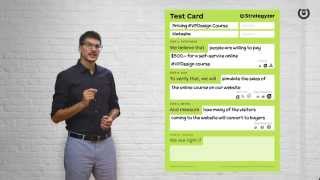
Use a test card to validate business ideas before building them. Set a hypothesis, assign someone to test it, and measure results against a baseline. In the example, a $500 course hypothesis is validated if its conversion rate matches or beats the existing Business Model Generation course.
Questions this video answers
$500
Natasha
Simulate sales of the online course on the website (website sales simulation).
The hypothesis is validated if the conversion rate is at least as high as the conversion rate for the previous $500 Business Model Generation course.
Chapters
So let's discover the test card together. This is a tool that allows you to describe how you're going to test the hypothesis. So let's look at example together. Let's give this test a course. We're going to call it pricing the value proposition design course. And we're going to assign it to Natasha, who basically does the testing and the data at our company. But let's move to the first block here, the hypothesis. Here you describe one thing that has to be true for your idea to work and you're going to select one hypothesis among the many that you have to test your ideas. So let's fill this out for our example, let's take a specific case here we said we believe that people are willing to pay $500 for a self service value proposition design course. This is a hypothesis that we had that we wanted to test before designing, before filming the course. And here we have one more thing. We describe if this is a critical test or not. In this case, before we actually tested the pricing, we of course tested if people even wanted the course. Now let's move to the next block here, the test itself. So we're going to describe here what we're going to verify what we're going to test. In our case we said to verify that we will simulate the sales of the online course on our website. That was a test we're going to perform. And here we have to describe of course, how much this test costs. Let's circle that in our case and we have to describe how reliable the data is. Let's circle that for this case. If you talk to people, it's kind of a test, but the data is not really reliable because you know that people don't always do what they say. But here we're simulating a purchasing situation, so the data is pretty reliable if that will really correspond to the reality later on in the future. Okay, now let's move to the next thing here. What are we going to measure? So in our case we said we're going to measure how many of the visitors who come to the website or will actually convert. So that was the particular measure that we looked at to validate or invalidate our hypothesis. And now let's move to the last thing here that you also want to define in your test, the threshold if your hypothesis was true or false. In our case, we said we are right. If with our hypothesis, if the conversion rate of this course is at least as good, at least as big, at least as high as the conversion rate that we had for our last course that sold at $500, the business model Generation course. So here we have it. A great tool to structure your testing, to structure your experiments, to figure out if your beliefs, the things that have to be true for your idea to work actually are true in reality.