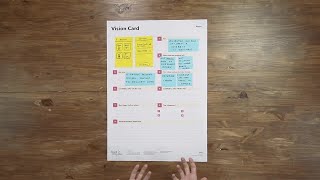
Claire from Board of Innovation walks through the Vision Card, a one-page template that turns rough ideas into concrete plans. She uses a wellness savings app example to show how to sketch your idea, define your target group, identify their problems, propose a solution, and list your top features like peer sharing and penalties for missed goals.
Chapters
Hi, I'm Claire, an innovation consultant with Board of Innovation. And today we're going to talk about the Vision Card. Now, the Vision Card is great because it helps you translate what may be a rough idea into something a little bit more concrete. So it helps you better articulate where you're going to go with this idea and also helps others understand really, what you mean. This can be nice when actually you're working in a group and everyone has a bit of a different take on what an idea might be. So it really helps you stay aligned. I love to use this in groups where everyone creates a Vision Card and then we are able to have a conversation about it at the end. To start us off with this Vision Card, if you look over in the corner, we always like to start with a sketch. Oftentimes you can just transfer over a post it if you already have your idea sketched out on it. So I'll start us off for visuals with a sketch. Here we have our discounts page of our app that we've created where we have fitness, health, food, et cetera. And we also have some goals. So maybe this person has setting a goal or adding new goals, like, did you drink a smoothie today? Or did you work out three times this week? So this was our initial idea, but now we want to actually take it a little bit further. So you see, we actually have nine different slots on this page, and those help us continue to get more concrete about this app. It starts us off focusing on the most important thing, the target group and the problem that they have. So actually, for us, we know that our target group is millennials. They don't have children and they're really interested in wellness. So these millennials also have problem. The problems are not being able to save enough money and also not always sticking to their health goals. So we found this out through deep user research and interviews and coming up with some really good ideas in our solution development. So we found this, and we decided this will be our solution to that problem for millennials. So what do we offer? We offer a savings account linking savings to wellness goals, and this comes along with an app. All right, so now we understand who we're solving for, what the problem is and how we solve it. But let's get a little bit more deeper on how it actually works for us as a company, because, of course, at the end of the day, we're also trying to have success in terms of revenue. And for us, first ideas to make money are that we could actually decrease our churn this way. And create really lifelong customers that have a longer lifetime value and a larger lifetime value up to €1,000. So for us, this is really why it's nice. So we'll see success in the long run for credibility, why this will rock. Well, we already have data on wellness purchases and we see in the environment of kind of different health and wellness trends, people love Fitbit, they love setting challenges and they love competing against their friends. So this credibility is already existing on why this might be successful. There are some other reasons though why it could fail. We also have credibility to be able to really articulate those. So maybe we actually didn't scope the problem right in the first place. We thought maybe that millennials have issues not sticking to their health goals, but. But perhaps we talked to the wrong people or we misunderstood the entire problem. This is often a problem that we could run into concern with bank having personal data. That's another piece of why it could fail. There are a lot of conversations these days around usage of personal data and this is definitely something that is not just in the banking space or the health space, but something that we just see as a larger trend. Also low adoption rate. So low adoption rate or not knowing about this app to could just kill us straight away. So that's something that we should be aware of of why it could fail. Now that we've looked at why it might succeed or fail, we really need to think about what are our next steps? How do we actually make this happen? Well, our call to action would be let's actually just build a first prototype or an mvp, a minimum viable product and that can help us already get some reactions and thoughts about this idea. Now we identify our top four features and this can be really nice because it helps us go from pretty high level to actually thinking about what this app or would have as a feature. So one feature could be a peer to peer experience sharing. So maybe you're doing some of these different goals that you've talked about and they're actually sharing with friends how that went for you. Another goal might be that actually if you don't meet your goals, we block 10% of your savings. So we're actually kind of putting a stopping limit on that if you're not actually achieving what you're doing. Other features so you could set goals for your friend and you actually could pay if they reach them. So I could go tell my good friend, ah, well you should really go to the gym more and I'll pay you money in order to do that. Maybe it's someone that really needs that extra motivation and they're motivated by more of their social circle. Last but not least, we would love to have random cash backs. We think that's something that really sparks with millennials. And so for us, that's another feature that we want to add. And last but not least, we tie it up with the value proposition statement. So for ours, we make it easier and fun to save money while helping you reach your wellness goals. So that's kind of a succinct sentence that really helps tie it all together for us. Now, once your vision card is done, if you're doing this in a group where everyone's creating vision cards, what I like to do is have everyone sign it with their name and actually put a title at the top. And the title actually helps us then refer to these different concepts as we view them on the wall. So we hang them up on the wall, look at them as a group, discuss and really challenge. You can add different parts and really create new ideas, even add new features and really up level your vision card together as a group. And once you've done that, you can do a round of voting, decide what you want to move forward on, and then take it from there. So good luck with your vision cards and turning your ideas into really strong visions and making them a reality. For more tools, go to boardofinnovation.com Tools to find vision cards.