Webinar: AI-powered corporate venture building
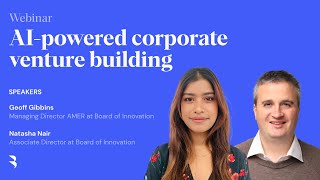
Jeff and Natasha explain how established companies can build new ventures internally, and why AI changes the game. Corporations have advantages in data, scale, and supplier relationships that startups lack. Success requires clear growth mandates, aligned talent, and strong governance.
Chapters
Great. I'm assuming that's working great. And so as we get started, here we are, Natasha and I, very pleased to be with you today. And so what we're going to be doing first of all is talk a little bit about the overall context around corporate venture building. What it is, what we see as some of the typical challenges and opportunities with it and how it's starting to shift in the current context, but. But then spend most of the time really around six shifts that we're seeing in the market, which points to an advantage that corporations have against startups in this new era of AI powered innovation that we are entering into. And so what we're going to be doing is sharing some stories and examples of what we see and then we'd love to have some discussion around what this looks like for corporations and actually how this can be applied in the real world. And so I will get us kicked off talking a little bit about corporate venture building. So I guess just at the, at the highest level, maybe just start talking about, talking about what corporate venture building is. Really. We'd see this as the process of actually an established corporation which already has what we call a core business, imagining creating and commercializing new business ventures somehow within their organizational structure. So maybe slightly off to the side or maybe somewhat disconnected, but somehow within their organizational structure. So not investing in startups like corporate venturing is a bit different like that, but actually building and launching something going from zero to one, as a lot of people would say, but taking advantage of the best possible use of the corporation's resources, expertise and networks in doing this. So, you know, in theory, corporate venture building is kind of the best of both worlds when it comes to innovation because you can think about how can you apply the kind of like startup culture and agility that you would see within the startup world with, you know, with the assets and capabilities and data and investment power that established corporations have. So in theory, it all sounds great. Obviously that's kind of different in practice and you know, from my own, from my own career, I've had, you know, many experiences where we've actually, I've worked with companies over the last 15, 16 years to launch new startups within the company. And many have also actually never seen light of day and live in this place that I call innovation heaven, which sadly is very heavily populated. And I think my goal in my career has always been think about how can we depopulate or prevent the overpopulation of innovation heaven. So we'll talk a little bit about what we see as Some of those challenges, I think some of the factors that we've seen to make corporate venture building successful from a practical standpoint are first of all, just having an actual growth mandate in the company and strategic alignment between the venture building effort and that it's very challenging when you have a disconnect between what the corporate center is actually looking to do and what this new group over here, which sounds fun and exciting, is actually trying to do as well, and a real mandate for growth and a period of time to actually do that. And I would say real clear management of expectations at the leadership level around what progress is going to require, the timeframe it's going to require, and how to think about assessing progress before you actually have revenue, before you have product market fit. Because it's very different to actually think about what's the success of a portfolio of new ventures versus the success of something that can launch within three months. The second two pieces I would say are having the right kind of talent and leadership that really balance that entrepreneurial zeal with the actual expertise that you need. That might be expertise in your core business, it might be expertise in a new industry sector that you're going into. It might be expertise in a particular type of capability that you need to develop in order to commercialize these ventures. And thinking about how you can actually have the right governance approach. Agile governance, I'd say is a massive oxymoron. But how can you balance the internal control that's essential within, usually within an established or publicly traded company with the external input and challenging that is necessary to really think differently and act differently in the market. Then the last two pieces, which I'd say is probably some of the hardest things to get right, but also really the over the long run, actually where you get the most value, I would say is figuring out what's the right connection between these new ventures and the core business so that you have just enough closeness and just enough connection to give access to resources, but not too much connection that slows you down or means that you don't take advantage of the ability to move faster or just think and act on different risk tolerance. And then the last piece, which I think is often not really thought about, is how can you have the right exit paths to actually maximize the value creation that actually come from this. So often I think this would typically look like a company new venture being spun in to the corporation that comes with its own challenges. From a talent perspective, from how do you actually preserve the value you've built in that new venture, but Then also, I think that could also look like how do you actually spin out some of these ventures as well? And I think the optionality around that I think is sometimes overlooked in corporate venture building. Those are some of the things we found. Some of the challenges we encounter, especially at the early stages of actually getting a new venture unlocked, are really actually how can you really wrap your head around the value and the business case of an idea? It's easy to fall in love with new ideas, but it's much harder, specifically in a corporation where you're trying to think about how can we get value as fast as possible to actually figure out where is the real value in this and how do we actually create that business case and the sustained investment that's needed to actually get that up and running. How can you actually decrease time to market? How can you work with complex groups of stakeholders to actually get things done effectively and make decisions rapidly at the pace of the market without getting slowed down by too much complexity? So it's that balance factor I think is important. And I think one of the things that can often be a problem rather than the actual sort of internal context. It's just the complexity of what's taken on. So actually, how can you ensure that whatever MVP or early stage version of a venture that you're actually looking to launch or produce is well scoped and it's not overloaded with too many features? Because one of the things we see is that as soon as you start to think about all of the things that could be possible with the assets and resources of a corporation, it's very easy for a new venture to become overly complex. And all of that complexity leads to extra time and extra need to engage with stakeholders, for example, as well as additional investment, which is all reduces the time that you're actually spending on solving customer problems. And I think this is a quote, not to be too salesy, but this is a quote from one of our clients at Toyota Vanderlander. We actually work with them to commercialize a new venture within the airport logistics business. And I think it speaks to the fact that it's one thing to start out thinking and acting like a startup, and it's super easy to and exciting too to do that. But the key thing is actually how do you sustain that beyond the initial burst of excitement that a corporation has? How do you prevent from falling back into the corporate pace? And how do you actually also manage the expectations once you're actually in the difficult stages of actually commercializing something when the leadership team within your company is no longer quite as excited about that new idea you had and they're not seeing results yet. How do you actually keep that going and keep that energy up? I think is a key challenge. I want to talk a little bit about some of the challenges we're seeing in recent months and years that might make people think that corporate venture building is going away. If you look at this image here is the GPT Store in chatgpt and you see this is massive democratization and ease of building an app or a GPT or whatever it is. And you could, you could almost assume from that that actually the way that innovation is headed is that anybody could be, anybody can launch a new venture, you could get a GPT to launch a new venture. There's all sorts of stories about that online of somebody got ChatGPT to start a new business for them or whatever it might be. And you could kind of think, well yeah, maybe that means there's no role for corporations in actually doing this. I think the Board of Innovation, we take the opposite view, which is that, yeah, that's cool. If you want to launch a GPT in two minutes and maybe get ChatGPT to create GPTs for you, wonderful. But that's not really going to actually solve a lot of the most pressing business model challenges and societal problems that actually would lead to big growth opportunities. That's often sort of window dressing or things that leads to incremental changes in the world. And so I think we're seeing actually that and we'll get into this in the next stage. We see that actually the democratization of some of these tools we believe actually will lead to the advantage shifting the other way towards corporations over startups. You also think about there was the announcement about two weeks ago, Walmart is closing its store number eight innovation unit. So this was a unit that was founded I believe, sort of six or seven years ago. And I think it's an interesting, interesting story of it's a closure but also a shift based on success. So if you read the press announcement from this that really for Walmart, they closed their store number eight incubator on the basis of some of the successes they'd actually had already over the last six, seven years. So they actually now see that they've actually graduated some of those capabilities from this operating approach they developed off to the side in store number eight into the organization. And so I think as we think about corporate venture building, I think it's really important to remember it's not just about having a unit or a lab Or a separate space that sounds cool or exciting. It's about how can you actually build those practices of corporate venture building into the way you actually run the company and maybe over time that it doesn't have to be that you actually keep these things off to the side in such a separated way. So want to take a pause here. We've talked about some of the challenges that corporations might face in corporate venture building. We have just launched a poll on the side. So on the right hand side of the screen you should be able to see a poll. We'd love to get your take on where you see the biggest challenges for companies in corporate venture building. Based on what we talked about. I see we've got some, Some responses flowing in if our leader is demonstrating impact before you've achieved product market fit, which I think is yeah, definitely a big challenge.
I also think there's a couple more votes for cultural and operating model conflict with the core business. And it seems that's taking, taking the lead.
Yes, it has taken the lead. I guess anybody, anybody in the chat that would want to add anything in terms of like where they've seen that sort of cultural and operating model conflict and any, any, any solutions around that too. I know from my, you know, my own experience, I think one of the key things is actually figuring out what are the ways in which the sort of the new venture group or new ventures within that portfolio can actually create a kind of win win partnership. So what could be some of the areas that the new ventures could be feeding learnings and talent also back into the business. So that sort of is actually viewed as a win win. And then I think partly it's about how can you, I think there's another piece around how can you make sure that the actual corporate venture group is not creating its own separate culture, but it's creating a culture that is a, almost like a derivative or a take on the corporate culture. It's an evolution of that rather than a completely separate culture as well. We've got a point here around, you know, maybe the strategy should be to actually start through incremental innovation and then grow from there as company starts to adapt. And I think often the case, I would say is that corporate venture building is not the first place you would start on a journey. And Mario is pointing out the challenges that people have in more regulated environments. And I think this, this, yeah, this definitely, definitely is a factor. Even when you just think about like the, the use and storage of data, for example, within, within the healthcare industry, I would say is Like a major challenge. And how do you actually make sure that you actually have access to data in a corporate venture when. When you, when there are so many restrictions around how you can use that? There's one comment. The solution is to hire consultants. I definitely agree with that one. Definitely. Awesome. Okay, so we will now shift gears. Natasha is going to take us through a little bit around some of the shifts we're seeing in the market that are shifting the advantage towards corporations in innovation.
Great. So we've really seen this shift if we just jump to the next slide. Jeff, across kind of innovation in the kind of early 2000s, we really saw this onset of design thinking taking the center stage. I think design thinking has been around for a lot longer than that, but it really kind of was brought about into kind of the main stage in the 2000s, really thinking about kind of human centered design and empathizing with our customers and our consumers or our users at the end of the day. And then as we kind of went into the 2010s, we really saw kind of lean startup methodologies come into play as well, which is all about kind of like rapid experimentation, learning from it and building through those kind of experiments and those learnings. And then we really see kind of this next shift a decade later around AI powered innovation. And that of course has really been fueled since about a year and a half ago when ChatGPT was launched into the market. And really it's this AI powered innovation that has resulted in these shifts that we are seeing in the market. And so we see kind of six key shifts around kind of corporate venture building. The first really is about kind of the front end development of concepts and the validation of that. And we'll kind of dive deeper into each of these six shifts in a moment. But really this front end kind of acceleration of concept development and validation is a result of making our workflows a lot easier, reducing the time it takes to kind of perform specific tasks that we can really go on to testing our products and our services and our experiences with real consumers and thinking about what that looks like in the market. The second shift that we're seeing is really around kind of the AI powered tools and the methodologies that we can then use to streamline those day to day activities. And we're also seeing something really interesting around simulating different models in order to come up with better products and services that is more validated through the different lenses of competitors and feasibility and viability and consumers, et cetera. We also see kind of shifts around product innovations as well. So you can create new experiences based on kind of human language interaction interactions. You can also create kind of more autonomous products and services, creating more personalized solutions with AI essentially. And then all of that then translates into what is a business model. How do we actually actualize and commercialize our products and services? And how can we use AI and leverage AI in order to create business models that work for our new methods, that work for the new products that we're essentially developing within our venture arms or labs or even groups within the firm. And so we'll kind of deep dive into each of these topics, starting off with kind of accelerated front end concept development and validation. So we've essentially used AI powered innovation methods to kind of rapidly develop concepts, et cetera, and to validate them. So you can think of this through the lens of, you know, what are the gaps in the market, what are the opportunities that we can identify. And with kind of just human intellect, you're only able to think about kind of a couple of competitors, a couple of trends, et cetera. But with AI, we're able to really take a look at multiple markets at the same time and really take a more expansive view really, really quickly. And with all this data, we're able to kind of triangulate trends and competitors and consumers to really come more holistic understanding of where we need to kind of play in order to win. And we're able to do this really quickly. Other things that we're able to kind of speed up are things like ideation, things like testing synthetically with consumers, using kind of customer Personas, both with our general population and also with Personas that we might not have considered before. And then we can also kind of accelerate prototyping, developing prototypes and bringing to life our ideas, ideas through text to image tools like Dall E or Midjourney. And we're really able to do this at speed across multiple or kind of leveraging multiple different tools. The one example that we have here is FigJam. FigJam essentially helps you build product plans in minutes instead of hours. And so you're really able to reallocate your time planning for what you're doing into different parts of, of the innovation process, which actually kind of matters. You're able to, with Big Jam, for example, cluster various ideas, automatically kind of surface and summarize insights through interviews and customer research. And so your analysis becomes a lot more quickly. And then also taking those insights, you're able to then kind of develop designs and code them immediately. So really you're seeing this front end of innovation, being able to develop a lot more quickly whilst retaining the same level of effectiveness and quality as you're combining both AI methodologies with human intellect. And that really takes us to our second kind of shift that we're seeing, which is we're able to kind of leverage a variety of AI tools and methods that are able to kind of streamline our day to day kind of activities. And so when we're thinking of developing products and services and experiences, a lot of the work that we're doing is centered around research, it's centered around testing new features and various kind of product management tasks. And those tasks essentially can be more efficient, again whilst retaining its effectiveness by using AI. And again, by doing that, we're able to free up more time to kind of strategically think about the product that we're building and the positioning around it in the market, et cetera. And so these AI powered tools are also able to help us get to a place where we can understand what is good enough quality in order for us to continue along the product development route. And that's really building upon kind of the lean methodology. A couple of examples that we can share within this shift around using new AI powered tools to help us develop our ventures. Essentially one of them is Outset, which is a tool that basically uses an AI chatbot to support, speak to real consumers and conduct real interviews with consumers qualitatively and quantitatively. And so what we're able to see through tools like this is that we're able to conduct hundreds of interviews really quickly within kind of a space of two or three days, and gain a lot of kind of data, and that helps us understand and get feedback on our features, on our products, etc. We also have tools like Craftful, for example, that are able to also streamline kind of day to day product management activities. So for example, if you're able to conduct some form of qualitative testing, whether it's using AI synthetically, whether it's using a combination of AI and human intellect, like a tool like Outset, you're able to take all this data and analyze it really, really quickly using AI. And that's what kind of a tool like Craftful is able to do. So you're able to really kind of draw the thread and find kind of key learnings and identify key features that we need to build using AI tools. So essentially these AI tools is able to make our work a little bit more streamlined, a bit more effective.
And just a quick point, there's a really interesting question in the chat around. What's the purpose of Deskilling from Hugh Evans. And I think really what we're seeing is that when you think about life and work as you're doing corporate venture building, there's so many different activities that are required and you need a wide variety of skills to be effective. And it's hard to find people that actually have all those different skills and experiences. Super hard. And also the right attitude and aptitude as well. What we're seeing is the potential for some of these tools to actually help people to be effective within corporate engine building, even though they might not have done these things before. Actually, if you take the example of running customer interviews with outset or analyzing user feedback using craft tool, maybe it's better that you don't actually have to have done these things before. If you have a tool that's like a copilot for you, helping you to do it for the first time more effectively, that's really what we see as the opportunity with some of these tools actually for a corporation. This is actually very interesting because access to talent is really very challenging in these kinds of contexts too. And so how can you actually make that a lot easier?
Yeah, exactly. And I think kind of following on from that, this doesn't necessarily mean that we're saying that AI is going to take over humans completely. It means how can we kind of.
Use.
The kind of tools that human intellect or that individual has a quality that people have and then combine it with maybe qualities that they don't have together so that we're able to kind of come to solutions or come to insights a lot faster. So it's really kind of leveraging both human intellect with the people that we have and then also just leveraging kind of AI tools at the same time. So it's not a trade off of either or, but it's really the combination that comes together that will ensure that the ventures that we're building are very powerful, are very impactful, ensure that they have like the empathy of a human being involved in them as well.
Cool.
Then kind of just going into our next shift that we're seeing, which is a really kind of following on from this conversation that we're having around AI tools and how can we be more effective and more efficient essentially using them. This shift is really, really interesting. It's also an evolving area which is kind of strategic simulation kind of methods. And so a large part or a large kind of challenge that corporate venture building actually comes down to is making complex decisions and also prioritizing often we have a lot data, a lot of different dimensions that we have to consider. So for example, if we're making this decision, like, what are we actually going to give up on, right? If we're choosing to prioritize X feature, what are we actually deprioritizing? Is it scale that we do prioritizing? Is it a premium feel? Like what exactly are we kind of trading off on? And often we kind of have a perception of what we're trading off on, but we might be missing other trade offs. And so simulations, for example, can help us think about all the different trade offs that we're making. Other things that kind of simulations can help us with, or the questions that can help us answer is, you know, how will our customers react to this problem? And that's not necessarily around kind of conducting interviews and qualitative research as we do it today. Because in those methodologies we really see this say do gap. And what I mean by the say do gap is when we're interviewing someone or when we're conducting a survey, for example, someone or a consumer might say one thing, but how they actually act might be different. And so in kind of traditional methodologies, we really see this like gap between what people say and what people do. And so we're still left with this question of how are people actually going to react to our products, products and to our services and to our solutions. But then also looking internally, how will internal stakeholders kind of react? How will the core business react? Will they welcome it? Will they not welcome it? How will our products kind of perform in the market against competitors? There are so many different questions and so many different dimensions that it's really hard with just human intellect to consider or it takes a lot of time and energy to kind of do that. And so you can think of kind of simulations to kind of help us solve these different, these different kind of challenges that we face. And so you can create various simulations. For example, imagine when you're doing kind of product development, you're able to create like a focus group or like a simulated focus group with the voices of consumers and engineers and quality assurance and the folks from finance, for example, all kind of working together to develop this product. You can also have the brand voice and the kind of core business voice as well, so that we're able to make sure that the products that we're actually developing isn't so different from what the core business is actually doing. And like I mentioned before, this area is still developing, but we have begun a bit of work with our clients. To use AI to kind of simulate competitive responses and essentially do a synthetic war gaming exercise that helps us understand not only how our customers are going to react to products, how they're going to be perceived against our competitors, but it also helps us understand, you know, if we launch X product, what are our competitors going to do? How are they going to react in the market, how is the market going to evolve with the product that we are, that we're implementing? So we're able to really use these strategic simulation methods not only for short term product innovation, but also longer term kind of market shifts and trends and evolutions.
Yeah, and I can, yeah, I can share like an example of this and sort of address some of the questions in the chat too. So it's actually one of the first places we actually have experimented with this actually is in a B2B context. So in the industrial sector actually, because I see some questions around, yes, I see that publicly available data on consumers is useful, but can you apply these outside of, in more enterprise or BP context? I would say absolutely. I think what it requires is that you need to have some internal data on your customers and then actually train any tool which could be. There's a question around the tools. This is all like these sort of strategic simulation methods are all possible using any of the sort of commonly available GPTs, ChatGPT or Gemini, whatever it might be, with the right data set and with the right kind of fine tuning of the model. So I'll give one example. So we're working with a company that is working in enterprise services around facilities management, for example, and we were looking at their strategy and their roadmap and potential strategic moves they would make. And we actually developed synthetic Personas of their customers and of their competitors and then developed strategic simulations of what would happen if they did X, what would be the customer response, the competitor response. And this process would typically be something that would play out over the course of a few days in a war gaming exercise within the leadership team. We actually ran those exercises within minutes and then were able to help pass apart what the different complex decisions that they might make. I think the value for corporations in this is that corporations versus startups, they deal with much more complexity, right? They are dealing with much more complex variety of stakeholders, they're dealing with a much more complex environment around regulations. And so the people they actually serve to benefit most from this basically sort of ease of complexity, like ease of solving complex problems are actually corporations rather than startups because they actually have the, the biggest complex issues to solve. And they are the ones who spend the most time struggling through some of these complex scenarios in their heads as they're trying to make business decisions. So we see this as an area where corporations actually have much more to gain than startups. So I'll go through the next three. I guess the next one we want to talk about is just the actual nature of what we mean by product or service is evolving. So I know for myself, since probably 2008, around the time I started innovation consulting, I feel like 80% of all corporate venture building efforts have involved an app of some sort, iOS, Android, something like that, at least a website. What we're seeing is actually the start of the disruption of mobile apps and of websites with a shift towards what we can think of as natural language experiences. We see actually that corporations rather than startups are going to have the advantage in doing these. I'll give you a couple of examples. On the right here we have this example. This is a new product that was just launched a month ago. It's called Rabbit. It's two things in one. It's a new device which basically offers what you might think of as apps, but delivered through a human language experience. It talks and chats to you through an experience rather than having buttons to press, let's say. Then it actually has its own proprietary LLM behind it, like an AI model behind it too, that actually runs the whole thing. There's also another example would be the humane AI pin. So again, these are things that are looking to disrupt and replace the smartphone and mobile apps and that whole infrastructure of how you actually. It is a very cool pitch hue, by the way. It's super interesting. I actually pre ordered one of these Rabbit things and hasn't arrived yet. I'm in batch number four, but super interesting. And it's kind of interesting takedown of the original launch of the iPhone, by the way, just from a sort of funny video standpoint. But anyway, so these two things, Rabbit and the human AI pin, basically the shift we're seeing is that you're not going to have a situation where you have a product or a digital service where you have wireframes and screens and all these kinds of traditional things that you've been accustomed to working on in corporate venture building. Typically you don't need any of that stuff when you have a model that actually builds and delivers the experience more fluidly in a way that's actually individualized and personalized to the person, to the individual user. If you think about that, success in these types of experiences is Actually not going to come from a bunch of humans sitting there and quickly iterating screens and testing. It's actually going to come from having better access to data, investing in training that data and having large scale audiences to actually improve those experiences based on the real feedback from the users and the world around them. Actually, corporations are going to have much more of an advantage in this type of experience in delivering this effectively and evolving it. Then startups with like eight users are going to have. So that's one of the shifts that we see is going to happen over the next few years where corporations will have a big advantage. The next one is sort of the next stage of how you think about that. So if you imagine that a, if you imagine that a, you know, a product or a service can actually interact with you and learn from you, then it really changes what that product is. So use the example of Netflix, right? So Netflix, currently you can see the picture on the screen here. Netflix is personalized to you, right? So when you and I log into Netflix, we would see different things, right? So we would see different movies and TV shows based on like, you know, here you see like popular on Netflix and recently watched. So like the recently watched would be different for me. And then it might show a different genre of like documentaries, for example, whereas for somebody else they might see, I don't know, like cooking shows, whatever it might be. So the experience is personalized, but it's still the same features. It's showing you. It's still showing you the main thing they want you to watch at the top. It's still showing you what's popular, it's still showing you recently watched. What we're going to see is actually the evolution of the emergence of what we would call autonomous products and services. These would be products that actually autonomously evolve and personalize themselves to different users. So imagine a scenario whereby you and I log into Netflix and we see different features fundamentally, not just different movies on the screen. Depending on the time of day, which device I'm on, as well as our watching habits, we would actually see different features. What that would mean is that for a venture team, you're not going to have one product, you don't have one roadmap. You're going to have basically as many products and as many roadmaps as there are users, and a vastly more complex and different way of actually managing digital products too. And so, same as before, the most crucial success factors in this will actually be the volume of data that can actually be ingested and analyzed at once. The scale of the user audience that's behind this and sort of the precision of understanding and existing data that you have around those audiences as well as, and this was a good point in the chat from a couple of minutes ago, the actual governance framework that's deployed to ensure that the way that products and services are evolved based on that data is actually deployed and used in a responsible and ethical manner. Hugh makes this point around managing the data properly. The people who are going to be most effective at this are not going to be the startups that tend to operate in a more ad hoc, sometimes irresponsible, I would say, fashion of like moving fast and breaking things. It will actually be the companies that have a structured, disciplined approach to actually creating the right data infrastructure, to actually creating the right governance approach to make sure that you can do this effectively and safely without getting sued, while also actually managing the best experience for the consumer or the customer. And so this is one of the areas we would see is going to massively change the way we think about products and services and is going to be something that's actually much harder for a startup to crack than an existing corporation. And the last one, we'll talk about the sixth shift, which is sort of the, you know, in some ways the most important but also I'd say like the hardest to crack. But this is why it's, I'd say this is why it's the most important in some ways is that the real growth opportunities that will come from AI are really actually the system wide innovations that enable entirely new business models and entirely different ways of running an organization too. If you think about the advent of the steam train or electrification, it wasn't that they just electrified or added steam to the existing models and existing ways of doing things. It fundamentally changed corporate structures and the shape of industries and how the economy was run. And so we're going to see over time that actually that's where the big growth will come from. It's not just like tweaking and adding AI to something that already exists. It's actually going to be about thinking about fundamental new models and how do you actually reshape industries with that. And so I'll give you an example. We're working with a current client at the moment. It's in the manufacturing industry working across different categories. And we started out looking at how could we actually use generative AI to actually use external data from the market as well as their own internal data to identify new product ideas within one of their categories. We actually realized a few Things in doing this work, we realized first of all, if you build this system, you can actually deploy it across all of the categories they work in. And the second thing is you can actually use this to actually fundamentally change the relationship that you have with suppliers. You can actually use this to fundamentally change your go to market model and redefine the way you look at launching a product and reducing product waste. It's an entirely new business model for how they run their enterprise. And actually so it's not just sort of like using ChatGPT to speed up the existing model. And so the fact that they're actually a large established company already operating across different categories and already have existing supplier relationships means that they're actually in a much better position and have access to much better data to actually enable this than a startup would. And so these kind of fundamental shifts and these fundamental kind of system wide innovations are where we see the biggest opportunity around AI. And if you think about some of the most fundamental, most successful industry changing innovations of the last couple of decades, they're not actually from startups. Things like the iPhone or AWS would be two of the examples I point to that have really changed the way that industries work, both in the consumer world as well as within the enterprise world. They have come from existing businesses that had their own core business and they've spun out and created entirely new models. And so I think we fundamentally see that the market will shift towards more of these system wide innovations and that corporations have much more of an advantage in actually doing all of this. And so I'd say if we were to summarize, I think overall that we would see that data and the management of data is actually going to be the fuel of this next wave innovation that we're about to see, not the hustle that is typically thought of as the key source of advantage within innovation. With that we will shift gears to another poll. We talked about six shifts. The acceleration of the front end concept development, streamlining some of those day to day activities, the strategic simulation methods, new experiences based on human language interaction, these autonomous products and services, and then the transformative AI powered business models. We've opened up a poll around those, the second poll and it'd be good to see where people see the most relevance for the work that they do. And then we'll have a discussion and feel free to comment in the chat around where you see the most relevance for your work too. Because it's always helpful for us to know that. I see a question, by the way, in the chat, Hugh is very active in the chat. Thank you, Hugh. And great questions and answers. What is the risk that Amazon literally floods the whole economic system? Super amazing question because I think you pointed out probably implicitly in this that they actually have some of the best access to data. Yeah, I'd say probably the hugest. I mean the risk is probably very huge. And I think for other companies that are working around them, I would say the biggest challenges is how do you actually figure out how to interact with an Amazon and have a sort of have a balanced relationship with them in that given that they have so much access to data. I think we're seeing for a lot of companies that there's a whole emerging field of how do you actually monetize the data that you actually have access to? And how do you actually have a sort of data monetization strategy which I think is. And sort of a data power strategy almost, I think which is actually going to be very important in how companies think about these things. Okay, so back to the poll. So the most energy we're seeing is around the accelerated front end concept development and then sort of just edging ahead is these transformative AI powered business models which to me actually that I feel is like the most exciting area that I, that I personally see actually, you know, from just from a personal standpoint. So I'm glad to see that that's even though it's like sort of one of the hardest ones I would see. It's, it's very, very powerful.
And I think there's a point around, I think someone mentioned in the chat as well that these are potentially more like shorter term, relevant, relevant applications in work. Because when strategic simulation methods do become more effective, that could potentially be altered. Something that kind of supports our work more. But yeah, I think you're right and that it's a bit more of a more kind of a shorter term outlook.
Yeah, there's a good, good point here from, from Andrew Maxwell. So he said that the biggest challenge is still cultural. Saying that access to data is a big driver of education is very corporate view. Yeah. And I appreciate the push actually Andrew. And I think I would say that the, the culture piece is definitely important and critical, but I think what we're seeing is that it won't be enough. I guess just solving the culture piece alone, it won't be enough. And I think in terms of the actual end advantage it will be probably around how can companies figure out the right integration of their data and the way that their people work and their culture and all of that together, I think, and making that work effectively is probably going to be the source of advantage in that area. I would say the startups will probably have less of an advantage because they have probably like the culture and maybe, you know, maybe some of the talents too, but the sort of access to data and I'd say the responsibility around the use of that will be, will be bigger challenges for them. Okay, so there's a. I'm just, I'll just sort of start going through some of the, the questions, I guess, because we, we're sort of at the, the Q and A section, so maybe address a comment from, from Mark and then Natasha, you take one. So for. There's a lot of. There's a lot that can be done from Innovation Theater, but successfully implementing innovation is the key major challenge will be achieving the acceptance of customers to switch from the existing models to new ones. How do you see that? I mean, I think. Yeah, great. You totally agree with you, by the way, that I think the key point is actually around sort of demonstrating change in the market and actually solving problems, rather than sort of a press release around a new feature or new launch. I would say one of the things that I think will actually help in the coming years is that as, you know, as new technologies emerge and as new types of experiences and interfaces emerge, that actually is a, that is a factor in how open people are to trying out new things. So I would say that one of the factors that could change things is that people will actually be much more open to new ways of working, new ways of interacting with businesses and new business models if they are actually interacting with those in a different way, using some kind of natural language experience, for example, rather than interacting with an app, for example.
We have another question from Anne and the question is we're always talking about the data sets of current customers, but how do you apply this for new potential customers? Really, really strong and very. Excuse me, question. I think what we're saying is we're not kind of completely excluding new customers. And also we're not saying that we're excluding kind of how customers will evolve in the future. What we're trying to say is that you're able to kind of take the data that we currently have about customers and kind of gain feedback from them synthetically and in more effective ways. And by doing so, you have a lot more time and a lot more resources, sources such as money, for example, to then go and do research with new or different customer sets that you might not have considered before. So it's Essentially like a reallocation of your resources, kind of testing synthetically with customers that we already know, with behaviors that we already know, but then also exploring how are customers evolving, how are, what are the new customers that we want to tap into and then taking those data sets to then inform our AI models. So it's kind of this combination of AI and the human as well. So it's not an either or.
Yeah, I'll pick up on a comment in the chat. So yeah, the biggest challenge is to ensure debiasing of data and inclusion of design principles to ensure values and moral compass. I think this is super important and actually this is one of the reasons I think we see the big opportunity for corporations. You know, people like to beat down on corporations and say they're slow and lumbering, but if you compare corporations to the startup world, they typically actually do better, especially publicly traded corporations at values and moral compass than a lot of startups do. Unfortunately, I can say this, having worked in public traded corporations as well as private companies, it's very different how decisions are made. And I think that what we're going to see is that I hope that we're going to see the elevation of that. And our hope is that actually while some of the AI models out there that are very nascent are definitely bringing their own bias, we have a confidence that it's actually easier to retrain those models, which are only months or years old than it is actually to train and debias people. So we see a bigger opportunity in that. So no, we're running out on time. Just a couple of quick things. We will be sharing the recording and we will follow up in the chat with some of the questions for people that are able to stay on. But to rounds out, we'd love to see if anybody would be interested in a follow up conversation. So there's another poll that we're launching. Some of the things we thought might be interesting for people to talk to us in a follow up conversation around because it is a short time we have together are what are some of these different AI powered methods? How do you actually develop these engines for actually doing concept development and testing within companies? What's the future of these autonomous products and services and how might that apply to your business? And then also transformative AI powered business models and what might that look like in your industry? And so we will open up that poll for those that are interested in a follow up conversation and then we will wrap it up from there and want to thank everyone for joining and maybe there's one last question we could do. Let me just see what we've got. How can we get big corporations to get their data ready to leverage AI? Yeah, I think there's a massive piece around. How can you first of all identify the sources of data that a company already has because it's often sort of existing in different silos. How can you clean that up and ensure and sort of debias that I think is the next piece of it. And then also I think the other piece, as I mentioned, is actually how can you figure out what's your strategy around how you're going to monetize that data and who you want to start sharing it with or stop sharing it with as you think about your AI strategy. And thank you all very much. It's nice to see some compliments in the chat and it's really enjoyable to do these conversations and yeah, would very much appreciate any thoughts and feedback and questions that people have. Feel free to reach out to Natasha or I on LinkedIn as well.
More from Zaur






An Immersive Workshop to Calculate the ROI of AI Strategy - AUTONOMOUS session

Predict, Optimize, Decide: Enterprise Decision Making For The Simulation Era - AUTONOMOUS summit


AI Insiders podcast ep. 9 - Not so cookie-cutter: Consumer Choices in the Age of AI

