Webinar: Identifying the right use case for autonomous transformation
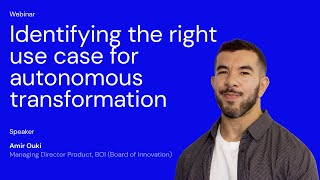
Amir Uki, Managing Director at BOI, walks through how transformation officers can pick which AI projects to pursue first. He covers frameworks for linking AI work to strategic goals and customer value, and argues that the best use cases solve problems that were previously impossible, not just faster versions of what you already do.
Chapters
Okay, looks like we've got quite a few people that have joined, so I will jump in and get started. Thank you everyone for tuning in. So I am Amir uki. I'm the managing Director here at BOI and I'm based out of our New York office. And for those that don't know BoI, we are a consulting and technology company focused on autonomous innovation and, and transformation across a lot of different industries, a lot of different verticals, and a good number of global markets. We are an AI native company, but I'd say a good chunk of our clients tend to be on the earlier side of the AI adoption spectrum and they come to us to help them figure out how to leverage AI to grow, to stay ahead and maintain a competitive advantage in the new era. So I'm very excited to kick off our Transformation series, our Transformation Officer series. So we're going to be releasing a series of shorter form around 20 minute webinars that are focused on different aspects of how transformation offices can create value with AI. And I'm going to, I'll try my best to try and keep to the 20 minutes today and I'll hopefully also be able to make sure that we have some time at the end for questions too, so feel free to drop those in the chat or in the question tab. So a little bit of context on why we've decided to start this Transformation Officer series focused on transformation leaders. We've been getting a lot of very clear signals with the folks that we've been speaking with that transformation officers are struggling to figure out how to identify the best use cases to value creation with AI. And I think this is not just limited to transformation offices. We're seeing this pretty broadly across the leadership spectrum. One of the first things that we're told is that there's a huge spike in AI vendors in the market, predominantly from new AI native SaaS products, sometimes from existing products or licenses that have really quickly become AI enabled. But overall we're seeing that leaders are unsure how to to assess different vendors and they're nervous about committing to anything that is more transformative than an initial experiment. And what that means is that they tend to feel both overwhelmed by the sheer choice that they've now been presented while also feeling kind of behind because they haven't figured out the best path to value yet. Second thing that we're hearing is around proving value at the ecosystem or the operating model level. So current use cases are really driven by specific business units and structuring those experiments at the business unit level to Actually ladder up to an operating model value is pretty hard. And the last thing that we are hearing a lot of is around finding specific transformation use cases and actually agreeing even on a framework on how to define what a strong transformation use case is, what counts as a transformation use case, what has this kind of long term transformative power and what doesn't. So after hearing a lot of different signals from transformation officers at different companies around these three points specifically, we decided to launch this series on different ways that these can be tackled. And as I said, we're going to go for a shorter form content with this moving forward. And it will be a collection of 20 minute ish webinars that we'll put out there and we'll put on YouTube, on our BoI YouTube channel as well. So the role of a. The role of data emerging technology and innovation has has really exponentially evolved in the past few years. And as that has evolved, so has the role of the transformation officer. So change is just happening much faster in the autonomous age and change making technology, things like open source LLMs, they're a lot more accessible than they previously were. So what is happening is that the role of a CTO is becoming a little less focused on on the how to transform and more focused on where to transform. So our understanding of the future here at BOI, based on what we are seeing is that in the next five years a lot of companies are going to start operating like software businesses and we'll see departments like marketing, Innovation or Finance be led a lot more autonomously by individual product owners who may actually have had nothing to do with with software or technology previously, but instead of managing processes, they'll be managing and responsible for their own AI driven products. And these products are going to just exponentially improve workflows and let them and their teams operate more independently. So whenever we talk about autonomous transformation or autonomous innovation or the autonomous era as a whole, I think it's clear to, I think it's important to make clear that we're not talking about automating away jobs, we're not talking about replacing humans. We're talking about how AI can transform these really key workflows so that teams can actually operate differently, operate more independently and focus their resources and their time on more value add opportunities. But what we are seeing is, is that when transformation officers are thinking of the value that is driven by a opportunities, it is just really important that we move beyond just productivity improvements. And what we should be doing is really critically assessing what we can do now that we couldn't previously do before. So we like to show this pretty simple matrix that basically demonstrates the opportunity areas that AI can enable. So just doing a quick walk through this, in the bottom left here, we have what we call AI efficiencies, which is essentially a business that is relying on an existing set of products or services, an existing operating model to deliver these products and services. But it's using AI to deliver them more efficiently. And that could mean delivering them in a faster way, it could mean delivering them in a more cost effective way. But it's very much focused here in this lower left box of what we're calling productivity driven AI efficiency. Beyond that, what we see is where a business could maintain its current set of products and services, but actually end up using AI to transform its operating model. Alternatively, we see businesses maintain their operating model and instead leverage AI to transform their products and services so that they become a lot more AI native. And I think what we'll ultimately start seeing are companies that are doing both up here in this AI breakthroughs box. So they are transforming their products and services and their operating model. And this, I would say, is the box that we're seeing the least activity in for now. I think it holds the most promise, but it's a larger lift and obviously a little bit slower in terms of, in terms of new entrants that are able to overhaul the operating model and overhaul their products and services, but still a really exciting area to keep an eye on. For us, the transformation opportunity lies in those three, three boxes that are beyond just AI enabled efficiency. So these three are what we're calling kind of the previously impossible section. And actually my colleague Jeff Gibbons will share a strategy in the coming weeks that really specifically targets how to make previously impossible a little, a little more possible. So we'll have that coming up in a couple of weeks too. Let's talk about how transformation offices are actually able to find use cases with AI at that org level. It sounds a little easier written out than it is in practice, but ultimately it comes down to aligning AI initiatives with your transformation strategy. And we're going to walk through a framework in a moment that identifies this middle ground between your existing transformation strategy and different AI initiatives, different productivity experiments at the business unit level. And what we know is that hoping that the sum of the parts of these different experiments will kind of automatically and default lead to transformation is probably misguided. And we know that active involvement from the transformation office is really critical to making sure that you're seeing change and you're seeing Value at the operating model level. Before we touch on that framework, we do think it's important to just spend a moment on establishing the difference between what we're calling a productivity experiment and a transformation use case. And the goal of today is to focus on, obviously on the latter. But we've seen a lot of signals from the community that sometimes it's difficult to set a clear boundary between the two and identify how they differ. So on the scope side of things, a productivity experiment is generally more short term, it's more narrow and task specific by design. Where a transformation use case is going to be a lot broader, it tends to affect multiple business units or the entire organization. And an example of a productivity experiment could be something as straightforward as automating data entry or employing chatbots for customer service queries. An example of a transformation use case is something as bold as, let's say, using medical history to create predictive and preventative healthcare products and services. And the impact of the two is generally very different. With productivity experiments being more focused on incremental improvements and immediate gains, where transformation use cases are focused a lot more on fundamental changes and a long term value creation. And again, both are valuable, but they do serve fundamentally, fundamentally different roles. They begin with different goals in mind. As we said, productivity experiments tend to be looking for opportunities to automate repetitive tasks. They tend to be more focused on identifying areas with really clear metrics for productivity gains. Where a transformation use case is focused on assessing the strategic goals of the org. It's about establishing and aligning AI initiatives with the long term vision of the org organization. And generally they tend to require more engagement from stakeholders across the org to make sure that the broader impact is really is really optimized. They obviously have different subject matter experts for each. With productivity experiments being very much driven at the business unit level, with transformation driven more from the transformation office, obviously. And I think this is a really efficient way to target expansion of AI initiatives. Really when it comes to business unit level experiments, the day to day of different workflows is known by the folks in that team. It's really difficult at the transformation level to know specifically where different AI tools and products can add value to very specific workflows. So we generally advise that productivity experiments are best led at the business unit level, where transformation use cases are driven at the CTO level. And again, productivity experiments tend to be focused on the process and transformation tends to be focused on the organization. Can one drive the other? What we've seen is that they can sometimes so oftentimes you can start with a productivity experiment and use that to start to build AI capabilities and get get quick wins. You can use productivity experiments to validate AI technologies and different approaches on a smaller scale. You can use them as an initial testing ground to figure out your company's AI maturity potential. And in some cases they can be scaled into transformation use cases. And typically where we've seen that be successful is if these experiments are generating really interesting insights that can feed back into the data ecosystem for other use cases or they fundamentally change that business unit in a way that sees contagion to other business units and how they operate operate. So sometimes they can drive, sometimes productivity experiments can drive transformation, but generally we advise tackling the two in different ways. So how do we at DOI identify transformation opportunities? What I'm going to do is walk us through a framework that we've used to help transformation officers identify really compelling and value driven use cases and then validate against them. So it's very different to identifying a productivity use case, which is, as we said, a little more focused on process improvement and the potential for automation of repetitive tasks. What we see a transformation opportunity being is much more focused on making the previously impossible possible. So there's three other quadrants of the matrix that we looked at earlier. We start with three key areas that we've seen the majority of high value transformation use cases actually originate from. So the first is starting from the company's highest priority, strategic goals, and actually working backwards from those to leverage AI as an enabler of achieving those goals. So rather than pursuing AI as an end goal in search of a strategy, we're thinking through how can AI solve our existing problems instead of trying to find new ones. The second box here is around customer values. So a really relentless focus on adding customer value. I think what we have seen to date is that a lot of AI experimentation is focused on generating value for the company or for the employee, but customer centric AI transformation is somewhat lagging behind. And then the third, as we mentioned, is identifying how AI can help us do really what we couldn't do, what we couldn't do before. I'll give us a couple of examples of what we mean by each of these that hopefully will be helpful framing as we go through the framework. But yeah, we'll do a couple of examples of each and obviously your company will have your own examples for each of these. But starting with strategic goals, this is probably something that you are aware of already in your company. It may be communicated through internal comms, it could be in Your annual reports. Generally, we find that folks tend to have pretty high visibility into what their company's highest priority strategic goals could be. So it could be something like achieving carbon neutrality by 2030. You could be looking to expand your presence in a specific region by a specific amount over a specified timeline. It could be something like fully digitizing customer interactions by a specific date. So a couple of examples there of strategic goals that could be high priority for your company. And we'll see a lot of variety from different clients around what their strategic goals are. On the customer value goals, they can include things like increasing personalized product recommendations. They could be focused on reducing delivery times by a specific amount over a set period. It could be focused on customer forward product innovation, like providing a really seamless shopping experience across omnichannel. Again, we see a lot of variety here. It's going to be very dependent on your company, your industry, your market. But identifying your customer driven goals is really important. And then the third box here, the kind of previously impossible, unimaginable, unthinkable goals that you can include. So it could be achieving real time visibility across your global supply chain. It could be being able to actually predict customer service issues and roadblocks before they occur and resolve them before they occur. If you're in manufacturing or logistics, it could be implementing a fully autonomous operations facility. Again, we'll see a ton of variety depending on what you are doing. But what we do with those is take them and use them as the start point for our transformation use case framework. And what we've done is that we've squeezed this onto a slide for today. But typically we'll use this framework to identify really actionable, measurable transformation use cases that deliver value at both the function level and the operating model level. Again, always starting from the company's highest priority strategic goals and then working backwards from those to leverage AI as the enabler for achieving them. So I'll touch on each of the assessment parameters briefly. But if you're thinking about how to best identify a transformation use case, then this is a great starting point. Typically when we run these with clients, they take about four weeks. Four weeks, Ish. All in. If, if you need kind of a guide point. So starting with the column on the far left. Excuse me, the column on the far left here. I would say that identifying goals isn't too hard, but prioritizing them, this is typically where we see clients come to us needing a little bit of. A little bit of help is on the prioritization side of stating goals. So we do want to be laser focused on what the top goals are across the long term strategy, improving customer value, net new innovation. And we recommend identifying at least one high priority for each. Ideally, you'll have more for each. So coming up with, let's say, three long term strategic goals, three areas where you're driving to increase customer value, or you have an aspiration to drive to increase customer value. The reason that we ask you to build these out is that we'll start to knock quite a few of these potential use cases out of the running in the next columns, which is by design. So you'll be left with a smaller group. Then you start with which is, which is what we want, a smaller group of use cases. Moving over to the second column here, once you've identified what these different goals are, then we want to identify the obstacles that are currently preventing you from achieving each of these priorities. And it's worth, I think it's worth noting that these obstacles aren't necessarily obstacles to AI adoption. We'll cover that in a bit. But these are really the business blockers that are preventing the priorities that you outlined earlier from actually becoming a reality. So an example could be perhaps your goal of carbon neutrality is just, it's just too resource intensive, or your goal of expanding in a specific geographic region is actually really hampered by a super competitive market that already exists there for your products. Whatever the blockers may be, we encourage you to really think hard about them and identify at least one for each that is preventing you from achieving those priorities in that first column. And then we use our expertise in the fields to ideate ways that AI could unblock these blockers specifically. And for us, this is a combination of, could be a combination of what has already been done in solutions that exist. It could be a solution that you are pioneering again. What we're focused on is going broader here as the next column is going to knock out quite a few of, quite a few of these use cases. Moving on to our feasibility and viability assessment. This is a really critical column and I think it's probably an area where a lot of folks joining today have maybe run into blockers have potentially been going in circles trying to figure out the viability of use cases. But it's a really, really important part of this work. And as you said, it's fairly intensive. We're looking at things like data availability and quality. We're looking at integration capability with existing systems and infrastructure. We're looking at the opportunity for scalability to handle future expansion. We do kind of an initial comprehensive cost benefit analysis, just to think about comparing implementation costs against the expected upside benefits, compliance, regulatory requirements, assessing potential ethical issues that could arise, and of course reviewing the technical expertise and resources that are needed for implementation and for maintenance. So a really, really important column here that helps us narrow down use cases that could really have an upside or may just not be viable for the stage of the stage of maturity that your org could be at. And then once we've done that, the final area of the assessment is identifying what will actively contribute to transformation at the ecosystem level. So thinking through does this use case have the opportunity to provide outputs, for example, that could drive other use cases within the company that could be through contributing new insights to the data ecosystem and then having those insights be leveraged via APIs for other use cases? It could be something like bringing in a new profile of customer that just really transforms your approach to say supplier sourcing. So again, productivity use cases tend to have pretty low contagion opportunity where transformation use cases that we would give higher priority to would have a much higher potential for a positive contagion. And then after all that, we assess the use cases and provide a final prioritized recommendation. So as I said, we squeezed a lot onto a sheet here just for the purpose of going through this today, but typically this takes around four weeks to execute. But it forms a really strong foundation for transformation officers to drive AI strategy. I know we're coming up against time here and we've definitely gone over the 20 minutes, but I'll run through a quick example of one line item across these different columns. Very much summarized. But an example could be having a long term goal of targeting 30% reduction in product to market time within two years. And maybe you can't do that currently because of an inefficient supply chain or long product development cycles. And we want to define why, for example, a supply chain is inefficient. A potential solution could be implementing an AI powered supply chain optimization system that helps you predict demand, it helps you optimize inventory levels, it helps you streamline logistics. There will obviously be many technical feasibility considerations, things like integration with your company's existing ERP and supply chain systems, availability of data, making sure that a solution can scale across the entire supply chain without degrading performance. And then on the transformation ecosystem side of things, there's some really interesting opportunity around if you are able to launch new products faster, that's going to change the way that marketing teams teams approach their strategy. It'll make it faster to deploy specific products for new markets which will have impacts on the go to market team. So there's some really interesting opportunities there. But the goal here was just to quickly throw in an example to show how these different parameters start to come together to prove out and validate a use case and then the outcomes of this kind of exercise that we are seeing. So you have a transformation framework that lets you easily originate and identify go or no go transformation use cases. We've got a clear validation for why, how and when or when not to pursue transformation initiatives. And we've got a really clear prioritization of use cases that ladders back in to the company's non AI business strategy. And then we've got a filter for decision making for enterprise AI solutions really across the organization. What we've seen being a cool byproduct of this is that different teams are able to assess whether to move forward or not move forward with different AI solutions by figuring out whether they fit in with this transformation strategy. Are they contributing to a transformation strategy or are they much more hyper localized without that opportunity for contribution to the ecosystem? So what we find is that solving existing problems does tend to have a faster impact at the value creation level and generally seems at the moment to be a more favored plan of attack for transformation offices. There we have it. So that is how we differentiate between a productivity use case and a transformation use case. We touched on a framework that we at BOI use to figure out what is and isn't worth pursuing at that use case level, what is highest priority, what a potential investment to upside ratio could be. Obviously we're very happy to chat through with folks directly after this call. We'll release this webinar and make it available. There's a lot more that goes into each of those sections of course that's hopefully this has given everyone a quick overview of potential paths in to identifying a transformation use case. And definitely happy to chat more about this with anyone in the future. So I think we have a couple of minutes left for questions. I'm going to move over to the question tab over here. See is this opening? Okay, here we go. So Gabriel asked, how is AI being used to also execute each step of this framework? That is a really great question. So I'm going to jump back a couple of slides here. How is AI being used to execute each step of this framework? So typically our outcome that we are working towards for this is a strategy for AI versus using AI to execute on this framework. So I would say that for us, the AI Inputs or using AI as a copilot in this is fairly low use. The goal for us is really to think strategically rather than to use AI for efficiency in this process. So again, we're going to be very strategy forward when we execute this framework versus using AI as a copilot, which would be I'd say more typical in an innovation process, for example, or a concept generation process. So a slightly different approach with this framework in terms of the role of AI in it, which I would say for us is fairly low by intention and by design. Next question here from Olga. How are ethics, privacy and cybersecurity concerns impact using the prioritization? They are used very, very, very heavily. So that's a core part of this feasibility and viability assessment column. I would say all of the companies that we work with at least have extremely stringent security data privacy requirements. Depending on the different markets, there are pretty intensive regulations to be aware of. So all things related to privacy, cybersecurity and ethics are a major input into reducing the number of use cases that we would recommend. We would not put forward a use case to a company that we feel is doesn't have a solve for data privacy, for example. So it's a really great question. It's very important to call out. It's a core part of this feasibility and viability assessment. There another question here. I think we have time for one more from Jose. So assessing the AI possibilities in terms of exploring the use of different AIs in the market instead of a strategy to build proprietary AI. So I think the question here is around recommendations on building your own proprietary AI solution versus off the shelf. That's a big part of this as well. It's part of the, part of the final recommendation. It can really vary on the use case. We don't shy away from recommending a buy instead of a build if it's the right move for the organization. We are ultimately focused on the value add. And if that value add is from an off the shelf solution, we are very, we're very forward about recommending that Sometimes a build is more scalable, sometimes it's a higher value add for a specific solve. Sometimes there's a software solution that can also operate at scale and solve a specific problem. What we're generally seeing is that at the business unit level, buy is a little bit more effective in terms of productivity. At the transformation level, we're seeing a lot more value add from building a proprietary product. And we do want to emphasize that that's a proprietary product versus building your own, your own LLM, which generally we, we don't recommend for the majority of our use cases. But really good, really good questions there. So we've come up over the half an hour, but really appreciate everyone joining the session today. I've got my email address and you can contact Voi at any point to talk through this approach, get some insight on any specific aspects of it, but hopefully you found it helpful. And again, stay tuned for the rest of this Transformation Officer series where we'll dig into different aspects. Today was obviously focused just on use cases, but we'll start to move through that process and focus on different areas that we're hearing from from the community. So thanks again everyone for joining and we will catch you next time.
More from Zaur






An Immersive Workshop to Calculate the ROI of AI Strategy - AUTONOMOUS session

Predict, Optimize, Decide: Enterprise Decision Making For The Simulation Era - AUTONOMOUS summit


AI Insiders podcast ep. 9 - Not so cookie-cutter: Consumer Choices in the Age of AI

