Webinar: the Death of the Marketing Funnel
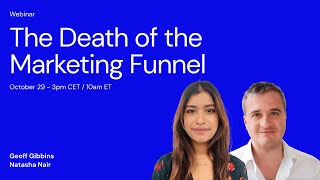
A webinar (hosts: Jeff Gibbons and Natasha from the consultancy 'by') arguing that generative AI is disrupting the traditional linear marketing funnel and enabling a new, always-on 'perpetual loop' model. The perpetual loop consists of Anticipation (data-driven pre-screening), Nudging (contextual in-the-moment offers/creative/price adjustments), and Learn (continuous feedback to improve agents, campaigns, and supply). The talk covers autonomous agents (marketing-to-agents), autonomous creative, synthetic influencers, intent-based UI, dynamic shelving/robotics, ethical/safety concerns, and practical implications for marketers (upskilling, AI-native workflows, and governance).
Chapters
Okay, excellent. We're going to get started. Thank you very much everyone for joining for this webinar today around the death of the linear marketing funnel. Very excited to have a discussion with you around this. Just quickly to introduce ourselves. I'm Jeff Gibbons, managing director at by and I'm joined by my colleague as well.
Hi everyone. I am Natasha, associate director here at by and I am calling in from New York City.
Excellent. So today we're going to talk about a few things. We're going to talk about first of all the disruption of marketing by AI. We're going to talk about the emergence of what we call the perpetual loop model, which we see emerging as a future alternative to the traditional linear marketing model. And then we're going to talk about the implications to marketers. We're going to try and keep it interactive. We'd encourage you to put questions into the chat. We will have a few polls coming through the time as well and look forward to the discussion. And I think really in the discussion we're looking to be challenged and asked questions around how do these things really work and is that really true and is this really going to happen? We'd love more provocative discussion. Excellent. So quick introduction to bi. We are the innovation consultancy reinventing how businesses grow. We work across sectors with companies to figure out how they apply AI to innovate their business, whether that's in new products, in the way they market, in the way that they actually run their supply chain. We do this through strategy, through actually building digital products and then also transforming organizations to AI native operating models. We are the hosts of the world's largest summit for AI innovators autonomous that we'll put a sign up link in the, in the, in the chat. It's actually the next version of this. The third version of this is going to be at the end of January. It's a two day event with over 10,000 attendees. We have expert speakers from across industry, academia, talking about the real world practice of being an AI innovator and lessons from the front line and you can grab your ticket in the link. Very excited for that. First of all, we're going to start to talk about the disruption of marketing by AI. I'm going to start with a bit of a story, casting our minds back maybe before some of us were born to talk about what we really see as the traditional marketing funnel and why it existed. We're sure that you've seen something like this before, this kind of traditional marketing funnel. It starts with a consumer becoming aware of something maybe they become interested in a topic or an ad or a thing that they see, they might consider it, then they might make a purchase and then maybe they like it and they keep wanting to buy it and they become loyal. And this kind of funnel really has dominated over the last several decades how businesses have run their marketing efforts, analyzed it, and also sometimes organized their teams as well. There's lots of different versions of this funnel, but they're all, you know, as you can see here, a lot of different colors. Sometimes it's horizontal, sometimes it's vertical, sometimes left to right, sometimes up to down. But they're all based on the idea of this linear narrowing path to purchase. Even though, even though you're actually looking at different colors and versions of it. So if we think back, this is, I think this picture is based before I was born, traditionally millions of people would watch the same ad at a moment that they were not actually able to make a purchase. So there was a real separation between that first awareness moment and the ability to even purchase something. So weeks or days later they would need to recall that ad in order to actually consider the product and buy it. Ads have to be memorable. That's why we had jingles and people ran their marketing efforts around this idea that there was this big disconnect between awareness and the actual ability to purchase something. This started to get disrupted by the idea of personalized online advertising. So if you think about the rise of Google AdWords in the early 2000s with tailored offers, and also the ability to actually transact directly. So there was a compression of the funnel where you could actually become aware of something, you consider it, and buy it all within a few minutes. That was a very new thing, except maybe outside of direct mail. And the rise of social media and omnichannel all played a role too in compressing this funnel. So if you think about it, you can now, you know, the rise of Instagram, you can now sort of see something and can buy it, the rise of same day delivery, of next day delivery, of E commerce, all these things compress the marketing funnel, but didn't actually fundamentally change the logic of that funnel. It was still based on, you go through the steps and there's this narrowing from that awareness through that purchase. What we're seeing today though is that generative AI is starting to flip the script. It enables skipping of steps, rewinding, fast forwarding, and also autonomous content generation. That actually means, and it actually means that we won't just be marketing to people anymore. So we also see a future where there will be massive automation in marketing, but also marketing to agents rather than just humans. There's a quote here from Sam Altman, the CEO of OpenAI. He said that 95%, this is, I think about a year ago he said this. He said 95% of what marketers use agencies for will easily, nearly instantly and at almost no cost be handled by the AI pre, instant and nearly perfect. And so what that means is there are massive opportunities to actually instantly create content, create millions of variants of content, but also think about the role that AI can play in actually moderating and making decisions on behalf of the consumer too. So if we think about AI powered marketing, we see that there are a few things that are going to help it work differently. So the first thing is this system of autonomous agents that we see emerging. So we see a future where consumers and brands and retailers and maybe even the vending machine next to you, they're all powered by agents that are communicating, they are collaborating and making decisions potentially on behalf of people too. As a result of this, we see that in many instances, brands will need to think about actually marketing to agents. So if I'm represented by an agent that's helping me to figure out what I should be buying and maybe actually making purchasing decisions for me as a marketer, I need to think about how can I be marketing to that agent, what does that agent need to understand? How do I structure my data in order to actually be understandable by that agent. We also see a future where creative becomes autonomous. We're already starting to see this in the world already. So there's a very interesting campaign that Pedigree launched. It's actually, you can see this billboard example here. It's an autonomous creative campaign on out of home media whereby they're actually promoting the adoption of dogs that are up for adoption. So in this example, you see Tiny the dog. That dog is available in the local area for adoption. When that dog becomes adopted, that image is switched out for another dog that's also available in that local area. And if I'm looking at a billboard at a different place or a digital screen somewhere else, I'm seeing a different dog that's currently available and then that will change. And so you can see how creative and campaigns themselves will be built to adapt rather than just be static. And lastly, the other thing we see is the rise of synthetic influences. So influencers play a huge role in how brands market today and how they build connection with consumers. We see a world in which there will actually be the rise of synthetic influencers. And we may not really understand the difference between a real human influencer and a synthetic influencer. And also the influencers themselves will start to use a lot of synthetic content generation tools to run their influencer businesses. And so if you think about this, what this means is that campaigns need to be run differently too. So you need to have real time feedback loops. Whether that's on how much a consumer likes an ad or responds to it, or whether a dog has been adopted to adjust the brief, maybe adjust the targeting, adjust the creative. That means you have to have dynamic campaigns that are modified in the moment, not just static ones. And then it also means that if you're marketing to agents, there's the ability to skip, rewind and fast forward steps in this approach to marketing, rather than following all the steps in order. So for example, if I market to an agent, it may actually decide to transact and make a decision about a product before the consumer is even aware of it. And so this brings about a fundamental disruption. So what we think of as this linear marketing one. So as I just said, like maybe the consumer never even becomes aware of or considers the product. If an agent is making that decision for them, they don't need to be. And that that means that the whole process consideration is more about how does the agent consider a product and what are the decision criteria that they would use rather than the consumer, which might be more rational rather than emotional. If you think about it from a loyalty standpoint, agents themselves might not actually have that much loyalty to brands. They're not the ones using it. And they actually might pick up on different signals from the consumer around whether or not that consumer should buy that. Again, equally, if you think about it, if you knew what worked well about this whole approach, you'd probably think about adjusting the creative as you go back through this process. And so actually the awareness you're actually aware of a different thing, it fundamentally changes the order of how you think about these things. Then the last piece is, what if actually the agent could expand the funnel rather than just be a process of narrowing. So there is a scenario in which an agent could become aware of a product, could consider it, and then massively increase the number of people who are aware of it by saying, well, this person liked it, so actually these 50 people should have this product instead as well. And so it becomes less of a process of narrowing and potentially a process by which agents could expand the funnel as they go forward. So these are some of the ways we see in which marketing is starting to disrupt the Linear funnel. Also we see that actually generative AI unlocks new possibilities in other technologies that marketers have been talking about for years. So dynamic shelving. So Walmart has started to roll this out in their stores. Now you could actually imagine that that dynamic shelving could be creating and providing content that's very personalized to an individual person, not just changing a price. If you think about robotics, probably many of you have seen these kind of creepy robots going around stores. They're monitoring shelves to see what's out of stock. Maybe those robots could actually have something to say to you now that could be personalized and they become a new channel. But also it becomes less creepy because they actually understand what might be relevant to you. The last thing is actually in terms of digital experiences too. So we see the emergence of what we call intent based ui. So visual experiences that are created in the moment for you. So the screen you see when you open an app is very much dependent on who you are, what you're interested in, where you're at. We see the emergence of, there's a company called, there's a new operating system called Magic OS which actually modifies the individual screens within apps that you see based on who you are and where you are. And generative AI actually helps to create those screens and create those experiences in a much more personalized way. And you can see the same thing would be applied to creative. And so if you think about it, the endless innovation possibilities of the collaboration between consumers, AI assistants, retailers, suppliers, even factories and content creators, there are many more touch points all working at the same time that could modify creative, could modify even the brief of a campaign, could modify pricing and even what the product is that's being presented to the consumer. And so there's a lot of ways in which the funnel gets kind of jumbled up and rethought in this process. So we'll take a pause at this point and run a poll around what people see as the biggest opportunity around AI powered marketing. From what we've seen so far.
Great. You should get a pop up where you can kind of go ahead and answer the poll. And while you're answering this poll, Jeff, we have a couple of questions that I'd love for you to, for you to answer. The first one is around marketing to agents. And David on the call is wondering if that means sales will become less emotional and more rational. Any thoughts on that?
Yeah, I think it's very plausible that it would be, I think especially in the next few years, I think in the longer term we might see a situation in which agents might start to have more emotional intelligence or understand the emotions of consumers and make different types of decisions. But yeah, in the immediate outset, they might make decisions more based on product attributes or cost or delivery time, which might be more. Yeah, might be more rational rather than. Rather than emotional.
Awesome. And how do you. And how do you think about kind of the more rational kind of element with regards to what we're seeing on the screen right now? Right. There is an improving in personalization. So this element of being more rational might lead to increased personalization. So I don't know if you have any thoughts around that.
Yeah, I think it depends what are the factors by which you would personalize something. So I think it would be interesting to think about. You could personalize creative based on someone's location, for example, which adoptable dog it shows you. You could also modify on the basis of the kind of personality of that person. So you could actually imagine that creative and campaigns could become more emotionally resonant with people. So it depends. What are the data points that you use to actually to kind of run that personalization effort? I suppose.
And I think there's a lot of.
Interest in this kind of in the moment tailoring and personalization. Yeah.
And we have a kind of a question sort of related to that, which is how would the AI agent pick up on the intent and the need to allow for that personalization?
Yeah, I mean, I think it depends how that person starts to interact with that. So if you think about it from a simple level, an agent could be in the future, your smart speaker at home could be an agent for you could be learning from your preferences and what you ask for. You could start to imagine that your interactions with that agent in the smart speaker, let's say Alexa, for example, let's imagine that Alexa becomes an agent for you start to change in that Alexa would be starting to suggest things to you. So you know, Natasha's. Alexa might say, natasha, I think you should go to bed. You look tired. Like there could be things like that that would start to change in your interactions with you don't look tired, by the way, Natasha, that was an example. But like, you could imagine that the way that you start to interact with things around you changes. And so that type of agent would pick up on the things it knows about you. You could imagine also that there could be an agent in your phone. Right. And that would know all sorts of things about you. It would know how active you've been that day when you got up it would know what you're interested in, what content you're consuming. So you can imagine that an agent in your phone would be kind of all knowing relative to a lot of other things.
Awesome.
Lauren points out, yes, it could get super grim and dystopian and I think there's a lot of different ways this could play out. And we'll get to this in terms of what this means for marketers. There will need to be a lot of, a lot greater safety and responsibility controls around this. Excellent. So I think we'll, we'll keep moving unless there are other questions to go with.
There are a lot of questions, but maybe we can keep going and get back to them.
Okay. Okay, sounds good. All right, so screenshot back on. Okay, so in terms of how we see things changing going forward, we're seeing the emergence of what we're calling this new perpetual loop model. So we recap. You'd have this real time feedback loop to adjust the brief, the targeting, the creative. You'd have dynamic campaigns, not just static ones. And then you'd have the ability to actually skip, rewind and fast forward steps, not following all the steps in order within a traditional marketing funnel. What we're seeing now is the emergence of this perpetual loop. There are three parts to this, as you can see, three circles. And it really works in an always on model of providing feedback loops and providing input on the other parts of this model. The first part of this model is anticipation. Gathering data on the health locations, social cues to pre screen brands or products to proactively discover relevant options to think about what somebody might need and might be interested in. The second part of this is nudging. So this would be the presentation of relevant options in the moment based on preferences, context, emotional and physical state. And that could look like generating content, it could look like new copy. It could be changing a price of something, offering a discount. It could also be just a notification from your agent. It could be that the nudge would be Natasha's Alexa saying, hey, you're running out of X, how about you buy some? Or how about I buy some for you? In fact, then the last piece of this model is what we call learn. This is actually continuously refining your understanding of the consumer's behavior and their propensity to make certain decisions as well as the agent's behavior. I would say actually to improve future nudges and improve future anticipation. So you see how these three different elements work together and we'll bring this to life with an example of a story. So imagine there's this guy Alan. He's had a busy day at work. He's picked up his children from school and it's been a long day. He's got this AI assistant. So we've got this visualized as like a small pendant. It could be his phone, it could be whatever. It picks up on the kind of tired vibe in his voice and his children's voices and notices also that they're running about half an hour later than they are usually on a Tuesday evening. Also, the assistant actually receive data from a campaign on a new pizza variety that just launched. And it thinks this actually might be something that Alan actually needs, anticipates there might be a need. So it's picking up on a few different data points here. His voice, the time, the location, the launch of a product, and making inferences around what that means. So then the nudge happens. So the AI assistant actually serves an ad. It pops up, maybe let's say on his phone. And this was an ad that was generated just to him. So there's a new pizza that's just launched, but it knows actually that Alan is in need of a gluten free option and so it modifies the ad to actually make it for a gluten free version of the product. And it asks him if he wants it to be delivered from a local store in time for when he gets home. He responds yes, and the children are delighted. The agent does it for him. He doesn't have to then go into an app and make the decision himself and go through all the steps. The agent makes the order. It does it via Uber Eats, but also it actually searches for a coupon and gets him a 10% of discount and free delivery. Alan and his family love the pizza. They have a great time. And he makes an Instagram post about their family pizza night with a picture of the pizza and mentions that they really like it. That's the kind of nudge stage. Now the next piece is what happens as a result of all of this. What's the learning that happens? There's a lot of things that that actually just happened. So Alan responded yes to the nudge. He also made a social media post saying they really liked it. So the resulting data from that information is used to influence future nudges for people like Alan and people in situations like Alan. It's used to also update Allen's assistant. It's also used to update the brand's profile for Alan and his family. Let's say that the brand itself has on the retailer might have a profile for him. It then learns a bit more about him. It then influences what Alan actually sees in the Uber app with the Eats app next time we talked about this idea of the instant ui. Maybe Alan actually sees different features on the app next time he opens it. And then lastly, if you think at scale, information like this could be aggregated with other data from other consumers to support increased production of that pizza for next month. So maybe this gets back to the brand manager and the person who's involved in supply chain and they start to say, let's make more of these pizzas for next month. And so behind the scenes, this campaign around the launch of the pizza has to be managed very differently. So obviously you go through the normal steps of figuring out what's the brief, what's the creative idea, what's the initial execution. But then you'd have to create these rules by which the creative and the pricing can be modified and also the ways in which it can't be right. So you would want to have rules around bias around profanity around just staying within brand guardrails. You'd also want to have rules around pricing and should you offer discounts or not. All these types of things. You'd need to create a framework for decision making in the moment that would be modified. And then you actually need to monitor and adjust and provide consumer and agent feedback. So it might be actually that you get a lot of feedback on that campaign, which means that maybe you need to change the brief, the creative idea or the, the overall kind of initial execution that's modified. And so there's a lot of different feedback loops going on here which mean that you actually need to run the campaign in a very different way. So we're going to do another poll here around what do we see as some of the biggest threats related to this?
Great. And as we're doing that again, so many, so many questions. So thank you so much for being such an active audience. One question, Jeff, as folks are answering the poll is on the topic of our current jobs and the kind of work that we do. So how would you advise human content creators and graphic designers to reinvent them skills, reinvent themselves or upscale?
Yeah, big question. Okay, so I mean, I think, yeah, we'll get to this a little bit in the next section, but I think part of it is around developing familiarity with some of the new AI driven content generation tools that are out there. I think what we see at Bois that the most important thing is not just to read about them or attend a training, but is Actually to start experimenting with them and start using them in your work. So find ways in which you can experiment with new tools. I also think it's interesting for people to think about how do they learn about the sort of fundamental logic of how, let's say you're a graphic designer, right? Like, how do you think about, like, what are the most important things that you do in your work that are the most high value, hardest to do things? And then what are the things that you wish you could make easier? And then think about that very deliberately in terms of how you want to use tools to automate some of your work and how you don't.
Great. I think just looking at the polls, super interesting to know that kind of loss of creative jobs isn't something that people see as the biggest threat. So I think that's a great question based on this. The other thing that I think a lot of people are curious about is the data privacy concerns. And one question related to that, Jeff, is why would I, as a person want brands to have and share so much personal data or personal information about me? And kind of, I guess expanding on that question, kind of, what do you think is the, like. The like gamut of how much data I can provide versus not provide, and how does that really work and what does that mean for marketing?
Yeah, no, very interesting question. I guess the first thing I would say is I think consumers already do give away this kind of data all the time anyway in many situations, just in the use of social media apps or especially if they're like an Android phone user. So it's a big difference between using an Android phone and using an Apple phone in terms of where your data goes and how much control you have over it. So I think the first thing is that I think people already do and maybe just aren't aware of all of the ways in which their data are used today. But the benefits I think that some people might see would be just access to things for free, access to discounts, and maybe just sheer convenience too, I think could be something. I think the bigger question is how do you actually, as a brand, use that data responsibly, given that it's likely you will probably have access to it and you will be canvassed probably by data providers who are able to offer it to you.
Awesome. I think, given that we have about 13 minutes left, do you want to continue and then we can get to the rest of the questions at the end?
Yeah. Okay, Sounds good. Okay. Is that showing? Yeah. Okay. Okay. So the last section is a Short one. And then we can get to the rest of the questions. So what changes will this mean for marketers? Yes, I think the first thing at an organizational level, but also at the individual level, as we saw in these questions, is around retraining and upskilling. So I think it's about how do people start to understand what the changes are in the market, how do they start to experiment themselves within that? Then more at the organizational level, I think what will need to emerge are more AI native workflows. So if you imagine in the running of a campaign, there will need to be more feedback loops and ways in which campaigns are modified, and maybe even the brief around a campaign is modified or the targeting overall. And I think there's a lot more to think through in terms of how do you actually stitch together the different pieces of data and the different ways in which you would need to market to both humans and agents. So there will need to be, within the ways that you run a campaign, workflows around what's the data we're providing to agents, what's the way we're providing messaging to them, and how do we interact with those agents. So there'll be a whole thing that marketers will need to need to take on. Obviously, to enable all of that, there's a bunch of technology that will be needed. So the use of new tools and access to new data, those tools could come in the form of ways of generating and modifying creative in the moment. It could be in terms of generating video content using AI. And then the last piece is actually very important, is the improved safety controls that are going to be necessary. I think if we assume that marketers will have access to this kind of information and will have access to these kinds of tools to modify creative, to modify pricing in the moment, there will need to be a lot more focus on safety and responsibility within the way that marketing teams are running. And I can imagine that there will be marketing organizations hiring AI ethicists and AI safety specialists within the next year or two to actually enable that. If you think about the example of an autonomous car, a lot of the challenge in getting that off the ground, which I think is actually showing fruit now. And if you look at San Francisco, it's reached 5% adoption now. Autonomous driving, the big challenge has actually now has been over the last few years around safety. And how do you ensure that that's going to work. And so I think that will be a huge, huge hurdle for organizations. But we want to see what you think. So we have the last poll before we have one more slide and then get to questions.
Awesome as you are doing that last question, I think a very related comment by Claire was will marketers need to build agent tech architectures into their martech or marketing tech stacks or will it be done on a use case basis on the back end? Curious to hear your thoughts, Jeff.
I would imagine over time the answer would be yes. I think, yeah, I can't see why over time it wouldn't be. It might be that you'd start out with specific use cases, but I would imagine that if you see mass adoption of agents among consumers, among retailers, among other brands, you'll start to see that it is necessary at some point. Now the question is, do you need to build that or can you borrow that through SAS tools? I'd imagine though, there are going to be a lot of SAS tools emerging around this.
Great. And I see that we have quite a few upvotes for improved ethical controls. Could you provide some more context into kind of what those ethical controls would mean? What should people take away in terms of ethical controls and the ethics behind this?
Yeah, I mean, I think, I think first of all, I just want to comment. It's actually really interesting to see that the technology tools is the least important and I would definitely agree with that. So I think as far as ethics and safety, I think you have to think about all of the risks of what could go wrong when you unleash creativity and the ability to modify campaigns pricing. So I think if you just take the idea of modifying creative, you'd have bias, you'd have profanity, but then also just, you know, how do you, how do you sort of stay within regulatory boundaries? So there's a few different categories on how you think about modifying campaigns. Modification of pricing is a whole other area. I mean, I think dynamic pricing is a thing that is quite common in E commerce already, but people aren't necessarily aware of it. Like Natasha and I might see a different price for the same product on Amazon, but I don't think people are aware of that. It's happening there and has been for a number of years. But there's a lot of potential for dynamic pricing to create a lot of conflicts and challenges in terms of how marketers actually make decisions. And I could see huge potential for backlash. The other thing I would say, just in terms of the actual product recommendations, there's a safety and ethics piece there. So obviously some of the standard stuff in terms of marketing to children, but thinking about if you know someone's health condition and you're recommending a product which actually might not be that healthy for them. What are the ethics within that? If you actually have more access to more information, it raises a lot more challenges in terms of what types of decisions you're making on their behalf and then also what the agents are doing. Like, are the agents manipulating you? Are they acting on your behalf or not? So there's all those factors around the agent as well.
Awesome. One comment that we had was, content creators can retrain and upskill, but communicating their human relevance to existing and potential clients can also be a challenge. Do you have any advice for Emilia?
Sorry, content creators, I didn't catch the first part of that.
Content creators can retrain and upscale. Right. But communicating their human relevance to existing clients is. Can be a challenge. So what advice would you give, especially discussing kind of human plus AI and discussing the human relevance? What feedback or advice would you give?
Yeah, I mean, I think that the thing would be a little bit about thinking about what are sort of the unique skills that you provide beyond the usage of the tools. I think, actually. So if you looked at that last poll, we saw that the biggest challenge is actually not going to be the technology and the tools, it's going to be the understanding of the AI workflow. So I think maybe if you could actually demonstrate the way that you've run a campaign or done something in totality, rather than just fluency with a tool, that would be important. I think it comes back to that point of the idea of experimentation and actually using things being the most important way to learn and to demonstrate your value as well. So I guess I see a couple more questions maybe to address the question from Gary. Why do humans need to be in the loop? I think there might be situations, Gary, in which humans aren't in the loop. Maybe I can kind of empower an agent to just say, yep, just kind of take care of, I don't know, let's say milk. Just make sure it's always there. I don't. I don't care how much I pay for it. I just want to make sure it's always there. And I'm basically taking myself out of that loop for the next however long. So that there could be situations in which the human is out of the loop and the human prefers to be out of the loop. I see a comment from Lucy around brands and platforms already having this data. I think it's more about the challenge of there are lots more things you can do with that data now, which is creating those safety, safety controls. Question From Lawrence around, do we have any clients who are already using agents already or applying these strategies? Yes, I'd say we do. We have clients that are using agents within their own internal organizations. And also looking at how, starting to look at how do they start to influence agents too? So looking at how do you optimize the way you deliver content in a way that's readable to agents and relevant to agents. So we start to see the changes happening already.
We also had a comment on kind of synthetic influences and kind of the importance of them and relevance of them. So I was curious, Jeff, if you could speak to that.
Yeah, I mean the synthetic influences, that sort of really gets into the creepy world potentially. I mean, I think, I guess maybe just to take a step back, if you think about the way that influencers work already, a lot of the way that influencers run their business is not actually them doing everything. So they often have people responding to messages. They already have chatbots maybe responding to messages. I think what we're going to start to see is that the entire influencer themselves might not be real. I think there could be some real downsides to that. How do you know what's real? Are you being manipulated? Is there transparency around that? You could also imagine a world in which you could improve the inclusion and diversity of influences. So I think there could be some pros and some cons. I think the question will be how much are people aware of that and how much do the lines start to blur between real and synthetic? And I think they're already starting to blur already because so many influencers are already using chatbots to actually communicate with people and creating messages anyway. So we're probably already on that journey.
I think one more question, given that we have about three minutes left. We had a question around. The entire discussion that we had, I think was more focused around consumer industries. But how do you think about kind of non consumer industries and this person mentioned, like steel for example, how do you think about how you would apply this marketing funnel to kind of non consumer industries? Maybe more B2B?
Yeah, I mean, I think wherever there is a buyer and, or a retailer and. Or a supplier, there could be agents representing each of those pieces of the puzzle. So, you know, the. Either the sort of retailer or distributor could be, they could have an agent that's making recommendations to a B2B buyer that's, you know, providing emails to them. I can imagine as a B2B buyer, I might find it useful to have an agent that screens all of my emails and only tells me about the ones that are actually relevant to me. So there's all sorts of ways in which it could apply to B2B markets as well. So recognizing we are almost up on time, one last thing. So there's been a couple of questions around use cases and starting to apply this. Want to just leave you with a few thoughts around ways that we can help you to get started. So we have been running some leadership workshops with teams to run through what are the different use cases? If you think about how you actually run your organization, how you modify campaigns, how you modify pricing, how you work with agents, and then also what's the way in which you're optimizing your content for agents. We offer now a dynamic campaign Sprint, which is a sprint designed to actually look at a campaign and figure out how do you run that as a proof of concept of how to modify based on real time information which you may have access to already. And then the last thing is to actually build a proof of concept tool. So as I mentioned, we built digital products for our clients and we're looking at how do we start to build proof of concept tools that will take an initial creative idea and pull in data and use that to modify the creative in real time using multiple agents. We've built similar tools for similar use cases and would love to talk to anyone if they had any interest around building a proof of concept tool for their organization around that.
We can confirm we are human beings just in case there was any doubt.
Gary but also like, wouldn't we say we were even if we weren't?
Would we? Maybe, maybe not.
There was a comment a little bit earlier around people will follow people around the avatars. I think that's totally true. But I guess the problem is that people might not know in a couple of years whether or not they're following a person or an avatar. And so that's really where things could go. Rocky wonderful. Well, great to have everyone here and thank you very much for your time today.
More from Zaur






An Immersive Workshop to Calculate the ROI of AI Strategy - AUTONOMOUS session

Predict, Optimize, Decide: Enterprise Decision Making For The Simulation Era - AUTONOMOUS summit


AI Insiders podcast ep. 9 - Not so cookie-cutter: Consumer Choices in the Age of AI

