Alex Friedman - How to be unapologetically authentic and optimist on the Internet!
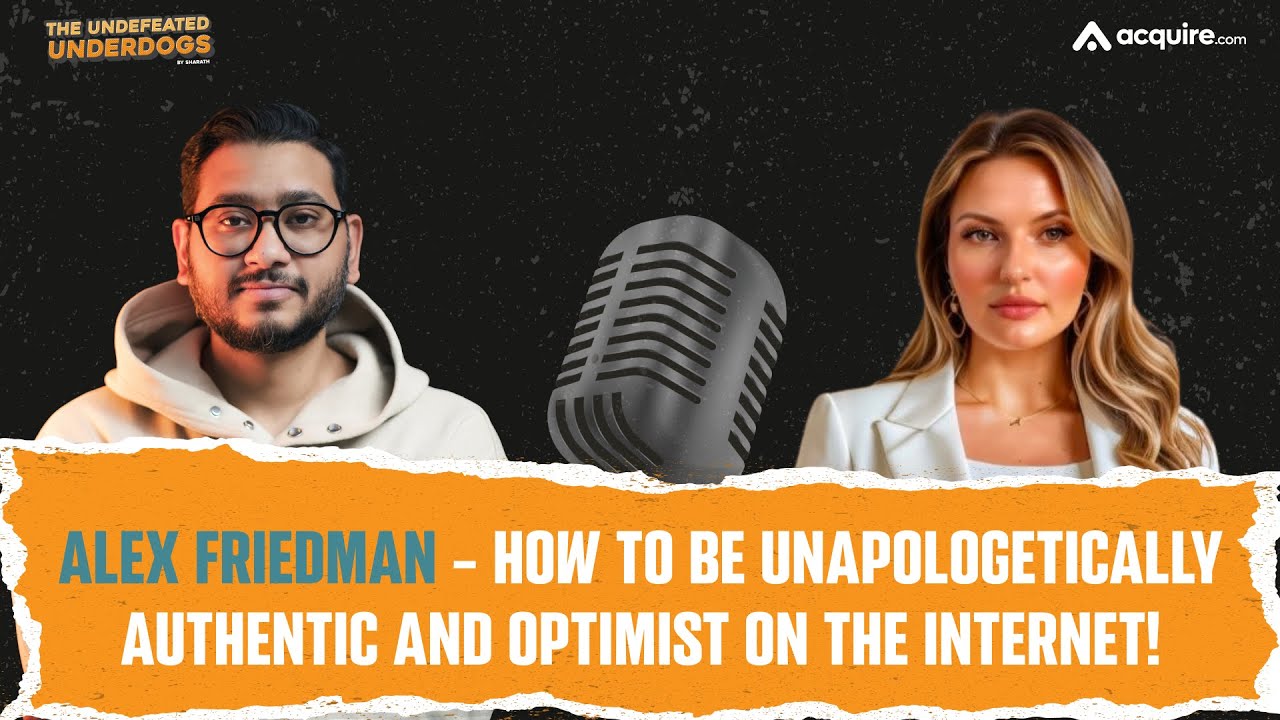
Alex Friedman, a three-time founder with 150K+ followers, built Founder Gigs in one night and hit $5K MRR in month one before selling it six months later. She talks about desensitizing to failure, why authenticity matters online, and how losing her best friend Erica to pancreatic cancer reshaped her priorities.
Chapters
Desensitize yourself to failure. Like, that is the number one hack to success, is desensitizing yourself to failure and desensitize yourself to messing up. You're gonna, you're gonna lose money. Like, statistically speaking, I've lost a lot of money on projects. I've also made a lot of money on other projects because that's the way this stuff works. You're gonna do something, you're gonna hire the wrong person, you're gonna spend too much money on a photo shoot or an MVP. It's just gonna happen, okay? And the quicker that you can learn to just get over it and move on to the next thing, and like the quicker response time you have, the higher your success— like the higher your chances of success really become.
Welcome to the Undefeated Underdogs Podcast, where I unpack and narrate stories of ambitious people who turn obstacles into opportunities. My goal for this podcast is to create a platform to narrate underdog stories and maybe play a small, teeny tiny role in Inspiring you. I intend to highlight the underdog mentality and make authentic conversations with people who play the long game, take action with a chip on their shoulder, and convert obstacles into opportunities. Buckle up as I'll be bringing some authentic founders, VCs, community builders, and content creators who got underestimated their whole lives, and yet they beat all the odds to become insanely successful. Now today, I want to tell you a little bit about our awesome sponsor, acquire.com. Selling a business is as tough as building a business. As someone who went through this process once, selling my own startup, I know the pain it takes to get to the end zone. This is where our sponsor shines. Imagine this, you're a founder who's built a solid SaaS product, acquired customers, and generating consistent monthly revenue. The problem is you're not growing forever for whatever reason— lack of focus, lack of skill, or just plain lack of interest— and you feel stuck. What should you do? The story I'd like to hear is you buckle down, somehow reignited the fire, get past yourself and the clichés, and start working on your business rather than just in the business. You start building an audience, move out of your comfort zone to do sales and marketing, And in 6 months you tripled your revenue. The reality isn't as simple. Situations may be different from every founder facing these crossroads, but too many times the story ends up being one of inaction and stagnation until the become business— the business becomes less valuable or worse, worthless. If you find yourself here or your story is likely headed down a similar road, I offer you a third option. Consider selling your business on acquire.com. Capitalizing on the value of your time is a smart move. Acquire.com is free to list and they've helped hundreds of founders already. Go to try.acquire.com/shiraz and see for yourself if this is the right option for you. Now let's get into today's episode. Yay, there you go. Welcome, welcome folks. Uh, welcome to the Undefeated Underdogs Podcast. I'm your host, Shiraz. Today I have a have a friend. I can call her as a friend. Unlike previous guests, I have little touch with them or they're completely new. Most of them are like, for the first time I'm having them on the podcast. I'm even meeting them. But today I have a friend. I'm excited to bring Alex Friedman. Welcome to the show, Alex. How are you?
Good. How are you doing?
I'm doing well. I'm doing well. For folks who don't know Alex, Well, I can do like a half an hour intro, but let me put it briefly in like probably like 30 seconds. Alex is a 3x startup founder. She's done so many things, but one of the most notable things is Founder Gigs, which actually she took like, what, 48 hours to build an MVP. In the first month, $5K MRR. 6 months later, sold it to Highrunner. That's a phenomenal journey I want to cover, unpack. But she's currently an EIR at Techstars. She's an angel investor and an advisor to many. One of the things I really love about Alex is her authenticity. I think Alex brings an angle of creativity to content, which is something very few people do and do at scale and do it at consistency. So that's one thing I personally love about her. And the result of that is, of course, throughout all her social media presence, she gained over like 150K followers in various platforms. And she's always amped up about founders, early-stage startups, talking about lowlights. Everybody talks about highlights, but amplifying lowlights and really making it as a discussion is something I love about you, Alex. But I'm excited, stoked. Welcome to the show. Uh, for, for folks, before we even go ahead with the questions and all, I have to tell you like a little story. The first time I met Alex is, of course, I never met her in, in real life, but we've, we've had so many chats before. And it was me when I was like looking for a job and someone tagged into a thread I wrote on Twitter and Alex and I jumped on a call. She was building this company called Howdy. which went to Techstars and all. But I have to tell you this, for folks who know Alex, what a phenomenal transformational journey she had in the last 2.5, 3 years. And I've been so inspired by the constant content you put out, Alex. So just want to put that out. Appreciate you so much.
Thank you.
I love you for everything you do. you know, especially for founders and bringing, like I said, shedding light on the lowlights. But just a fun question to start off.
Yeah.
Why do you have like a cowboy hat on your Twitter?
Okay. This is why. So when I started my Twitter was when I was running Howdy. It was like brand new. Okay. So I'm going to add a little cowboy hat next to my name on Twitter, right? Because like the company's Howdy, I was doing for Howdy. And then I just kind of kept it there. I never got rid of it. A big reason why I never got rid of it is because— so Ryan, I don't know why I'm blanking on his last name all of a sudden. Your old boss, Ryan.
Ryan Hoover.
Yeah. So Ryan Hoover came and talked at Techstars Music back in 2018. And one of the things that he said is he told a story about why he keeps his name and his profile picture consistent on every platform, even though his profile picture Like, something like 15 years old at this point. So this was a long time ago. And he's like, oh, I do it for consistency because now everybody, they know my face based off that picture. And so I had the same profile picture for a very long time. I just changed my profile picture for the first time like 2, 3 months ago. And I refuse to take the cowboy hat out.
Yeah. I think it's Ryan who kind of made it popular that your profile picture is your brand. And to add that, Naval famously quoted, like, every brand as a person, they have a unique resemblance to them that they expose or express on others, right? So I completely agree. And I've regretted so many times changing my profile picture, and I bite my tongue, like, Damn, I have to remember Ryan's philosophy. I agree with him so many times and I'm sticking to my profile picture for, I think, for the rest of my life. I think this guy Ben Simmons, I forgot his Twitter handle, whatever, X handle. He's the one who said, yes, to add to what Ryan said about brand, make it playful and colorful when you add an emoji. So going back to my days when I built Shoutout, I had this megaphone next to my name, same way, but I sold it and it felt irrelevant now. But completely agree to your point of glad that you brought it
up. I'm pro you bringing back the megaphone, for
the
record.
Well, let's do it. Yeah, I think megaphone is something that maybe I'm more of amplify positivity and kind of community aspect of it. Probably I'll just bring it.
My thing is, I'm like, well, I live in Austin. It makes sense. I'm like, it's funny because people will meet me and they're like, oh, I was expecting you to have a Southern accent. I get that pretty frequently. And I was like, why? And they're like, oh, because you live in Texas and you have the cowboy emoji. And I'm like, oh, whatever. It's
fine. That's so fun. I think the immediate observation anybody will have if they're new or stranger that visits your profile. Again, like I said in the intro, you kind of blend creativity and storytelling into your content. Just want to highlight some examples when it comes to storytelling. Your recent tweet about your dad's big mistake of showing his potential customer like another option, which ended up losing the sale, as well as, you know, some of the tweets about like age comparisons. You know, you're not late, you're early. You know, there is a blend of like, I think you draw a sense of a lesson from a real life story. Talk to me about that process. Like, how do you think when you write these tweets or when you put out content, how do you find that angle? it's very hard and it requires a knack to find that angle. So talk to me about that process of writing tweets or anything.
It's funny because a lot— so a lot of my tweets are actually written on the fly. Like, I don't use a scheduler. I write them in-app and then I draft them. I have like a couple of those apps. I've tried them. I've never really done well on like scheduling or like other people's content for inspiration. I find that I draw the most inspiration from real life. And I've been raised by entrepreneurs my whole life. And I know that that is like a complete privilege. And then getting to work in Techstars where I was constantly also surrounded by entrepreneurs.
Of course.
There's not a lot of people that get that opportunity to sit in rooms of 50 startup founders that are building out their dreams and get to work with them intimately for 3 months straight. And so a lot of the experiences I talk about online are literally taken from real life experiences, or just from listening to people and hearing about issues. And after a while, when, I mean, I've probably worked with like over 1,000 startup founders at this point in my career, maybe more, honestly. I mean, I've ran and been a part of like 6 or 7 Techstars programs. I've gone through Techstars, I've invested on my own. Like, I talk to founders and then I also make content, so it just happens. And so I've started to pattern match these situations or these issues that I hear from people pretty consistently, and then I can draw that back to a story or an instance that inspired me. So whether that was a conversation with a founder, whether that was a conversation with a mentor, or whether that was something that like I just saw and observed growing up I like to tell those stories because it's just a it's fun. Like it's literally just me reminiscing about them. Like I love that my dad told me that story all the time because he hammered it home. And then as I got older, I mean I'm thirty. I'm I turned thirty-two next week, and I only feel like I started appreciating that story maybe maybe three four years ago. And I think it's because up until that point I was so stubborn and being like no I know what's right. People want options. People want a ton of cool things, right? And now after hearing all these stories from all these founder friends, from me building unsuccessful businesses and unsuccessful projects, I'm able to look at that story and say, hey, there's probably a lot of people out there that need to hear this same exact thing. And maybe I'm a good person for them to hear it from. And here's a story that I can use to back it up.
I love it. I think it's, it's again, going back to your state of being authentic, right? You find these lessons that apply to you and you went through it, so you have that authority to like express it with command. So all of the stories I've read— oh my God, I've read so many of tweets, of your tweets, and I find it very fascinating to have that, you know, like you said, the pattern recognition. that match that story, uh, to any startup founder to like have a takeaway. Have you ever felt like you, you ran out of stories, like you're out of your fuel, your gas? And if yes, how do you refuel it?
Yeah, it's a great question. Um, yeah, all the time. I mean, there's, there's certain times I, I get like this imposter syndrome like anybody else, right, where there will be like a day where all of a sudden none of my tweets are taking I'm getting, I'm getting no, the algorithm is hating on me. And in my head, right, I go through the same, the same thought process that probably most creators do, which is like, oh man, everyone probably decided that they hate me. Like, I probably did something, nobody likes my stuff anymore. And it's done. I need to move on. I need to figure something out. But, but I noticed that once I walk away from the computer, And honestly, just don't go on Twitter. Don't read other people's content. Don't do anything like that. And I just have conversations with my friends, which most of them are founders. If I call up a friend of mine and we'll talk for an hour, we'll talk about their business. I'm an advisor for, for like 5 startups right now. If I call one of them and sit in our call and they bring me a problem, there's usually a lesson I can pull out of that. that I said this is applicable to a mass audience, and then I can go on and I'll write about it. So not really. Um, I feel like if anything, it's more of burnout than it is, uh, like a complete loss of inspiration. It's more of just me getting in my own head and being too online.
Oh my God, that's, that's so unfiltered answer right there. It's like Right. I love it. I love it so much. And you, even in your couple of answers before, you've pretty much mentioned about surrounding yourself with founders, right? And, or be part of these communities. So for people who are introverts or they don't have that reach, what should they do to actually surround themselves with high-quality people who are smarter than them. They're like 5 steps or 10 steps ahead of them. They kind of have the ability to like build a rapport with these founders or like, you know, make them friends, right? So how did you end up in that situation? And how would you, if you were to go back and say like, you know, some ex-founder to do the same, how would you advise to do that?
Honestly, I think if you're an introvert, the internet is like a godsend, like, because you can be on Twitter, and you can be in Discord, and you can be in these like Reddit communities, right? Where there are a lot of entrepreneurs. Granted, you don't know if everyone is, is really who they say they are. But you honestly have to like kind of worry about that in real life too. You have to do your own like diligence on anybody. But I really think joining like online communities, which is Initially, for anyone that's listening, but like how we bonded in the first place is our love of online communities. Because, you know, I used to always think I was an extrovert. I think I'm a very extroverted introvert, but the pandemic is really what catapulted me because I'm more comfortable interacting with people online. Like, you won't really see me out at events. Like, you won't really see me at networking events. Because they're really draining for me. Like, I get really tired. I don't really like it. I'd rather hang out with my friends than go to a networking event. But I can network and interact with people online, which I feel like is an introvert's dream. So if you're introverted, but you want to be a part of, of this kind of founder community, I say join online communities, find, find communities of founders, reach out to people one-on-one on Twitter. Literally just ask people, hey, like, I don't want anything from you, but would you be down to have a 15-minute phone call with me so I can just like get to know you? Or like, what's one lesson that you have for me? And honestly, 9 times out of 10, people will say yes. Like, that's what I found is people are generally pretty friendly and want to help people and they want community so bad that they'll reply and they'll like want to interact with you. But you got to put in the work to just say like, hey, I want this from you. Do you want to make it happen?
I think an authentic ask. So a couple of takeaways, or just to summarize what you said or add to what you said. I'm like you. If you put me in a 100-people conference or an event, I get so anxious. I'm like, I don't know what to talk about. My mouth will just shut down immediately. But what I realized, thanks to pandemic and thanks to these in online communities, I found that I have so much— I'm very comfortable with talking to people like on the screen when I don't have anybody around me, and I can sometimes dominate or I can piggyback, right? I feel for founders or for anybody who's just getting started, just try to take your shots as much as you can. I think that's the best way. And you'll find an angle where you get very comfortable with. It can be texting, it can be video, it can be audio, whatever the thing, the format it can be. I feel making that decision and making it intentional is really important. And I think just to echo your point, the other thing you said is very interesting as well, is you just have to ask.
I mean, honestly, what do they say? 90% of it is just showing up. It's just asking. And I think it also comes from the thought of getting a no is very rarely personal. I used to take nos very personally. I used to think, oh, they just don't think I'm like good enough for them to talk to or whatever. And as I've gotten, I guess, more successful in my own career and have more people reaching out to me, if I don't reply, it has nothing to do with the person that, or if I say no, it has nothing to do with the person. It has everything to do with myself. Either something's going on in my life, either I'm burnt out, either I am just like way too busy and I need to limit my, like, my interactions, or I'm just like tired and I like, it caught me at a bad time. But it, it like the most persistent people that I've found are the most successful. Like sometimes getting a no, it doesn't mean no forever. It means no for right now. Or if you don't get a response, it just means, okay, that person's just busy. Mm-hmm. I'll circle back in like a month.
I think there is a very valid point people should realize. It's about expectation setting for yourself and for others, right? And when you have zero expectations and take your shot, it works. If it works, it feels like a miracle. If it doesn't work, it feels like an action you took and you learned a lesson. Maybe you should change your wording. For example, if you're DMing people or emailing people cold, So there is always like, have that learning hat. When you switch to that hat, pretty much everything you do amplifies and compounds. I truly believe in compound interest. That's how I've made pretty much my career by taking so many shots, just like shooting shots. This podcast, I didn't reveal this outside. I've DM'd close to 300 people.
That's awesome.
And only you are the 37th guest, if I'm not wrong, on the show. So my success rate is so— if someone puts expectation on it, it feels so bad that out of 300, only 30 people, you know, said yes and made a conversation. But on the other end, you have to see like half glass full. 30 people, 30 incredible people, 30+ incredible people said Yes, and gave their time to me, some stranger who's asking their time.
I think about it like I look at your lineup and I'm like, that's badass lineup for like for a first time like podcaster who's kind of like doing this now, right? It's an incredible lineup, and the fact that you were able to get those people not just for a ten minute phone call but for an hour of their time is so freaking awesome. And like that's the thing: you gotta shoot your shot. Like it's as simple as that. And even it's funny because it's like I adore you. I think you're absolutely. Absolutely incredible. It took you like three messages to get me to to actually commit to coming on the podcast, and it had like I said not a single thing to do with you. It had nothing to do with you, like me not wanting to be here. It had nothing to do with me not like loving the podcast or wanting to see you succeed. It was solely because of me and the timing and stuff like that. But it wouldn't have happened if you didn't follow up with me either because. Like I said, the timing, the busyness, whatever.
Yeah, for whatever reason, I think that time. Yeah, I remember. I think you were in Mexico City. Something happened. We changed.
I'm on sabbatical for the last few months. I'm going to Mexico next week. I was in Greenland. I was in Japan. Like I'm I'm all over the place. I've been home for like three weeks out of the last three months. So like I don't really post. I post a little bit of that publicly, but like I'm not gonna post all about it. So but it's as simple as that. Like having this conversation now you're like oh. Okay, that makes a lot of sense why Alex maybe didn't reply or wasn't as enthusiastic. Nothing to do with—
And so the other important thing, which is, you know, I know we're kind of on a rant here, but it's very important to stress on this topic because if you just shoot one shot and you wait, you will get attached to that shot. So for me, you are one of 300. So I have 299 messages to go out. I'm very busy. I don't have that Bandwidth to think about or judge Alex's reply or her reply time, how much time she's taking to get back to me, or why is she not replying to me? No bandwidth at all because I have another DM waiting for me, another guest to invite, another guest, another guest. So get busy with taking shots. I think that's really important. If you just think that take one shot and that turns out to be a miracle, I feel like, you know, you're bound to failure. For folks like listening, or like, they just burn out. I think even myself, I used to get burnout. I think this was back in 2018 when I took my maker journey. I built this startup, invested money, invested 18 months' time. We didn't even launch the MVP. It was so bad that Everybody
has one.
Right. And my biggest complaint then is I took one shot and I went all in. That's it. I have no other navigation or I was never busy. So I think that that literally changed. That fall actually really helped me to rise back. And now I'm like, okay, who the heck? It's okay if something doesn't work. It's fine.
Oh, like I wrote about this recently actually, because I had this conversation. Desensitize yourself to failure. Like that, the number one hack to success is desensitizing yourself to failure and desensitize yourself to messing up. You're gonna, you're gonna lose money. Like statistically speaking, I've lost a lot of money on projects. I've also made a lot of money on other projects because that's the way this stuff works. You're gonna do something, you're gonna hire the wrong person, you're gonna spend too much money on a photo shoot or an MVP. It's just gonna happen. Okay. And the quicker that you can learn to just get over it and move on to the next thing, and like the quicker response time you have, the higher your success, like the higher your chances of success really become.
I love the word desensitizing. I think that's the word we people should have to develop a thick skin.
Yeah.
You can have like, you know, a light-hearted— you should be like, you should dominate this area if you want to build a startup, right? Because there is so much competition. Everybody's competing, everybody's competing in their own way, you know, attracting customers and all that. So you have to be very authentic. You, so you as a founder, have you ever wondered, or talking about the thick skin, Have you ever felt like personal, and how did you navigate from those personal losses or falls and become more thick-skinned? You know,
again, honestly, just repetition. I mean, like the first, the first 5 times I did it, it hurt. And then by the time the 6th time rolled around, I was like, well, I know I'm like, I know I'm smart enough to make something happen. And then the 7th time it got a little better. And then the 8th time it got a little bit better. And then it just constantly got a little bit better. Kind of like the whole compounding thing that you were talking about. Like my first business was a nail polish product and it ended up getting replicated by overseas manufacturers. And I was 20, I got a patent on it when I was like 22, like now like 10 years ago, which is crazy to think about. But I ended up getting vendor agreements with like Forever 21 and Urban Outfitters and Bed Bath& Beyond. I was so excited. It was my identity. It was my first business. And then it got replicated and you could buy 2 of them for a dollar. dollar on AliExpress, and all my buyers pulled out. And it was like, at the time, it felt like the worst thing that had ever happened to me. I was like, I was crying. I was— it was horrible. And it took me genuinely, like, probably 2 years to really get over that. Wow. Because this was my baby. Like, I thought that this was my future. I thought that this was gonna be like my end-all be-all to success. And You know, before that, there wasn't really a lot of things I was super proud of. Like, I never was really good in school. I never got like really good grades. Like, I wasn't that kind of student. But I was the girl that got a patent and got my product into stores before she even graduated college, right? And so it was something I was really proud of and all my friends knew about and other people like I was talking to my entrepreneurship classes and they all knew about it. So it felt really embarrassing.
Hmm.
That it didn't work out the way that I wanted it to work out. But, you know, and then, and then after that, I started just doing the same thing, working on smaller projects, not spending as much time and money on them, like literally giving myself a deadline and saying, hey, if by 3 months in this isn't working, I'm just gonna move on to something else. Like, it's not a big deal. And now I'm at the point where honestly, I'll try anything. And if it doesn't work, it just doesn't work. Like, I don't really spend too much time stressing about it, but also it came from a lot of me just trusting my own abilities now and upping my self-confidence to say like, I'm smart, I'm capable, I'm gonna be successful. I don't know if I'm at the success, like I'm not the height of success that I want to be yet, but I'll find the path there. And any time that I waste on one thing is like inhibiting me to go after that path. So it's just better to just keep bopping along until you find the right thing.
I think as long as we play the long game, we should be fine. And we never know, we can't predict what will happen tomorrow, right? Like anything can happen tomorrow. You yourself don't know when you started Founder Gigs. I remember that tweet and we've had these conversations in DMs about like freelancing, you know, sourcing freelancers and like designers.
Yeah.
You would've never imagined that Arlan, they just come forward to like acquire FounderGigs. That's, I think that is bonkers. A tweet to acquisition is bonkers. So let's talk about that. Talk to me about that whole journey, your expectation setting to like just tweeting out, having fun against being micro small projects to $5K MRR to like 6 months acquisition. Walk me through how you felt.
Yeah. So that was crazy. I'll start there. That was a crazy ride. So what happened is that, like I've said, I've worked with a ton of startup founders. I'm friends with a lot of founders, a lot of founders trust me, it's probably part of like the authenticity thing. It's probably also part of like not really judgmental. Like, I've seen it all. It's easy for for me to talk through issues with people. And, um, in over the course of like 3 days, I had, uh, 3 different friends reach out to me and say, hey, Alex, this is like super vulnerable of me, but I'm running out of money. And, um, my startup's not profitable yet. I don't want to shut down the business. I just need to make an extra $3,000 a month, let's say, um, to keep this going. And so that happened once, then it happened again, and then it happened a third time. And so eventually I said, you know, I don't know anything like that. They're like, do you know anyone that's hiring for a part-time position or for like a small advisory role? Like anyone that could just help supplement my income as I continue to build my business? And I was like, no, but you know what? Let me tweet it. Okay. I probably had about 8,000 followers at the time. Maybe a little less, actually, maybe around 6,000. And I just tweeted it out. And all the tweet said is like, hey, a few of my friends, my founder friends are looking for part-time roles working for another startup. Does anyone know anyone that's hiring? And I got a ton of comments on that post saying, no, but this is a great idea. Like, this is a great idea. Wow, like, you should build this. And At the time I was like, this isn't an idea. Like I wasn't thinking about it genuinely. I wasn't thinking about it from the perspective of it being a business. But I got all these comments from people and I said, all right, yeah, no, this is a good idea. So I went onto a no-code website and I built it. I literally built it that night. I stayed up till 4 o'clock in the morning. It was like September 11th, 2 years, maybe a year, 2 years ago, 2 years ago now.
It was literally 2021.
September.
Yeah, I remember.
It was September, September like 11th, 2021. And I stayed up until 4 o'clock in the morning. I built it. It was funny. My boyfriend was sitting on the couch next to me and he's just like, are you going to go to bed? And I was like, no, I'm going to try to launch this by tomorrow. And he's like, cool, right on. Like, go for it. And then the next day I posted it, I got probably around like 100 signups. So it didn't blow up at the time. And all these people were commenting on it being like, wow, this is so impressive, Alex. And I was like, oh, thanks. Like, it was completely free. People could just sign up for it. I was DMing it to a ton of companies trying to get them like building out this pool. And it had a job board component. And then it just so happened that another gal on Twitter tweeted something out and said, hey, this is a vulnerable post, but I'm running out of money. Does anyone know where I can get a part-time job? And her post went viral. And all these people started commenting on her posting, hey, Alex Friedman just built this thing called Founder Gigs, just called Founder Gigs. And so because they were commenting Founder Gigs on it, everyone that was looking at her viral post relating to it saw it. And then it ended up getting something like, like 2,000 or 1,500 signups in the first 48 hours. Wow. Like, it was nuts. And I didn't know how to monetize it. I didn't know what to do with it. It was completely free for like the first month. So technically we didn't hit 5K MRR the first month. We hit 5K MRR the first month that we started charging for it. And I have to give a huge shout out to, his name is Ayush. He worked with me on this. He's absolutely incredible. I couldn't have— I couldn't imagine a better person to work with me on it. He was working with me on Howdy at the time. And then I said like, hey, I just did this thing. This is nuts. Do you want to work on this with me? And he's like, yeah, let's do it. And he was all in right away. Awesome. So he was a huge part of it. But we launched it. And then the next month, I started asking people, okay, like, I don't know how to monetize this. Can you guys send me ideas? And people started sending me in ideas, monetized it that month, got $5K MRR. And then, and then yeah, about 6 months later, Arlan approached with the offer for acquisition. And at the time, which I've also posted very publicly, but one of my best friends had just been diagnosed with cancer. And so I was like, honestly, I know that there's a business here. There obviously is. But I don't have the bandwidth. This is either gonna die or I let it get acquired. Totally. And so it, it seemed like the acquisition was the right step and it worked out. It worked out great.
It's, it's like, it feels like a script. It
was nuts. It was one of those things that whenever I tell people, like, that's what I mean, where you just put stuff out and you never know what's gonna hit. If someone asked me, and the thing is, I invest, which is so embarrassing to admit, because if someone said, hey, there's this product, would you invest in it? And it was Founder Cakes. I'd be like, no, like, I don't know if that's ever going to be like that. But it blew up. And it came from a few factors. It came from, A, I already had the network. It was super easy for me to share it because I'm friends with a lot of founders. I know what founders want. I like know what they experience. So I built it for a market that I knew so intimately. And for a market that really trusted me. So it wasn't difficult for me to sell it to them. It wasn't difficult for me to get people to sign up because they're like, well, we love that. Like, we know she has our best interests at heart. Here we go. So that was a huge part of it. And then just moving as quickly as possible. Those were like, that was the 2 things that made it successful. Nothing else.
Yeah. Founder market fit is way important than product market fit. A lot, a lot, many times founders underestimate because of the ideas being very sexy. On paper thinking that they might have the edge of launching that product and taking to the market because the market and product has that fit. But honestly, I feel everybody should start from, do I have a command in the niche or am I being celebrated or recognized by people who I'm building for? I think that is really key. That question really defines a lot of things like confidence, like you said, ability to execute super fast because you won't have self-doubts or anything. You just like execute. You know this, it feels like they're going in a straight path. There is no zigzag or anything. It's like very clear, very crystal clear. Yeah. That's a great point, by the way. I think I love the two. I was about to ask like, what are the two biggest takeaways? Thankfully, like you just You know, give it away to me.
I mean, I didn't, I didn't have any time for self-doubt, to be honest. I was just, I was too busy building it. I was too busy, like busy being like, hey, this can help a lot of people that I consider to be my friends, obviously, based off of all the comments that I got on that initial tweet. And so I just built it. It was crap. The first product wasn't good, but I just didn't overthink it. And then they, there's a big saying with product market fit where they say, Doesn't really matter what the product looks like. Doesn't really matter even totally how it functions. If people need it bad enough, they're going to use it. And Founder Gigs version 1 was a great example of that. People needed it bad enough that it really didn't matter if it didn't work half the time. And it didn't really matter that it kind of didn't look that great. Like they wanted to use it.
And one of the things I want to dive a little bit deeper about Founder Gigs is it's a marketplace, right? Yeah. It's a job board for founders who want to like do part-time as well as at the same time for startup founders who offer these jobs. So, and marketplaces are freaking hard to build. If you were to like do it again in a much better way, how would you do it? And that advice will help people to like, you know, think about their marketplace ideas.
Yeah. If I was to do it again, what would I do? I don't know if I would make it a marketplace.
Oh, man.
I know.
Another unfiltered—
Honestly, my biggest, love it or hate it, I don't know. I like authenticity is one of my core values. So it's kind of hard for me. Like, I probably wouldn't have made it a marketplace. I would've made it more of like a recruitment platform and figured out a way to charge people a percentage of their earnings. And then I would have partnered with companies in order to do it and acted as their recruiters. That's probably what I would have done instead. That's actually what we tried to do and where we made the most amount of money. We did it. We had a like premium feature where we acted as recruiters for some of these companies. And we were able to charge people like $1,500 a month from doing that at one point. So that worked out great. $500 to $1,500. $100 a month. If I was to do the marketplace again, I would have probably made sure that I had someone that was either a former recruiter and had access to more companies, or I would have, I would have figured out where to find companies a little bit better, like how to position it for companies that wanted it more. Because I really knew how to position it from the founder perspective. That wasn't hard at all. It was a bit more difficult to position it from the company perspective.
I think that's a very good point. A lot of marketplace ideas, founders have a command or a domination in either side of it. It can be supply side or either demand side, and they fail to fill the other side. So it's a very good point of bringing an expert or someone who has— who can fill that uh, gap. That's, that's true. I think I never thought about it. I should probably like revisit my marketplace ideas. Um, yeah, I think that's a very good point.
I mean, that's why a lot of people move away from marketplaces is because they can only get one side of the marketplace to use it actively. So I mean, that's why— I don't know, I'm not trying to be cynical by any means, but I'm like, if you can find a way to not make it a marketplace, I'm very supportive of that kind of business. And then if not, hire someone or find a partner that knows the other side of it and can recruit the other side of it really well.
Oh my God. Yeah, I've tried a couple of times, but I lost the interest even. It wasn't fun. It instantly becomes stressful because you have to really— you can see clearly a gap as a founder. If you're seeing gaps in your ideas, it's less motivational, right? Like, you know, but anyway, that's for— I think, yeah, absolutely. I think that's great advice. Let's talk about— you've done, you know, so many shows, podcasts on founders, so I don't want to like revisit the same questions, but I want to really talk about your content, you know. Yeah. the way you write viral tweets, for example. And, uh, the other thing I wanna— let's, let's talk about that. Like, talk about like virality.
Yeah.
What makes, uh, you know, a content piece viral in your opinion?
Um, I think that I talk like I am— I talk like I talk in real life. Like, that's a big part of it. So when people read my tweets, I genuinely believe a lot of people view me as more of a friend than a content creator. And they also feel like they know me more than they know other content creators. I don't, I don't ever want to be seen as like this unattainable figure for people to like that. Like, yeah, of course I like the respect. Like, I like people knowing certain things about me or what I've accomplished, but that's never my like first primary goal. I'd rather people view me as like the friend that's either like a peer mentor or building themselves in public. Like, that's a big part of what I do. Mm-hmm. So I think a big part of the virality is people just looking at my stuff and saying like, oh, that's Alex. Like, oh, like I can read that like I'm reading it from a friend or like someone's texting me. So you'll see at the beginning of a lot of my tweets, I'll, I'll use informal language. I'll do things like IDK or, oh, I don't have any ideas. I cuss. Mm-hmm. I don't cuss a ton, but I cuss like enough where I feel like it has impact. All that stuff, funny enough, even though it is the way I talk, it's intentional. It's very intentional. Having like things that are misspelled, improper grammar, not adding in all that stuff, it's intentional. Because it feels more personal than than authoritative, authoritarian. And I think that that helps. I think the other thing that helps is stories like three different posts of mine consistently go viral. The first one is one-liners that are just easy and very relatable to a very wide audience. Those will go viral. The second one will be stories that relate back to my family or friends or conversations that I've had that have a lesson at the end of it. And then the third one are what I call like listicles. So really, like, I did one on Taylor Swift and just had 5 facts about her, um, about her tours. I did one about Costco and it was like 5 facts about Costco. The way that I position that isn't like, hey, I am an expert in X, Y, and Z, and here is a list of 5 things that you need to know about Costco. Like, I literally tweeted like, hey, I found out this cool thing about Costco. Here's 5 things that I learned. Like, there's no sort of authority to it. It's like how I would talk at a dinner party as opposed to me being on stage giving a presentation. And I think that that plays into everything that I do. And that is what allows those 3 types of— 3 pieces of content to go viral for.
That's very counterintuitive, I have to tell you that. If you go ask or if you just scrape on the internet about how to make content viral, most of the suggestions are you should dominate or you should have an authority. Very less people say that I think authenticity beats authority, period.
Right.
I think that's key. But the other thing is authority can work in short term. Like, there are so many content creators that I don't want to name them, but they're quite dominating in that particular niche, but they will be forgotten in the long run. People remember people who seem to be people. Not someone else, right? So that means you should be authentic. I love that. I think even I'm taking lessons about the 3 things you mentioned, at least you. I think we should all do a retro of ourselves, like the content we put out. What are some things that we really love and we shouldn't shy about? We should double down on it and keep it going, right?
Like, sorry, um, not to cut you off, but based off of your point, I was actually thinking about this this morning. There are a lot of people on social media that they have a lot of followers, but I don't feel like anyone actually cares about them. Mm-hmm. I don't think anyone actually knows who they are. They just follow them because they get this information or they like what they teach, but like they don't have a real brand to them. And I'm a much bigger fan of people as brands. and putting out content that feels like authentic to them. I don't need— like, here's the other thing that I've realized about authority as a whole is I don't need to tell people why I'm smart. I don't need to tell people that I'm accomplished. They can either, they can either derive that from the content that I put out or they don't. And it's not my responsibility to tell them otherwise, right?
Yeah.
I don't need to shove authority down anyone's throat. I just need to show up, be myself, and put stuff out there. And, and, you know, hope for the best.
I feel— I think pandemic is, is to blame because a lot many people have a lot of time and they don't know, you know, how to express themselves. So that's why I feel like in, in between 2020 and 2023, if you really like do a good analysis of some of the folks who gain massive following list They just, they were very authoritative, but where are they now? And some of the folks I know, again, no one wants to name people, but they lost the touch of what they do authoritatively 2 years back. It's not 10 years, guys, 2 years. They were authoritative in that niche 2 years, and now they disappeared because it's not a game you play for the long run. I think authenticity, being yourself, there is no game. Literally, you're being yourself. It's expressing the lows and the highs, the things you go on. And I really appreciate you about, again, going back to the intro, you just equally or even more shed light on the lowlights, like some of the failures, take for age. Those tweets are very Simple and it's so relatable that a lot many people, they just doubt themselves because they're in 40s. They can't— the ability or time to build something from ground up. But helping them, inspiring that truth itself is like, you know, it's so authentic to me. I feel those are the things that I love about you and your content. And coming to that point, Why do you think it's so important to highlight some of the downfalls or failures of anybody's journey?
Because like a few reasons. One, I think it makes it so more people don't give up. I think if anything, we need more entrepreneurs. I love entrepreneurs. I think that anyone that can have like authority over their own lives, And be able to support themselves, whether that's a huge business, whether that's a, like a small business, whether it's a solopreneurship, I think is absolutely incredible. And I think there's a lot of people, um, up until this point, we have viewed entrepreneurship as being this like only for the 1%, whether that's people that came from privileged backgrounds or only for the 1% that made it. Mm-hmm. We never highlight people that make $250,000 a year running a podcast or on Twitter or on social media, which $250,000 a year working for yourself in social media and making content is so freaking cool. So much better than working at a 9 to 5, in my opinion, in my world.
Yeah. Oh, 100%.
And, um, I think just like, like shedding light on those lows, it makes people feel less lonely. Like when I was going through this really hard time with my company, when my product just got replicated, I didn't even know who to turn to. I was so embarrassed. I, I like had only seen all these stories of all these 23-year-olds. Like at the time Evan Spiegel was building Snapchat and was the billionaire, billionaire 24-year-old or however old he was, right? Like we see a lot of stories like that and I don't think that they're encouraging. I think that they're encouraging maybe in small doses or to very specific type of people that want to like use that fuel to say like, oh, I want to be like that. So I'm going to put in the work. But I think it ends up being discouraging to almost everybody else in the in-between. Mm-hmm. And so I think highlighting that, I just, I like the idea of not, of people not feeling like alone in their journeys and also like not wanting people to give up. I think that's the biggest part of it is like, I've wanted to give up so many times, like so many times in my career, and I didn't. And the only reason why I didn't is because I had mentors that told me that they believed in me and told me stories about their experiences. So if I can do that at scale, then hopefully that inspires a lot of other people to just keep going as long as they possibly can, if this is what they want to do with their lives.
I feel you know, people becoming brands is one level, and those— the same people becoming safe houses for other people where they feel like, you know what, I can share with this set of group of people who are on the same level. They had, you know, similar experiences, failures, or feelings before that they express pretty transparently. I feel that's why I love the build in public moment. And again, I think it's not for everybody. It should come from within. Because someone else is doing, you shouldn't do it. If you genuinely feel like you want to be transparent on the internet, go for it. If you don't feel that way, it's fine. That's another thing, right? To your point, a lot of people, they just do this stuff because other people are doing it.
most inauthentic thing you can do.
Right?
Like, you don't need to be vulnerable because you think it's what people want to hear. Like, you post what feels most true to you. And I mean, I just, I don't think I would feel right posting about how much money I have, or like really highlighting the super, like the accomplishments I've had. Mainly because there's a lot fewer of those than there are failures. There's, there's There's a lot. There's— and I think I honestly, and I don't think that's just true to me. I think that's true to every single entrepreneur, whether they will tell you that or not. There are a lot more strikeouts than there are hits and home runs. And it's just like what feels true to me if I'm gonna share about my life is obviously there's gonna be a bigger highlight on the downfalls than the ups.
Love. I think so many, uh, tweet gems, you know, we're gathering in this conversation the past 50 minutes.
I know we're gonna— both of us are gonna be writing after this, like, putting out all these bangers, all these viral tweets. I
know, right? Yeah, uh, we should, we should name this podcast like Banger Content. How to
write a banger tweet with Alex.
Let's, let's talk about Uh, one of the things I really want to talk about is the vulnerability side of Alex.
Yeah.
And, you know, one of the things I really love about you is, again, going back to expressing yourself, whatever you're feeling, right? Talk to me about, uh, so one of the things, uh, that stuck to me and from the experience of you losing a friend is You said that in one of your tweets, I don't remember what, but I actually bookmarked it. The amount of grief is the amount of love. And that is so— for me, it actually lifted a lot of burden because of the things I went through in my life. It shows that you really care. And when you care so much, it for some reason brings positivity into your life. You're not really losing anybody or anything, or, you know, even going back to these failures, because you give a damn about the thing you care about, right? So, so talk to me about Erica. Um,
yeah,
the whole experience and the vulnerable side of Alex.
Man, I love this question. I'm a little caught off guard because I've never People don't usually ask about grief. It's interesting. And I've noticed that since losing— I guess for anyone that is listening that doesn't know, Erica was my best friend. She got diagnosed last year with pancreatic cancer when she was 31 years old and 34 weeks pregnant. And then she passed away in February after 11 months. So a big part of why I sold my startup was that I wanted to be there with her. I pretty much gave up my life for the last year to be with her. And it was, it was, it was really, it was kind of a mind, it was kind of a mindfuck, for lack of a better word. Because I was blowing up on TikTok, I just started my TikTok and reached 50,000 followers in the first 2 months, and then found out my best friend was dying. And I tried really hard to just keep going. I sold my startup, we didn't know she was terminal when she was first diagnosed. I actually found out that she was terminal on the same day that it was announced that FounderGigs was getting acquired.
Wow.
So I was sitting in my dad's garden. It was just announced that FounderGigs was getting acquired. It was on Twitter. It was Arlan posted about it. And I was getting hundreds of congratulation messages and phone calls And texts. And then maybe 30 minutes later, Erica called me and was like, hey, I just got out of the doctor's and they said they— that I have months to live. Wow. And I was at my dad's house and sitting in his garden, and I was like simultaneously having a panic attack, crying my eyes out while getting all these congratulation messages. And all I could think about in that moment is like, I would trade it Like, I would, I would like anything that I could give in that moment. I would have given it if I could, if I could change it.
Yeah.
And I didn't have that opportunity. I didn't, I didn't have that choice. And so it made me start thinking a lot about these times in my life where, you know, Erica and my last vacation together, I canceled it at the last moment. She still went with her husband. Because I had like an investor meeting, and I didn't—I don't even remember what the investor meeting was. But obviously, it was before she—before she was diagnosed. Every everything after she was diagnosed was one thing. But there was a lot of instances that I could point to where I had picked work over being with her, and these are memories that I would have held on to now. And I expressed that to her before she died, and she was like, Alex, like. let that go. Like, that— she's like, I don't even think about that. Like, please don't be upset about that. But it is one of those things that I look back on now. Um, and so it genuinely changed my perspective around building businesses and the way I want to live my life and like where I want to put my time and energy. Um, because like when you finally reach that point where like you don't have an option, Right? You're probably not going to pick work. Like, I'm just saying, like, you're gonna pick the memories and you're gonna pick the people that you love. Um, and I share that pretty openly online. I shared a lot of that experience online, not just because it was very, like, therapeutic to me, um, but because I felt like it was a lesson that a lot of people needed to understand. Like, up until This last year, I'm— I was like a workaholic. Like, I, I made a lot of sacrifices pretty, pretty much all the time to work over being with friends and being with family. I wouldn't go on family trips. I wouldn't go home for the holidays because I'd be working. And now I would never do that again. Mm-hmm. Like, I'd just never do it again because I realized that's just not— it's just not worth it. And so it's a big reason why I share about that publicly because, A, I feel like she would want me to. And I think it's important for other people to reach that point. And it's, it's funny because I've actually had a few people ask me, they're like, Alex, do you ever feel nervous about posting these vulnerable things online? Do you ever feel like it's going to hurt your brand or hurt your reputation? And I can honestly tell you, A, no. I have no concern about that. But B, I've had some of the top, like, entrepreneurs, the top VCs, some of like the top, like, people that have hundreds of thousands of followers, that have Wikipedia pages, that like people are dying to get calls and meetings with, that have messaged me because of these, because of these tweets, who have just said like, hey, I followed you, or I've seen some of your tweets before, but I just need you to know people need to hear these things. And I really appreciate that you did that. And so it's just like a reminder that like, I feel like I'm doing the right thing because of authenticity and, and, and it's not forced. Like my messages, the tweets that I write about this stuff that I write about grief, they're never forced. They're never because I think that they are like, oh, people need to learn this. It's because I experienced that pain and I don't want other people to experience it too.
You certainly changed the way I think about work. I'll tell you that because I think one of your tweets were about spending time with your family, prioritizing family, friends, and the important things to you over the things that you achieve in the long run, say work or building startups. building audience and all that. Because I think I read one of the tweets about you expressing about Erica, and I felt like, you know what, damn everything. I don't care about some of the things I do. I have ambitions, fine. But I have a— at that time, I have like a 1-year-old who just took his first steps. And I cherished so much that I started like, okay, spending more time intentionally with my wife. I talked to my mom and all that. I think you just want to say that you certainly changed me from that angle. I'm more of like a family person, but I always like you, like you said, I think most of us who are ambitious, they just prioritize work because that's how it was drummed on us by many others for years, right? You have to prioritize, like not to point blame on Steve Jobs. He's a legend. I love him to death. He's my indirect mentor, but he prioritized work over family. And like you said, even in your previous answer, we just compare Evan Spiegel. I'm 34, he's 23, building a billion-dollar business. I'm a lost cause.
Yeah.
Steve, he prioritized work, made a massive change. Probably that's the way. So I feel lot many people should just ask these questions within, and whatever answer that comes out, live up to it. That's it. I feel not comparing with others and living your life is the biggest blessing you have.
Every day that we wake up healthy and everyone around you is healthy is like a blessing. And I don't think you realize that until someone close to you or until you get sick, right? They— there's a saying where it's like, um, uh, it's like a healthy person has 1,000 wishes, a sick person has one. Yeah. And then like, unless you're prioritizing that stuff— but it's not just about, um, prioritizing family and friends and all that over work. It's about also not bringing your work home with you, right? Like, I have this habit, or I did have this habit of If something happened to me and I would go and be with Erica, I would, I would be so busy being upset about this thing that happened, right? Like about someone being mean to me on Twitter or being rude or whatever. And so even though I technically wasn't working when I was with her, I wasn't being present because I was thinking about this thing that, that doesn't even matter. That was like so irrelevant that I don't even remember what it was today. So I think that's a big part of it too. It's just if you're going to work and if you're going to be present, if you're going to be a figure online, learn how to separate those things and not bring it home so you can be as present as possible and actually show the people around you that you care and you prioritize them.
Yeah. And I think adversity changes a lot of things. That's the transformational thing I was talking about in the beginning. you know, when I was like introducing you or even just having that pre-chat is because now you don't give a fuck about anything. When you lose something that is really important, everything else will fade away, right? You just said about trading anything that you have right now for bringing Erica back, right? So I think that is For ambitious people, I feel— I think ambitious people should face adversity to an extreme level because we will kind of take that fall or that loss and convert into something. Again, to your point, will become so thick that who cares? Like, all the results and nothing will be like, you know what?
It's so funny. I love that you said that because I've never thought about it that way, but it's so true. Like I had the worst thing that one of the worst things that could have ever happened to me happened to me at a very young age. And anything that happens now, I'm kind of like, all right, I'll figure it out. Like, like, I'll figure it out. It doesn't, it doesn't really matter because nothing will hurt as much as that. And I made it through that doing pretty okay. So yeah, I've never thought about it like that, but I like that.
No, yeah, I think that's why I feel, uh, That's one thing I think people should talk a lot about, how adversity shaped them and turned them into even better, make them better. And I think that teachings are very important. I know we are running out more than the time we've been booked for, but one more question. I have so many questions, but one of the things I want to kind of ask about you is How did you recover from the loss?
I haven't yet, to be honest. I don't think I ever will. I think it's one of those things that like you wake up every day and you just hope that it's gonna hurt a little bit less. And sometimes it does and sometimes it doesn't. And I mean, a big part of taking the sabbatical is to try to do that, to try to just appreciate the life that I have, the life I've been given, the fact that I am alive. Like, a lot of the appreciation for that is kind of what inspired me to take this break now. But no, I mean, I still think about Erica 24/7. Like, she just never leaves my mind, which is why people ask me, like, how do you talk to someone that's grieving? And I'm like, ask about the person. Like, I love that you asked about her and weren't afraid to ask about her because A lot of people are afraid to ask someone that's grieving about the person that they're grieving. And they're like, oh, well, I'm worried that if I bring them up, they're gonna get upset. I can guarantee that person is thinking about them 24/7. Like,
Yeah.
It's just, that's the way grief works. And I think it'll be one of those things that probably I'll deal with for the rest of my life. Because that's the person that she was. And I'm really grateful. At the end of the day, I'm really grateful that I got to have a friendship and a relationship like that once in my life.
Right. The reason I asked that question about— that's how I want to end this podcast episode, is because I'm more of like a half glass full guy. For life. And even for you, I'm sure, and correct me if I'm not, you know, if I'm wrong, after this call, you would probably reminisce those moments you had with Erica than the moments you didn't have with her, which is in the future. Yeah. You, you must have gotten like, you opened photos or like text messages or like, you will, you will probably like be in that mode than you know, the loss side. So because I've kind of, not to your extent, but, you know, when people ask about my failures, I'm like, damn, I get the opportunity to tell them about the things I did, which are more important than the things that didn't work out. So I view it that way. That's why, you know, I kind of brought it up, but it's, yeah, I think, you know, More strength to you, Alex. You know, I feel you'll go places for sure. Uh, people would be stupid to not predict that. And, uh, I'm, I'm so fortunate and grateful to call you as a friend. And I've had, you know, I've had a blast, uh, talking to you as always. We should do this more, probably. Like, you
know, can we just make this recurring? I don't even care if it's recorded or not. I just want to put it on my calendar once a month. We'll do a catch-up. But either way, I'm really grateful that you asked me to be here and to chat. And thank you for the very authentic questions and the very thought out. I loved the questions.
No, I think the guests make people like us open up more. So I usually get nervous in front of my guests because I ask these weird questions. Sometimes they feel like— but with you, I'm like, you know what? I'm talking to a friend. Let's.
We're hoping anything that I probably be like, yeah.
But Alex, appreciate you, grateful for you, your presence in our life, you know, in so many other people's life. You certainly changed me about many things. So I love you and do your thing. You're amazing. You're you're you're blessed. You're full. I just want to tell you that you are so full. Love you too. So, uh, on that note, I just want to, you know, thank our, you know, listeners for giving us the time and attention. You know, you are the reason we do these conversations openly, authentically. You energize us, you fuel us. Uh, stay tuned for more, more people like Alex, and probably like we'll bring you some other time, you know, for round 2.
I'll send you— well, it won't take 3 messages to get me here.
It's okay.
I forgive you.
All right, guys, that's it for this episode. Stay tuned. Uh, thank you.
Thank you. Cheers.
More from 5harath

Julian Weisser - Why ODF is on a mission of making things for people who make things!

Ryan Gilbert - How to master the art of building and scaling curation newsletters!
Chris Hladczuk - Tactical advice you need to know to build a fintech startup in stealth!
Andrew Rea - Why first-time founders should invest time and effort in building conviction!

Blake Emal - How to convert people browsing your website into people buying your product!

