Arlan Hamilton - On a 10yr mission to empower 1000 underrepresented millionaires!
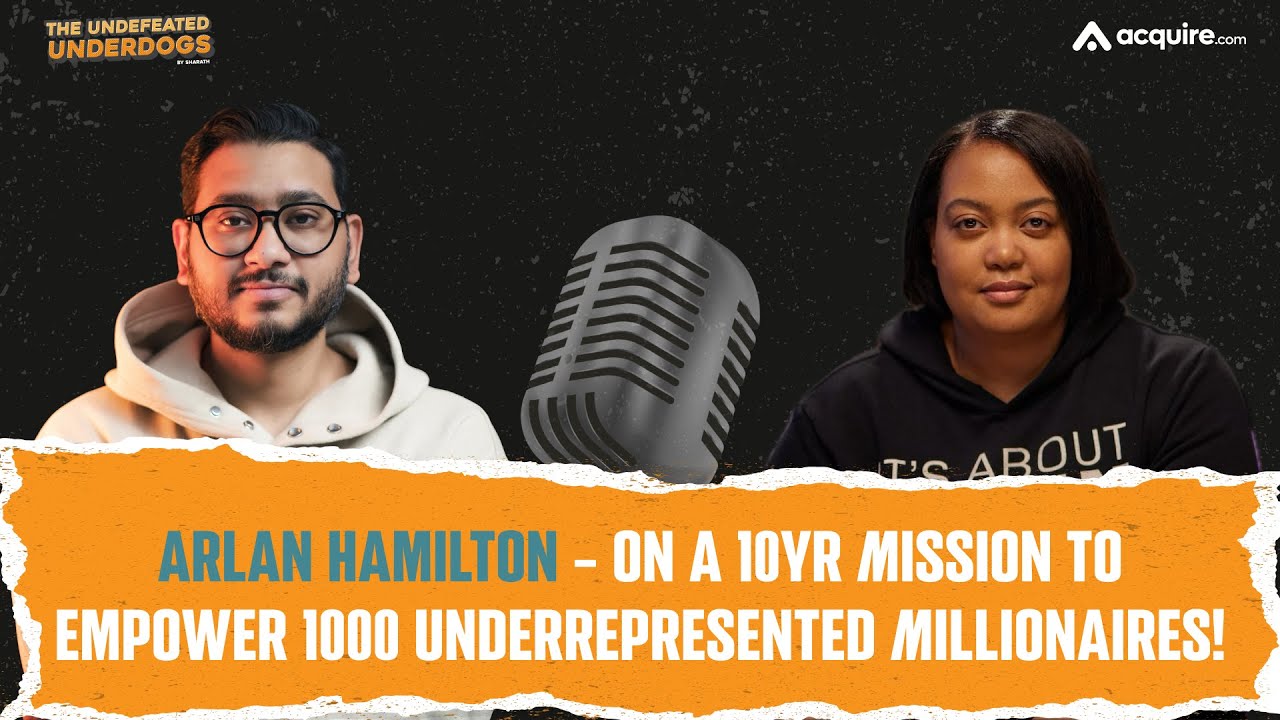
Arlan Hamilton, founder of Backstage Capital, is on a 10-year mission to create 1,000 millionaires from underrepresented groups. She's built a multi-channel ecosystem including a podcast, book, and annual conference launching April 9-12, 2024. Hamilton looks for founders with curiosity, resourcefulness, and audience traction, drawing lessons from 200+ investments.
Chapters
Well, I'm just— there's so much we have to overcome just to walk out our front door in this country. You know, it's just like there's so much that you can just name any group and we have to take on so much. And that's not to say that every underestimated or underrepresented founder should be invested in or is fantastic or is even a good person, because it's just not true. But it's— if you have made something happen for yourself as an underrepresented, underestimated founder, Especially in the US, it has been against all odds. And let me just go ahead and see if I can put some of that money back into founders who deserve it.
Welcome to the Undefeated Underdogs Podcast, where I unpack and narrate stories of ambitious people who turn obstacles into opportunities. My goal for this podcast is to create a platform to narrate underdog stories and maybe play a small, teeny tiny role in inspiring you. I intend to highlight the underdog mentality and make authentic conversations with people who play the long game, take action with a chip on their shoulder, and convert obstacles into opportunities. Buckle up as I'll be bringing some authentic founders, VCs, community builders, and content creators who got underestimated their whole lives, and yet they beat all the odds to become insanely successful. Now today I want to tell you a little bit about our awesome sponsor, acquire.com. Selling a business is as tough as building a business. As someone who went through this process once, selling my own startup, I know the pain it takes to get to the end zone. This is where our sponsor shines. Imagine this, you're a founder who's built a solid SaaS product, acquired customers, and generating consistent monthly revenue. The problem is you're not growing forever for whatever reason— lack of focus, lack of skill, or just plain lack of interest— and you feel stuck. What should you do? The story I'd like to hear is you buckle down, somehow reignited the fire, get past yourself and the clichés, and start working on your business rather than just in the business. You start building an audience, move out of your comfort zone to do sales and marketing, And in 6 months you tripled your revenue. The reality isn't as simple. Situations may be different from every founder facing these crossroads, but too many times the story ends up being one of inaction and stagnation until the become business— the business becomes less valuable or worse, worthless. If you find yourself here or your story is likely headed down a similar road, I offer you a third option. consider selling your business on acquire.com. Capitalizing on the value of your time is a smart move. Acquire.com is free to list and they've helped hundreds of founders already. Go to try.acquire.com/harath and see for yourself if this is the right option for you. Now let's get into today's episode. My next guest went from homeless to breaking barriers in VC, championing diversity and inclusivity in in many founders who are underrepresented minority, you may call it, whatever you want to call. She's a powerhouse. She's the dynamic force behind Backstage Capital, a VC firm who tirelessly advocates underrepresented overachievers in startup industry. They made over 200+ investments, including Maven, Candidly, and so on and so forth. I can go on and on. And she's also the founder of High Runner, and she was I think she is a tour manager right now as well, which is something I'm very excited about to talk. But it's none other than Arlan Hamilton. Welcome to the show. How are you feeling today?
Thank you. Thanks for having me. I'm feeling all right. Yeah, I'm feeling pumped about everything.
Awesome. Yeah, right off the bat, one other thing I didn't mention in the intro, she's also the author of It's About Damn Time. It's one of my favorite books I've added to my collection in 2023. I'm fortunate that I met Arlan in person in HubSpot event recently happened, and this is like a signed copy. So I'm stoked for that. 10 years from now, down the line, I would be like showing this to my kids. So right off the bat, I have this question. I recently saw you post on LinkedIn about you're on a mission to empower 1,000 millionaires. who are like, you know, underrepresented, you know, who comes from, you know, people like me, like who are brown, Black,
who
are minorities. So talk to me about it. Why do you care so much about that particular aspect? And what is, what is something that you're, you're planning to do to achieve that goal?
Yeah. So the first of all, I'll say the word that I use and I have trademarked in 2 countries is underestimated.
Underestimated.
Trademarked in. And the second part is, this is my new book, Your First Million. Is my new book, and I really break down why I want to empower 1,000 new millionaires who represent the demographics of the country. Um, and just generally, it is— I'm not— I don't really hate billionaires. You know, some people hate billionaires just because. I don't really, but I think that one person having $1,000 million is pretty full on. And wouldn't it be interesting if there were 1,000 millionaires who could collectively have even more power and more influence on the quality of life that we get to have? That to me is a thesis that I'm willing to try to play out and see how that works out. And so I just think we have a lot of time to make up for, as I talked about in It's About Damn Time. There's a lot of time we have to make up for. That's why I called it that. And one of the ways we can do that is to empower ourselves to, you know, look at it. We don't have to all be rolling in dough. We don't all have to have flossy things. But if we are all, if we have what I call mini empires, you know, small empires, then we can collectively say where dollars are spent. I think that's very powerful. And that's a future that I want to see. So I say over the next one, the next 10 years, I want to help create and catalyze 1,000 new millionaires.
You're just giving me chills, and I got already goosebumps when you mentioned with so conviction that you want to do this with an intention, right? Your answer reminded me of a famous Jay-Z lyric, which is, what's better than one billionaire? 2, right? Like, I think exactly what's better than Probably like 1 billionaire, 1,000 millionaires is what I feel like is what you're aiming for.
You get it.
And yeah, because I can see where you're coming from because it's an abundant world and the more people who empower, more people we can generate or help is basically going to be positive-sum game. And startups are always positive-sum. Follow-up to that, how you want to achieve that? Like, do you have like a strategy or a roadmap that you want to reveal? I know you kind of expressed in that book, which haven't been in public. It's not available till January, if I'm not wrong.
Yes, I don't know when this comes out, but January 2nd is the book launch date. So you're either hearing this for the first time, you can get it, or you can preorder it.
Awesome. Yeah, I'm going to preorder it for sure. I'm excited for that. But yeah, do you have— have you laid down a plan How are you going from 0 to 1 to N in this process of, you know, making 100,000 millionaires?
Yeah, so there's 3 main ways. So the book itself, Your First Million, is an offshoot of a podcast that I've had for 4 and a half years called Your First Million. So you can listen to the audio of that for 4 years, or I recently in this, in the last 12 months, launched a video version of it on YouTube. So just really taking the media, taking the book and the podcast, and if people consume a few hours of that, of both, there's such a foundation. I just got off of a call with about 75 people who are on my book launch team who volunteered to be on it, and they each were telling me different parts of the book that really resonated with them. And more, more people than not said That just the idea that I can make a million dollars or I can have a million dollars, I didn't even believe that before I read the book. And that's just the beginning, right? So look, I interview people from all walks of life who have made their first million and a lot more in some cases. And that, so that way of like helping the mindset shift is through the media. Then I have, if you go to arlansfirstmillion.com, A-R-L-A-N-S firstmillion.com, I have a It's a 1-hour video that tells you how I made my first million step by step. And in that, you also learn about a program called Spark that I have that kind of teaches every week, truly how to make $1 million. Right. And there's a podcast episode I have that's like $1 Million in 24 Months, on your first million. I have all these different things. And then the third big piece Is the event that I'm doing in April. So April 9th through the 12th, just like we met at a big event, right? We met at Inbound, which is a huge event.
Yeah.
I've always wanted to put on an event like that, but obviously not that big, but a big event. So we're having an event, uh, April 9th through the 12th, 2024 in Los Angeles called Your First Million Live. And that's where if the book and the podcast and Spark and all the things have kind of Got you on the right path to start, and you're working on things. You have—I say this—it's not Netflix. You have to—you can't just watch it or listen to it. You have to do something. You know that I talk about. But if that has you really inspired and you're moving, you're making moves, and then you want to convene with the people who are also learning this along the way, that's where we get together. So there'll be several thousand people there, and each year this—I this will be a ten-year annual event, and every year more and more people will go on stage who have become. millionaires or have made their first million.
Wow.
And we will attract—
I think, yeah, it's kind of like Apple's WWDC conference celebrating developers.
Yes.
Kind of celebrating millionaires who are in the making, who are manifesting to become one.
Yes.
And who wants to get inspired from. I like the community angle as well because it's not just you're broadcasting this book and saying, hey, you can do it, but let's also gather together and show each other, like, you know, brotherhood or whatever you want to call it, like that camaraderie where we all can win together. So I like— that's why I was very fascinated about when I met you is that you're such a warm person to really approach. And because you are egoless, you came from level zero, you know the drill and the struggle. So you know how people crave about authenticity and all that. So that's why that really attracted me. And I appreciate you for welcoming me and being on the show today. I love that. I love that. I'm rooting for you all. And probably what I'm manifesting is I will be probably like one of the 1,000 millionaires.
Yes, that's what I want. UBS, the wealth management company, says that in 2027, there will be 86 million millionaires across the world. That's, you know, a good solid 3 or 4 years from now. I believe that a lot of people who attend the first Your First Million in April will walk across the stage in 2027 as millionaires who weren't. I really, really believe that.
Wow, I love it. Talk to me about like this belief, right? Like, and I think when I met you, I've asked this question about, hey, where did you find the belief in yourself when you were struggling to find a roof. And you've kind of elaborated in the book as well. It's about Damn Time. But I want to hear from you personally. Where do you find the belief even till today? You're actually shooting stars even till today. You're not stopping, right? For a homeless person, getting a home is shooting a star. And from there, you're shooting another star. So now you want to make thousand millionaires, which is like another ambitious thing. So where do you find this belief?
It's very, it feels very natural progression to me. It's that I continue, like I started wanting to build Backstage Capital, the venture fund that has now invested in 200 underestimated founders. I started that with the understanding that there are so many of us who have been overlooked and undervalued and underestimated. And if we just had a little bit more, we've done so much with so little. What would happen if we had a little more? That was the thesis, right? And then, and then, you know, it would've been a dream come true to just be able to do that. I said I wanted to invest in 100. In 2014, I said, I want to invest in 100. People laughed. Now we've invested in 200. So, having done that, I've seen thousands of companies. I've seen ups and downs. It hasn't always been nice, right? It's been some really, Rocky road, but I've seen it. And and what I get reminded of every single year is just like how amazing people are. So you say you're rooting for me. I'm rooting for all of us. I'm rooting for you. I'm rooting for you to be on that stage. I'm rooting for you, you know, for this podcast. I'm rooting for the people listening to the podcast. And so that gives me the fuel every single day because if it were left up to me. And it was just like, oh, what could I gain from this? I don't think I would have been able to get off of the floor of the San Francisco airport. I don't think I would have had the fuel, you know, or the inspiration to. I would have been really depressed. But I was thinking, oh, I wonder what will happen if I can make this work. So, like, what would happen for other people? So, for now, like, when I think about, okay, I am going after these audacious things and I could kind of rest on my laurels, retire even. Because I've kind of done a lot, you know, like I could, but I'm like, there's so much more that I have been— I've seen now that has evidence that there's so much more we can do,
right? I think once there is— there is a— there's a lesson for people who are— who make progress in 1%, you know, increments. Once you see that 1%, the 2% will become easy. Once you see 3%, 3% becomes reachable and easy, right? I think I— so One of my favorite personal heroes of mine is Lisa Nichols. She was on this show called Impact Theory by Tom Bilyeu, and she was like this incredible person. She was a single mom. She also struggled a lot in the beginning, and she makes sure herself that she will reach her goals. Yeah. And she believes in one thing which actually gives me chills even now talking to you, is that If something you can imagine vividly in your brain, that is reachable.
Yes.
You know, in physicality, in reality. So it's just a matter of time, matter of effort, matter of like, you know, opportunity and all that. So you remind me of her.
Yes. I gotta look her up. Lisa Nichols. I'll look her up.
Lisa Nichols. Yeah. She's phenomenal. She's an amazing motivational speaker and oh my God, she kind of like, you know, Now and then if I go in the rabbit hole of like Lowe's, I just like hop on and on that particular episode, she's like a superwoman. Yeah. So talk to me about like Backstage Capital. One of the things I wanted to ask is that you've worked with incredible people like Mark Cuban invested in it and you had a chance to like change people's lives. So what is that That you've learned throughout building Backstage Capital in this, in the, in this last few years?
Oh, I've learned a lot. I again reinforced what I believed. My theory was that we can do so much with, with just even a little bit more resource. The founders that we've invested in, I've really been through a lot. I mean, we invested, started investing in 20, the very end of 2015. And so much has happened. And then you think about 2020 to 2023, just so much has happened. There's some companies that are really thriving. I've learned. Yeah, I've just learned that it's been a, it's been a beautiful ride watching people's dreams come true and watching them see that they can do something that they might have thought that they couldn't. And also watching people who have in the past had their dreams doused, the flames doused, saying, look, there's a little left. There's still chance. And being that oxygen for that fire for them has been helpful, has been really fulfilling. I mean, of course, I've learned some tough lessons too about people. And definitely I learned from Mark Cuban. I do. I learn from him. You can't help but to learn from him because he's just seen so much, done so much. And he's very, I would say, generous with information. Although it's not like him telling— I'm like sitting at his feet and he's telling me things. It's just like how he operates. I just pay attention. I pay attention to how he operates. And he's so authentic, he can't help himself. He just tells it like he feels. And if he doesn't like something, he tells you. If he thinks something's stupid, he thinks it's stupid. But if he thinks it's really interesting, you know, he'll have a great conversation with you about it.
I love that. Yeah, I think, you know, I think the recent news about his $3 billion stake in Maps and all that, I feel like he's more authentic than anybody else. At least he's ambitious and authentic and he always like shares his lessons like very vocally.
I think he's also, you know, he's a mastermind, so he's always a few steps ahead of people understanding what he's up to. And I don't know, like with Maverick— I love the Mavericks, by the way. So I don't— it's interesting because I had talked about him, about the Mavericks, maybe a day before that came out. And he just kind of keeps everything really close to the vest. I saw him 3 or 4 days before— I saw him in person at a game 3 or 4 days before that news came out. And the only thing I noticed was he looked happier than I had seen him. You know, he's never sad when I see him, but he looked pretty joyous and content when I saw him.
I think that is something you know he does.
But I also he does, and I think that's very real. But I also think he has a bigger play somewhere. Maybe. Yeah, people are talking. They're not talking about the like. I don't think he's gonna be president, but I think he's thinking about like how does he bring gambling to Texas, and how does he become? You know, have instead of six million dollar net worth, how does he have a sixty million dollar net worth?
Hmm. Yeah, that's interesting. Let's talk about founders. You know, what makes an underrepresented startup founder an overachiever in your eyes?
Well, just there's so much we have to overcome just to walk out our front door in this country. You know, it's just like there's so much that. You can just name any group, and we have to take on so much. And that's not to say that every underestimated or underrepresented founder should be invested in, or is fantastic, or is even a good person, because it's just not true. But it's if you have made something happen for yourself as an underrepresented, underestimated founder, especially in the U.S., it has been against All odds. It is being against people who— like, for Black people, this country has literally— we had a Black Wall Street in Tulsa, and they literally burned it to the ground because they were so threatened by our success after having enslaved us, right, for however many years.
Hundreds of years.
So if you are a Black founder, for instance, And you have figured out how to do something and it's all legal and it's all on the up and up and it helps other people and it makes profit. You are like a unicorn and you are special and you have gone through something. And you can say that for like any of us, Latinx. Did you say you're of Indian descent?
Yeah, I'm Indian. Yeah.
Indian American, LGBTQ, women in general. It's just the truth. Poor white people in this country are treated like crap.
Right.
Right? It's very specific. And that's not just like— there are a lot of wealthy and affluent white people who have helped me. And the ones who get offended by what I said just now are the ones that are the problem. They're the problem. Because if they can't see it, then they're just being blind to— they're being Willfully ignorant. It's the ones who are like, you know what? You're right. Like my great grandfather owned the railroad. Da da da da da. That's how I have this money. So let's not mince words and let me just go ahead and see if I can put some of that money back into founders who deserve it. How about that? How about we don't get so swept up in our ego and our oh I it wasn't my it wasn't me who had slaves. Okay. Okay, great. You know, great. So then you agree, then that's not fair. So let's all work together on that.
Yeah, I think the togetherness is something that, you know, a lot many people have hard time to accept, sadly. That's why we, that's why we, we, that's why it's, we are all called as minority in the first place. Yeah, there is a reason. Yeah, because majority of people are like, you know, against this. So I, I don't want to get into, uh, all this, but I really want to understand your mind when it comes to investing as a VC, which founders make you impressed? Like, you know what, I have to invest in them. So what is your criteria of looking at founders, underrepresented founders, and say that if I invest here, not for money, but they will create more impact? Like, in your words, probably create 1,000 more opportunities or 10,000 more jobs, et cetera, et cetera. So What do you see? What do you see in a startup or entrepreneur before you invest?
Well, I am a venture capitalist, so I'm investing in people I believe who will make money, and they can make impact as well. That'd be great. A lot of times you can see it early because I invest so early that it's hard to tell. But a lot of times you can see in someone's curiosity. You know, that's a sign of intelligence. Is are they? Curious. Um, and are they open to feedback without getting too defensive? Because if they're talking to you, who's someone that they're looking for money from, in a certain way that's really defensive and it's kind of awkward when you ask a question, you press a little bit on something, how are they talking to their vendors, their customers, their employees? That's what I always wonder. So it doesn't— I'm not being a tone police. I'm not saying, oh, you have to be super nice or whatever. It's just It helps me understand if you're like, if I say something and I challenge something that you say, just like Mark Cuban does with me all the time, right? Like if I challenge what you just said and you're like, oh, that's interesting. Like the way I think about it is dot, dot, dot. Or like, oh, let me, let me tell you how, you know, I had thought of that or whatever it is. That is one way. And then another way I've heard people react to that is, oh, you don't know what you're talking about because I know everything there is to know about dot, dot, dot. You just don't know enough to, you know, it's just like, Okay, well, how far is that really going to get you when you have so many— you're a leader, and so do you have so many stakeholders you have to think about? How does that— how far does that get you? And so you can always learn that skill and gain it over time. And then someone who like comes to me and they have few resources, but they've been able to really galvanize an audience, that tells me something. Mm-hmm. Like if you don't have an outside investor, you don't come from money, you may have a little bit of money in savings or you may not. But you have like a waiting list of 10,000 people because they just really love what you have and what you've done in the past, what you've done before you met me with the resources you have.
Right.
That is always how I'm going to look at it. What have you done with the resources that you have in comparison? And that's how I look at it. It's like, oh, that's interesting, because if they got this far with the resources they have or they lack, that means that they have more resources They'll they'll go this far, most likely. So it's it's you know that's the agency that you can have going to someone is that maybe you don't have a bunch of money. I didn't have a bunch of money, but I had a lot of information. And so my first investor just invested in me because I had learned so much on my own. She's like, "Oh, you know so much. You read so much. You understand so much." I just want to see what you can do with that.
Love that. And talk to me about the economics, right? Like you know, I think you've talked about the mindset of a founder. Talk to me about like. The ideas you invest— you said you were very early. What ideas excites you or like makes you
think— That changes. That really does change over time. And unfortunately, we don't have a ton of time left to discuss, but it does change. Right now, I would say, because at 43 and working on Backstage for a decade, what it really takes is like I say, could I do that on my own? If I had a decade to do it. Because if they— if I could not do it in a decade, that means that it's really something special. It goes back to your impact question. And it means, oh, I can live through you though. I can collapse time through you.
Awesome. Last question. I know we are 1 minute away. How has your philosophy about investing changed since you started Backstage Capital?
It hasn't. It hasn't changed. It's been reinforced. If we have done so much with so little as underestimated people, what would happen if we had more?
That's awesome.
Same as 10 years ago.
That's awesome. One more question because I still have time. Uh, what advice would you give for people who are right now in tough times? So I am personally in a tough time right now. I, I got laid off last week. From my day job, I have I have I have my pregnant wife who's like twenty five weeks, and I have like this house closing. So I'm asking this for myself: What advice you give me who are going through tough times? Like generally,
think long term. Get yourself out of bed as quickly as you can, and out of a tough mindset, and you can almost do anything. Whatever skill you have. Uh, what is your skill? Like, what is your profession?
I'm, I'm a community builder. I'm a founder myself. Uh, marketing, branding.
What sort of job were you laid off from?
I was the head of community, uh, at an early-stage startup.
That's something— that's a talent that a lot of, um, entrepreneurs need, but probably even better for you short term. that a lot of recently venture-backed companies need. So, you know, what I would say is go to— I know you're asking in general, but I'm saying specifically, go to different funds. Yeah. Tell them what your skill is. Tell them like your situation. Tell them you were laid off recently, you have a baby on the way. And so you are in a position— they're in a position where they have a little leverage. And the thing that you normally would charge X for, you're going to actually charge Y for. But what you can do is like a 3-month Like a 3-month consultation with them and then get a couple of those and then kind of bring that in. You can also, if you want to spin up a course real quick, Amy Porterfield— look at the Amy Porterfield interview that I did on YouTube on Your First Million— and Danielle Leslie. Both of them, Danielle Leslie and Amy Porterfield, will teach you how to create a course really quickly and then sell that course online. And it sounds like something that you would be really good at. And it could be about community. So maybe they don't want— they can't afford to hire you, an entrepreneur, but they can pay $100 to hear you talk about how to build your community in 90 days or less.
Yeah, love that. Arlen, this has been a pleasure. Appreciate you for joining. I would love to stay in touch. And for listeners, you know where to find Arlen. She's a powerhouse. So let's all root for her for this big ambition that she's chasing. And that's a wrap. Cheers, guys.
More from 5harath

Julian Weisser - Why ODF is on a mission of making things for people who make things!

Ryan Gilbert - How to master the art of building and scaling curation newsletters!
Chris Hladczuk - Tactical advice you need to know to build a fintech startup in stealth!
Andrew Rea - Why first-time founders should invest time and effort in building conviction!

Blake Emal - How to convert people browsing your website into people buying your product!

