Dan Westgarth - How to establish yourself as a leader in tech!
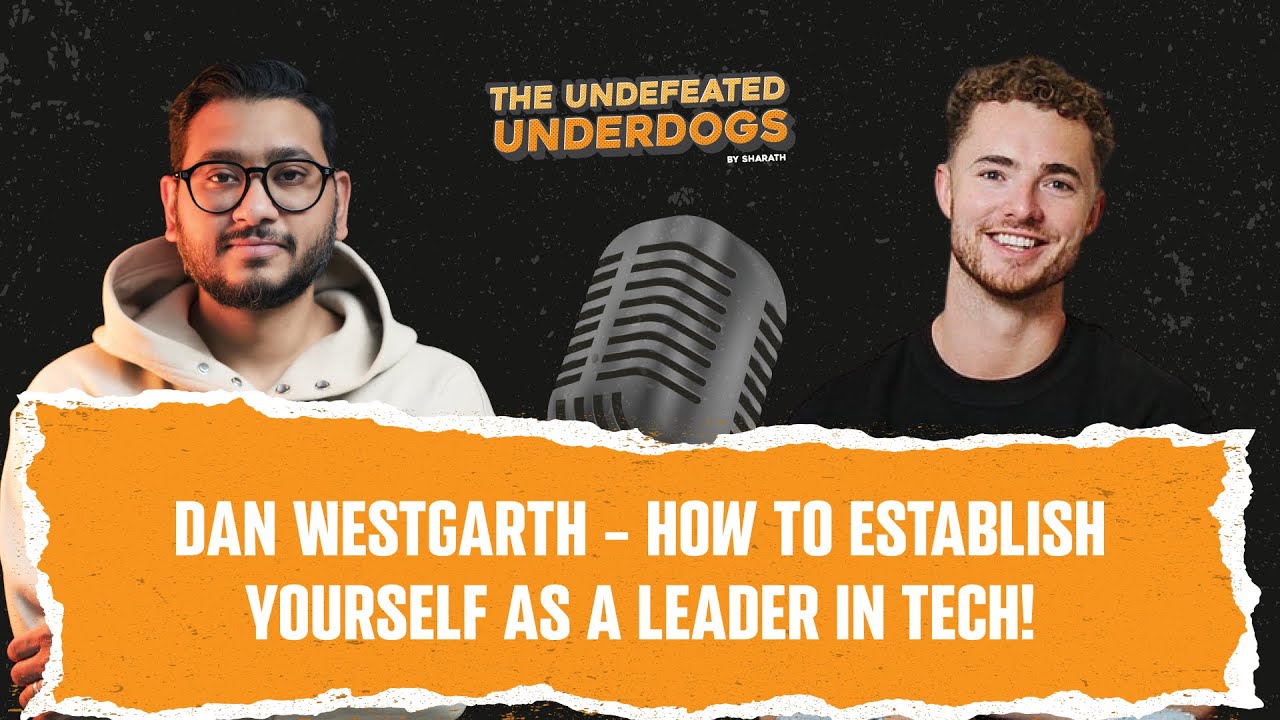
Dan Westgarth, COO of Deel, went from fixing PlayStations at 10 to leading a 600-person operations team. He picks one high-impact focus from ten priorities using quantifiable metrics, and credits early community-building with shaping how he runs the company. Deel's removing barriers to global hiring and planning HR-fintech products like performance management and equity issuance.
Chapters
People rarely forget. I'd like to say never forget, but in some cases they will. So rarely forget. So if you put someone in a bad position, you sell them a bad product, you give them bad service, they're not going to forget that.
Right.
And they're going to share that with their peers in their community.
What's up everybody. Appreciate you all for tuning into the Undefeated Underdogs Podcast. I'm your host, Sharath. I'm grateful for you for taking time to like, you know, tuning into the episode. Today I have a special guest. I have Dan Weskarth, the COO of Deel. Deel is a one-stop HR solution. And if you're a founder, a startup founder, like thinking to expand your team and working with global talent, Deal is your thing. Go sign up at Deal. They do like phenomenal things like, you know, working with contractors and like hiring full-time employees worldwide. So Dan and I, we had like a brief call before this episode and man, I have to tell you guys, I'm super impressed by the immigrant hustle he exhibited and the way he actually went from being a customer support rep to like, you know, where he is right now, the CEO of Deal, which is a big transition and I'm excited to like get into it and let's unpack this beautiful story. Dan, welcome to the show. How are you feeling today?
Dude, good to be here. I'm feeling awesome.
Awesome. That's great. I always like want to like, you know, hear that from the guests, but yeah, let's get into it. I think right off the bat I have like this obvious question. So you work at Deal as a COO. Let's— tell us about what's your day-to-day look like? What are some things that you do that pushes the deal to the next level?
I always have about 10 special projects. Out of those 10, I select a single priority. It's very easy to have many different priorities. I think it's really important to have one. That is always the thing that I'll focus on from the special projects roster the most, and stop nothing to get done.
Right.
And that's always a very high impact thing for Deal, for us as a business. That's kind of from the special project side. And then also we have the day-to-day running of the business. So operations at Deal is 600+ people. We look after payroll, we look after customer support, payroll operations, financial crime prevention, We do HR as a service, we've got HR experience. So all of that stuff is dashboarded. It's running 24/7. Right. And so I will check in on that. I'll check in on that multiple times a day and understand why is efficiency dipping in a certain country, or why is there a backlog starting to pick up in a certain area or on a certain topic. And that is something that's living and breathing. And if you're not checking its vitals, you don't know how its health is.
Right.
I'd say there's 2 sides. One side, central projects, those 10 things, single priority. Second side, it's keeping the business moving, keeping the business running.
Yeah, keep the wheels going, right? So let's cover the first part. Let's unpack a little bit. Mostly I'm interested in how do you decide which one to pick up, which project to pick up? Because like you said, if you have 10 ideas, especially you being the know, face of the company in a way that actually moves the company to the next level. What are some things that you consider that are priorities that moves the needle for deal, or any advice for people you can give who struggle and suffer in terms of prioritization between all these ideas?
Being problem-focused is the advice that I would give. Every project that I run in operations is solving some problem. Right. We quantify how big that impact is. For instance, it could be a margin or revenue-driven project, very easy to quantify a change in margin or a change in revenue.
Interesting.
Or it might be an efficiency-based project. For example, one of the projects we're running right now at Ideal is setting up country pods of support agents that can do highly specialized work. Within a certain country without needing to escalate that workload to second line and third line specialists.
Right.
But that drives efficiency for deal, it drives margin efficiency, but it also drives a lot of customer efficiency and improves the customer experience because that query is now being solved at a first level. It doesn't need to be reassigned or escalated.
Right.
I think that's a good example of where you perhaps have impact of Many different angles.
That's interesting. Yeah, I think what you said kind of makes sense even for founders who are, who just generally struggle with what should we pick. Like, I think quantizing and kind of tagging it to the company growth itself is going to like, you know, work a lot. All right, let's kind of like take a step back and I want to ask this specific question. In our brief intro call, You mentioned that you started a business at the age of 10. Talk to me about it. Like, man, that's at the age of 10. You basically have to play with your friends, not like build businesses, right? What's going on in your mind? Like, what made you like start a company? Tell me, explain to the audience the story about that.
I really wanted a PlayStation 3. the PS3 came out on my 10th birthday and I didn't have the money to buy one. My parents weren't going to buy me one. So my dad said to me, if you want to buy one, you have to go and make some money and then that will unlock the purchase that you want to make. Right. So I found on eBay that you could buy used PlayStation 3s or broken PlayStation 3s, and I found that broken PlayStation 3s were probably 25%, if not 20%, the value of the brand new working one, so maybe I could buy that and I could figure out how to fix it. Anyway, I went through with this.
Right.
I bought one, I bought a broken one, it had a Blu-ray error, and on YouTube there was some dude somewhere explaining how to replace the Blu-ray laser on the PlayStation and fix the PlayStation. So I went ahead and did that, and fixed the first PlayStation, played on it, got the games that I want, I was like, oh, okay, I can now sell this. For some margin, and then I'll repeat. I'll get another used one, and I'll change the Blu-ray laser, and I'll use that as my personal machine. I did that like 3 or 4 times, like, okay, this is starting to become interesting. Right. And some of the PlayStations that I wasn't able to fix, I could then split those up and sell further parts. So I kind of rinse and repeat this for a couple of years until PlayStation stopped producing units with faulty Blu-ray lasers. A lot of fun.
Yeah, so it's kind of like, you know, necessity is like the mother of invention, right? Your desire to like buy these little things made you to like, you know, become— I think that seed is really important. And after that, what did you do? Like, did you really love the whole business side of things, like flipping, adding, like, you know, repairing and all that? Like, What caught you like, uh, the most interest? Like, okay, this is something I'm really good at.
I think it was the community side of it.
It
was really exciting. I got to a certain point, 10, 11 years old, and friends wanted to buy PlayStations and they had similar constraints.
Hmm. Okay.
They would then come to me and say, well, can I, can I buy, can I buy this PlayStation from you? And they would do that. And then they would come to me and say, well, I've actually broken my phone. Can you fix this too? Before you know it, you have a very strong community. And when you have that, selling into that community and selling into that market is so, so easy. And I think that's what I found really exciting. And I've applied that in mature business, right? The last couple of companies and also investments that I've made. I think strong community is really, really important. And I think really back to the original question of, What do you prioritize when you're running a startup? I think that is a really, really difficult problem to solve. It's almost impossible to understand what to prioritize. Whereas at a big company, it's actually pretty easy because I have this long list of things that I need to do. Quantifying prioritizing is way easier than when you're a startup. And I think when you're a startup, your community will really help you prioritize because they will create a market need of, I need this product, I need it now. And then you'll say as a founder, well, okay, I'm going to go out and build that and then sell into that community-based market.
Oh man, I think you've tasted firsthand community experience like way younger. I really love that story because I expected something else, something different. Like maybe you caught the enthusiasm of selling, the joy of, or the thrill or the adrenaline effect that you get when you do something right. On the other side, you just said people, which is very fascinating to me. What are some lessons that you still carry from 10-year-old Dan, 11-year-old Dan, that you still value at a higher percentage in your life about community or about doing certain things?
Yeah, I think a couple of things. One is people. rarely forget. I'd like to say never forget, but in some cases they will. So rarely forget. So if you put someone in a bad position, you sell them a bad product, you give them bad service, they're not going to forget that.
Right.
And they're going to share that with their peers in their community. Second thing is, world is really small. And I've seen that, like, not in my teenage years, but the last decade in my 20s, when you're working in whatever industry it might be, like, I mean, technology and specifically fintech, HR tech, that community is really small. Maybe somebody based in Hong Kong or Singapore,
right,
they will have mutual connection with somebody in London. And I think the point that I would make here is it doesn't matter what industry you're in on the professional side, The world is still really small, whether it's investment banking, medicine, whatever else. So those things combined, there's no real running away from people or communities, right? Because the world is very small. And number 2, people don't forget. So it's really important that you treat people well and that whatever you're building is rolled out with a lot of thought and care.
I love that. I think both Both of those lessons are so powerful. The world itself, tech especially, man, like it's so small, right? Like the way you connected with me. I had a friend who DM'd me like after I— after me tweeting that this is my dream podcast list. And he, uh, if I'm not wrong, is Andrew, right? Like, uh, Andre,
right?
Mm-hmm. Shout out to him for connecting me to you. It's such a small world. Like, you know, I'm a big fan of Dealafar, like observing how you guys like make moves and like helping, you know, remote distribution work solve and all that. And such a world, like, you know, we're talking right now and we're building this, you know, beautiful story out from you. I think tech world is really small. And the other point which you said, I absolutely, I suggest like people to go one extra mile to do that, which is Show care and show thought and build like relationship with your community, your audience, your friends, the people you work with, right? And the people you look up to or the people you advise as well, right? Everybody counts. Everybody is kind of like a small family. I love those 2 specific drops you made. You're from UK, if I'm not wrong, right? Yeah.
Yeah.
So you're, you're and I, we kind of like share this, uh, this immigrant, uh, hunger, hustle and all that. Like, talk to him about like how you navigated that energy and converted that energy into fuel for yourself to make a big career out of it.
Yeah, it's a really interesting point because a lot of my friends in my personal circle are immigrants or from immigrant families. and most of which come from developing countries. Maybe the second or third generation, but still, like, the parents moved to UK or US from developing countries. I never really considered myself as an immigrant moving from UK to US, but I am an immigrant.
Mm-hmm.
And I never really thought that I had immigrant mentality. All right, well, UK guy in US. Um, I didn't have this background coming from a developing country. I didn't categorize myself as kind of like having immigrant hunger and immigrant mentality. And it's the past year or so, I had this dawning realization that
I
absolutely am and absolutely do have immigrant mentality. It doesn't matter if you come from the most privileged background in the world. But moving out of your country, your city, going somewhere else, setting up, finding somewhere to live, finding connections, making friends, fighting in your job and in your career to grow and elevate yourself, it's really the same process. And it can happen at so many different levels, right? My girlfriend's parents, for example, they work in blue collar jobs. They were immigrants from a developing country. But the same thing exists, like the same, the same, the same mentality. And I thought that was like something that I realized personally. I thought that was fascinating.
Right. No, I have to echo to your point. Take Harry and Meghan, the royal family. They moved to the US. Even they're struggling. It's not like, you know, they're the most privileged background you ever imagined, right? Like they come from a privileged family. They are— everybody's watching them. Yet I saw the documentary recently, I think a couple of months ago, yet they struggled to find a place to live. So it's, to your point, it's so real. It doesn't matter where you come from. Maybe you have a little edge if you come from a privileged family, you have a little money and whatnot, but you always have that struggle and you have like a chip on your shoulder in a way, right? You want to prove, you want to build a good relationship in this new arena, pushing yourself beyond the boundary and whatnot. That's so fascinating. I think that's partly one of the reasons I think why Deal acquired LegalPad. You know, I'm a big fan of LegalPad. That company actually helped me break into tech. When I broke into tech, like, you know, my first job in tech, I used to be on H-1B visa and LegalPad is the one who helped me. So shout out to them. I think partly that's one of the reasons I think you were pretty much involved in the acquisition as well. Talk to me about like how you guys treat immigration, acquisition of LegalPad and everything. What are some things that you want to pursue in the future to make things work easy for immigrants working at US companies and vice versa, right? some folks working at UK companies and whatnot.
Part of our mission is to break down borders, whether it's hiring, managing, paying your workforce. And mobility just is a part of that story. People want to move around within different countries, and there are different pull and push factors. Maybe it's family, maybe it's a business obligation, maybe you're doing the run the business work that we talked about earlier, you need to be in a specific time zone or a specific country. But finally, people will always want to move. And the services available to make that happen are, I would say, somewhat suboptimal.
Mm-hmm.
We want to optimize them, make them available to everybody on the Deal platform. So moving between countries is very easy.
Right.
We've had an immigration service and an immigration offering for some time, even before the days of our acquisition of LegalPad. But that immigration service was mainly based in Europe or covering Europe, Middle East, Africa. The LegalPad component is very heavily focused on North America. So really great story. Natural match between Deal and LegalPad and the mission that we're on.
Yeah, LegalPad. Oh my God, I think I have countless times recommended LegalPad to like many folks who are like, who wants to break into tech? They made my, you know, my first transition super easy. I used to work at a corporate job and the founders itself, they're very passionate as well. They just want to like, you know, They have skin in the game. They're very empathetic towards operators. And yeah, I think kudos on it. It's match made in heaven for you guys. And I feel like you're going to improve a lot in terms of solving immigration and like removing boundaries. Let's also take a couple of steps back. I want to unpack the whole getting into deal story, which is quite fascinating. But before there, Revolut, like, talk to me about it. Like, I think you started as a partnerships manager or customer service rep. You talk to me about like how you entered, you know, that company and leading to deal. What's like the story behind it?
Yeah, I was looking for a first professional graduate position and I studied natural environment degree and surveying. And the blue-chip companies in that space weren't particularly interesting to me. You have to put on a suit and tie every day and spend a lot of time visiting physical sites. I didn't want to do that. I've always been a bit of a geek deep down. I like being on the computer and working on tech-based solutions. That's really where my deep interest is. I think deep interest is there and also in finance and capital markets. a combination of 2 of them. And I had job offers from the blue-chip companies in the natural environment space, but I was looking for something that would feed my appetite for curiosity. Right. And I came across Revolut, fired off an application, and actually spoke with the Revolut team on, I think, Facebook Messenger, because they were so small at the time. And I managed to get to the CEO of Revolut through Facebook Messenger. And he said, okay, come down for an interview and we'll find a position for you. So I was hired as a partnerships manager. The person that hired me was not at the business on my first day and they didn't really know what to do with me. He said, okay, fine, you're a young guy, go and do customer support. And I was pretty good at that. And then moved into the operations team and then finally product management and general management and launched Revolut in the US.
That's awesome. So you kind of touched the partnerships, the customer service side of things, and you also touched the product side of things. How is it like, so what are some things that you learned as you progressed from Revolut to Deal about taking care of customers? What are some things that you want to pass to the listeners about how should they take care of customers, how much of a priority they should give to customers, and the things that they should avoid, you know, when they deal with customers?
Yeah, I think first and foremost, you have to use your product. It doesn't matter what your position is, how big the product is, you need to find a way to use it. I'm using Deal 10+ times a day. I think the answer to that question is like Very rarely do execs actually consume the product that the vast majority of their customer base are using.
Right.
I think starting off in support and actually understanding how customers use the product and how customers feel about the product and the emotional momentum that they build up when using it is really, really important. And then second to that, experience in product management is also really important to understand How the product is built.
Yeah, I think, you know, customers are— I love those both of your lessons, which you learned from Revolut and whatnot. Couple of other things which I want to cover before we dive into the whole, you know, you getting into Deal. So one of what are some important things that you learned as a product manager, you know, at Revolut, like Some things that you still carry with you as a CEO of Deel?
I think always, always putting the customer first and knowing when something is significant enough to change up your product roadmap. Very easy for product managers to become obsessed about product roadmap and product roadmap accuracy, but there are certain times where you just need to see what's in front of you. and make a change very quickly. That's going to have some effect on your product roadmap, but really that's a good practice. I think it's good practice in business as well. When an opportunity comes along and you need to change something, you make that change immediately. Don't put it off.
Love that. What are some common things that you find in between product and operations, uh, in that, that I think First of all, I'm very fascinated with the fact that you moved from product management to like, you know, something completely different, operations. So any commonality that you find really interesting that people should focus on?
Totally. I think that good product management and good operations always start with deep understanding of the topic and the story. For example, we're developing products that a deal, which are a combination of software and moving pieces or ops. For example, one of the things that we've recently released is called Anytime Payroll. We're able to pay anybody at any time, calculate the tax, make social security contributions, tax remittance, and then pay that person. This was a combination of software and also a lot of operational moving parts. Though I truly believe that the skill set between product manager and operation manager is very similar. Operation managers tend to have a little bit more bias to action and a little bit more business experience, but fundamentals are very similar.
I love that. Yeah, that's what I think, you know, uh, that's what my curiosity is, like, what's something that you really like helped me— helped you move from product to like operations? So Awesome. I think I want to also unpack your encounter with Deal. So talk to me about— I think you briefly explained to me how you met Alex, the founder, and how you got into Deal. Talk to me about that, how it all happened.
Totally. Met Alex and Shuo both on the same day in SF, and they're also really big on network and community. From that day of meeting them, I think I spoke to Alex every single day since then on WhatsApp. So we became incredibly close, incredibly good friends, and developed that really tight CEO-COO bond right from the get-go. So after knowing him for some time, he gave me the opportunity to join as COO. Previous job at the time was general manager. So moving from a kind of high-growth general manager into a startup COO. To be honest, the transition was very easy. Most of the responsibilities are very similar. Because really, as a CEO of a company of less than 100 people, you kind of are a general manager, you're doing everything and anything, and you're just making it happen. Now, Deal is 2,500 people, we'll continue to grow, continue to acquire other businesses, and the docket for a COO is like very, very, very different. And to be fully transparent, I've invested a lot in training and counseling, and there's quite a few people in the industry which have been significant to my personal growth story. And at Deal, the operations department is truly awesome. We have a high-performance culture. We're 24/7. Operations itself is in over 60 different countries. Yeah. We have teammates at Deal in over 100 different countries. So it's a truly international organization. It's a truly multicultural organization. And I have a lot of fun doing it. It's awesome.
That's the important thing, having a lot of fun. Underline that, guys. Whatever you do, make sure you have fun and you work with people that actually challenge you, right, and bring the best out of you. I'm so glad to hear that. And a big fan of Alex, you know, I love his tweets. So one particular thing which I want to also highlight about is you start as a As a customer rep, right? Customer service rep, you know, in partnerships and whatnot. And you grew to GM level and now you're in the C-suite, right? What did you do right in this whole process of going from zero to like where you are right now that you feel very proud of? This is something that I kind of figured out for myself. that I want to pass it to the listeners?
For me, the common theme has always been hard work. I think that there are many smarter people than me in the companies that I've worked at, but the thing which has always prevailed has been the hard work. And you work hard to do the best you can possibly do in any field or in any subject matter. And, you know, if I look back at the last 8 years, 9 years that I've been working at professional companies, like a lot of hard work and commitment has gone into that. Worked, you know, 80-hour weeks or more, like a lot has happened a lot of times and it's happened back to back. Mm-hmm. You know, when there's big serious projects on the table, you can do that for 6 weeks at a time. Knowing yourself and knowing your limits and knowing when you're truly tired and you're at risk of burnout, and then knowing how to work smart and work fast. This is really important. But the hard work has been a consistent theme throughout the career. I didn't know how to work fast or how to work smart when I first started out. I was a customer support agent doing tickets. I didn't know how to do this at all. It's just, how hard can I work? How many tickets can I do? How can I make the customer feel good? How can I solve their problem? And then apply the same thing in product. I hadn't come from a background of product or engineering, so I was faced with Figma files and screens and GitHub commits, and you kind of just work backwards from that. And then you work, you build these techniques, personal techniques. How can I very quickly review Figma designs? How can I understand the developer's code as quickly as possible? How can I translate what I need to do into business requirements or vice versa. Okay, different stakeholders. Yeah, so common theme has always been hard work.
So it's very interesting what you said about hard work, because I think you have to have like an appetite for learning, right? You always have to push yourselves to like learn something that's completely new. In your case, like you said, you're not a product guy, you learned how to like, you know, figure the whole thing out. Do you have like a framework that you implement even till today? Like operations is not— it's no joke. Like, you know, it's such a big part of a company, especially a fast-growing company like Deal. What are some learning techniques or frameworks that you kind of implemented in the past and as you go right now in working at Deal?
Sure. I'm a big fan of using different reading speeds. So very fast, fast, and slow. And I think when it comes to learning, you should read things very fast in the first iteration, and then you kind of have a rough idea of what's going on. And then from that very fast read, you can extract the points that are actually really meaningful and will help you understand what's going on. And then you take those points and you build a kind of library, and then you go very, very slow. And you ensure that you understand everything and then you question everything and you ask and pull different stakeholders and different people together to understand what's going on. I think that's like a pretty good framework for learning that I still practice and will continue to practice forever.
I love that. I think the fast and slow approach is going like, you know, it's kind of like a macro micro thing, you know, right? I love that.
I'm doing this on Slack every morning. We have 2,500 people. Slack is the main tool we use for communication. Right. So you have to consume so much information in about 30 minutes. I'm definitely reading Slack at a very fast pace. Very quickly looking through the application using shortcuts. And then anything which I believe is meaningful or requires action, influence, input, you set it as a reminder. So I'm, you know, 8 o'clock, 8:30, doing my very fast reading, drinking some coffee, and then I will go into the reminders which require that slow, deep thinking. And then you think, well, how can I influence this person? How can I create energy? How can I create impatience on the project? And that's what helps the company move.
Yeah, I love that. So you yourself said that, uh, you're quite new to all of the things that you faced in the past and even now, right? Like you're still learning. You have this hunger, the immigrant hunger and whatnot. Have you ever faced imposter syndrome, especially working with smart people around you?
Yeah, it's not something I've really obsessed about. I've heard other people talk about imposter syndrome for hours. It's never really been something that I really focused on. It's never really a big blocker for me. Or big distraction.
And how did you overcome? Like, what are the things that you did that you fight? I know, I think I have imposter syndrome every single day. Even now I'm talking to you, I'm like, am I being, you know, keeping up to myself, to your standard and whatnot as a host and bringing the conversation? But I think there is no one-shot silver bullet. Like, there is no solution for it, which is my take. But I want to hear your take. What is some— how do you handle it?
Man, I don't know. I just don't think I look at things that way. I'm always in the moment, always taking a very short-term view on something. My short-term view right now is just to answer your question as best I can and create talking points. I'm not even thinking on that level, and I rarely think on that level in the moment. So it's never been something I got hung up on.
That's smart. Like, that's one way to, like, you know, handle it. It's basically like purely, purely like, you know, dedicating yourself to this moment and giving your 110%, the best you can to provide value and whatnot. Let's talk about deal a little bit. Like anything that you want to mention that you're about to do a deal, like that's something that, you know, that revolutionized HR or like payment, payroll and whatnot. I think the Legalpad acquisition is going to really Eliminate the boundaries, like you said, anything that's exciting in the bag right now for Deel?
So I think it's worth taking a step back and thinking about where Deel started. Deel started as a fintech company, really. We were a payments company helping contractors raise invoices and get paid for those invoices. And we're still a fintech company today. Fintech is kind of at the core of what we're doing and the core of the technology. But now we're an HR company. Our tagline and our mission is Deel, the global HR company.
Right.
And I think the reason that we are here is because we've identified so many inefficiencies and exciting problems to solve in that HR space. And when you bring HR and fintech together, you can do even more. So what we're doing today, contractors, employees of record, global payroll, I think really is just the tip of the iceberg. We want to get into areas like performance management. We want to be the HR system of record. We want to be offering game-changing benefits, mobility, equity issuance. There's just so many problems we can solve. And we haven't got to the scale we want to be. Deel is about 15,000 clients right now.
Right.
15,000 companies using the product. I want there to be 100,000, million customers using the product. And then we'll touch so many international workers around the world, and we can use data to then produce efficiencies and products which have never even been contemplated. Data in HR is super, super siloed. And some companies and products which are trying to break those silos as independent businesses and independent offerings. Once we get to the scale that we want to be at, we'll be able to produce those inefficiencies on one single platform.
Love that. Yeah, I'm definitely super bullish on Deal for various reasons. One is, I think, again, going back to removing boundaries, now everybody can work anywhere thanks to the internet, right? Like, you can find interesting opportunities, with smart people and Deel is making that super easy, which is as long as people are, people have the craving to work, you know, or go beyond globally, you guys are like there forever, right? So, which I think, you know, it's going to be a long, long, long time. I want to like touch upon one last thing about you've entered tech, your journey very young at a very young age, right? You fell in love with entrepreneurship at the age of 10 and you grew super fast, like becoming a GM and now CEO. What advice do you give for young folks who are figuring out things, especially people who want to break into tech? Any wisdom that you want to share?
Yeah, a few things. I think first of all, use that global market. Previously, companies were only looking at 50-mile radius. their offices. Now companies are looking worldwide and they're focusing on the skills, not the location. So as a job seeker, it's really important that your research is on a global level and you find companies that are interested and you find the positions of those interested companies. Then it's about persistence. I don't think applying for a job is just a case of submitting a resume. I think there needs to be more done than that. You need to be reaching out to the people on LinkedIn, following them on Twitter, understanding. And no, maybe they won't notice you, but maybe they will notice you, and then that will, that will help on your application, especially if you're applying cross-border from a different country, from a different region of the world. I think that's really a really important part.
That's love. Yeah, I think the way I did was I relied on 2 things. One is Creating serendipity for myself by being there, like, you know, showing up on Twitter every day, creating content or contributing content to other people's posts. Number 2 is proof of work. Like, you have all the power to like take these shots for yourself, like build a side project or a podcast or write a blog post or start a newsletter and whatnot. I think, like you said, People are right now in a space and zone where they are seeking smart people who put skin in the game, right? And that's the power of the internet. I feel I just want to echo what you said. But this has been like a very fun conversation, Dan, and thanks for sharing. Thanks for being vulnerable. Thanks for like being so relevant to folks. Like, I think a lot of my audience they come from immigrant background, they have these big dreams, but they don't know where to start. And I think your story is a perfect example, I think, in my opinion, for people to get inspired from. You really are a true example. So thanks for being on the show and explaining your journey, narrating your story. Any last few thoughts before we wrap up?
Manish, thanks so much for having me. Great to be here and great to be part of your podcast.
Yeah, thank you. Appreciate it. And again, thanks for folks who are listening. We do appreciate your time and your attention. That's like the most important thing for us. Stay tuned for yet another episode. We have like a lot many guests like Dan, more inspirational stories and more unpacking to be done. Until then, cheers.
More from 5harath

Julian Weisser - Why ODF is on a mission of making things for people who make things!

Ryan Gilbert - How to master the art of building and scaling curation newsletters!

Chris Hladczuk - Tactical advice you need to know to build a fintech startup in stealth!
Andrew Rea - Why first-time founders should invest time and effort in building conviction!

Blake Emal - How to convert people browsing your website into people buying your product!

