Jared Kleinert - This TED speaker is changing the way IRL startups retreats happen!
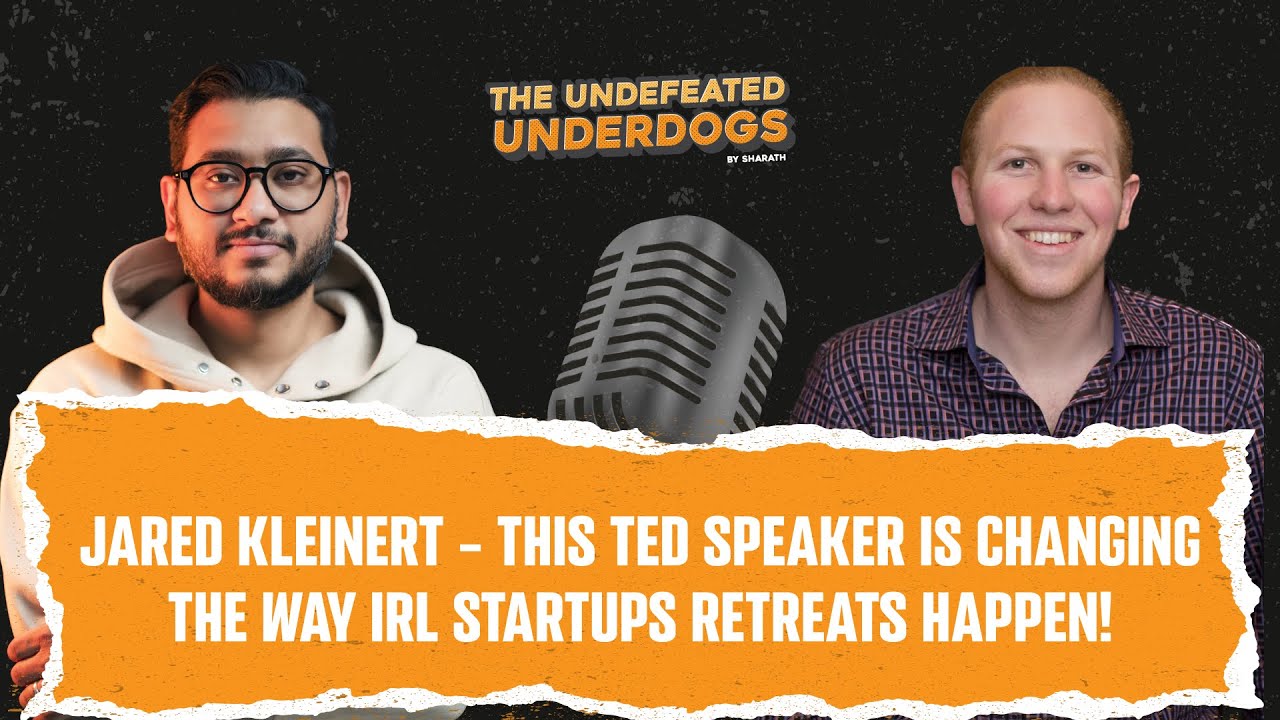
In this Undefeated Underdogs podcast episode, host Sharad (5harath) interviews entrepreneur, TED speaker, and author Jared Kleinert. Jared recounts his unconventional path: at 16 he cold‑emailed David Hassell, became an early employee at 15Five, and chose not to attend college after being influenced by the Thiel Fellowship community. He leveraged unpaid mentorship, strategic cold outreach, and early networking to land his first paid client (a NYT bestselling author) and to launch his consulting firm Kleiner Ventures. Jared discusses the creation of his two bestselling books, 2 Billion Under 20 and 3 Billion Under 30, and the role of writing, speaking, and community in building his personal brand. He outlines his philosophy of “pleasant persistence” in cold emailing, the importance of personalizing outreach, and the balance between volume and value. The conversation moves to mentorship models—traditional, peer, and virtual—and how curated mastermind groups and paid communities accelerate growth. Jared shares how physical and mental resilience (ultramarathons, jiu‑jitsu) support entrepreneurial stamina. He then details the genesis of Offsite, a startup that streamlines corporate retreats and offsite planning. Drawing on a decade of remote‑first experience at 15Five, he identified a $60 billion market opportunity for offsite logistics, built an initial service model, and pivoted to a SaaS marketplace (offsite.com) that functions like “Airbnb for offsite venues.” He describes challenges transitioning from service to software, fundraising narratives, team hiring lessons, and future product roadmaps (expanded marketplace, planning platform). Throughout, Jared emphasizes intention, focusing on inputs, and framing challenges as growth opportunities, offering actionable advice for young founders on networking, community, and persistence.
Chapters
Even today, you know, it's really just about following up, following up, following up. You know, I told you before we hit record that we signed sort of a marquee client, uh,
Yep.
this morning, and that was a result of multiple follow-ups and touchpoints, uh, as is most of our fundraising for Offsite, as is, you know, a lot of good things in life. You just gotta keep following up. So until they tell you no or until they, you know, answer and say yes, Just keep following up.
Hello, hello, folks. Thanks for tuning in to the next episode of the Undefeated Underdogs podcast. I'm your host, Sharad. I'm so grateful to be here. With this particular guest because the guest I'm about to introduce is a TED speaker. He's an author of 2 New York bestselling books. He founded so many startups and he started his business at the age of 18. That's freaking phenomenal. So I'm actually very stoked to invite this guest. Jared, welcome to the show. How are you feeling?
Great. Thanks for having me.
Absolutely. Yeah, it's a pleasure. And I kind of like find interesting people like you, very ambitious, and your ambition is kind of like contagious and it rubs off on other people. So, and I hope like, you know, this conversation rubs off on people who listen and we can like get inspired, like at least like, you know, 1 or 2 people out there. So yeah, let's get into the conversation. I don't know, man. There is so much Jared did and I feel so small in front of him because it's phenomenal. I feel like, where do I start? He wrote 2 of the amazing books, 2 Billion Under 20 and 3 Billion Under 30. I just want to also unpack why those titles came in picture. And you also founded this thing called Meeting of the Minds. It's a private invite-only network for entrepreneurs. And you did your own venture at the age of 18. My God, like, you've worked with Fortune 100 executives, authors, Emmy Award winners. My God. So right off the bat, how did you do all this? Is there like a secret sauce you found at the age of 18? Like, you know, are you like a superhuman?
Don't go to college, you know, if you're a teenager listening to this. Yes, I was fortunate. Actually, at 16 is sort of when like my experience in the tech world begins. I was reading an article in Forbes about the most connected man you don't know in Silicon Valley. This guy, David Hassel. Today he's the founder and CEO of a company called 15Five, which is probably close to a billion-dollar valuation. Have 250 employees or so, and they're leaders in the employee engagement and performance management space. If you don't know 15Five, you might know Lattice or Culture Amp. They're all like very similar.
Right.
I cold emailed David before the company was publicly announced. I ended up being employee 6 or 7 at the company when I was a teenager. And I just work unpaid in exchange for his mentorship when I first emailed because I was 16. I was just like, hey, I got nothing to offer you but time.
Right.
Thankfully, they were willing to work remotely from, or I was able to work remotely from South Florida where I grew up for a Silicon Valley sort of venture-backed startup. And that turned me on to the concept of offsites because I got to attend offsites for a company that was remote first over a decade ago. Right. Certainly brought me into the world of tech startups. And as I was sort of starting to work for 15Five and, you know, tinkering with my own projects on the side, I came across the Thiel Fellowship or the 20 Under 20 program, as they used to call it. And so basically the, if you don't know what they are, like they were Peter Thiel had started giving kids $100 grand to drop out of college. But these are some of the smartest people you'd ever come across, like the founders of Ethereum and Figma. And there's like multiple multibillion dollar companies now that come out of this group of maybe 200 people now. But they basically influenced me not to go to college. And so Cold emailing David and offering to work unpaid was one of the biggest positives in my career early on. The Thiel Fellowship also came into my life. While I was never a fellow and never received that grant, they did have a larger community around them. Right. And basically influenced me not to go to college right away. Ended up never going to college. And then through that community, I got to go to a conference and later multiple conferences where I was just meeting some of the smartest entrepreneurs, scientists, nonprofit founders that I'd ever met in my life and that were really unique from a sort of global standpoint. And so that led to the books and speaking and all that. I was basically profiling Uh, Thiel Fellows, Forbes 30 Under 30 types. It then extended out to covering Olympians and actors and, uh, other entrepreneurs. Wow. And so that's what led to writing, uh, a series of books. Uh, it was called 2 Billion Under 20 because there was, there's 2 billion people in the world at or under 20 years old. And we were trying to take a select group of them to inspire the rest of the generation to act on their passions in life. I later did the same thing with 3 Billion Under 30. Honestly, I think the titles could have been a lot better. They're like clever, but they actually help you sell lots of books.
Right.
It's not like How to Win Friends and Influence People. It's like, what's the book about? It's like influencing people. So I do think I could have retitled the books, but the actual process of writing the books, Speaking about it, the networking that I was able to do through that process over many years led me to current investors now and clients and key employees even. I've been very fortunate that some of the early experiments that I tried, like cold emailing someone I read about or trying to join a community, led to a lot of positive things now. And hopefully I'm doing things now, like, you know, meeting people like you that lead to positive ripple effects in 10 years from now.
Exactly. That's what I think the core purpose of an entrepreneur is to learn something and pay it forward, right? I feel— think about it. David taught you something and you are teaching so many people out there, and people who learn from you will teach, you know, and that viral effect, the chain effect will go on. And man, I love the story. At the age of 16, kids tend to play video games or sit, watch TV in their parents' house. What was the influence that made you read that article? There should be a bigger influence, right? Either it can be friends or family. What was that like? Who made that influence?
Yeah, totally. I mean, I'm born a white dude in the US, like there's a lot of privilege in that that shouldn't be overlooked. And then also come from an entrepreneurial family. So I got to see a few successful businesses in the family, but I wasn't sort of, you know, I wasn't in line to join any of the businesses. Like I was not entitled to anything. still not entitled to anything. So I grew up in a fortunate position to see what success looks like or can look like, but certainly desiring to create my own path and do things my own way. And so that's a lot of my upbringing. I was working in the family. My grandma has a catering business that I was working at from 11 years old until 16. So certainly learned about work ethic from my family. And then I actually tried tinkering with some business ideas as early as 15, but none of them ever quite got off the ground. They were more projects looking back as opposed to actual companies. Yeah. I would say the first real company I started that generated revenue that I could pay my bills on was at 18 when I left 15Five. But I did tinker with things, a few ideas when I was 15 and like they weren't going anywhere. So, you know, I definitely, and I had like a negative experience with a mentor. Hmm. And so when I reached out to, yeah, I was working for like 6 months with this guy I met Turns out he was a former white-collar convict and spent time in prison for securities fraud on Wall Street. And so that's probably the very specific relationship that led me to read about David in Forbes and reach out to him because he was the complete opposite of this other person I spent 6 months hanging out with and trying to learn from. So if you want like one relationship, it's sort of like the opposite and caused me to really go for it the next time around. That was it. I don't talk about that one as much, but yeah, it's, yeah, I grew up in a very fortunate position, have a great family, but then also had some of those maybe failures or like negative experiences that quickly led me to seek out a more positive option.
And sometimes I feel like If something bad happens early in your life, that is actually good if you think, if you put it in the right way, right? Like in your case, like, you know, you've gone through something and which actually made you like seek something better than what you were before. And if I may ask this, what was the cold email like? What did you ask David? Is there any particular thing that you want to share with us then? What made you like how David actually got it to you? Like, okay, let me pick this kid out of, I don't know how many emails you got at that time.
I think practical that, and I didn't do this as cleanly as I'm recommending, but if you're listening to this, I think any cold email where you're personalizing the outreach to the other person, Making it all about them, trying to provide value upfront. So in this case, I was offering to work unpaid in exchange for mentorship. I later replicated that same offer to get my first consulting client who happened to be like a number one New York Times bestselling author, offered to do like a month of work unpaid in exchange for the relationship and the opportunity to You know, earn more business potentially. Um, and then following up, uh, you know, it did take a couple follow-ups to land that one. And then even today, you know, it's really just about following up, following up, following up. You know, I told you before we hit record that we signed sort of a marquee client, uh,
yep,
this morning. And that was a result of multiple follow-ups and touchpoints, uh, as is most of our fundraising for Offsite, as is, you know, A lot of good things in life, you just got to keep following up. So until they tell you no, or until they answer and say yes, just keep following up.
I like that. And I do have like a separate question on the whole cold emailing thing. But do you think people feel like— A, I feel people who appreciate the cold emailing or approaching randomly, or people who've done that before, they appreciate you following up so many times because they see that persistence in you, right? But what about like people who are like, man, this guy's annoying? Yeah,
you're gonna get some of that for sure. I think in a perfect world, you're not sending that many cold emails. I wrote a new book actually called Networking and sort of talk about, which hopefully is a much better title than the previous books, right? Like what's networking on? It's on networking. But if you don't have any network or community, then you're in a position where you have to send cold emails or DMs, things like that. And then as you build your network, you can start asking for warm introductions and you can start posting about things and having people come inbound to you. Right. And that's sort of a more ideal scenario, but Cold email still works. We do it from a sales standpoint with Offsite and we're doing a much greater volume there. You know, we're sending thousands of outbound emails a month. And so, you know, naturally we're getting a few people that are like, stop emailing me. And, you know, statistically you're gonna get some of that. But I do think people appreciate pleasant persistence. So—
I like that.
That's what I go for. I go for pleasant persistence. You can use GIFs and like, you know, funny things to sort of break the ice. But also like, just because someone's not replying doesn't mean they don't want to work with you. Like either they just didn't see the email or they're busy or they were on vacation or they're— there's a million things that could have happened. Mm-hmm. Maybe they meant to reply to you and like it's in draft, but they never sent it.
Right.
I just think it's worth following up.
Yeah, absolutely. I think that's what I call when I do cold DMs. So I've built my whole career on cold DMs. I've approached Naval Ravikant just by emailing him cold from a project I did. He responded and I did so many— some of these podcast episodes, they were cold. David Perel, just approached him cold. He replied and said yes to the podcast. So I got my first tech startup job by cold DMing people. So the power of cold DM is so underrated, and people still often feel like there might be a negative mark on their brand if they approach someone with an ask. But definitely not. Like, people authentically— if you're authentic, like you said, when you make more about them and less about you and you present the value to them, you know, people usually tend to like— even this conversation, I just called you randomly, right?
Like, you personalized it. You said, hey, like, saw your funding announcement, I have this podcast, you want to come, you know, talk about Offsite? And here we are.
Yeah, there you go. So definitely do people— you know, I encourage people to like, you know, cold DM. And I, I really like the word you said, pleasant. persistence, which is adding flavor, adding that color to those messages, the copy, instead of being very serious or being annoying. Right. So I love that as well. But I think, like you said, when you assume positive intent, if other people are not replying to you, your life becomes so happy and easy. Or else you'll tie up— you'll be tied up to this ridiculous expectation, like everybody should reply to you, right? So that's what I do. Like, when someone doesn't reply, probably they're busy, or, you know, give them some benefit of doubt, right? So is there any advice that for the time you give for others and the value you get, the knowledge you get, right? That's like the biggest trade-off, you know, that you're— the biggest trade you're doing, right? Anything that you do differently, or what should people, Gen Z, especially people, kids who are like with lowest attention span, what should they do to be in your position?
Yeah, I'd be very intentional about who you reach out to and the value that you're looking to provide to that person. I was fortunate in that I reached out to the right person for me, but I was probably less intentional about emailing, you know, David from 15Five versus when I did it later, A couple years later, I cold emailed Keith Ferrazzi, number one New York Times bestselling author of Never Eat Alone. And I was writing books. I wanted to learn how to market those books. Mm-hmm. Um, I was building a brand around networking and relationship building. And so I reached out to the guy who wrote the bestselling book on it. Uh, so I was much more intentional the second time around, but in both cases, uh, I was clear what type of person I wanted to work with, learn from, meet. And then I was very clear about the value I could provide them, which when you're young, it's typically your time. So offering to work unpaid in exchange for someone's mentorship, or if you're trying to land a key client, offering to do a month of work for free. Hmm. When you're young, or really at any age, but especially when you're young, you can just be very selective and offer an insane amount of value, typically with your time, and prove yourself. And then it becomes a lot easier to get more clients like that, leverage the relationship you have with that mentor to get access to other people and sort of build off of those initial experiences.
I love that. That's very key, right? Like, intention is, I think, probably the differentiating factor between those who seek materialistic things versus those who play long game. They just like, they want to like learn insanely, you know, unlimited learning and whatnot. So I love that. Talk to me about your marketing consulting company you founded at the age of 18. Like, I think if I'm not butchering your last name, Clenet Ventures. Did I do it right?
If I could go back at, you know, to 18, I probably would have started a tech company sooner versus doing the speaker, author, consultant part of my career. But everything happens for a reason.
Absolutely.
But I—
and why is that? Why is that? Like, why did you feel like you want to start a tech startup versus, you know, consulting company?
I wanted to, Start something like Offsite ever since I was at 15Five. It was really exciting to be in the early days of a venture-backable business. I happened to pick a company that then grew to be hundreds of people and like, you know, is a billion-dollar company or will be very soon. It's really hard to know which companies like are gonna get to that For sure. But yeah, I basically started Kleiner Ventures to pay my bills because I decided not to go to college right away. And so I needed to be financially independent. And I also wanted to do something where I could, I was being very intentional, but I wanted to pay my bills in as little working time as possible. And I wanted to essentially get paid to learn the skill sets I wanted to learn. And so I did some marketing and business development work when I was at 15Five. So I was able to take that and maybe bring it to another industry. I was also working on my first book at the time. And so I wanted to learn how to market a lot of books. Also learned under David about sort of networking and relationship building at the personal level. So I made a shortlist of people like Keith Ferrazzi. I think Adam Grant was on that list and, you know, a few other like New York Times bestselling authors who also had a reputation for being well connected and networked. And yeah, just offered to work unpaid in exchange for their mentorship, for an opportunity to work with them. A month of free work for Keith turned into Having him as my first ever client. And again, I wasn't as intentional as sort of, I can talk about looking backwards, like I really was looking for a job. I asked Keith for a job. It's just he wanted to sign me as a 1099 contractor, which made him my client. And then I was like, holy shit, I have a number one New York Times bestselling author as my first ever client. You know, it's gonna be easy to go get other— Authors and speakers as clients now. And so that's what I did. I leveraged that first case study to go get other clients. And then, yeah, I was getting an opportunity to practice book launches. Like I helped with Never Eat Alone Expanded and Updated. And then I worked on a few other book launches and then I had my books and that opened like a speaking component to my business. And then that sort of opened up facilitating for executive offsites in the Fortune 1000 as, you know, companies that wanted to market to millennials saw some of the speaking stuff and the books and then realized I did marketing consulting. So it was kind of random for a few years, but it was really taking some skillset that I had around marketing and business development. Applying it to a new industry, perhaps being somewhat intentional about getting a first client that was an ideal client. And then leveraging that first case study to go build my business. And yeah, I definitely would recommend doing that again. You know, like if you're starting any company, trying to land your ideal clients upfront makes it that much easier to go get more clients like that in the future. Even if you have to discount, even if you have to offer for free, I think that's a very good strategy.
Yeah, I love that. I think it's kind of like a networking effect, right? Like, you— it's snowball. You only have to get one big, you know, whale, and every other fish will, like, you know, follow you. Talk to me about working with these incredible people who you look up to, right? Like, it's not because It's not something like everybody gets an opportunity to work with your heroes, right? And how has that experience laid a foundation for the post-Jared ventures? Like everything you did, like Meeting of the Minds, Offsite Now, writing 2 books, giving a TED Talk, that there should be some solid foundation. So talk to me about that. How did you feel working with these insane minds?
Yeah, I actually think I most value my peer relationships right now. And so, and I talk about it as having like 3 different kinds of mentors. So you can have your traditional mentors, which are, you know, David from 15Five. Keith Ferrazzi was certainly like a mentor. And then I had, I did have a handful of more traditional mentors earlier in my career, and that was certainly valuable for perspective, for new opportunities, for opening, you know, certain doors and providing access. And I do think that's a very important part of any healthy diet is, you know, traditional mentors. I think where you can add to your diet is with Peer mentors and then also with virtual mentors. And virtual mentors are podcasts, it's books, you know, 99% of all recorded human history is available to you without having to talk to Tim Ferriss or without having to,
you
know, meet Tony Robbins. Like you can get everything they would tell you in person through something they've recorded or written and shared online. Right. Except for in very rare scenarios where it's contextual and related to what you're going through right now, in which case I think peer mentors are where they can fill in the gap. And especially as you're going through certain experiences in life, like being a startup founder, you know, I most resonate with other founders that have had similar challenges that I've had, that are around the same size as our business, or maybe they're like one step ahead. But those are the people that I'm seeking most, you know, to spend most of my time with. And I value their input probably more than I do traditional mentors right now. Or even like we have angel investors that are running, you know, companies that are, you know, unicorn tech startups. Mm-hmm. We definitely try and bring them in whenever possible, but they're also just plain busy and don't have a lot of time. to help. So, and even the help they're offering, like, you know, they're— one of them runs like a 1,300-person company and we have 11 full-time. And so, you know, to hear his management style and experience, like, may not apply to what we're going through right now.
I love that. I really love the concept peer mentors. I feel like, uh, in So I think in my experience, I kind of learned how to tap into the network, like truly network of people who are like 10 or 20 steps ahead of me. Like, for example, you know, cold emailing Naval, he's like way ahead of me. How do you build peer mentor network? Like, is there a method you followed? How did you find these interesting people who are also in the same level or like you said, 1 or 2 steps ahead of you?
Yeah, I think there's a few strategies. One, you could find communities that are preexisting. So finding the Thiel community early on, spent some time in the Forbes 30 Under 30 community, mostly online, but they also had some events. So finding preexisting communities, whether they're event-based, whether they're online, that's a great place to start. You can always start your own community and be the person that invites everyone else to the party. And I've had a lot of success with that over the years through projects like 2 Billion Under 20 and 3 Billion Under 30. And that extended to online communities. And then I've always had some sort of community related thing to my work or connection related thing to my work. Absolutely. Even going so far as to start a mastermind group, which the very value of something like Meeting of the Minds and attending those events, being part of that mastermind group is in the community.
Right.
And then there's things like joining mastermind groups if you don't start one, or you could basically like pay your way into certain communities. So like I'm a member of Hampton, which is sort of a new CEO peer group that started maybe a year ago or a year and a half ago from Sam Parr, who's the founder of The Hustle. And then, yeah, stuff like that. I've joined or were backed by an accelerator and so I'm part of a sort of a Slack community around other founders that are backed by the same VCs as I am. And then just over the course of like a decade, just meeting people, staying in touch, you develop your peers that way as well.
Yeah. And in this last 2 minutes, you've repeatedly said community, community, community, community. And I think that's like the foundation that every founder are right now craving for, right? So in your experience, what are some lessons of community building that you've learned that you want to share with the audience?
Probably pretty similar to other things we've talked about in terms of identifying who your ideal peers are and then looking to join communities where you can meet lots of those people at once. So having intention around that, providing value once you join communities. So not being salesy when you join a community, but looking to help other members of the community. If you really wanna be intentional, like target the curator of the community and try and provide lots of value to that person because they can connect you to everyone in the community. Yeah, I mean, don't be afraid to invest in communities as well financially. That's probably the one where most people avoid, but It's such a cheat code if you're able to join a mastermind group or things like that, or an accelerator, provided it's a good one. And like accelerators, you're not paying in cash, but you're paying in equity, which hopefully is more valuable. So yeah, there's a filtering mechanism that comes with that investment, or maybe there's a community that you have to apply for.
Right.
Even if you don't pay, there's sort of a filtering of that. So I think that filtering mechanism is a very good thing, provided that community is full of your ideal peer mentors and then just being valuable. And that could come through amplifying their work. It can come through celebrating their work. It can come through introducing them to potential clients or new job opportunities. There's so many different ways to be valuable. Even just listening to them if they're going through any issues and sort of working through those issues with them is very valuable.
Yeah. And I think what you said is absolutely true. Paid communities kind of eliminate a lot of friction because the quality is so high. Very few people can afford it, and almost all of them are intentional because they're like you. They want to meet other people and learn from them. So I feel that's like you said, it's like a trick, like a shortcut to get into that cheat code. Yeah. So I love that. And what made you write these books? Is there a particular intention behind it that the lessons you have learning and you want to share it? And what was like the inception of writing?
I
mean,
I don't know if I would've picked books as the medium sort of looking back, but I had a personal interest in writing. And so it was a pretty unique experience. And like, I intend to write more books in the future, even if they're not meant for commercial success or whatnot. I don't know, it's just a lost art form. I do think writing though is a very powerful tool, right? Whether it's writing or it's speaking like a podcast or video like YouTube, I think it's worthwhile picking one of those, you know, a written, spoken, a recorded medium and documenting thoughts, interviewing people, publishing on some regular basis. Yeah. I do think that is A very good practice and you can build your own community through that, especially if you're intentional about it. I've had, like, I've tried a podcast before, but I just wasn't successful in doing it the right way. I've had a newsletter before, which I was better at. And now we're starting to build some of that with Offsite and publishing content regularly, but that's more of like a marketing thing.
I love that.
Yeah, books were just a random medium.
It
led to some good things, so I'll take it.
I'm sure. I feel like people must have learned a lot of ton of things from those books. So I feel before diving into the— I want to unpack how you got into Offsite. What was the idea? And you said You had that idea before, like, you know, way, way years before, right? Like starting at 15, 5, still have that intention of like doing something. But before going there, talk to me about your TED, you know, session. And the topic is why young people hold more power than ever before. So talk to me why. Like, if you want to gist the whole conversation in this, like in the next 5 minutes, That's super awesome. But anything that you've learned— I think it was in 2015, if I'm not wrong, or right, like around that time. So it's been like, what, 8 years? So do you want to add something to it, or do you want to—
Yeah, first I have to remember what I said in order to add to it. Uh, no, I was fortunate enough to do, um, TED at IBM. Uh, I had a friend that was working at IBM at the time They were doing an event with the TED organization and she invited me to apply to speak. They asked me to speak, which is another reason for doing things when you're younger because purely the age difference or the fact that you're young is a differentiator. I think it's less and less of a differentiator. You know, like back when I gave the TED Talk, like I was 19 at the time and that was a differentiator. Now 19 is probably not as impressive, you know, so maybe the 12-year-old listening to this should try and give the TED Talk and leverage that.
Right.
No, I was, the talk was basically around like why young people have had success faster in their careers and why that wasn't really possible even like 2 generations before. And it basically boiled down to being able to— well, it was like crumbling institutions. Like, there is no clearly defined path of success with a lot of new technologies or with a lot of new problems to solve in the world. We have social media and the internet and other technologies where if you solve a problem, And you can provide value to people, you can amplify that greater than ever before. And then there was this concept of out-collaborating the competition where you see social media influencers all the time doing collabs, or you see companies like Duolingo that build technology in a very iterative way. Like as you use Duolingo, you're translating parts of the internet and then helping them sort of build their audience and build their community.
Right.
You know, so finding those like partnerships or doing collaborative projects like the book series where I, instead of just being a sole author, I did an anthology where 75 people were contributing their own stories to the book and then had vested interest in promoting the book. So, you know, a few of those like major threads were, you know, why young people hold more power than ever before. But I would also argue anyone can leverage those ideas regardless of age to achieve exponential success in record time.
What is something that you've— I think writing books, I think those are all, I feel, still play a big role for youngsters to, like, you know, if someone is at 18 and they start a podcast and they do it for 10 years, they're still young. That's ridiculous.
Yeah,
right. They're like below 30 and they've done one They picked one skill or a craft and they spent like 10 years solid. So that's like an unfair advantage for young people, anything, right? But given the age we live in, where attention span is so short and people are moving super fast, content is all over the place. What is something that you add to that talk, or what is something that you've learned that probably, you know, that you discovered hope? This is what young people have an advantage to in this age. Like, you know, we are moving at a very fast rate.
It might be something around being patient and maybe adding resiliency to that. Like, one of the things that I've worked on the most in the last few years is just building more mental toughness and being able to deal with problems as they arise. And like, I've, I've proactively worked on that by like, I run like an ultramarathon once a year and like kind of purposely undertrain so that the day of the race is just super terrible and painful. But I, I can—
So you go through the suffering to— Right.
And then I also picked up jiu-jitsu in October. And so like 3 times a week I'm going to class or someone's trying to like break my arm or break my leg or choke me out. And, you know, of course it's all safe and you like, you tap out or whatever. Or even just sort of taking on very hard challenges and then dealing with the ramifications of it. I think building that toughness and resiliency and then applying it to like the same thing for a long time, you know, it's gonna take a few years for any business to get off the ground. It's gonna take a few years to build any sort of following or community, even if you don't do it for a podcast or a newsletter, building your own network is going to take time.
So
I think you're onto something with patience and sort of maybe adding in some resiliency around that. It's good. Life's going to happen to you whether you want it to or not. So might as well just be prepared to deal with hard stuff.
Absolutely. You know, I'm wondering like why you want to go to jiu-jitsu because you're building a startup, which is equally like painful or hard, right? It's like, it gives you so many—
Yeah, in a way though, like, you know, if like something comes up every single day almost, that's like someone sends you an email that you don't really like or some problem comes up and, you know, can just remind yourself, like, no one's literally trying to choke me out right now. Like, I'm not gonna die. So let's take a deep breath. Let's just solve this problem. And, uh, you know, or like, if you just wait, like, a lot of problems go away as well.
Yeah, yeah, absolutely. Yeah, I think, uh, I recently, uh, saw this show on Peacock, you know, hosted by Rainn Wilson. It's The Geography of Happiness or something like that. under those lines. In the first episode, he went to Iceland, and the unofficial Iceland motto is apparently they believe that everything will work out by itself. That's it. If you believe in that, for some reason, all those people are happy because they think the problems will go away, fade away by itself. And like you said, if you play long enough, You'll figure it out, right? And if you play like 10, 20 years ago, if you want to be in the same game, iterate to being patient, something will come in and you'll know the answer one way or the other. So it's kind of like that.
I think it's more nuanced. Like, there are some things where if you just wait, it'll work itself out. And then there's other things where you need to address it immediately.
Absolutely, for sure.
You won't live to see the next day. And that, you know, like jiu-jitsu is a good example of that too. Like, you know, if you can get in a certain position and it feels bad, but you're not actually being attacked, it's sort of you're just in a bad position. But like, if someone puts their, you know, arm around your neck, then you have to address their arm and try and remove it. You can't just wait for them to take their arm away. Like, that's not gonna happen. Right. It is based on, there is some nuance to it, but yeah, like practicing resiliency is good. It's definitely made running a startup easier and like being able to cope with stress and learn how to handle it. And then I also like work with executive coaches that help with that. Talk to peers all the time. So I think building this ecosystem of support. building coping skills for that are all super important.
Yeah, I love that. And so one of the follow-up questions I have is not everybody are going to wait, right? For some folks, for some founders, things work out really fast. Like, it feels like they've made an overnight success or they made something out of, like, from nowhere. due to luck or timing or whatever you want to call it, really happens. And for certain set of people, it really takes a lot of time. Like, you have to put the effort, like you said, address those urgent issues, and you keep on going. And eventually something will happen. How do you manage comparison? Do you ever compare? Or if something arrives in your mind, how do you Like dodge that bullet and still focus on the mission, the bigger picture? What is your mental methodology or like any framework that you want to share?
No, I don't have a good framework for that. I think, yeah, I guess it goes back to intention maybe. I feel pretty clear about what I need to be doing today, this week, this month. And that's all I can focus on at the moment. It's also, it's the only thing that's going to matter is my inputs. I can't necessarily control the outputs.
Right.
Like, it's also running a startup's hard. So like, I'm not in that position right now where things are just like, we're, you know, success is happening overnight. I do feel like things are happening for us and like we get really good opportunities. However, I think it's somewhat of a byproduct of just a lot of input right now. And so I'm focused on the inputs and what I can control. I mean, certainly I can see other people maybe having success faster or this or that, but, you know, I can only control my life and, you know, My inputs. You also have no idea like what they're going through. Like they, they might be more of an underdog. They might be less. They might have a great career, but personal life could be you know terrible. So I think I think I heard it from like Chris Bosch, the the NBA player, and I'm like a diehard Miami Heat fan.
Oh nice.
He said I think he said something to the effect of like if. you were at a table and everyone like dropped their problems on the table and you got to see what everyone else was dealing with, like you would probably pick your problems up again instead of trading them with others. So like, I feel, yeah, I mean, for all the challenges that I've faced or that we've had with work or blah, blah, blah, like I feel super grateful for what I have. I think you can reframe any challenges you're going through as sort of an opportunity to get your black belt in some, you know, in like whatever you're struggling with so that later you're gonna be more experienced and can, you know, benefit as a result. So yeah, I think it's all in the framing and you can only control what you can control. So obviously—
It's all in the narrative, right? Like it's all in your own, you know, the storytelling you tell yourself in your mind, or you have like a Zen type of mentality. It's very calm. In the last 45 minutes, you were like very clear, very on the intention. You know what you're talking about, and you acknowledge if there is nothing there, you acknowledge basically. So I like people like you. And that's why I said in the beginning that, you know, ambitious people like you rub off on other folks because that's, that's clearly like, you know, something that you exhibit, right? So, uh, man, I'm so grateful that I brought you on the podcast.
Yeah, I appreciate the, the comment. Um, definitely not that way all the time, but I think it's practicing like dealing with randomness and, you know, whatnot that then allows me to hopefully come off that way more and more. So, uh, yeah, I appreciate it. Uh,
but I'm glad at least I caught you on the right
day,
right?
I'm in a good mood.
Let's talk about Offsite. How— how— so let me tell you guys about Offsite. For folks who don't know, Offsite is the easiest way— is a company and startup that helps other startups to arrange, manage retreats, offsites, which are so important in team building. And if you are part of startup, you'll know, like, you know, your team probably had gone through a lot of shit just to host one yearly offsite. And I went through, like, you know, so much, there's so much turmoil, like, you know, to figure things out logistic-wise and whatnot. And it is such a no-brainer idea to me, at least. that I always, when I came across Offset, I'm like, why didn't I think about it? That was like my first reaction. It was so obvious but so important at the same time and so effective and so impactful. So, Jared, narrate the story. How did you end up building this? What was like the backstory of it? What you're doing right now? Let's actually open the door.
Yeah, it was that decade of working for 15Five, you know, being at a venture-backed startup that was a pioneering remote-first company. And I got to attend offsites back when that was a very unique thing. So in many ways, I got to see the future on that front. And I worked at a company that helps other companies with employee engagement, retention, alignment. So I was able to connect that Offsites can help remote companies with those things. Then I took my 7-year speaker, author, consultant turn and I was speaking at, facilitating, hosting offsites essentially for those 7 years.
Okay. That's interesting.
And maybe, you know, most of our clients right now are venture-backed startups or high-growth companies. And I was speaking mostly to corporate audiences, but, you know, I was speaking at offsites and I was facilitating executive team retreats mostly in the Fortune 1000. And then I was running 3-day mastermind summits for 20 to 40 people at a time, which is 100% an offsite. And so during the pandemic, I sort of had, you know, The realization that, or I was betting that every company was gonna go remote or hybrid because I saw that trend from when I was at 15Five to pre-pandemic. It went from, you know, 5% of companies were remote or hybrid to maybe 15 or 20% of companies were remote or hybrid.
Whatever it would be.
I was betting on that trend and just thought the pandemic would move us forward, which we've been, I've been right about so far. I was betting that as a byproduct, all those companies would have to plan offsites because running a company is hard and getting everyone, you know, keep them engaged, to recruit great talent in the first place is a challenge, to get everyone aligned is a challenge. And so all the pioneering remote-first companies like Automattic, which they make WordPress and Tumblr, They're now a corporate investor of ours, which is really cool. But like they were doing offsites over a decade ago. Buffer, Zapier, GitLab, you know, all these pioneering remote-first companies were doing this over a decade ago. So there's probably something there and some reason they do it.
Right.
And so I was betting that that would, the need for offsites would explode. And then I was looking around and I didn't see any software that made offsite planning easier. And probably the reason there wasn't any good software was because it was a niche problem before the pandemic. But post-pandemic, you can see that there is a venture-backable opportunity, right? There can be a billion-dollar company out of this.
Right. Yeah, absolutely.
The actual market is like corporate travel is expected to hit $500 billion by 2030 and then offsites is a niche that is probably gonna be $60 billion, give or take, like of that by 2030. So it's a fast growing niche. And then certainly what we're doing for like offsites could be done for conferences, trade shows, sort of other gatherings of people. So yeah, it was sort of betting on that. Mm-hmm. Started working during the pandemic on building Offsite. Certainly other companies have seen the same opportunities and have like, we compete with a couple of YC-backed startups and, you know, a couple other companies as well. But I think my seemingly random experiences leading into the pandemic give us a unique perspective on this and it's allowed us to build product in a certain way. Certainly the team that we've built around this We're all sort of scratching our own itch from previous experiences in hospitality or working at marketplace companies or dealing with employee engagement challenges at a remote-first company. Yeah. And then we were able to like buy offsite.com and sort of try and build a category-defining brand. We've been able to raise some money and start getting clients. So yeah, I'm really excited for what's to come. I think we're trying to release this episode on August 15th, which is the day that if you're listening to it on August 15th, we've just launched basically Airbnb for finding your offsite venue. Right. So we realized that one of the biggest problems in planning an offsite was finding where you would have it and it would take like over a month to go back and forth with hotels. To actually sign your contract. And then there's so much risk involved with that. Like I, when I was doing Meeting of the Minds, like I overbooked room blocks at hotels and wasted tens of thousands of dollars. You know, there's like the food and beverage minimums and like attrition rates with hotels. It's just, it's really difficult to know what a good venue is for an offsite.
Sure.
And that decision impacts your travel and your flights. It impacts the rest of your Agenda because it dictates all the activities you can do. It, it like meal options you have. So we decided that the first venue should essentially be a marketplace for finding your venue, being able to actually secure a venue in a few clicks. Mm-hmm. Get discounts on your offsite venue and preferential treatment. And so we, we built that. You can just go to offsite.com, make an account for free. And start searching the marketplace. And then, yeah, we're on Product Hunt. So would love your support there as well. Absolutely. I'm really excited because it's the first time in like 2 and a half years that we've sort of fully shipped a product that is software. We've been planning offsites as a service up until now. We still do end-to-end offsite planning where we're doing venue selection, negotiating, contracting, We're helping companies plan their agenda hour by hour. We're managing the budget. We're doing travel support,
right?
On-the-ground support even. But that's— that could be a really nice business. But I think having software starts to make it scalable to help thousands of companies and millions of people who work at remote and hybrid companies. So yeah, excited to see how the launch goes and hopefully it makes makes it easier and more cost-effective for companies to plan offsites. And then we got more software in the future that we're going to build as well, you know, but this is the first product that we're launching, which is super exciting.
I'm rooting for you guys. You know, I'm going to, like, like you said even before, like, I'm going to be on top of the roof, like shouting, like, hey, look at this. If you're a startup or a founder with some money and you want to, you know, you're remote and you want to bring people together, your employees, this is the perfect way. Well, yeah, we'll be— I think Product Hunt will love— the community will love it. I was there for almost like, you know, for a year, so I know how things work and, you know, what people react to. And I'm having this conviction that, you know, people love it, love Offsite on the launch day. Talk to me about like the difficulties of building a company like Offsite, because it is not like a very straightforward the solution is not like you get on a platform and you basically wrap it up type of a thing. What are some difficulties that you've encountered and how did you solve in the whole— in your experience of building Offsite?
Yeah, one of the challenges has been starting as a service business and transitioning to a software business. I think there's a lot of positives in doing that. For example, the biggest being, I believe we'll end up building software that is much more intuitive and actually solves a problem for people. Whereas some of our competitors, you know, or if you were just going about it as an engineer without ever talking to customers, like you might build something useful, you might ship something faster, But it may not actually solve the right problems or the biggest problems for customers. So I think there was a lot of positives in starting a service business and then working to build software, but it like that transition's very challenging from how you build your team to how you market yourself. You know, fundraising is, has been interesting because we were like, yeah, we have traction, but it's all service revenue traction and we're trying to tell a story of a venture-backable startup. So I think it's always been easier to fundraise with a much, much lower traction, but one that was purely on SaaS subscriptions or, you know, on some amount of marketplace transactions that was, you know, via software.
Right.
I think there's pros and cons to it. Yeah, we definitely like made other issues, which a lot of startups did in the last few years. Like we overhired at one point. Hmm. Yeah, we made some decisions on like early team members that didn't pan out. And so I think in those scenarios, it's dealing with the problems as they arise, doing the best you can to solve them in the moment, trying to get smarter about it in the future. Like, it doesn't make sense to sort of beat myself up over previous issues, even if they— like, some of them may still have a ripple effect now. But I'm hoping that we just win and winning takes care of everything else. Yeah. And we can sort of win despite the
challenges.
You know, despite being the underdogs versus like, you know, the companies that got out, you know, faster, got into YC, you know, had their initial community backing them, but then they amplified a, you know, a less than stellar product. And suddenly they're dealing with the fact that they have a product that isn't great. Yeah. Or, you know, they don't have a resilient team like we do. And so I think there's pros and cons to all of it. Um,
yeah,
so this is, this is what we got, but what we got is pretty awesome. You know, we got like, I think we have the most customer-friendly company. I think we have the category-defining brand. Like, you know, we've got offsite.com. We, you know,
yeah,
there you go. Offsite. Like, uh, I guess I learned my lessons from the books, right?
Um, I think you should do like a meme with Oprah. You get an offsite, you get an offsite, you get an offsite, you know? You have that brand presence, you know, which is, and the word Offset is such a, such a like simple name, right? So, but when did you realize that service is not going to scale? I have to like do this pivot and I have to move towards building a product because I—
Since day one. Yeah, it was, it was, yeah, definitely part of the DNA of the company. It was Like to go from services to tech-enabled services to software as a service, right? That's literally where the phrase SaaS comes from. So it's, I don't think it's an uncommon transition, but it's, there's pros and cons to it for sure. So yeah, I'll, I guess I'll leave it at that.
Yeah. What's next? What's next for Offsite apart from the Product Hunt launch? Anything exciting that you guys are cooking? You kind of sound like, like in your pitch, you're like Airbnb for finding offsite venues, right? So are you taking full inspiration from Airbnb? Because it's kind of like a similar thing, but for offsites, particularly particular to that niche. Yeah. Any exciting things you want to share?
We're expanding the marketplace into other categories so we can help you find your venues and we have that in software now. But back in the service realm, we have a shortlist of speakers and facilitators that you could bring in for your offsite. We pair people with their— with travel support and with activity providers. So we have sort of a multi-SKU marketplace already, but we just have one main SKU in product. So building out the rest of the product is definitely a priority the rest of the year. Next year we'll be launching sort of the offsite planning platform. So I mean, I have a very clear vision for that back from 2021, but essentially like the Canva or the Rippling to like allow you to start planning more and more of the offsite yourself.
Nice.
As opposed to needing a company like Offsite. So that's sort of the future. And yeah, just focused on Product Hunt today and this week. In early September, we're going to SaaStr, which is a big industry conference. So if you're listening to this and you're gonna be at SaaStr, shoot me an email or send me a tweet. We're doing a big karaoke event on September 6th.
Oh,
nice. So we already have the venue and everything, and we're gonna have a lot of fun with that. Have a nice ground game. So like no booth sponsorship, but like lots of people at offsite running around with bright orange shirts and doing video sponsored. And yeah, after that, like maybe we'll do some sort of product launch, maybe like a smaller one in November, December, but really just like earning clients, building the business, heads down. Right. Yeah. And hopefully, you know, raising a Series A sometime next year, launching the second big product and sort of continuing to build Offsite.
I love that. And what an exciting way to build a startup, right? Like scratching your own itch and finding people that have the same itch. And, you know, you've been sitting on this idea for so long after talking to you, that's what I felt. And I'm rooting for you, Jared, and the whole Offsite team. I'm here to support. And let's make a big splash of it on the launch day when this goes out, the episode and the whole Product Hunt launch, you know, I'll be there to amplify and whatnot. But any closing thoughts before we wrap up? Anything that you want to say for the audience?
No, go check out Product Hunt. Would love your support there. Check out offsite.com. There's no cost to set up an account. No credit card required. So while we're doing that, check it out.
Awesome. Yeah, go check out people. We'll put all the links in the show notes as well. But thanks, guys. Thanks for tuning in. That's Jared, and that's what he's doing at Offsite. Do follow him. He's amazing, as you know, if you heard him. But yeah, stay tuned for the next episode. Till then, take care, have fun, do whatever that thing you're doing. Cheers.
More from 5harath

Julian Weisser - Why ODF is on a mission of making things for people who make things!

Ryan Gilbert - How to master the art of building and scaling curation newsletters!
Chris Hladczuk - Tactical advice you need to know to build a fintech startup in stealth!
Andrew Rea - Why first-time founders should invest time and effort in building conviction!

Blake Emal - How to convert people browsing your website into people buying your product!

