Jay Clouse - How to be an all-rounder creator!

In this interview on the Undefeated Underdogs podcast, host Sharath talks with creator‑entrepreneur Jay Clouse, who brands himself as a “Creator Scientist.” The conversation covers a broad range of topics: Jay’s working definition of a creator versus an artist, his belief that content creation is a repeatable business machine that can be improved through data‑driven experimentation, and the practical steps he takes to run experiments (hypothesis, approach, results). He explains how he tracks key performance indicators (KPIs) across revenue, expenses, affiliate income, social‑media growth, and YouTube metrics, and how a monthly 10‑minute KPI review drives strategic decisions. The discussion moves to platform‑specific tactics, especially YouTube Shorts versus long‑form video, and the importance of native short‑form content. Jay shares his affiliate program structure, emphasizing compelling recurring commissions. He outlines the personal traits he believes are essential for creator success—patience, consistency, resilience, and a continuous‑improvement mindset. Advice is given for creators balancing a full‑time job with building a creator business, recommending a gradual shift of income proportion. Finally, Jay mentions his sources of inspiration, the power of self‑belief, and gives shout‑outs to mentors and favorite creators. The interview is rich with actionable frameworks, metrics, and mindset advice for aspiring and established creators.
Chapters
There are a lot of people who are enjoying all the results that you want to enjoy, and the only difference between you and them is that they believe in themselves more. And so they act accordingly, like they do things because they think that they can and it will work.
Howdy, friends. Thanks for tuning in to the Undefeated Underdogs podcast. I'm your host, Sharath. Today I have a very special guest who's a good friend of mine, who's also like a kind of like someone I look up to when it comes to like YouTubing creator and other things. This is none other than Jay Clouse. Jay, thanks for being on the pod.
Excited to be here, man. I told you before we started recording, I look up to you as a software creator. Something I've never taken on myself personally. And ShoutOut is such a beautiful, simple piece of software and something that I use in my business every day. So thank you for making
it. Awesome. Yeah. Thanks for the kind words. So for folks who don't know Jay, let me give you guys a brief intro. Jay's a podcaster, writer, YouTuber, and he calls himself Creator Scientist, which is something I want to dive deeper into the conversation, but he's on a mission to help people become professional creators. He writes at Creator Science, hosts Creative Elements, a narrative interview podcast exploring the brains, the frameworks, and, you know, every other things about top creators. So he's, he's a master in, in creating everything. Uh, he's also a community builder. He's got like tons of experience with paid membership communities as well as cohort-based courses. Jay, let's get into it. I do have a few things I've prepared for you.
Yes.
Again, you're a top hat because you're a master of many things. All right, let's get into it. Let's go back to 2020. I think first of all, I've just remembered this. The first time I came across you is on Twitter, of course. And when you were doing this thing called I think 100 tweet challenge.
Tweet 100. Yeah.
Tweet 100. Yeah. So a lot many people joined. I think I joined as well. I love tweeting. So I saw then like, okay, this guy's insanely crazy. He's like, he's onto everything. So I've observed like you from afar, from the sidelines and being a big fan. So let's go back to 2020 because that's one of the interesting tweets you did. is about defining a creator, which is— shout out to first to Legion who actually initiated the thread. There are like tons of creator definitions right there. I know you have like a working definition, you know, which, you know, we can talk about, but is it still evolving or do you want to keep it as is? What's going on there?
Yeah, it's hard to give things definitions when people are going to put their own definition on it anyway, but
Mm-hmm.
In general, I would say that a creator is somebody that's making something for the purpose of providing value to somebody else and then capturing some of that value for themselves. Like there is an inherent transaction there, in my opinion, because if you're not doing that, I would, I would bucket you in the realm of artist, which is totally viable and legitimate and awesome. Uh, but, um, the threshold between artist and creator to me is I'm making this thing for the purpose of creating value for somebody else. And in so doing, I will also capture value for myself.
I love that. It's kind of like a two-way street. What you're talking about is you want to provide value, at the same time, kind of capture value from others. I love that definition. And so it's very interesting what you said about creator not being an artist. So why do you think— is there like a strong belief that went into that thought, or do you have like a backstory for it?
I don't think they're mutually exclusive either. Like, to me, it's kind of a Venn diagram where creators are artists. Not all artists would call themselves creators, and that's okay. So, you know, I very much Especially this year, I approach my work more and more through the lens of being an artist, but also knowing that my vocation, the actual like career I'm building, is as a creator. That is, that is the business that I'm making. But, you know, the things that I make, yeah, I do approach them as an artist might approach them in some ways. Like, I want things to be beautiful and usable and remarkable and unique. Mm-hmm. but still for the purpose of creating value for somebody else so that I can also extract some of that value for myself. That's just the nature of running a business, I think.
I think it's very interesting what you said. An artist does usually express. That's like the way they do things. They have a painting or they have a thought they want to express and to transform that thought into a painting or a song. or something else which is more expression. But what you're saying is about value. Value is a lot different than expression. You know, expression is like a, like a natural thing. Value has— value should be like value, value. Yeah, I'll stop saying value so much. But
a lot of artists will find that the thing that they made to express themselves does create some value for somebody else, and that can be a good thing. They might still not identify as a creator. They might identify more as an artist. And there's like, there's such a blurred line here because, you know, professional musicians, I would say they are creators, but they probably don't identify that way. They probably identify as artists. So, you know, I think we all kind of know what we're talking about here when we say creator. It's like, yeah, I've, I've seen that, like, Your work is mostly in the form of content most of the time as a creator and scalable digital assets. That's typically what I talk about.
Yeah, it makes sense. It makes a lot of sense. So let's not spend too much time on the definitions, but let's get into an interesting angle which you mentioned, which is actually your your course, or basically the Creator Scientist, you call yourself as a Creator Scientist. So again, going back to creating something, I always thought it's kind of an art, but you claim that there is much more beyond than art, which is there is a science behind it. There is some thought process, there is some frameworks involved, there is some ins and outs. And tell me more about That thought line, where did you develop that?
Yeah, this is part personal belief and also part the change that I want to help creators make for themselves. If you're a creator in the definition we've kind of spitballed here, you're building a business and you should embrace that. And you should also recognize that a business is a machine in some ways. You can build this thing to be Repeatable, reliable, and ultimately, like, you are inputting your creativity and your time, and the output of that machine should be value for other people and also value for yourself. And the only way to make machines better and perform better over time is to consistently improve them. And how do you do that? Well, you, you look at the guts of this thing and see, okay, what are the inputs in the system? What are the outputs? How are those inputs leading to the outputs? And how can I change those inputs in order to change the outputs. And the best creators that I see are really good at that process and also open to that process, cuz a lot of people won't want to do the hard work at looking at things and understanding how did the inputs become the outcomes. And so what I try to do with Creator Science, my newsletter, and any product that I create is to help people better understand the machine that is their business as a creator. Mm-hmm. and start to look at things from more of a lens of data and experimentation and say, how can I meaningfully change the trajectory or the results that I'm seeing? Because it's not magic and it's not mystical. Like, it's all there for you to explore and understand. And that's what I'm trying to help more creators do.
I love that. I think what you're trying to say is It's a way of expression. That's step one. But you have to get into a deeper level to see what works and what doesn't. I think a lot many people, at least in my opinion, they purely focus on what works and they leave what doesn't work, which is actually pretty much very important too, because once you start focusing on what doesn't work, you end up being, you know, doing what works. And I feel a data— I've never heard anything, at least in terms of a creator perspective, that data is involved. Data-driven is all usually like, I'm a product person, I build products and I work in community-based roles. So data is very different for us in startups as founders and whatnot. We treat like, okay, what's working? What feature is hitting? What page views are hitting? Let's actually double down on this copy, et cetera, et cetera.
Yeah.
I think I want to dive deeper into that. Like, how did you identify, like, did you see the power of data before and what determined you to be like, actually, like, you know what, this works as well for creators?
Yeah. Before I was a creator, I was a startup guy and I ran product within startup companies. And so I look at all this as products. Like, it was so empowering to me as a product person to realize, oh, Content is a product and it's a product that I can control and move all on my own because in my startup days as a product manager or a product lead, I had ideas for things, but ultimately like that had to go through engineers, designers, and out of the other end came things that weren't quite what I was thinking because of whatever compromises we had to make. And also you're kind of playing a game of telephone when you have a team involved. So, it was really empowering to me that content itself can be approached as a product for a business. And I came at it with a product lens and I look at things like, okay, this is what I'm trying to achieve with this. This is the problem it's trying to solve for somebody. Is it performing? And what is the feedback that I'm getting on it? And everything is data, whether it's qualitative or quantitative. The number of likes I get on a tweet is data. The number of retweets I get is data. The amount a tweet succeeds within a timeframe after posting, that is data. Looking at your analytics inside of Instagram just that show, you know, when are your followers most active, that is data. Whether you know it or not, you're taking some cues from some data somewhere. I'm just encouraging people to like really lean into that even more. Yeah. And it's not making a ton of spreadsheets. You could go that far, but you don't have to necessarily go that far. Like you don't have to map out every little interaction, every piece of content you put out over time on a spreadsheet. I'm sure you would actually get some really good insights if you did that. But looking at the things you're doing as experiments and saying, okay, here's my hypothesis. I think if I do this, the outcome will be this. Here we go. And then looking at the results and saying, was the outcome what I thought it would be? And if not, why not? How does that inform The next experiment. An experiment could be anything. It could be the time you post, it could be what you post, it could be, you know, how you edit the video. It could be the thumbnail that you make for your YouTube video, anything. I just encourage creators to approach these things with more of a curious lens, with some more rigor to say, everything I'm doing, I can collect data to improve my efforts forthcoming. It doesn't have to be lucky. I don't have to go viral. I can look at these things and improve reliably over time.
Right. So it's interesting. I think you and I, we can relate to being data-driven because we partly did at some point of life dive into numbers, like look at numbers every day. But so don't you think looking into data too much can be tiring, especially for for people like creators, right? Like they tend to enjoy what they do in a way. Sure. And optimizing is good, but for people who are getting started, at least in my personal life, I try to optimize when I hit a point, an inflection point where I think, you know what, I'm on a machine, this is running by itself. I don't want to like, you know, add new frameworks to it. I'm already in the flow. Let's actually try to optimize. So take my example, just like, you know, for the sake of conversation. When I started my Twitter journey, I had like 200 followers. I used to tweet 50 tweets per day. Like, whoa. Like, I actually went bonkers. Like, it's all inputs. And I like the way you framed as well. It's all about inputs. Like, Putting it out, shooting in the dark and whatnot. This was like 2, 3 years ago. So I quickly started like, okay, this is a mission I've built for myself. It's working well. And I hit an inflection point. You know what? I don't have to do 50 tweets. Let me actually try to find certain templates I want to talk about or some frameworks and threads and whatnot. So let's not get into details, but The point I want to make is for people who are not into numbers, it might be tiring for them. It might be like, oh my God, I'm stressful. I only see not many things moving forward. The needle is not moving. What do you suggest or what's your input for them?
My blunt answer is I suggest you get over it because you want this thing to be successful. I'm sorry, but if you're looking at numbers all day long, even if you feel like you don't like numbers. You're looking to see how many likes did I get on this post. You're looking to see how many views did I get of this video. You're looking at numbers. Just go a little bit deeper so you can say, I'm going to take control of what's going on here. Because it's way more empowering to say, oh, I understand, or I think I understand what happened here. Let me adapt because of that. Because that's the only way you're going to reliably and in your own power get to the right place. Otherwise you're just playing a slot machine. So like you have to get over it to some degree. But again, like there's a spectrum of how far you go here. Like I don't have any spreadsheets outside of my KPI tracking that I do on a monthly basis. And by the way, once I started doing KPI tracking on a monthly basis, my business improved on all the measures that I was measuring. Not a coincidence. But what you can look at is just more anecdotal things like Twitter is my biggest social platform as well. I decided to run an experiment. What if I post more threads? You know what happened when I posted more threads? I could see that my followers went up. So that informed my inputs and decisions that I made. I decided to say, okay, well, let me just do more of these. They don't have to be like crazy in-depth world-changing things, but let me just publish more threads and see what happens. Good things happen. I also started to get the feeling that, huh, you know what, when I space my tweets out, each of them do better. And sometimes if I tweet a thread that's doing well, and then I just put out some other tweet, it seems to slow down that thread that was going well. Hmm. I experimented with that. I tried that a few times. And I proved that to be true, at least for me. I don't know why that is. But that informed my behavior. Now I said, okay, I actually only need like, one good tweet or thread per day. And that was great because that actually allowed me to reclaim some time to move towards something else. So if you're afraid of these numbers, you're more closely going to be living the life of an artist than you are a creator because like you aren't focusing on building the machine. And that's okay if that's what you wanna do. Right. But if you're saying, I want to be financially incentivized and compensated for all this effort that I'm putting in as a creator, then you should embrace that what you're doing can be controlled by you. And you just have to look at the data and put a little bit of rigor into what you're doing.
I really like that more than the previous approach, which is like numbers, numbers. I feel like behavior is much more, at least for people who, they don't, they're not into numbers. I think behavior is such an important way of looking at things, like how you said, space out tweets or create a YouTube video with a different tile or thumbnail. It's all about experimenting. So the follow-up question I have for you is, how do you treat experimentation and iteration? I just want to like dive deeper into your mind of working things, especially you have like different sets of channels. You have a YouTube channel that requires a different iteration. Twitter is a different iteration. Content there is different. So if you want to talk about that, that would be great.
A lot of it I do subconsciously at this point, but I'm trying to make an effort to document more of it consciously because what I'm realizing is the experiments that I'm running make for great content for the newsletters that I'm building. We, in our membership community, The Lab, that's the membership attached to my newsletter, we have an experiments channel where I have a format now that when you are trying to achieve some result and you think you have a pathway to do that, post about it. And this becomes like a shared space of knowledge for the whole community to share these experiments. So, when I approach things, It's always through the lens of hypothesis, approach, results, and those results inform the next hypothesis, like the next assumption of what I'm doing. So, I'm always experimenting and I try to empower other people on my team to do the same. Yeah. I don't have any employees, but I have a YouTube editor and he works with our thumbnail artist. Ostensibly, like, he's in control of the channel. Right. And so, I keep track every month, again, in that KPI spreadsheet of the major important data points on our channel, which is namely view time, number of views, average view duration, and click-through rate. And I'll track that every month and we'll see where we're trending. And based on that, we'll say, okay. Like this week, we redid the way that we edit the introduction of the podcast because we actually spoke with a consultant, Paddy Galloway, and he said, okay, for a long-form interview podcast, you're going to see a huge drop in viewers in the first 60 seconds of the show. And his advice was, I would encourage you to really try to optimize for retention in the first 60 seconds because that'll flow through and have a downstream impact on the rest of the video. So we changed the way we did the introduction on this week's episode, really doing like a highly edited 60-second intro to the show, uh, that was literally posted last night. So we don't even have enough time yet for YouTube to show us the data on that retention graph, but I have high expectations that the 60-second retention will be much higher than before. Now that may introduce some other problem, like maybe we'll, we'll see a huge drop after 60 seconds now. And so the challenge becomes, how do we move that forward. But that was a hypothesis where we decided to take an approach and we're going to measure the results. And based on that, that'll inform the next video that we create.
I absolutely love that. I'm actually taking notes for myself because, man, I'm not optimizing anything at this point. I'm just like recording. I have an editor who does things and just put it out.
I don't, I don't even love the word optimize for this because optimize feels like there's a perfect solution. And that's not even what I'm going for. I'm just going for improvement. Like, I think more about that 1% better type of idea where it's like, what can we do to just make this better? You don't have to optimize. I don't even know, like, at what point you would say this is optimized. It gives me anxiety because it makes me feel like there's a right or a wrong answer, and I'm trying to get the right answer. And what I'm trying to do is get a better answer.
I love that even more. I feel like maybe that's what my problem is. I'm trying to— I'm trying not to optimize, but at the same time, not trying to make it like slightly better. Like, you know, I read this. So I think maybe this is me being a content creator, but I do have that side of things where I want to— I try to like become better as a product person or become better as a community person, right? Like, I have to like adapt. Like Atomic Habits, you know, I read James Clear's book, shout out to him. He kind of, you know, put that thought in my mind, like always try to be 1% better. So man, I love those points. Don't try to optimize. Just to summarize for the listeners, don't try to optimize. Look at behaviors if you're afraid of numbers and try to become 1% better. Hypothesis, take an approach, observe the results, experiment, iterate. Yeah, rinse and repeat. Rinse and repeat. Love that. So wait a minute, I think what was my next question? You have— you've touched so many points. So, okay, how do you balance experimentation versus like, okay, these are the certain things I want to experiment as a content creator? Like, for example, certain tweets or experiments. How do you balance putting your time there versus like, okay, you know, certain templates really work and let me put here certain effort. Like, how do you balance that?
I don't really have templates that work. Like maybe sometimes I'll look and see what has worked for other people and use that as inspiration, but I'm pretty much always experimenting. You know, there are some constants, like I'm going to publish a newsletter every Sunday, I'm going to publish a YouTube video every Tuesday, and I'm going to publish that as a podcast episode every Tuesday as well. Those are the constants. But the variables within that are pretty flexible. Like, yeah, the podcast has a certain format that I don't play with too, too much. But I just said, like, we just changed the whole intro to it. So we do play with that newsletter, that format is fairly, fairly stable. But I play with that sometimes too. Like, Hmm. One challenge I was having with my newsletter was my click-through rates were lower than I wanted them to be. I wanted them to be like more than 3%, and most emails were like less than 1%, sometimes half a percent. And that was a challenge because I was beginning to sell advertising in the newsletter and I was like, well, I want people to have more of a behavior of clicking things in there. So what can I do to change that? So I changed the format of the newsletter where instead of having the entire article in the body of the email, I would have like a 2 to 3 paragraph teaser and then say, click here to finish reading. And not only did that increase my click-through rates reliably, but it also gave me a lot of insight about how many people are reading closely and actually want to read the full article. That was really insightful as data too. Right. So I'm pretty much always experimenting. If I'm not experimenting, then I'm not getting better because If I'm just doing the same thing over and over again, like I'm gonna get the same results.
You
know, every system is perfectly designed to achieve the result that it achieves. And we're constantly trying to get better results. So that means I have to, by definition, change something about the process or the content or something to get different results. And that is an experiment.
I think it works really well. I can relate to that thought process because every newsletter edition or every podcast or every product iteration will become new because you're trying something new. So you don't feel like you're repeating and you're becoming like a cog in the wheel. You are kind of adding a fresh flavor every single time. Yeah. I think that's what I did when I, again, I stopped writing this newsletter called Product-AWise last year. I did like 24 editions, 24 weeks back to back continuously. And again, ShoutOut came in, so I have to like focus, shift gears, but That's what I did to keep the ball rolling and to keep me excited about this newsletter. Every edition, I used to like tinker a little bit, like 1%, one slight difference from the previous version.
Yeah. You don't have to change a ton. Like we're saying, like if you look at science, you only can run a legitimate experiment if you only change one variable and the rest remain constant. So, by definition, there's a lot of constants that you'll be doing each time you experiment with something, but there should be something that you're trying differently for a reason, for some specific intentional reason to measure differences based on that change.
I love that. Let's switch gears a little bit and talk about KPIs. You mentioned that before, you have a spreadsheet you revisit every month. For folks who are listening and they're like set of people who are just getting started and there's a set of people who are like, they're trying to up their game. What KPIs would you suggest? And I ask this question for myself because I don't have a KPI. I'm just, I think in your definition, I'm an artist right now, but I want to turn into a creator. So
yeah, I, so A lot of people have different viewpoints on KPIs. KPI stands for key performance indicator. It's some measurable, quantifiable way for you to know that the important things in your business are being measured so that you can improve them. And a lot of people will tell you that you should have very few KPIs and just say like, this is the only thing that we're trying to optimize for. Mm-hmm. Um, I take a little bit of a different approach, especially in my position, leading a community of other creators who like want to experiment and get better. I track a lot of stuff. So for me, I have a dashboard that tracks revenue, expenses, net income as like totals.
Right.
So I can show like the, the increase in totals, but also like the percentage increase. I'll break that down by category. Like I'll have affiliates as one part of my income bucket, and then I'll actually break down affiliates into who those affiliate partners are. So I can actually like really see a full story of what's changing on both sides of the P&L, income and expenses. And then I'll even track data on all of my social media platforms where it's like, okay, here's the growth in followers on platforms A, B, and C, like Twitter, Instagram, and TikTok, even though I'm not really doing TikTok. I'll track downloads on Spotify, not just in total, but on the 2 platforms I care about most, which is Apple Podcasts and Spotify, to see if that's growing. So, I track a lot of stuff and that may sound like, wow, that sounds crazy, but it takes me 10 minutes every month. I do it once a month. It takes me 10 minutes. And it gives me this incredible historical look at what's going on where I can draw trends and understand what changed, what's different here. Months where I feel like, oh, man, I'm spending way too much money on software, I can look back and say, actually, this is marginally above where I was spending in January. I'm fine. It's helpful to have data because data doesn't lie most of the time. Right. And then you can just kind of pick that, like everything that you track. I don't even know if I would even call these things all KPIs. Like to me, it's data and I may change the KPIs that I'm really focused on month to month where it's like, actually, I want to increase my net income. How am I going to do that? I can either increase revenue, or I can decrease expenses. It gives you levers to play with. But I like to have a full picture so that month to month, I can run experiments of, okay, this month, let me just see if I can get 10% growth on Twitter. How would I do that? That's my goal this month.
Love that. Okay, let's, let's talk about— you're big on trends. You know, you've started your YouTube channel recently. Let's talk about YouTube trends. What are you seeing right now that are like Really working, at least for you as well as on a whole in the industry?
I don't think we've really cracked this yet. What's really working on YouTube right now is Shorts. People who are making really great short-form content, they're seeing millions and millions of views and now they're getting a path to monetization, which is really great. The question that we heard a lot and asked a lot when we were starting to get into YouTube, because we only launched the podcast channel in January, or sorry, July of this year. And even the big channels were like, we're not really sure how to connect our main channel and our Shorts content because they were worried that Shorts content would detract from the long-form videos that subscribers have come to want, even though YouTube said that they're building these things separately. So it seems like in the last month or so, YouTube has doubled down on that perspective and been like, you should keep all these things in one channel. They introduced a new tab on your YouTube channel called Shorts. So it kind of silos them off. They're going to go after TikTok in a big way. And I think they'll be really successful in that way.
Mm-hmm.
But what a lot of people try to do is take, like repurpose bits of long-form videos for Shorts, thinking that will introduce people then to the long-form version of that thing. What I haven't seen a compelling story for is if that is actually true, if short-form viewers become long-form viewers. But what I have seen is typically something that's made natively for vertical short-form performs much better than a repurposed thing for vertical short-form, even if the video quality is really high. Like you can pull out 60 seconds from an in-person podcast interview and it looks really good. Like it's aesthetically pleasing. Mm-hmm. But that's not gonna be the highest performing type of vertical short-form video. People who actually script and construct and edit a 60-second clip for short-form specifically to tell a story in that, in those constraints, that's always gonna perform better.
That's interesting.
So a lot of the Shorts creators that are doing really well, they are focused solely on natively creating short-form video.
I was a little confused when you said natively creating. I thought like Gary Vee putting his phone in front of him and record for a minute and just posting it.
No, not necessarily. Not necessarily. It could be shot from your phone. But what I'm saying is if you just take something out of a longer form video and say, I'm gonna try to make this fit as well as I can within 60 seconds, that's not gonna perform as well as saying, I wanna tell a story about this idea in 60 seconds and scripting it with the idea that this is going to be a 60-second video. That might be with your phone, that might be with a DSLR that you sit down and speak to and you have some B-roll on there. Native just means like I made this to be a 60-second short-form video.
Gotcha, gotcha. I think it's more, there is intentionality, like I want to make short videos versus taking a short video from a long-ass podcast.
Yes.
I have like a follow-up question there, which I'm, I kind of like, Asking for myself, maybe it can be relatively relevant for many folks who are listening. So this is my 7th episode. I haven't done any— again, not optimizing, but I haven't done any promotion content, like no teaser per se. I'm just enjoying this for myself and learning mainly from the conversation. Today is a special— it is a different day because this is about podcasting. So I have to implemented what I learned from you. What do you suggest for people like me who are just getting started as a podcast host? What kind of promotional content we have to create around our podcast?
I don't even think that you need to, because in my opinion, it's gonna be mostly a waste of time because the people that are creating— the only promotional content that I see that has any real positive impact is repurposing from a video podcast for short-form clips. I think there is some merit to that. I don't have a ton of compelling data, but it definitely gives you some opportunity for, uh, organic scale on the short-form platforms, which creates some awareness of you, which maybe becomes podcast viewers. But the reality is for most podcasts, This is not a new audience acquisition vehicle. This is, this is deepening relationships with your existing audience. So really you just need to make sure that people in your audience know that you have a podcast. And it's less about like, hey, you know, here's this audiogram from it, cuz that shit doesn't work. And it's more about like, I, I, this week I spoke to this person. We, we've had a little bit of success with the video show of creating, we call them trailers.
Mm-hmm.
That we can, we can show like, hey, there's a new episode. Um, and some of those do pretty well, especially if the guest decides to retweet them.
Right.
But, um, not incredible. And even like today's episode with Jake, I think it's a banger of a video. And we, we redid the intro. The intro became the trailer. Trailer's really good. Last I checked, it had like almost 4,000 views on Twitter of that trailer. But the, the YouTube video itself has like sub-300 views. So you're not, you're not seeing a lot of behavior of people going from video trailer to watching the video interview on YouTube. But the, the nature of having your show in video is good because it could get some good reach in YouTube. Like, I have seen some long-form video interviews get picked up in the browse section of YouTube and in search, and that can do pretty well. Mm-hmm. Our, our Justin Welsh interview does like 100 organic views every 48 hours right now, which is crazy. Like, 100 people just out of nowhere find my podcast every 48 hours because of this one interview with Justin. That's where a new audience comes from, is just being a video podcast on YouTube.
I love that. I should definitely repurpose some of the Shorts. That's my plan. Want to be very mindful at the same time not to go too crazy on editing and adding more effects and whatnot. Awesome. So one thing I think I forgot to ask, which is you've talked briefly about affiliate system, right? As a product builder, there is certain kind of rules you make an affiliate program work, which I failed as a founder and I learned after failing. This is how you should run an affiliate program. Just to give a brief lesson there. One is you have to prepare the content, make the links available for your affiliates to share with their audience. Basically, you have to do the work for them and they will just distribute. That's one major lesson I learned. How it works for content creators, is it the same or do you have something, some different approach?
It's pretty much the same. I've never been super successful with affiliate sales, at least for my courses. Like I have done a couple of concerted campaigns. I did an effort with the Smart Passive Income team last year for my freelancing courses, and that was pretty good. But like I very much worked with their team to like construct the copywriting for the emails and things. What I've seen be effective for the membership, the Lab, I've paid out like $6,000 in affiliate fees over the last couple months. And what, what really just works there is it's a compelling program from an incentive structure. Like it's, it's $1,500 minimum to join the community right now. I offer a 25% recurring commission to anyone that's referred. So not only is that like $375 or up to $625 if you sell the second tier per year per referral, members are also incentivized to make the community really great because they want people to renew. Because they'll just pick up that check again next year. So having an affiliate or a compelling incentive at like the individual level, which is hard in SaaS because like if you're a $15 per month SaaS company and you give, you know, 33% commissions, you're giving $5 per month per referral to that person. And it could be a lot of work to run a good affiliate campaign and net, you know, $25 per month for doing a pretty good job of sending customers your way. Yeah. So I think it comes down to the incentive and what type of scale the person is working with for how much work they're willing to do themselves. If you have a great campaign or a great product with a great incentive and it doesn't take a lot of volume to do well, people will do more work themselves.
I love that. Yeah, definitely. I think, you know, that's a very clever way of putting it, incentivizing and luring people in to actually buy in. Uh, some other questions I have which are, uh, kind of cliché, but I want to ask, like, take, take your opinion on what do you think a successful creator— uh, what qualities you think a successful creator should carry, in your opinion?
Yeah, I think they need to be patient, uh, and also consistent and resilient. It's kind of the way I'd put it because this is a game of attrition. A lot of creators that I got close to and we had masterminds together and we're trying to do things, they've quit. They've given up because it's hard. Even if things are going pretty well, it's a lot of work. It's really hard. Most people will give up. So you need to both be consistent so that you're publishing over time so you get the benefit of time passing, but then patient to let time pass. To know that I'm gonna keep doing this. This is in it for the wrong— the long game.
Mm-hmm.
Uh, and you also need to be resilient because it is challenging and sometimes the data you get back is not good and you have to make hard choices.
Right.
A lot of people give up because like things are hard. So if you're, if you're patient, consistent, and resilient, you're gonna be in a really good spot to be successful. Um, and I would add that you, you do need to have this lens of improvement. Because you can't just be consistent and put out garbage and never care to improve upon it, or like look at why it's not performing well and expect that time will solve everything for you. Like, you do have to be taking some steps to try and get better over time. But if you're getting better over time and you're willing to do that for a long period of time, you're certain to find some level of success. Like, there's just no way around it.
Yeah, if you, if you play long enough, you'll find success in no time. You just have to be very patient. Love that. How do you see competition? Do you see— because I think it's slightly different for SaaS founders or startup founders. Competition for them is being authentic in a way that you attract your customers. Like, you know, you do great customer service that differentiates you from your competitors, for example.
Yeah, I think it's different. And I think it's different in a creator realm than SaaS because I think Competition is a lot more real in SaaS because the stated benefits of the product are like very specific jobs to be done type things that you can say like, did this solve my problem? And did it do it more cost effectively than this solution over here? It's a lot easier to compare software and even try software.
Right. Yeah.
In a creator world, there are a lot of people who are going to be sharing a similar message, but Mostly for the creators I work with, I would classify as creator educators where the thing you're making is for the purpose of knowledge transfer. And there are going to be other people who are trying to transfer that knowledge, but you choose different universities based on a bunch of different factors, right? If you're going to college, you could go to a lot of different colleges and get a very similar education, but you make choices based on other factors. Sure. Maybe you look in to see who's going to teach you. But in the creator world, it's very much like, what are the other factors that care— that I care about? And it's like values, personality, teaching style. We have the ability to choose our own staff of teachers for our lives and like pick them one by one. And people will choose your style if it is a unique style. Like the worst thing you can try to do is just mimic the competition because then you don't have your own style. Why would people choose you?
Mm-hmm.
So I don't see a lot of competition. That said, like, there are definitely people who are swimming in a similar place and teaching similar things. And if there weren't, then the people who are looking for the things that I'm teaching would all find their way to me. But right now they find their way to all kinds of different places. So it's on me to get in front of them, which is a lot of work. Like, it's very much like a push thing as opposed to a pull. If you're a creator who is helping people achieve some outcome and no one else is doing that and people are looking for that outcome, you're gonna be in a really great place. So it is good to try to figure out like, are there a lot of people already trying to do this? Because if there are, it's not that you're going to suffer a loss of sales that you would've had otherwise, but if there aren't, then your upside is a little bit higher.
Absolutely. Yeah, I think it's about what you said. Absolutely right. You know, why am I blanking suddenly? No, I think competition, you know, dives a little deeper into authenticity. And the more authentic you express yourself, and you sort of find your own tribe in a way, right? And it applies to pretty much everything, everything you create, you know, your— the way you deliver value, the way you care about what you talk and whatnot. So I love that. The other thing I want to also talk about, you know, for people like myself, I do have like a full-time job. I'm doing a lot of things on the side just out of my passion. I love creating. love creating content. Podcasting is one example. What are some tips you give for people like me, especially like balancing time, uh, taking things seriously? And you've— you yourself was a full-time employee at one time, and you've moved from there.
I think the longer you can prevent yourself from putting financial pressure on whatever your creative outlet is, the better off you'll be, because You do need to find your own voice, your approach. You need to make things that are authentically you. And if you have financial pressure on that thing, you're going to make decisions that are financially motivated, which will take you away from making the best decisions for the product. So having a full-time job, having a part-time job or freelancing on the side, whatever it is, whatever you can do to generate income to cover your needs while you build that thing to find an audience that really cares about it. I think is a really positive step. And think about your income as a proportion where you have like whatever is bringing the money now, and that's 100% of your income today. And then you have your fun thing that you hope to become 100% of your income, but right now is 0%. You just want to change that proportion over time where you're still hitting the income, the total income that you need, but the percentage is starting to shift towards the creative work or the the creator business that you're building. And once you get to a point where that's fully taking care of your needs, then you can make a decision about the other thing. But I would protect the integrity of the creator thing you're trying to do and remove financial pressure from it as long as you're willing to stand it.
Yeah. And at the same time, you perform really well when you remove that type of pressure. And you just, again, we go back to the same thing, you kind of like do art for the sake of art, like, you know, you kind of produce for the sake of producing it. Love that. I do have an interesting category, which I try to like, you know, make it fun. So I call this Rapid Fire 5. I have like 5 questions. You know, whatever comes to your mind, just shoot it out. You know, just some, some things are fun, some things are a little bit serious. But here we go. So the first question I have is, Which YouTube channel are you the most inspired from?
Most inspired from? Ooh, good question.
Because there are a ton, you know, you have your own taste, so I want to tap into that.
Yeah. Well, in general, we're trying to pull more inspiration from entertainment channels versus business channels.
Hmm.
So I, we, we've been looking at, uh, some of Hayden Hillier-Smith's videos, uh, because he's like crazy good in the edit. Um, I've also been trying to see long-form video podcasts that are remote that are pretty good, and I haven't found ones that I like a lot, to be honest. It's a hard thing to do. Um, what was the other one I wanted to bring up though that I thought was really fun? Oh, I really like the Pat McAfee Show. Because it's like high production, but it doesn't look high production. They have like a rotating cast of characters. That's really cool. So I'm trying to learn a little bit from that.
Love that. We'll mention all the shoutouts in the show notes. Okay. So who's your all-time favorite podcast host?
All-time favorite podcast host. I think that You know what? I think I'm going to have to say Tim Ferriss. He's the person that got me into podcasting. He's an incredible interviewer, actually. He's really, really good. But I do also want to shout out Rich Roll, who also is an incredible interviewer.
Absolutely. I love them both. I think one of the important episodes, at least for me, is Naval's interview with Tim Ferriss. All 3 of them. He did 3 episodes that actually changed a lot of things for me. So shout out to Tim. So what are you geeking these days? Like, it can be content, it can be tinkering with physical products or software products. What do you like most geeking about?
I think I would just say YouTube. Like there's so much opportunity there. The analytics are so clear. I wish I would've started on YouTube years ago. So we're looking at how we can re— like overhaul our whole content strategy next year to be more YouTube-centric. And that's really exciting to me.
Love that. So one lesson you learned recently that changed your perspective as a creator?
I learned this lesson over and over again all the time, but all you need is belief. We love these documentaries about Elizabeth Holmes or the WeWork founder or Anna Delvey, and we're like, how do these people get away with these things? Yeah. But the thing is, they just believe that they could. And sometimes that goes really wrong, but there are a lot of people who are enjoying all the results that you want to enjoy. And the only difference between you and them is that they believe in themselves more. And so they act accordingly, like they do things because they think that they can and it will work.
That hit really hard. It's been a while. I kind of think about beliefs, you know, these days it's all about like creation, iteration, experimentation, like how you mentioned. That really hits hard because on many levels, if you're doing something wrong and yet you believe, you make it happen, right? It's that thin line. So belief really works for people who's doing incredible things as well as terrible things. So it is not biased. Yes. So I think it's so pure by itself that if you have the courage to believe in yourself, It really doesn't matter, like you know what you want to achieve. So I love love that. Thanks for you know bringing that up again. Last question: If you want to give a shout out to one person who helped you where you are right now, who would that be?
I would shout out Chris McAllister. He was a coach that I worked out worked with in 2017. His website is siteshift. And he helped me identify some limiting beliefs that once I cleared them out, I was able to pursue being a creator.
Awesome. Shout out to him, uh, and thanks for him for so that you— we, we have you.
Yes,
the, the Jay we, we love. Man, this has been so much fun. I have— I do have a lot of questions about like creator educators, creator entertainers, the differentiation you did. Many questions about metrics, many questions about like other things. Maybe we should bring you back, but at the same time, I'm trying to like, you know, finding different times with these episodes, like, you know, 50-minute limit, 20-minute limit, and so on and so forth. But this has been so much fun. I learned a ton. I hope I implement some of these lessons for my podcast and, you know, definitely like observe the behaviors. experiment a lot and tinker a bit, 1% become better. But yeah, what are some things you want to like, you know, give a shout out about? What are you up to? Where can people find you?
You can find me on Twitter @jklaus. You can subscribe to my newsletter at creatorscience.com.
Awesome. That's, that's so simple. We'll include all those links. Jay, this has been a blast. And Appreciate you coming.
Yeah, man. Thanks for having me.
Absolutely. And folks who are listening, that's a wrap. Stay tuned for the next episode, you know, where I talk to like founders, creators, venture capitalists, you know, so many other interesting people and hopefully like, you know, make your life a little bit better. Stay tuned. Thanks.
More from 5harath

Julian Weisser - Why ODF is on a mission of making things for people who make things!

Ryan Gilbert - How to master the art of building and scaling curation newsletters!
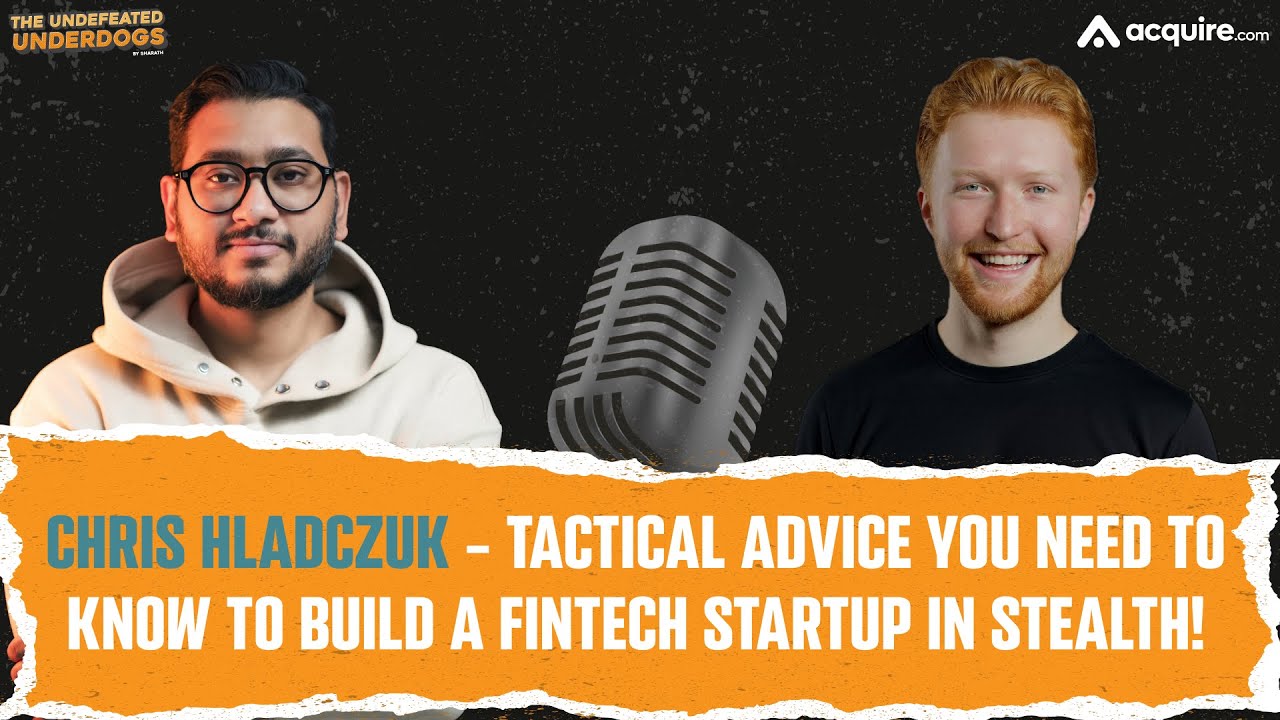
Chris Hladczuk - Tactical advice you need to know to build a fintech startup in stealth!
Andrew Rea - Why first-time founders should invest time and effort in building conviction!

Blake Emal - How to convert people browsing your website into people buying your product!

