DPT Student to CashPT Practice Owner with Kevin Prue | CashPT Lunch Hour #8
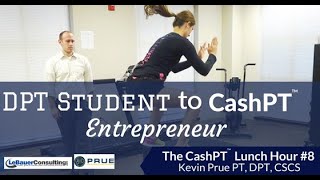
Kevin Prue, a Duke DPT graduate, opened a cash-based physical therapy practice in Cary, North Carolina, charging $125 for evaluations and $65 per treatment. He combines rehabilitation with performance training, uses Google SEO and seminars to market, and recently broke even while being named a top practice.
Chapters
All right. Hey, this is Dr. Aaron LeBauer with labourconsulting.com and the Cash PT Lunch Hour. Thank you all so much for joining us live. Let me introduce Kevin. Kevin is a doctor of physical therapy, strength and conditioning specialist. He graduated from Duke University about a year and a half ago to the
end of May 2014. So, yeah, 2014.
And is about eight months into a cash based physical therapy practice in Cary, North Carolina, which is about an hour and 30 minutes away from me. And we should just be sitting in the same room instead of.
Yeah, why didn't we think of that?
Right, Right. Well, maybe next time. So awesome. Kevin, will you just take a moment and introduce yourself to everyone? Let us know how you got into physical therapy and how did you get into cash based physical therapy.
Sure. So kind of going into college, I was, you know, I was a baseball player, played in college, and I just kind of figured that would be my career path. I'd play as long as I could and get into coaching or something along those lines. My freshman year, I ended up having Tommy John surgery, which is kind of like an elbow reconstruction for those who aren't familiar with it. Rehab from that came back, played some more, had a shoulder surgery, rehabbed that came back from that and kind of was at a crossroads in terms of what I wanted to do as far as my professional career, because it was pretty obvious at that point baseball wasn't going to be it. And then the coaching and traveling aspect wasn't necessarily something I really wanted to do for the rest of my life. And so I took my exercise science kinesiology degree and kind of looked at what can I use this for? And kind of planned well, you know, I like pt. I spent so much time in it as an athlete and I want to kind of blend the rehab and the performance side together. And I didn't know if there's anything like that available. So, you know, PT school was the obvious choice for me. When I was in PT school, I started making plans for owning my own practice. And it was something I always kind of wanted to do and knew that would be in my future. Didn't really learn about Cash PT until probably my third year PT school. And it was actually a classmate of mine had suggested that a few of her friends in Atlanta had cash practices. And kind of being the typical person, I was like, that can't work. I mean, how'd that happen? And so I started doing more research into it and I found your stuff. I found some other stuff online and kind of saw how the Model works and why it makes sense. And from there, kind of the rest is history. Went through my rotations, got ready to graduate, and as soon as I graduated, I started laying out the groundwork for my cash practice.
Awesome. So when you told someone, when someone said, when you're graduating, it's like, what, early May? And when your professors comes up and says, so, Kevin, did you get a job? Where are you going to work? What'd you say?
So they kind of knew that I was planning to open my own practice even from my first year. And we kind of joked about it. A couple of professors I was closer with were like, well, good luck with that. But then when I said, I'm opening a cash practice, the eyes kind of went, what are you thinking? Like, we want you to succeed. First off, we don't think it's the best idea for you to open a practice right after you graduate, let alone a cash pay practice. But I mean, they tried to be supportive and kind of said, you know, if there's anything you need, let us know. If you have tough cases and you can't handle it by yourself, we'll try to help you. Good luck Was pretty much the advice that I got from them. We still joke about it. I talk with a few of my professors there and they're curious on how things are going. They're glad to see it's going in the right direction, but not quite as receptive to the idea. Say you are when we first met and talked last year.
Yeah, yeah. Oh, I mean, the, I got these looks. It was just like, you know, that's,
that's kind of what it was, you
know, And I had a CI tell me that no one was going to pay more than their copay for physical therapy. And I said, you know, I was like, well, just talk to me in three years. Check in with me in three years.
Yep.
And, you know, I don't know. I think I'm sure he knows what I'm doing. But it was, it was, that was the attitude that I had, you know, that received, you know, from other people.
Yeah.
Did anyone, I mean, did anyone really tell you, like, oh, it's a bad idea and you really shouldn't do it and try to talk you out of it?
No, no one was that straightforward with me. They know. The people that know me know I'm pretty kind of thick headed. So I got my mindset I was gonna open a practice and that's what I was gonna do. So there's really no talking me out of it. But body Language kind of, kind of gives you that idea where they're like, I don't know if that's the best idea. You know, I've been practicing 20 years and I haven't gone that route yet. So what makes you think that you can do it?
Right?
And so I'm just kind of going along the path right now and hopefully I can give the talk to me in three years talk and be in the kind of same place you're at now.
Awesome. So what was it? Was there anything specific that, that you learned about or heard or, you know, a specific instance where you said, oh, I've got to do cash based, I can't do this insurance thing.
Yeah, I mean, I think the most important thing was I was like, wow, I just spent 60 to 90 minutes with my patients and we can really focus on some of the manual techniques that I always kind of found interesting even before PT school. And then some of really breaking down the mechanics of a movement. Right. And not just going over. We have to knock through these five exercises real quick in the 30 minutes we have you here. So that was a big turn on for me. You know, I think part of it too is bridging that gap between rehab and performance where, you know, someone's capable of going up and down stairs. So as far as the insurance is concerned, they've completed rehab and they're done.
Right.
And they would no longer cover services. Whereas a lot of my guys are high level athletes and for them that's not really functional. Right. They need to be able to plant and cut and explode and do these things. And so they were essentially paying cash services anyway once their services were no longer medically necessary. And so kind of just figuring, well, why go through the headache of trying to file this insurance stuff and go through all that when the majority of my clients and patients are going to be willing to pay the cash services anyway? It's a win for me. As far as the time concerned, it's a win for them because what we can accomplish in that time period is better than other things that they can do. And so that was kind of the big turn on for me. And then I kind of want to dabble in a few other projects. I mean, I want to get into teaching a little bit and do some of that stuff. And so having that little bit of extra slot of time or being able to kind of make my own schedule is also a nice big turn on there.
Yeah, yeah, it's lifestyle.
Yeah, absolutely.
You know, what do you. So what do you do in Your spare time?
Well, right now there's not too, too much spare time with trying to get the practice off the ground. I'm actually working with a new company called New Grad Physical Therapy, which I don't know if you've heard about it, but it's essentially kind of a how to survive going from the classroom to the clinic. And so we're just putting up content and articles. So I'm doing a lot of writing for them right now and trying to draw a larger market for that as well for a lot of the new grads out there, PT students that are out there.
Awesome, awesome. Are you, do you exercise, work out, do something like that too?
Yeah, I mean try to as much as I can. It's not quite the same as when I was playing, but my wife and I've been getting up at 4:35 in the morning trying to drag ourselves to the gym which has been a, a fun project to do. Knowing that you're gonna be at the clinic till seven or eight some nights. But yeah, trying to get in there as much as I can. Definitely.
Awesome. Awesome. What? So like, I guess one of the questions people ask is, you know, so what about those patients you've never seen before that these really hard cases? You know, what do you do when someone comes into your clinic and you're like, oh my gosh, I've never seen this before. It's totally crazy. You know, what's your, what's your backup plan? Or what do you got to support you?
Yeah, so I mean I get that question a lot. As far as the cash pt, you're in the clinic by yourself. So what are you going to do when you run across these situations? And my answer is catching. Kind of the same thing I would do if I was in a small insurance based clinic. Right. There are a lot of clinics out there. Was only really 1 or 2 pts there. And so my go to is, you know, evaluate them as thoroughly as I can. There's going to be some dysfunction there that I can pick up on right away and treat in that first visit and then so I'll treat them as best as I can. Internet's a great resource, journal articles, that sort of stuff. And then I have a few mentors that I kind of rely on when, hey, there's something that's really not right about this case. Have you ever seen anything like this? And they've been able to give me some pretty good answers to help me with some of those tougher cases, which is definitely something I would recommend to Any new grad, whether you're in a cash PT practice, insurance practice, whether you're just a staff PT somewhere, always have a mentor that you trust and someone you can bounce questions off of.
Yeah, I had a friend, a classmate of mine who took a job, I think like in South Carolina somewhere and. Or it could have been North Carolina, but it was, I know, south of where I'm at.
Right. Somewhere around there.
It was because this guy was going to be this great mentor to him and he was a great manual pt and he was going down there for this other PT and he got there, he spent about a year there and he had no mentoring. I was like, well, what happened? He's like, well, I didn't learn anything. I just treated. I was just there to treat patients. And this is a multi therapist clinic in network. And I mean, so I mean it's not like all, you know, Right.
It's not, it's not a given. Just because if you're in a clinic with other clinicians or a larger facility that you're gonna get this mentorship. It's all about relationships and who the people are themselves and that sort of stuff.
Right, right. Awesome. So what are some of the things that you're working on when you're not seeing patients right now?
So we still do. I'm doing a lot of marketing. I'm trying to do a lot for my website development and trying to get to that first page of Google for a lot of different search keywords. So we're doing a lot of writing for the website, a lot of content development, doing some of that content development for this other website I'm working with. And then actually I go out and give a lot of talks in our area, whether it's to youth sports teams, gyms, personal trainers. I've actually gotten a pretty good relationship with. It's called the Triangle Rock Climbing Club and they have three big indoor rock climbing facilities. And so I go out there about once a month and give a talk on overuse injuries for whatever is ailing the most. Most people there that month. There's a Fleet Feet running store which you may be familiar with. They bring me in to do some screenings and things like that for helps them from a marketing standpoint. Helps me from a marketing developing, relationship standpoint. So a lot of that kind of in your face, personal, one on one marketing kind of strategies is what I'm doing when I'm not usually in the clinic treating people.
Awesome. Are you doing. What kind of screens are you doing?
So kind of like A modified FMS SFMA kind of deal, depending on what space I have available to me and who the client actually is. Sometimes it's just like an upper corner screen, depending on what it is, or a lower quarter screen. When I use the fms, I try to take my athletes through that and at least get an idea of how someone's moving and kind of strength, stability, mobility, that sort of thing. But I also try to break it down based off the sport. So if I'm seeing a basketball player or volleyball player, I'm going to look at jumping and landing mechanics. If it's a soccer player, I'll look at some planning and cutting and that sort of stuff. Just to get a better idea, big picture wise is how do they move segmentally and then how they move in a sports specific fashion.
Gotcha. Awesome. And have you, have you done anything with. So if you've taken the SFMA FMS courses, you've taken those?
I have. One of my professors at Duke is very close to that process of development in that he does a lot of the research, Dr. Butler at Duke. And so we had a ton of it going through PT school. So basically I was exposed to almost everything you're exposed to in the courses. And then I went through and took the courses just as a secondary kind of backup measure there. So I have a lot of experience with it. I mean, almost three or four years of using it between PT school and out in the clinic.
Oh, wow, that's awesome. And are you doing things like when you're marketing, you're doing okay, I'll do the FMS screen in the marketing. And then if you come to the clinic, you're using the SFMA to evaluate patients or are you intermingling them more?
Kind of intermingling them more. I'm probably not using them the most researched way, to be honest. I mean, I'll get all the key cut points that are on either test, depending on what I'm using, whether it's in the clinic or out of the clinic or FMS or sfma. But I also try to just kind of use judgment and look at some of those mechanical things like the landing and jumping. We'll break it down with video, you know, getting in the valgus or something like that. I do a lot of overhead throwing athletes with my baseball background. So we'll look at kind of what we call like the inverted W. You know, are people getting on top of the baseball or not? So we kind of break down some of that stuff as well.
Okay.
And then looking at the scapular mechanics tied into that as well.
Okay, awesome. Very cool. Let's see. So what, when you go out marketing and do your talks, are you, what are you doing to kind of collect people's information or contact them or give them your contact information? How are you kind of leaving those talks?
Sure. So every talk I go to, I get a sign in sheet with name, email address. I have a stack of cards, business cards there. So when they sign up, they can take them if they'd like. And then I will send off a follow up email to everyone that comes to one of the seminars, just thanking them for coming, kind of personalizing it to. If they stayed after and asked me a question, kind of addressing that question and then realistically just kind of inviting them to call me if, you know, they have a problem now that they don't want to discuss in front of this whole group or if something comes up in the future. And I get, you know, probably about 50 to 60% response rate from just those personalized emails. Like, you know, hey, it was great to see you come. Do you treat ankle? Like, I know you talked about hips today, but do you treat ankles as well? And then we kind of spin that off into. Yep, absolutely. Why don't you come on in, we'll do an eval on you and kind of get a more in depth process of what's going on there.
Awesome. Are you sending those out like one email to each person? Are you using like a email service that you can personalize them with names and stuff?
So I am actually personalizing them myself. I'm kind of using like a template where I'll create, you know, thanks for coming to the seminar, blah, blah, it was great. And I'll just copy and paste that to each person. And then if I know who that person was and I remember talking with them, I'll add like an extra sentence or two in there. And I probably should look into something where it's a lot more efficient, but that's what I'm doing now. So it can take a little bit longer than it's probably ideal.
Yeah. Yeah. Awesome. What other ways are you getting the word out or are people telling you they're hearing, like, how are people hearing about your practice?
A lot of it's word of mouth, kind of like, you know, I mean, that's the big one. Actually, I just got a call today from a new patient who said that she was out volunteering at some school function, who talked to a mother, who talked to another mother of someone who was at one of my seminars and it got passed down the chain that way. And so they're starting to talk about it a little bit, which is nice. I am on the first page of Google for more and more search terms now. And so I've been getting more Internet hits that way. But really I'd say it's probably 70% word of mouth, 20% Google, and 10% directly from the seminar. Someone I meet at the seminar who kind of schedules an appointment that day or the next day.
Do you get any referrals from physicians?
I've had one or two from a nurse practitioner actually. That was actually when I first started the practice and I talked to the patient, the patient's like, so how long do you know so? And so the nurse and I said, I gotta be honest, I've never met her, I don't know where those referrals are coming from. And I reached out to her to kind of connect and never heard back and did a follow up kind of thank you card to her and never heard back and still get a few referrals from her every now and then, which is really strange. And I'd love to meet her and figure out where that came from. But as far as physicians go, not much. I haven't really spent a lot of time trying to do that either.
Yeah, yeah. Have you tried or did you just say, okay, go in a different way?
I mean, when I first opened, I sent out kind of the typical send out some notes and flyers and this and that. But just by talking with other cash owners and using their experience, I know it's not the most successful way to go about it. I figure as I grow and I get more of a patient base and those patients go back to their primary care or their specialist, whoever they saw, if they like me, they will tell them about me. And hopefully if a physician, he here's enough of, wow, that name keeps coming up. Maybe we should connect. I mean, I'm not against it at all. I definitely think it's a great relationship to have. And you know, I just want to make sure it comes on equal terms where they're as interested in my services as I am in their services. And being first off, being right at PT school, I mean, and being my own clinician in a cash pay practice, I can see the blinders going up pretty quick and kind of shutting me out right away. So.
Right. No, I say, I completely agree with you, but that was one of the first things that people were like, oh, you have to get physician referrals. I Tried it and it wasted a lot of my time. And most of the referrals I got, I didn't really get any from those efforts. But since then, I've treated some physicians, and even when I've treated them, the patients who call are not ready to plug down more than 50 bucks for physical therapy. They haven't bought in. It's just really rare. And it's not anything that I think that we shouldn't do, but I think there's so much. There are better ways of going after patients, especially with direct access, et cetera. So while we're talking about that, most people on the show aren't from North Carolina. So I know what your direct access laws are, but why don't you tell everyone else, like, what our direct access laws are here in North Carolina and how you make those work to your favor? Work around problems.
Yeah, I mean, we pretty much have unfettered direct access. I mean, I can see patients at one of my seminars and technically evaluate them right then and there, which is a great way to get my point across. And I can even treat them right then and there. So if we're looking at something like a pelvic instability, I can evaluate it in front of a group and kind of talk about, are your hamstrings really short or are we just having trouble firing kind of motor control wise from the core and show them something we can do and make that correction right then and there in front of people. And people are like, wow, he's a magician. And it's really not that complicated to us. But for them, they never would have thought going that route. We needed a prescription for manipulation of the spine, which has been fought very hard. And I believe recently they're making a lot of headway on removing that.
Right.
So that is pretty much the last little hurdle we have to leap as far as North Carolina goes.
Yeah. So I do great. I do mobilizations. I get people in position and mobilize, and a lot of times that's really all I need, especially with soft tissue. So it's really not a hindrance to me.
Yeah, same. And I mean, even if I. If I wanted to manipulate a spine, I can position them and still get. There's a lot of research that shows you can just position them into that kind of manipulation position, not actually go through the high velocity thrust.
Right.
And still receive some of the benefits.
And that's. You get the benefit and the cavitation without a thrust. A lot of it.
Right. And so I can do that without any, any requirements. There. So there are ways around it, right? Not that, not that we're promoting, you know, skipping around no stuff.
But there's, I mean, there are states with more stringent rules. And what a lot of people have trouble with is, oh, I've only got 30 days to evaluate them or 30 days to get a plan of care. Well, that doesn't mean we should turn them away, turn away patients who seek us. And there's a lot we can do in four or five visits in, in an hour, once a week or you know, sometimes if, if I have to get someone a plan of care signed in two weeks, I'm going to see them. I'm going to start seeing everyone twice a week because, you know, I get a lot more done before they need to go see their physician. So. So tell me, it's like a little bit about. I want to know a little bit about your practice, how you're set up. Like, are you, you know, how big's your space? How many treatment rooms do you guys have?
Sure we are. We're about 1600 square feet, give or take. We have two treatment rooms. One of them is currently used by a massage therapist for the most part. Both of them are. Both our treatment rooms are private. So doors close, you can do whatever you need to in that, that space. We have a little back office here where I am now where I can get some of my paperwork done and calling potential places to go out and give seminars and that sort of stuff. And then we have just a nice little open gym space for some of my personal training clients or sports performance clients or for anyone who needs, you know, the PT exercises and that sort of stuff. But it's just me for right now and then this massage therapist who comes in and out of the space. We have minimal equipment as far as even the gym equipment goes. I think we have, we have a treadmill for some of our running analysis programs. We have a lot of thera bands. We have a dumbbell set which is one of those interchangeable ones, but it's actually regular plates, so it feels, feels like a real weight. And for some of my athletes who like being in the gym and they don't like that kind of fake plasticky interchangeable weight. It's a nice little. Nice looking to have there. We are trying to set up a Pilates therapist in the clinic. She's someone I graduated with. She's a pt and then she's also Pilates instructor. So we're trying to rearrange the space to fit her equipment in. Where she can come in and treat clients either as a PT or as a kind of Pilates instructor. So that's down the road, hopefully. We're hoping in October we get her started, but now we're looking at probably after the first of the year.
Okay, awesome. What do you do, like documentation wise, checking people in. Do you have someone sitting there when people walk in and how do you let people in? And secure way, sure.
So it's, it's me. I check them in. I have an online software that I use called Apollo Practice Management, which has a whole cash PT module on it, which makes my life a lot easier. So you don't need to use any of the insurance G codes for Medicare, any of that stuff. It gives me a place to schedule, collect money and kind of track patient accounts, put in all the patient information I need so I'm not carrying around a bunch of paper files all over the place. I try to schedule my appointments. I do about an hour for every appointment, but I block them off for about an hour and 15, so that way I can do that patient, get them the paperwork they need and get them out the door before the next person comes in. And you know, I just kind of sit out. We have a little desk out there which is kind of where a receptionist would be and it kind of looks like there should be someone sitting there. And maybe one day we'll have a little office manager to kind of help me out with some of that stuff.
Stuff.
But as far as the patient receipts go, I have a PDF with drop down menus. So I have all the coding and stuff done that way. So at the end of every visit, enter my codes in, print it off, hand it to them and they're ready to go. So we've kind of made that pretty seamless. Yeah, other than that, pretty straightforward.
Awesome. Awesome. So what are some of the biggest challenges you've faced like in the last few months and what do you feel like, like your biggest challenge right now in creating a successful cash based practice?
Yeah, I mean, so it's, I mean I wouldn't necessarily say it's a challenge per se because it's part of any business, but like the marketing is definitely, I mean Cary is a, a larger suburb of Raleigh and so we have a huge population base to draw from. But also means there's a lot of PT clinics and I mean I've never seen so many chiropractors offices in a small area. I mean every corner there's one. Which kind of was also an indicator to me that a Cash practice here would survive. There's a ton of dentists, there's a ton of chiropractors, a ton of massage therapists. But so just getting my name out there to this mass of people has been my biggest challenge. And especially when you're fighting some of these big box clinics with a ton of marketing budgets that can go directly to a physician, buy them lunch every week and get referrals that way. And just trying to fight that fight has been a big challenge. But we're just about done with our first year and the growth in our last three months has been right where I'd want it to be. Whereas the first couple months you start kind of scratching your head wondering, did I make a bad choice here?
Right. Awesome. Awesome. So what's your greatest accomplishment so far?
Definitely when I broke even finally so the clinic was no longer bleeding money, that was a big accomplishment. But we actually, we were named one of the best practices in the Raleigh Durham area. Being open only for a year, which was pretty good accomplishment. I was pretty proud of that. And surprisingly there hasn't, I haven't gotten too many phone calls that said, hey, I saw you in the magazine as one of the top practices. We'd love to come see you, but it's only been out for a couple months, so hopefully that'll just be out there forever. And eventually we'll get some people from that as well. But from a personal kind of accomplishment, I'm pretty proud of that.
Awesome. Awesome. That's great. So what are your five and 10 year plans?
So five year plan is to definitely grow to a place where my schedule is completely full for where I want it, which is going to be about 20, 25 people week. I have in my mind right now I want that volume to be pretty stable. I mean, obviously you're gonna have these ups and downs, but somewhere around that number would be ideal. I do want to get into some teaching, whether it's at a PT program or a PTA program, and probably a PTA program to be honest, just because it'll give me some more flexibility in my schedule where I can go teach one or two courses and do some of that stuff. I want to grow our actual gym space into more of a performance style gym where we can do real strength and conditioning work and bring on a strength coach and do some of that. And I, I think that's probably more in the ten year plan. You know, originally it was in my five year plan. But just looking at how things are going and developing, I think that I'M going to push that down the road a little bit and worry more so about my PT services, my PT skills versus that kind of string and conditioning stuff. And if it comes, if it comes sooner, great. If, if not, I'm not going to rush it. I'd rather bring in this Pilates therapist and spend time marketing that and growing that part of the business. So I'm hoping five years from now the two of us will be nice and stable with our volume 10 years out, we will have a strength conditioning style gym, me, this other therapist treating full time and then doing a little bit of teaching stuff like that on the side for me personally.
Awesome. Awesome. That's really cool. So we're. Oh, I've got five more minutes of our planned time. So I just want to ask everyone, if you have any questions directly for Kevin, please type them in the chat box. The other thing I want to know, and I want to ask you, Kevin, but anyone else who's listening is do you know of anyone else who graduated from physical therapy and went straight to a cash based practice?
I know you did. No, no one, no one that I graduated with was even thinking about it. Most people I've come across, I'm not. I have a few people that I know that went through residencies and fellowship training and then opened up after that.
Yeah.
Which is essentially the same thing.
They opened a cash practice after that.
Yep. Yeah, There's a guy in somewhere in Pennsylvania, I believe, who did a sports residency and he opened up after he completed the residency. See. But really that, that's about it that I can think of off top of my head. It's, it's a select few.
Yeah. So welcome to the club.
Yeah, I'm happy to be there.
Yeah. Let me know if you find out any other club members. I'd like to, you know, just be great, you know, send me this guy's information when you get it. I'd like to kind of be in contact with people and see what the like. But I know there's got to be more people out there and maybe it's just we're on the cusp of, of more people coming into it.
I think Carlos Barrio from Spark Physio, I think he technically opened his practice right after he graduated, but I know he was a personal trainer for six or seven years for a while and then went back to PT school and they kind of restarted his personal training business and that. So he would kind of fall into the category as well, I think.
Yeah. Okay. Yeah, I know Carlos. I didn't really realize, I don't know that I realized about that, but. But about him.
I could be wrong, but that's what I think.
I'll shoot him a message and see. Okay, so I got a question from Trevor for you. And he asked, how much do you charge for your visits?
Sure. So we do 125 for an evaluation or for a one hour treatment and 65 for halves. Our personal training rates are 65 for an hour, which is. I do those as well right now. And the ideal would be to get someone on to do that because I kind of want, you know, my time, if you're seeing me, it's an hour, it's 1:25.
If not.
But for now I don't mind doing that. And. And I don't think I could justify selling a 125 personal training package right now just based off what other people charge in the area. And then we do something called fitness consulting, which is it's $150 per month. And essentially that is a person comes in once a month. We develop a at home personal training program. We walk them through the program and then send them away with it and they go home and work on it for a month and come back every month to follow that up. So I price that basically because it takes about half an hour to walk them through the gym space and take them through the program. Takes me about 45 minutes to an hour to create it. And that's kind of where we came up with that number.
Awesome, awesome. You send them home with printed handouts or you got a computer program you're using.
So I send them home with a printed handout of the program. And we have certain exercise videos on our website for certain lists if people have trouble remembering what it is. And then they always have access to me through email or phone to get corrected form or pictures or whatever they need.
Yeah, yeah. Awesome, awesome, that's great. Well, how, if someone wants to get in touch with you, can you tell everyone where they can find you online or how they get. How do people get in touch with you? So your website address is. Where do we find you on Twitter, etc.
Sure, sure. So my clinic's website, it's ww.prupt.com so it's my last name, P R U E. Our Facebook page is Pru Physical Therapy and Sports Performance. Twitter handle. For myself personally, it's Dr. Kevin Prue. And for the clinic it's Pru PT. And then my email, I have no problem giving out. I get email from students or potential cash owners when they see some of this stuff. So it's Kevin K e v I n.p r u erupkey.com so a lot of my, a lot of my name just thrown out there. So if you can spell my name, you can contact me somewhere.
If we put Kevin Prue into Google, we should find you.
You will find me, I guarantee it.
Yeah, yeah, that would be the number one, my number one suggestion for anyone who wants to own a practice is that if you put your name in Google you should pop up. Or not me, not Kevin and not Aaron, but your name, Dr. Smith DPT should pop up.
That's some good marketing if you can get people to type in their own name and get your stuff to pop up.
Exactly, exactly. Well, Kevin, thank you for coming on today and this has been really great information and we're going to have to get you back on the program in about a year or so and maybe at least by the before the three year mark. Definitely. Because there's some other topics that we need to talk about. Let's do this again sometime next in 2016.
Yeah, sorry for being late. That computer technic difficulty is it could
have been my fault the first time, it could have been my computer but like I said, I restarted. So who knows. But that's life, right?
Yeah, absolutely. We made the best of it. It was great. I enjoyed it.
Yeah, this has been really good. Thank you very much. I just want to let you guys know to say thank you everyone for attending. I'm going to post up some of the replay to my blog in a few days or a week. But you can also join us on Facebook at the Cash PT Nation. It's a free Facebook group, you just have to request to join. And if you have any questions for Dr. Prue, you can come to the blog and leave them at the at my blog or go visit his blog or contact him personally and appreciate you guys so much for joining us. Thank you very much for the Cash BT Lunch hour. This is Aaron LeBauer Have a great day.
See you guys.
More from Aaron


My clinic has NEVER been in-network with insurance companies—and it NEVER will be! #cashpt








