Good Debt or Bad with Will Butler | CashPT Lunch Hour #55
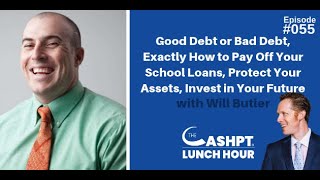
Will Butler, a former physical therapist turned financial advisor, explains why paying off student loans too quickly can hurt long-term wealth. He breaks down good debt versus bad debt, the benefits of federal income-driven repayment plans, and why PTs need insurance, disability coverage, and diversified assets beyond stocks.
Chapters
Welcome back. This is the Cash PT Lunch Hour with Aaron Labourer, your host. And today my special guest is Will Butler. Will is a physical therapist turned financial advisor. And we've had many conversations over the last few years since we met about loans and debt and, you know, financial investing, et cetera. And I felt like I had to have him on the podcast today to share what he knows with you guys. So, Will, welcome to the show.
Hey, I'm glad to be here. I was always wondering when I would get my spot on the Cash PT Lunch Hour.
Well, dude, I saved it for you and it's the right time.
I know. We just kept. You sit on it, you sit on it, you sit on it. And then you and I both saw the same things happening recently and it was like a no brainer.
Yeah, yeah, exactly. And I think it was you had posted something in the Dr. PT group and someone else said something else like, you know, I even made a comment, I was like, I don't think people really get it. So then I felt like I had to explain and I actually didn't get any. I didn't get any comments back, which. And so to provide some context, one of the things that as an entrepreneur you need to be willing to do to be extremely successful is learn how to invest. And as a physical therapist, you know, I came out of school with about $80,000 in debt. People are getting out now. 150, 200. I've heard someone had $250,000 in debt and then someone else between him and his wife was also. PT had 350 and with that much debt, I think it seems like it freaks people out and it seems to stall people out from moving forward.
So.
Well, I just want to kind of, kind of have this conversation together so that people can hear it. And I think that. Let me just ask you first, like, first thing, like, tell us a little bit of background about, you know, what you and physical therapy. Like, how did you become a physical therapist? And I want you to share your story about going from PT to financial, investing and advising. And where did that all come about? Because these questions are great and I'm excited about them, but I want to let people know a little bit who you are and the point of view you're coming from.
Yeah, I think what's funny is my mind right now is kind of geared towards improv related stuff. And like, so as you were talking about that, I was like, all right, we've established who. All right, we've got where Cash PT Lunch Hour will And air. And then what? And you, like, boxed me. And I was like, awesome. This is very focused. But, like, so I got into. I've always been fascinated about in pain and stress response and how it just kind of seems to course correct people. It just moves them through their journey. And I think sometimes it's conscious and sometimes it's on subconscious levels. And that kind of naturally progressed me into physical therapy because that's ultimately what we do is we were like masters of stress management. And so that got me into PT school. And then I would. I like to think that it was a higher purpose, higher cause, like some sort of recessive altruistic trait that I had that got me into these advocacy meetings. But the reality is oftentimes free lunch. But you put somebody in front of you long enough and hear their message long enough, and it starts to change and cause things. And I really do feel kind of maybe some sort of can't think of a better verbiage than maybe I had some sort of a recessive hippie gene and it, like, stressed. And all of a sudden I was like, you know what, advocacy? I'm going to get into this. And then I went to the University of St. Augustine, which is really predominantly an orthopedic program. I know that obviously they meet certain requirements and so they address all these things, but that's what people think of when they think of St. Augustine. And that's why I was there. And a lot of the things we were advocating for seem to deal with orthopedic situations, which I thought was great because that's all I wanted to do. But it, like, didn't resonate with that advocacy gene expression. I just didn't like. It was just hard for me to believe that we were doing so well as a profession. We now needed to pool money and go talk to legislators and say, hey, we need more permission. Because that just didn't resonate with me. But being a student, I didn't know any better. And it was one of the few times I kind of sat back quietly, and then I get into clinical practice and get smashed with imposter syndrome. All the things that happen to somebody newly and freshly practicing. But what I realized that made me not feel like the autonomous clinician that St. Augustine would constantly drill into you, like, this is what you want to be. This is what you want to be. It had nothing to do with specials tests, had nothing to do with evaluations, and nothing to do with any of that. Had everything to do with, like, money and how to manage it. Ranging from like student loans to retirement stuff, like, when am I going to be able to stop practicing? I have benefits, but what does that even mean? And like, and like everything had a financial correlation, which is so interesting. Right? Like you would think, here I am practicing people telling me their complex medical histories. I'm like, cool, you can tell me that all day. I'm fine with it. But you asked me about what do I do with my debt, what if I want to start a practice, where do I go to do that, how and when do I balance? I didn't know any of it. So that's kind of what launched me into that. And that was a friend challenging me saying, well, if you're telling me you like helping people, if you're telling me you like building relationships, if you're telling me you like to debunk myths, you're telling me that you're really frustrated about all this money stuff. Like, first of all, why don't you learn about it? And then when you learn about it, why don't you share it? And then not only that, but why don't you go talk to people who speak your language, other clinicians? And that was kind of the push off of me into this. And that was a long process, but that's how I ended up into this. I still manage stress, but my modalities aren't movement and massage. My modality is money.
Yeah. Wow, that's awesome. And I would like you to share
this I thought was really powerful.
It was part of your talk at SSPT Live about two years ago when you're talking about the elephant in the room, but you were talking about how growing up you guys had a different money mindset or and things that happened with your father. Do you mind sharing that? That was really powerful story and I'd like other people to hear it because I think it helps set the. Set the stage for what I. The questions I really want to ask.
Absolutely. So what we just covered was kind of like the logical progression of how I got to here. So I think sometimes though, like, you can build a vehicle, but you've got to fuel it, right?
Yeah.
The fuel for me wasn't a little bit of it was anger. Like, how did I get this far in life and still feel so ill prepared? Like some of that was that. But the overwhelming fire has everything to do with the premature passing of my father. He was a business owner. He'd been through it, through good times and bad. There were some times where it consolidate his business down to a point where he actually Ended up working for one of his distributors or one of the people who he distributed for versus his own business. So I've seen what happens with businesses in good times and bad. And when my dad passed away, business was actually great. He had just moved away from this distributor, started his own thing. The family leveraged everything to make this work. One day he's out cycling, riding his bike, and he drops dead of a heart attack. Like that happens. That doesn't make me unique. That's not like the radioactive spider moment. But what actually, though, helped me realize very quickly is, like, my dad was a man of great intention, and he had done a lot to, like. He wanted to build a business not just for himself. He wanted to build it to support his family, to put us through school, to be able to take time away, to be there when we were having life experiences. He wanted to be able to provide employees opportunities to grow their lives and to support their families. He wanted to serve the local construction community. There really was this mindset of growing and being more than who and actually and what he was, and then one day has a heart attack, and none of that matters. So then in those situations, when the primary objective is all of a sudden off the table, you've got to fall back on the alternative and contingency, and in this case, the emergency plan. You know, in this type of situation, when my mom's pregnant with my youngest brother, I mean, what's the natural instinct? You say, well, is there life insurance money? Yeah, there's the emotional loss, but there's nothing that you can pull off a shelf and fix that. And so what do you do? Well, let's kind of. Let's do what we can do. And when my mom went to make the life insurance claim, the company who supposedly was carrying life insurance policies said, Mrs. Butler, this is an awful time, but there are no policies enforced with us. Your advisor, your business planning advisor should have told you that.
Wow.
And so that right there, like, I went through all the. All those stages and all that grieving. I was mad at the advisor, and then it turned into me being, like, mad at my dad. Like, how could you? Like, why would. Like, how does this happen? Like, you. You never told people. You never bragged about your business. You bragged about your family. If we meant so much, why did we end up in this situation? And then you just start to pull back, and then maybe it's Matt, maybe that's maturity. I don't know. But I started to realize, like, that's not what this is about. My dad was a great person. The guy who my dad was working with was well intended. But, like, intentions don't get anything done. Like, actions, whether perfect or imperfect, action gets something done. And so the last thing I wanted to do and kind of what fuels me now is, like, people get caught up in life, and they don't step out of the rat race to really take perspective and, like, take purposeful steps towards what they really want. And I've seen what happens when people don't do that. When they don't. All they care about is the upside. They don't worry about the downside. What's your backstop? And I think that that's. That's what I want. That's what I enjoy most now, is helping business owners think differently now so that they can appreciate the best times and they can weather the worst times. Right.
Right. Wow, that's powerful. I mean, I think that. I mean, that's a big why. I mean, that's huge. But in the first time you told that, and, I mean, I was like, oh, damn. Like, I can totally see that. And I can totally see how even as a business owner myself, I'd overlook that. And for years, I know I did because I was like, I don't have the income to any of this or want to, even as a parent, think about, you know, like, what's going to happen. So that's important. I want to come back to some of the best ways that people can protect themselves later on in the show. So where did. So you went to PT school? You got out of school, got a job. And was there something that happened where you were like, okay, being a PT isn't for me. I need to really shift gears and go back to this, you know, fix what. What I didn't have for myself, for other people.
Yeah. And I don't know that there was one absolute moment. I think some of it came down to how I defined or identified myself. I didn't identify myself as a clinician, identified as myself as a person, but the skill set of a physical therapist. And there are a lot of skills that transcend physical therapy that make a good physical therapist great. So I just took those skills and kind of leveraged them into this. One of the big things that sort of pushed me actually comes back to my family. So, like, you know, my brother's going through high school, like, out there in the Pacific Northwest, like, this is awesome. Family's back in Ohio. And, you know, I get reports from my sister like, hey, like, you know, John's not doing the best. I'm like, well, what do you mean? Every time I call, everything's great. And what I started to realize is I was missing precious, valuable moments. Those mountains have been there for tens of thousands of years. They're not going anywhere. But this time with my brother is finite. And so in the discussion and thought of the move, I was like, you know what? Like, if I'm gonna make a change, if I'm gonna leap, if I'm leaving an area of the country that I love to go back to be with, like, this is a time to take a chance. In. The company I was with made a real strong counter offer. Like, they were, like, drawing up director to ownership plans, you know, an opportunity shortly out of school that a lot of clinicians don't get. And so, like, there was definitely that point where I had to decide, like, do I leap or do I stay? Like, what do I need to take some sort of massive action?
Yeah. And so what'd you do? You just quit your job, move back to Ohio and pack your stuff up and drive home?
Yeah. I mean, when you distill it down to that, that probably is the component parts, but, like, that process took time. Like, I thought about it. I realized I wanted to have a larger impact than. Than what I was having on a local level. And that's not to take away from anyone. I think that that's really important that people have some more introspective moments and ask what they actually want to do. Like, care about the data you should be assigned. You should gather data to impact others. Do you want to treat local and help your local? Then that's what you should do. Do you want to impact a profession? Then that's what you should do. You need to define that.
So did you, like. Did you know you wanted to be financial advisor? Did that come from somewhere?
Yeah, I didn't even know that that was. For some reason, I didn't even know that that was like, a job. Like, I don't know why I didn't know that. I think that's kind of weird. And it took somebody with perspective that I was not capable of having to identify the skill set that I have that would be a right fit for it. Yeah, that was one of my best friends. His name's Jeff, Jeff Stevens. He and I actually work together now. And he just. He says, well, I've had a pit in my stomach for probably three years. Every day when I go to work, I feel bad that I haven't talked to you about what it is that I do. But I've been so worried that when I propose it that it'll jeopardize our friendship. But it reached a tipping point and I have to talk to you about this. I just have to. And if you hate me forever, fine. But like, I don't want to look back in 10 years and know that I didn't talk to you. And so that's kind of actually where it came from.
Wow. Wow, that's awesome. That's awesome. So now you've been doing financial advising and was it investment advising type? And is that the best way to describe what you do or is there a better way to.
I mean, I think like the official job title is financial advisor think. Like, I break it down to a lot like within a, within a clinic. Like a lot of people, you have skill sets and modalities that you practice with. And I would say that my primary modalities, circle investments circle is insurances. A lot of analysis is run. I mean, really my process when I work with people, it's no different than a soap note. Like in any clinic, the modalities are no different. It's management of behavior, not necessarily the management of money that leads to success. And I mean, we see that in practice, right?
Yeah, yeah. Awesome, awesome.
Also,
let's. I wanted to, I want to kind of, I think the best place to start. And so one of the big things is, you know, I see a lot of people, you know, they're like, I get it. School, There's a lot of school debt. And physical therapy as a profession, if I get a job somewhere, especially an outpatient ortho in a non physician practice or non hospital owned practice, my salary would be capped by insurance reimbursement. Right. And so people get out and they go, well, I've got 150,000 or more in debt. I can only get a job for maybe 65, $75,000 a year. Or I could go get home health for 95. Like, how long is it gonna take me to pay this off? And so what I see often are people putting off, you know, starting a business, investing in themselves, buying a home, and just making choices that I see are best. You know, like it would be in their best interest. But they're saying, oh, well, I've got to pay off my school debt for first. I've got to pay down my school debt as fast as I can. I've got to sacrifice everything now to pay that off instead of, you know, starting my business. Which, you know, Aaron's view is, well, if you start A business, you can earn a whole lot more and pay in the long run, pay it off faster, you know, you can. Why delay investing in a home or the stock market where the sooner you invest in those, the longer your, you know, the, the more growth opportunities and the longer your growth is going to compound.
Yeah, yeah.
And I don't have. Because I'm not a financial advisor, like, I don't how always have the words to tell people, like, well, you know, it'd be in your best interest to, you know, like, government loans aren't bad loans. Like, it'd be in your best interest to figure out a different way to think about your loans or to pay them off while you're doing some other things. So maybe let me just start with, you know, like, what's your take on that? Or maybe we need to start about like, what is good debt and what is bad debt and why is debt good? You know, maybe we should start.
Yeah, well, I'll just kind of. I'll springboard off some of the thoughts from what you were saying and maybe that leads us down a little more specific of like what you were asking about right there. I think, I think sometimes because of the tunneling effect of stress, negative stress in these situations, like, nobody looks. I have to be careful with absolute statements because I hate them. But what I'll say is when life is going great, people are rarely looking for opportunity. They become positively complacent in a sense when that's a great time, when life is great, look for opportunity. When people are going through very difficult times, they tunnel vision and they start looking at the wrong kinds of opportunity or they view it differently. So what I'll see is here are people who are just really, really stressed. They identify that their source of stress or their pain is the student loan debt. And so they start to panic and they start making rash decisions. Probably like an acute flare up of like low back pain. You know, you go pick up a paint can and boom, stabbed with it. But like, there's nothing wrong with the paint can. The pain can didn't do that to you. The back is actually more. Yeah, the pain's excruciating, but you're going to be okay. Over time, you see a physical therapist who reassures and gets you back to what you want to do. And in this sense, what I've seen a lot of times students do is not just students, but fresh clinicians, seasoned clinicians. Everybody is. They're so focused on that. That's all they can see. And they. And they forget like exactly what you say. Like there's no amount of money that you're gonna put as a fresh clinician in the stock market that's gonna out earn a successful business. It's just not, it's not possible at that point. Can you put a lot of weight? Totally. Like, you can always make arguments, we can always nitpick and look for the zebra when we're talking about horses. But in this purpose, in this thing, I think about those things. So I think a lot of that is that people aren't asking them what they actually want to do and who they actually want to be. So they're not looking at things the right way. They're listening to these loud voices. Because there's a lot of. Jeff always uses the term financial pornography. I hate it. I don't know why, but it's really fitting for this. And I think maybe clickbait is a little bit more appropriate. Not as off putting, but like, I think in this you see a lot of that same clickbait marketing in the financial world. And like people hear it and then they try to make decisions based on that reasoning when that's not even what aligns with them. Like, if you genuinely want to be a business owner, you should have a plan for your student debt. And the easiest thing to plan for your student debt is to pay it off. But easiest is not always best. Like you can still use an income driven repayment plan to make your repayment strategy almost zero. So then you can use the money, the thousands of dollars you would pay towards that debt, to build a business, to invest in an education with somebody like you or Greg or Paul or Danny or all those different people. Like, that's investing in yourself, that's going to make more money for you than putting that into a Roth IRA than throwing it at your student debt. That's not me saying you shouldn't pay off your student debt, but. But like you can't plan a successful business when you're letting the debt dictate your decision. It's not possible. Yeah, like when you talk about good debt versus bad debt, I mean, I think you can get into that kind of conversation. But I think with this, I think, like, what do you actually want to do? Who do you actually want to be? And are you taking purposeful actions to that point? If you want to be a staff clinician, because there are a lot of headaches with ownership, great. In that situation, you probably want your debt gone or you need a very strong solution for it because of the weight that that's gonna pull on your finances, but, like, you can't put off significant things that are gonna require a lot of time and a lot of failure because somebody says you've got to do this before that, like, it doesn't work.
Yeah, yeah. I think that, you know, and I can see there's two sides of the coin. There's the person that, like, I'm never gonna start a business. I enjoy clocking in and clocking out. You know, I've got my, my, my car paid off, my credit cards paid off. It's time to go. Student life's easy.
Right, Right.
But. And at the same time, like, I see student loans, especially the federal loans, it's like, that's pretty good. Because if I can't make a payment, all I gotta do is call and say, hey, look, you know, Uncle Sam, I can't make the payment this month. Whereas, you know, the banks are gonna, like, ding me something.
Yeah.
You know, And I mean, yeah, I gotta accrue more interest the month I don't pay. But I mean, when you're right.
And like, if in those situations you get disabled, you go back and you explain your case to the government, they're gonna make a modification to the plan based upon that. Maybe you get full forgiveness, you pass away, that's gone. People aren't getting anchored with it. And I think, like, that brings me up to maybe this will be the only thing I really like, Details for student loan planning stuff. People are so quick because it's marketed so well to refinance, refinance, refinance. And I just don't think, as a fresh clinician, that significant of a decision should be made that quickly. Because, like what you said, Aaron, let's say you go through a year, two years in a typical private practice where you're just. You're kind of capped. You don't feel like they're like your professional goals are not aligning with the owner's goals. Like, you're not feeling fulfilled, and you make a decision to refinance. Now you have to pay $1,800 $2,000 a month. And you say, I'm gonna leave. Now you've got a problem. Now you have an expense that you have to satisfy monthly. But if you were to leave those as federal loans, and you say, I'm striking out on my own, you. You call up the servicer, say, hey, I've changed jobs. They say, what's your income? Funny you should mention that. I just started my own business. It's literally zero.
Right.
And Next thing you know, that payment goes from a definite $2,000 to maybe $25.
Right.
Like, you just bought a lot of flexibility.
Yeah, that's tons. I mean, that's huge. Like, I mean, I know people got started in the business. They spent $500 on a business or a couple thousand dollars. I mean. Yeah, you know, that's huge. And I think that, you know, here, let me ask you about this. So in regards to, like, buying a home, like, I know, like. Like some of the most wealthy individuals, corporations. It's land ownership, right?
Yep, yep.
McDonald's land, right. I love this McDonald's. And if you. If you as the listener, start thinking about this. So this is what McDonald's does. And will may have a better way to explain. If I don't catch it right on the nail, the nail on the head. McDonald's is buying the land under the buildings by franchising the building and renting the building to the owners. So that's how they're buying land all over the United States and the world. And the owner of the franchise, I don't think the owner franchise owns the land underneath. I think Maybe it's the McDonald's corporation. And the same things happen. Like the Catholic Church does a very similar thing where they own so much land in Boston and New Orleans and around the world because of the churches and parishes and all these. I mean, I guess my question is, how do we start thinking like that?
I think of this a few ways. There's, like the mathematical expense, but then there's also kind of like the emotional mental expense of ownerships. And I think, like, with real estate and different things like that, I think it's smart. It's a smart place to put money because it's a physical, tangible asset. I think that there. It's subject to different climates and different. There's different stuff to factor in, I think, when specifically related to a home. Because people say that a lot. Should I delay home ownership? Should I delay those certain things? Well, then my question comes back and it's the same way. Or what if it's that hungry clinician who knows they want to be an owner? They buy a house in Arizona, and then next thing you know, you're saying, hey, I need a clinician and I'll teach you some things. Come out to my place in North Carolina. Now you've got somebody who's like, mortgage and rent and those things. Maybe they're not the right person for home ownership, but I think they should get into it. What if you have A family and you're going to be in an area for a period of time, depending on what the markets look like. A lot of times carrying a mortgage is better than carrying rent. And I think like, again, it's like what you said, it's not necessarily an or situation you do this or that. I think it's. And so maybe that's the mindset shift is that we need to start thinking about more of. And can I do both of these at the same time? Can I own a house and run a business? Can I pay down my debts? And you know this. I think it's the.
And yeah, yeah, no, I get it. Because it's. Because the absolute is, well, I have to finish one before I take on another because I don't want to be in debt.
What a waste of time. Because the same time, that same five year period that you're using for debt is the same five years you can use to make all your business mistakes or your most significant business mistakes or
your most significant business, like growth.
Yep, exactly right.
You know, I think it's interesting, I listened to a couple podcasts this last year just about like the compounding effect of just being invested in the stock market. So can you explain? So let's say I'm not even in the. I don't have a dollar in the stock market. Right. Like, that's not the only investment I should be making. But what am I missing out on by not having anything in play in the stock market? And then the follow up is like, when do I know I need to do that? But you know what I mean? Like if I get 10 years of stock market growth off $1,000, I'm missing out on.
Yeah. So like, I think the most simple and most frequent example that I'll use is take some sort of a fixed account like an ira, whether Roth or traditional, that has funding limits. When people say, and you basically, if you put about 450 to 475 bucks a month into that, you'll max it out, that'll cap out that account. If somebody says, well, yeah, but I want to use that $400, $450 towards my loans. All right? And they do it over like just a five year period of time. So over five years, five grand, what is that, 25,000 bucks. So that's what that feels like. Short term, $25,000. Well, if you compound that at a real conservative return, let's even say 7% that down the road in retirement, each year wasn't $5,000, it was more like $65,000. You basically lost out on five earning years in retirement. So it's like a door hinge. A door hinge turns very slight, but the swing is very significant, covers very large margin from a very small effort. And I think that just that perspective is not one that people appreciate. And so, like, maybe instead of trying to pay it off in five years, maybe we stretch it to 10 years because that allows you to get that money cooking for your future. Because there's never a convenient time to save, especially for fresh clinicians before their family lives start getting complicated, before kids start costing a lot of money. That's their time maybe to push a bolus of cash into the market and let time grow it geometrically. Right. Instead of linearly. And so, like. But if you don't make those efforts now, what's going to happen is you're going to get to a spot where you sit down with somebody and you say, all right, Will finally got the guts up to talk with somebody. How are things looking? And I give you a report and I say, look, you're doing a lot of things great. We need to put it. You got to put the gas down a lot harder. And they just say there's no room for it. So now, instead of crafting what you wanted in the future, you're now compromising your future versus crafting it because you just don't have the most valuable resource, which is time. Now, that's not to vilify paying. It's not to vilify any of those. I just think sometimes you need to look at it from the start of the funnel. Sometimes you need to look at it from the end of the funnel. You need to look at both sides of it so you can have an appropriate perspective to make the best decision for your situation. So many people don't do that because they say, well, debts the devil, so let's just pay it all off, right? You know, maybe.
Well, you know, a car, like a car loan, that's, you know, I'm gonna go to, like, car, you know, back to cars and credit cards, you know, high interest rate, credit card loans and cars.
What?
You lose 20% of value on a car when you drive it off the lot. And your credit card, I don't know what the. If there's a specific rate, but it's, It's. You lose a significant amount, especially the more exotic of a car you have.
Yeah, right.
And then, and then with a credit card loan, which, you know, I've had plenty of, from racing bikes or Just, you know, here and there and paid them off and figured out, okay, this is what I need to do. I've, you know, but credit card loans aren't the best loans because, you know, what do you get, like 18 to 20% interest every month? And that can get to a point where people can't even pay the interest payments.
Yeah, well, so it's interesting. So with that, I want to piggyback off of that and talk about perspectives because about sometimes people are waiting till it's the best time to do something. And it's not always an ideal time. Like sometimes if you've got strong credit and a good income, a car loan is a great thing for you to be able to take out because the payments low, interest rates usually low. But what if you need to get to work? You don't have good credit, but you have a good credit balance. I would sometimes challenge that person to buy their car with that. Because if you don't have a steady income, you can't pay the bank. Bank tanks your car. But a credit card company is never going to take your car. So you're now strapped with the painful. Now obviously this is more of like a financial survival of the fittest. But it comes back to what you and I were saying, that we've got to be a little bit more slow to vilify and make some absolutes in how people use money. Because that same thing that could be bad for you and I, debt wise, could be what gets that person to work reliably to generate an income to be able to pay something off.
Right, Right. And I know people who've maxed out credit cards and become millionaires.
Yeah.
You know, they, they have an opportunity and they need to max them out to invest in something that they know is going to work and believe in. And then, you know, I'm staying in a room of dozens of millionaires who don't have a graduate degree.
Yeah. It's amazing. So then springboarding off of that, what I really appreciate about what you just said is like talking about the principle of diversification. And a lot of times people like to look at that very micro, like on this kind of micromanaged level of like that deals with my stock portfolio and then within that my asset classes, my bonds. And that's how they think of diversification. I think we move one level out and I think that's where the diversification becomes. Where do I actually have money? Is it liquid? Is it illiquid? Because if you have a ton of assets and they're Illiquid. What do you have to do? You know, I have to go borrow that money from somebody else. I'm not saying that you should bootstrap everything, but you need options. Cash is king, right. In that flexibility of having it is important. So being able to have some money in savings, have some money in some non market correlated assets, meaning like the market zigs and zags, it doesn't matter that pot does this have some money in something that sits in the background that you can't get rid of too quick because you'll be more patient with it. Like real estate, you'll give it time. That I think is more true diversification. And if all you're worried about, you can't acquire those assets if you're just burying your debt. I think there's a good example in the PT world right now, and I feel fine using it because he publishes it openly. But Jared Casaza of Fifth Wheel PT is the blog he runs. He's very open and says, hey, I save 90% of my income. My opinion, that's financial behavior. That's a couple standard deviations from norm. Not everybody can ascribe to that. Just like most people probably couldn't keep up with you on a bike. Right. Like, similarly, you were out there, you were outstandard deviations from norm. But because of that, even with his PT student debt load, he and his girlfriend have taken most of this year and they've been traveling throughout Europe and Asia and doing that because they made a decision of what was important. They realized debt's gonna be there, not important. We need assets to enjoy stuff. Let's do this. And it's bought them an opportunity at a cost. I think the video game society has us always thinking that we should win, that there's never a downside to a situation. And I think we recognize that consciously, but I think subconsciously our behaviors are, I need this to win, I need assets, and I need the debt gone. You know, that makes sense.
Yeah. Yeah. So let's say someone is. I'm gonna talk about like someone who's out of PT school. They know they want to start a business. They. They're low on capital in that they, that they, you know, think they need to, you know, like, you know, the way PT school teaches, we have to have a $200,000 loan. But it's like, it's not even like, I need to go get a $200,000 loan. It's like, okay, I need to invest in know business and rent and systems coaching and just Figuring this whole thing out. But I've got this student loan debt that's, you know, breathing down my shoulder. I've got a car payment, you know, I would love to buy a house one day or maybe I have a house. Like how, where does this person start to figure out how to make that next step? How do I justify investing or going into more debt to get the, you know, to get to the next place where I want to go, you know, to get to that next level of success, you know, where does that person start to, you know, make finite decisions?
Yeah.
Based on, you know, moving towards ownership of some business of some sort.
Yeah. I think first step is taking some time to kind of quiet your mind, like pull yourself away from distractions. I mean, for some people, religion helps them do it. For some people, it's their own form of spirituality, whatever it is that causes you to connect to some sort of a flow state. You can really be introspective and really see what get that put down and to see if it resonates. And then you just have to start asking yourself like, is what I'm doing now going to get me there? And then, you know, that's kind of the thought. And if it's not, what could I think? That's kind of. So it starts with the individual. And then I think the next layer on top of that is find people, find a community. Whether maybe it's a family member, maybe it's a friend, maybe it's a paid advisor, maybe it's a mentor. It could come from a lot of different places, but somebody who can shoot straight with you in their opinions at times carry enough weight that you are okay changing your behavior based on that opinion. Because usually our ego kind of gets in the way. Right. So that layer and then have that person really vet your idea and see like, alright, okay. And if that pushes you forward, ride with it. Start building out a business plan. And then that's when I start. I think you start finding mentors and building your team around you, creating the systems, finding people and networking with people. Right. Outside of that, we're doing what you perceive you would like to do, that they're doing. Start having those conversations. The longer you stay between your own ears, the more time you waste. Because it's only based on your perception. You're not actually getting what's real, you're not getting the real slice. And so by the time you enter market, you could be way off base. I think that's how you build it and you just kind of add layers to it. And then I think you need to create some constraints because I've met people who have nursed along an idea that maybe they haven't put enough gas behind. And they've really kind of been a situation where it's like, you need to stop this. This is not for you. Because they've maybe had the wrong people in their corner. There needs to be some time deadlines because if you're not. If that's not right for you, you need to get into a system that is. But I think that's probably the first best step. Start asking the right kind of questions, really refine that. Why? Even though that's kind of been a diluted thing as of late. Find people who you can will vet your idea. Start networking with the people who are doing it. Find people who have demonstrated success in it. Have somebody kind of audit your overall perspective. That's what I do a lot. They say, well, will, what this is what I'm doing. Because Aaron's told me, encouraged me, Greg has, Paul has, Jerry has, all these different. Ben, Gene, all these different people said this practically. What do I need to be doing and focusing on? Maybe this means zero contributions to investment accounts for a couple years because all that money goes into the business. Maybe it means that now somebody in your 20s, you're purchasing term life insurance because you just got married and you're expecting your first child and you can't leave them out there in case something happens while you're chasing your dreams. It absolutely means protecting your income because what if you can't work? Like that's a problem. Like it means doing those kind of that foundational groundwork stuff before worrying about how am I going to diversify my portfolio, my stock portfolio, let's start purchasing land. I think you need to create the core and then add on top of it.
So what are the core, I would say core investment or like core investment strategies or protection strategies that someone who, like me, who has a family, has a successful business like, needs to have in place. Like whether it's investment or insurances, the main things that someone like me or someone who's gonna open a cash practice or even any kind of business a year or two in, you've got some cash rolling. Like what are some things they need to make sure they have.
So we're assuming that we've got something sustainable that's viable, it's growing, it could be thriving, but it's demonstrating promise, right?
Yep, Absolutely. And you have. And you're not just by yourself. You got, you know, A spouse and maybe some kids or you know, parents, other people you have, you have to take care, take care of.
So I think like if you're in a situation where you're self employed, I think you want to always make sure and double check that basic insurance is in event that something happens that you have the right ones in place. I think that ranges from professional liability. If you own the building that you're in, making sure that the business, the physical structure is insured properly. I think having and establishing. I don't always think somebody has to have a financial advisor, especially if it's, if it's a keen interest and it's something that people will do their own homework on, fine. But people also need to not delude themselves. They're so slow to. They want other people in their community to purchase their services, but they're very slow to work with another professional. Blows my mind. Blows my mind. But anyway. But I think making sure that those kind of fundamental. Asking yourself the darkest questions of what happens if I'm not here? Or worse, what if I'm disabled and not able to participate, providing for my family, like do I have solutions for those things? You tick those boxes. The next layer, if you're actually looking at practice, how do you see that evolving? Is this something where you want to stay self employed because you like the control, you like being that subject matter expert, you like being wearing all the hats, fine. You need to start putting in a retirement plan for yourself so you can start stuffing away some money, help you with some, be more a little tax advantaged. You need to start figuring out and contributing an appreciable portion to that because a lot of time as an owner, you're playing catch up because you looked past, you forewent, forgone, foregoed for not an English major you overlooked or you stepped past those initial investment years to build a business and invest in yourself. You're probably going to have to play a little catch up and that's fine. I think that you run trajectories on the kind of life you want to live. Like am I going to need $100,000 to live on in the future? 200,000, 300,400? What's your lifestyle look like? Run some analyses on that. So then you know how much you need to be saving. I think if you're bringing people in and you identify key talent, you need to start asking yourself questions of how am I going to keep this person here?
Right.
You need to be able to know that. And that's where you start looking at other types of accounts and things. But I think that's the best place is constantly be evaluating if I'm not here, what has to keep happening. Making sure that the legal documentation supports it. I think a good attorney. Making sure stuff plays out. Like, if you want to leave your spouse, if you want to leave your wife, your clinic, because you have systems that would enable her to run it. Is that what's legally going to hold up in court, should you pass away? Like, that's important. That's really important.
Yeah, yeah, yeah.
That's vital.
And that's where you would put into a will, right? Yep, yep.
Wills and trusts and all kinds of different things set up for sure.
That's awesome. That's great. So. And yeah, that's awesome. Like, I have a ton more questions, and I think we're gonna have to
do a part two.
I know we may have to do a part two. I think that. I think that this has been awesome. And it's got me. It's just every time I talk to you, I think I'm like, I got
more to think and more to share
because I think it's really great. And it's something that I didn't grow up learning. And we're not being taught in school because, of course, it's not part of being a great clinician. But as a business owner and entrepreneur, these are things that I think about all the time and I try to impart on my coaching clients and teach other people and. And the way you put it and the analogies you've used have been really helpful and are always great. So thank you very much for being here and sharing that. Is there any one last thing that you think maybe we didn't cover that would be important to cover, or maybe if even there's a student listening, the best tip for them, if they didn't pick up on a lot of this. Is there something else that you think would be.
I think for students, one of the best things they can do. Start tracking what their money is doing. Not necessarily that they're investing it, because legally you're not supposed to invest your student loans. But I think knowing their money behaviors and how and what tendencies they have with money, because that'll help them understand their behaviors. Like, maybe they keep great track of it, but maybe they spend it in the wrong areas. Maybe it's not accounting, a bookkeeper they need. Maybe they need a cpa. You know, like different things like that. Know your behaviors. I would say for somebody still in school and I would say in school is a great time to start asking yourself those questions of what's my tendency towards to help somebody grow something else, to grow my own thing or like, what and who do I see myself becoming?
Yeah. That's awesome. That's awesome. Well, thank you, Will. I really appreciate you being here. Like I said, this has been invaluable to me and I know it's going to help at least one listener out there, if not thousands. I appreciate your time and sharing your knowledge and expertise. Where can someone find you if they want to ask some questions or learn more about what you're doing?
I think. I don't know if it's up and running yet, but financial physio.com is a really easy way. You just go there and you can schedule a meeting. I just like to chat and network.
Yeah. Your digital coffee.
Huh?
You get digital coffee?
Yeah, grab a digital coffee. Safer, a little bit cheaper. They never screw up your order. But I think, yeah, man, I think that's probably the best way. Or direct message me on social media outlets. I like to be accessible, easy to get in touch with.
Awesome. Well, we'll put your links to social media and digital coffee up on our blog. Show Notes.
I appreciate that. Yeah, of course.
Thank you so much. I'm looking forward to the next time I see you in person and we have you on the podcast.
Awesome. I appreciate it. Thank you.
Have a great day. And for the Will Butler and Aaron LeBauer this is the Cash PD Lunch Hour. We'll see you guys next time.
More from Aaron


My clinic has NEVER been in-network with insurance companies—and it NEVER will be! #cashpt








