Launching a CashPT Practice: The CashPT Residency with Derek Nielsen Part 2 | CashPT Lunch Hour #40
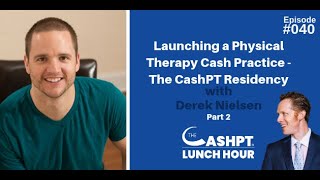
In this episode of the CashPT Lunch Hour, host Aaron LeBauer interviews Dr. Derek Nielsen, a CashPT resident who is transitioning from clinical training to launching his own cash‑based physical therapy practice. Derek explains how his desire to own a business led him to the cash‑based model, his experience learning one‑on‑one treatment and the SFMA, and the shift from clinical skill development to business building. He emphasizes the importance of documenting insights to create email content, ebooks, and eventually video series, and shares his current marketing actions: building a website, creating email funnels, running a Facebook ad for a course, and planning workshops for gyms and a wellness facility. Derek describes his operational setup in a Durham wellness center that provides existing scheduling, payment, and front‑desk infrastructure, while he retains his own email system (ActiveCampaign) and plans to train staff. He discusses challenges in sales, follow‑up systems, and the need to learn how to sell and communicate value to patients. Practical advice for aspiring cash‑based PTs includes mastering clinical outcomes, developing business skills, finding mentors, and focusing on patient acquisition. Derek outlines his five‑year vision of owning a gym with personal trainers under him, and reflects on lessons learned, such as the greater importance of business acumen versus endless clinical education. The conversation ends with Derek’s excitement to launch his practice and Aaron’s plans to check back in later.
Chapters
Foreign.
Hello and welcome to the Kashpugou Lunch Hour. This is Aaron Labourer with Labour Consulting and the Kashpg Lunch Hour. And my special guest today is Dr. Derek Nielsen with Labourer Physical Therapy and soon to be Kaizen Physical Therapy. Hey, Derek, how's it going? Welcome to the show.
Thank you. It's going well.
So this is your first time on the show, right?
Second, I know, yeah.
Your second time on the show. So I interviewed Derek. It's probably been six months. Yeah, yeah, six months ago, last fall. And Derek is here, working here at our clinic as a Cash PT resident. He started almost a year ago. It's been almost 12 months. So it's been 11 months. He started in May and within what, like, no, you started. You came in May 15th or you
came in May 15th.
So he came in May 15th. We spent two weeks and Derek didn't quite have his license, but it was probably the best thing that happened to him, he says. We did a lot of training that week. We went to SSPT Live and came back. Derek started treating patients and then within a month, I was gone for two and a half weeks.
Right.
So Derek's been kicking butt and doing really well. And we had him on the show six months ago to talk to him about what he had learned up to that point. So if you haven't listened to that episode, be sure you go back and check out that episode too. So today I've got some questions for Derek and we're going to talk about where he's at right now, where he's going. A lot of the questions are going to be the same, so I'm going to go back and re ask them so that we can see what's his answer. How's it different now than it was just a short time ago? And he's preparing to leave and start his own business. And I've got a new Cash PG resident coming in in about two weeks. Two weeks. Tyler Shelton from UNC Go Duke. So if Tyler's listening, he'll laugh at that one. So I'm a Duke fan and he's a UNC fan. So he'll be here in two weeks and we'll start training with him. So I want to take the opportunity to talk to Derek and see what he's up to and where. Where he's at right now with his business. So thank you for being here.
Of course.
So, Derek, tell me a little bit about, like, let's go back and review, like, what brought you into this program with me, like, what what happened? When was it? What was like, when were you like, oh, I want to go, you know, work with Aaron.
So I don't know exactly when. It was during school, but I always, always kind of wanted to own my own business and I didn't know how to go about it. I did. I always wanted to own my own business. And I didn't know, I didn't even know the cash based model existed. And I was thinking about, how am I going to do this with insurance? And then I went on clinical rotation where I was treating. There was quite a few times where I treated four patients at once. And I was like, I can't do this. This is, this is too much like I am not going to school for seven years to sit here and say, you know, you do this exercise, you do this exercise. I could just, you know, I could go to a weekend course and be a personal trainer to do that. So I, I started looking around like, okay, what, what are my other options? Because I don't want to, I don't want to work in something like this, in a meal. And I had followed Greg Todd for a while. I had seen your stuff out there for a while and I, and I saw that you, you run the cash based model, you treat one on one. I was like, that's what I want. I want to treat one on one and give people better care. And then I listened to one of your webinars and then I ended up reaching out to you and saying, hey, I know you're a consultant, but I don't want to buy your product, I want to be your employee. And went from there and interviewed me. And ironically, you are luckily enough. You were looking for an employee from there?
Yeah. Awesome. And then, so what was the,
What
was the thing that, like, what was, what was your first like once you got here, what did you think you were gonna learn? And what, and what did you actually learn? Like, what were you expecting to learn? And did you know, did you learn the same? Did you learn that or did you learn something else?
I didn't expect any. I didn't know what to expect. I mean, not only, not only was I not used to the cash based system, that, that one on one treatment, but I also wasn't used to anything because I, I was fresh out of school, so I had, I had no idea what to expect. I will say that it was a lot slower than I expected. Not like patience, but in, in regards to, okay, we take our time with patience. We don't, you know, sometimes I felt rushed and Hurried. And you'd always be like, dude, it's okay, like relax, it's totally fine. Like, you know, if we don't. Cause I would want to. When I started first treating patients, I would want to treat, you know, they come in with shoulder pain, neck pain, low back pain, and you're like, sometimes we can only get to one area. Like, that's just the way it is, you know, just take it slow. So I would say that's the thing that I learned most was just to relax. And, you know, I think people understand because when they, most of the patients that we see have been to somewhere else and when they're not getting results and then they come here and we're just a little bit slower and really thorough with stuff, I think they're totally fine with it. If you get a patient that's not been to somewhere else and doesn't know what physical therapy is, I think that there can be that chance that they're like, well, this is, you know, you're being really slow with stuff and what the heck. But when the majority of your people come from somewhere else that they haven't gotten better, I think they're more than willing. So I would say that's the. One of the first things I noticed was just how relaxed it is.
How do you like, as an employee, did that allow you to do something different than you might have if you had to see four people an hour a week?
So for, I would probably say for the first six months, like, I would do a little bit of business stuff. And as I learned, and if you're starting out, if you're looking to start a practice and you're coming fresh out of school, this is one thing I told Tyler as well is, you know, as you start to learn things, document it. And because those can become your blog posts, those can become your follow up emails, you know, because if you're learning things, other people don't know it and your patient could definitely benefit from hearing it. So as you learn stuff, make sure you document it. Whether it's writing it down or video. That's something I wish I could go back a little bit further and as I was learning, document more. But I did do some of that and so I did have a lot of time. Probably for the first six, six months or so, I would say it was really just learning clinical skills. It took me a long time to learn that sfma.
Yeah.
To really understand it took me a long time.
Did you go and you went to that course before you came here?
Yeah, yeah.
And so what was the. What was probably the number one and number two things that you learned in the first part of. The first part of the program, Was it take your time or was it something. Was there something else that was like,
oh, this is the. I'd say how to treat. Yeah, like that's, that's something I've told you a lot, right, Is I think you. You undervalue your knowledge and treatment skills. I would say that was number one is like. And I. And I've told you this too, is I think a lot of people want to. Want to put the carriage before the horse and they're like, let me learn business. Let me learn business. Let me learn business where it's. No, let me learn clinical skills first and then figure out business. Because I think you can hide. You can hide a little bit of bad business with a really good product. I think it's a little bit harder to do the opposite. But I would say that's the number one thing that I learned was better clinical skills. And like I said, that probably took me about close to six months, like, studying constantly on that stuff. And then number two was how to talk to patients. I started answering phones, listening to Sarah up front, listening to your course, listening to some of Paul's stuff. And communication. I'd say that's number two.
Yeah, communication. Treating patients and then communication.
Yeah, how to communicate. How to get them to. How to get them to buy in what you're offering. Great.
What have you learned since then? So about six months in, we kind of switched from clinical to business. And that was right about the time when we did the last podcast was a few, like about a month after that or so. What would you say is like has been. Have been the things that you've learned, you know, as a Growing your own business, creating your business. What are the most important things?
Oh, I don't know. The most important. I think it's knowing your options really, I think is the most. Has been the most important thing. It's because I'm not going to be an expert in anything. Like, I'm not going to be an expert in doing a workshop or I'm not going to be an expert in doing a podcast or an expert in anything like a webinar or going and talking to people. But I think that what the second half of the six months has allowed me to do is study a little bit of everything and then kind of get a global picture of. I can see myself doing this or I can see this working here and then just Continue to hone down on, you know, okay, I see it working here. Like, so I'm gonna go, for instance, I'm gonna go and talk to a gym and I'm gonna go present with. To them. I'm putting together a presentation for them and I've been studying some about, okay, what. How do I make a presentation that's not just beneficial for. I mean, obviously my end goal is to go in there and try and get patients, but also you want to present it in a way that is beneficial to them. And so I've been really coming in and reading some material on, you know, how to build a presentation that, that isn't only beneficial for the end goal that I want, but it also is beneficial to those that are, that are listening to it. So stuff like that.
Yeah. All right. Have you gone to. But you're still going to clinical. You're still doing clinical learning right now, but it slowed down a little bit.
Yeah.
And what, what are the, I guess what are the first things that you did? Like once we transitioned and you said, okay, now I'm going to start focusing on my business. What were the first things that you did to get that ball rolling?
Started building a website and, and building emails. Like, emails. I, you know, I started doing that pretty, pretty immediately started, like I said, documenting because you don't want to go back and have to just hurry and rush those things out. It's just a lot easier to, you know, when you have an epiphany or you have a patient that mentions something to you or you have this, you know, you have this reoccurring theme with patients that come in with some sort of pain or something. Make sure you document it and write down. And that can be, like I said, your blog or an email. And that way you're not just rushing to get. Let me hurry and build my ebook and my email sequence, you know, and it'll be. Be a lot, a lot less or a lot easier if you just slowly roll that stuff out.
How many emails do you have in your. Have you written. I don't know, like I gave you some. But have you used the ones that I gave you or just write your own?
I think I've turned them. I have, I've used some of them I edited a little bit to make match more of my style. But I use the. Definitely use the thick theme. I'd say for the, for the back. For the Just for the back pain ebook. I think I have like 30.
Yeah.
So I have. And then I have. I don't know, I probably have close to 75 or so.
And you've got me. Ebooks.
4.
Yeah. I don't even know how many do I have one.
If I, if I could go back, this is the thing I would say, and I told you this last week, if I could go back, I think I would change an ebook to a video series. Yeah, I really think I would change that and start getting really good behind video. Because video is going to sell people so much better than, you know, a blog post or, or an ebook.
Yeah.
Like, because if they can see you, they're gonna know I can trust you so much faster.
What's the. What you're doing that right now, right?
Yeah, I built a course. I've got a Facebook ad that's running to it. I've only had two people opt into it, but I am getting, you know, I'm gonna remarket those that are clicking on it and showing some sort of interest. So hopefully I can get some people out of it.
What's the point of an ebook?
To get them into your back end systems. Really?
Yeah, it's like, does the content matter a ton?
Not that much. Most people aren't even gonna read it.
Double down or forget about it. Ebooks.
Oh, it doubled down. Gotta have that. You gotta have something. It's not necessarily an ebook, but you gotta have something for people to opt in and get there to collect their email and follow up with them.
Right, right. Double down and forget about it. Calling people who download your ebook.
Forget about it. Why? Because it, I don't know. I think that's definitely a skill to have. Like, it can be a skill, but a lot of people aren't gonna answer. You're gonna constantly call them. I tried it. I tried it and it was. I get people to answer. I didn't get anybody show up, but I would get people to answer and talk to them and try and follow up. And follow up. I mean it's just a lot of work.
Yeah. If you had, if you had no patience. Double down and forget about it.
Forget about it still.
Yeah. You're gonna do your work somewhere, what would you do instead?
Network. Yeah, I'll go out, I'll go out and network. Try and get in with, I'll try and get in with people that can send me not just one patient, but multiple.
So what about the person, what are you gonna do with the person who downloaded your ebook? How are you gonna contact them after they download it?
Call to actions within the emails. Yeah.
30 of them.
Yeah, 30 of them, yep. Yep.
Great.
What's.
How much is too much to pay for physical therapy?
I think that's a poorly worded question.
They've asked you that a couple times.
I know, but it is.
So reword the question.
How much is too much to pay to get back to running or get back to exercising or playing with your kids? That's a better question.
It's kind of a trick question.
Yeah.
You know, it's like $75, you know, but.
Yeah.
So tell me more about that. Like, what. What is it? Why is it. Tell me, like, why is that such a poorly worded question?
I think it's a poorly worded question because people don't. So it. People aren't going to automatically think of physical therapy is going to get me back to this. It's. It's been recommended by my physician to go to physical therapy. I don't know what it's going to give me, but it's been recommended. And if you can talk to them that you're going to get them back to doing X, Y and Z that they want, then that's a much better question. I mean that if you think about it, a patient's not going to care. If you're a physical therapist, a massage therapist, or personal trainer. If you can get them back to doing what they want, what is the
best question to ask a patient to get that information from them, to get them to understand that you can do that for them?
I don't know if there's a best question. I think there's a set of best questions like, how long have you been suffering? What have you tried to get that hasn't worked for you. What's the number one thing you want to get back? I know that's the one you were wanting me to answer. What's the. What's the number one thing you want to get back to doing? Yeah, I think that's probably. Probably the best question, but I think it's a set of questions to get them thinking about, okay, what have I been through? What do I want to get back to doing? How much? I don't know.
Here's another one I've learned recently working with my coaches is when you get that thing like that, when you find out the thing that they want, the number one thing you say, why is it so important to you? What does that mean?
Like, what.
What does that mean to you?
Yeah, you know.
Oh, yeah, right.
Just brings that value thing. Yeah. Yeah. Awesome. Awesome.
What. What have you learned? Like, I don't know if we've Asked this, but what have you learned that you didn't really expect to learn in the last few months? So I know that you, you know, you said that I undervalue the clinical stuff, but you know, like, you know, from the beginning, like teaching you that, which I understand it's valuable, but at the same time it's like, yeah, I've been doing it for so long that I was like, yeah, we'll just, I'll just teach you this stuff. But what have you learned in the last four or five months that you didn't expect to learn? It was like, oh, I didn't think about that. Or I didn't know that was coming.
I don't know. I really don't know. I didn't. Okay, I didn't expect to learn that. Businesses knowing business is probably, probably this kind of goes back on a little bit what I said, but I think it's as equal or greater of importance than clinical skills like learning business. If you do have a good product, it does go back a little bit on what I said, because if you do have a good product, it can cover up some poor business skills. But if you have a mediocre product, you can make it rich if you have great business skills. So I would, I would say that business is as equally or probably even more important than, than once you get
the, once you get the treatment skills, the product dialed business is more important than continuing to perfect your product.
Yeah, yeah, yeah, that's it. That is what I learned is, is that I thought I would go to continuing ed. Like, let's. Let's go learn a new skill. Let's go, let's go, let's go. And now I'm like, no, I'm getting patience better. I just need more patience.
Right.
That's really what it comes down to.
Right, Right. Where do you see yourself in five years?
On a beach.
Blue water. Blue water.
I don't know. I don't know exactly. Five years. Some hoping. At this point, what I think I would really like to do is end up having personal trainers under me and a gym and me treat me, be the PT when they need me, and then have them probably rent space out of a gym that I own. I think that in five years would be a great goal to have.
So things are. Since we talked last time, where you're going is a little different. So when we chatted in October, you're like heading back to Utah now. What are you doing?
I'm staying in North Carolina. Durham. It's like a 45 minute drive from here.
So tell us about like, what do you have set up over there? What are you working on?
So I'm going into a wellness facility. I was thinking about moving to Raleigh because I wanted to go to a little bigger city. But then I found this place in Durham which is about 25 minute drive from Raleigh and it was just too good to pass up. It's a, it's a wellness facility that has massage, it has yoga, acupuncture, has a naturopathic doctor and then it has a counselor in there as well, and then now me. So it's a kind of a one stop shop type of deal and it was just too, too good to pass up.
Mm. And you've got, are you renting space? Subleasing.
How's that work? Yeah, I'm renting a room out. Okay. I'm renting a room out. There's a couple different options I could do, but they have, the great thing is they already have systems in place. They've already got an email list, they've got a Facebook page, they've got a scheduling software. They actually have somebody at the front desk that works like nine hours a day. Like they have all of this stuff that I can just plop right into.
Are you, are you gonna be able to take advantage of all that? Are you gonna use all their systems or are you gonna do some of your own stuff?
Yeah, I'll use their stuff. Yeah, they have their, I'll use their scheduling software, their payment software. I'll still, I'll still use ActiveCampaign for my email list and stuff. And then I'll probably, I'll probably still use, I'll probably still get something so I can document billing and stuff.
What about when someone calls and talks to their person that's there nine hours a day and says, Did Dr. Nielsen take insurance?
Yeah, I gotta train them. Yeah.
Are you gonna be able to train them?
I'm not gonna do it for a little bit. I'm gonna, I'm gonna take care of everything in the beginning while I'm slow and then I'll eventually work into to training them so when they, when they, when somebody calls. Because I'm not even going to put the. It's called collective wellness. I'm not even going to put their phone number on my website page like I'm going to make. I'm putting my Google voice number and having them reach out to me. And then what? I'll tell them when they call. If somebody calls their front desk to talk to them, I'll tell them to just get in contact with me in
the future when you get busy or you. You'll be able to train their front desk person to answer phone calls.
Yeah.
And then we gonna like just have your Google Voice forward to their number or something.
I don't know what I'll do. That's a good question. Probably be.
The easy thing is tell Google Voice to forward there.
Yeah, probably will.
So you're moving to Raleigh. You've got all your systems, everything set up right. You've got your emails, your website, your blog. You've got. You've now got a Facebook ad running for like the last week. What else do you need to do to start seeing patients? What's left on your list?
I got a insurance. I actually don't even have an LLC yet. So I've got. Those are the two main things.
You got a payment system for people to pay you yet?
Yeah, they have one there. That's basically it. I mean, and then, and then try and keep continuing to get people in the door before I get down there and get people on my email list.
Yeah. When you start June 1st.ish. So how many meetings do you have between now and then with other people to try to get patients done, like to try to build a network.
And right now I only have one, but I. Well too, I guess, because I have a workshop I'm doing at the place at Collective Wellness. I'm gonna do a back pain workshop. But that's right after I start. Beginning next month, I meet with a gym where I'm presenting to them. I reached out to a couple gyms. They've shown some interest. This is a funny story. 1. One gym was, you know, they. Nobody, I guess no PT had ever tried to get in and talk to them. And they were like, all about it. And then they reached back out to me or I reached out to them and said, hey, when can we make this happen? And they said, you know, we think this is a great idea, but we found out we have a personal trainer here that works in a PT clinic around the corner. We're gonna see what they can do. It's like, okay, well, you know, I. And then I just tried to show my value a little bit. They didn't respond back, but I'll reach out to them again. So hopefully there's. There's three that I reached out to. All three of them showed interest. One I'm immediately going to present to. The other one said, reach back out to us when it gets a little bit closer to the time you'll be here. And then, like I said, the other one kind of shunned me. Yeah, so we'll see.
One of our trainers is a. And they can do something.
Yeah, yeah. So. Well, they said we're gonna see what their clinic offers. And I, and I just told them, okay, well, I'm, you know, I would, I'd still love to be valuable to you and present you, help your personal trainers be better at their jobs. So we'll see what happens.
Is that the offer that you gave them? So tell me, it's like when you contacted them, what did you say? Had that conversation go? What did you offer for them to. What was your excuse to get the door?
So I'm, I just said, hey, I'm, I'm gonna be opening up a new business here shortly. I'm a physical therapist and, you know, I want to, I said, I want to know of a good gym where I can refer my patients to, but I also want to offer your gym some value and, you know, what are some things you're struggling with that you feel like a physical therapist could help your personal trainers and knowing more about. And that's basically it. That's why I said all three of them. Awesome.
Awesome. What's your number one recommendation for someone that wants to start a cash based practice?
I would say my number one recommendation for cash based. Well, it depends on clinical. Like, are you solid clinically? I would say that you have to, you have to, you have to get solid clinically. Like, are your outcomes really that good? Working in a traditional outpatient setting? Outpatient setting. I felt like, okay, as a student, I felt like I could, I didn't even know my outcomes because it was just, I was treating so many patients and it was, people would stop showing up or they would, you know, they'd fall off. And it was just like, I didn't even really know my outcomes. I would know within a visit, that visit, okay, they feel better than when they walked in. But a lot of times I felt like I didn't even know if I was making that much of a difference. So I would say, you have to know. Okay, are you comfortable treating one on one for an hour? Are you confident in your skills? I would say first, first you have to be aware of that and then, and then second, you have to learn business and figure out how am I going to get patients in the door and find somebody, find a mentor to help you figure out business because PTs are horrible at that.
Horrible at business.
Horrible.
What are you saying about me?
Yeah, generally they are in general.
If you could go back and do it all over again, would you do anything different up to this point or what would you do different?
I wouldn't have learned so many special tests. No. I don't know. I don't know. I wouldn't do anything different.
Yeah.
Nope. I don't think I would. Everything's been great. I feel confident, I feel ready, and, you know, I think. I think as. As long as I grind and keep pushing and trying to get patience, I feel like. I feel like I have a good enough product that I'm not worried about. I'm not worried about. Once people are in the door, what I can offer. The only thing I need to worry about is getting people in the door.
What do you think is, like, from what you've learned so far, what do you think is the thing that other people are missing or maybe doing wrong or. I think, like, missing? What are they missing? When they're trying to figure out how to start a practice or get new
patients in the door, what are they missing? I think it's learning how to sell. I think that's probably the biggest thing. Learning how to sell, how to talk to a patient and verbalize your value and getting them to see it and then back in systems. Yeah. Being able to follow up with people without you doing anything. I'd say those are the two things. Awesome.
Anything else you'd like to share?
No, I don't think so. Okay. I mean, I'm excited to start.
Yeah, I'm excited to. I'm excited to have you start, and I'm excited to follow up with you in, like, another six months to a year once you get your feet settled and everything. Thank you for being on the show.
Of course. Yeah.
Thank you for working here and putting in all the hard work you're doing.
Yeah, I'm getting paid to be on the show, so I can't. Can't say no.
I can't. All right, this is for the Cash PG Lunch Hour.
This is Aaron LeBauer and Tarek Nielsen.
Thank you guys so much. You want to go grab some lunch?
Sure.
You got time? All right, see y' all soon.
More from Aaron


My clinic has NEVER been in-network with insurance companies—and it NEVER will be! #cashpt








