What's in Your Web? A Myofascial Release Practice with Phil Tavolacci | CashPT Lunch Hour #7
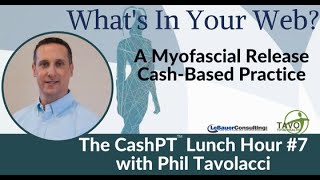
In this hour‑long live interview, Aaron LeBauer hosts physical therapist Phil Tavolacci, owner of the 100% cash‑based, multi‑therapist practice Tavo Total Health. Phil shares his personal journey into physical therapy, his early work in inpatient rehab and sports medicine, and the chronic pain that motivated him to seek manual therapy. He recounts the pivotal zero‑balancing session that spurred him to start his own clinic, initially a hybrid of personal training and insurance‑based PT, and the growing frustration with insurance billing that led to a full transition to a cash‑only model. Phil explains how he educated patients about the switch, introduced super‑bills, and managed the change in revenue flow. He describes the evolution of his practice space, the current contractor model (70/30 split, independent contractors, no non‑compete), and the mix of therapists (PTs, OT, massage, acupuncturist) all trained in myofascial release. Hiring criteria, compensation philosophy, and the importance of a high‑paying, turnkey environment are discussed. Phil outlines his pricing trajectory from $90 to $202 per hour and his rationale for charging market‑aligned rates. Marketing strategies shifted from community flyers and doctor outreach to almost entirely word‑of‑mouth and a niche directory. He highlights the essential ingredients for a successful cash practice: delivering results, premium patient experience, appropriate pricing, and a capable office manager. Mistakes he made include inadequate hiring vetting, letting ego drive premature expansion, and underestimating overhead. Phil also introduces his book, "What’s in Your Web? Stories of Fascial Freedom," a collection of autobiographical and practitioner stories illustrating how fascial dysfunction relates to life experiences. Finally, he shares future goals, including diversified income streams such as residual book royalties and selling artwork, and offers advice for clinicians considering a cash‑based model.
Chapters
All right. Hello, this is Aaron LeBauer with the Cash PT Lunch Hour. Thank you guys for coming here today. I'm just seeing a bunch of people showing up and gonna wait a few minutes more for everyone else to come in the room. I'm really excited to have a really awesome guest today. But before I introduce our guest, let me just kind of go through a little kind of housekeeping issues. This is live, so if for any reason your browser kind of shuts down or you get popped out, just refresh your browser. So hit the, you know, the little arrow with the circle on it and come back in and join us if you have any, if you have any questions for me or for Phil, you can put them in the chat room in the chat box off to your right. And we'll try to get to your questions as best as we can today. So let me go ahead and introduce my guest. His name is Phil Tavolacci. He's a physical therapist and owner of Tavo Total Health in Silver Spring, Maryland. Phil is also the owner of a 100. His practice is a 100% cash based practice and he's got multiple therapists working with him in his practice. And their specialty practice is myofascial is about myofascial release and physical therapy. He's got occupational therapists, massage therapists working with him. So multidisciplinary specialty, niche practice, 100% cash based. I'm super excited to have him. And Phil is also a published author and he's published a book titled what's in your Stories of Fascial Freedom. And for those of you who are here today, if you stay until the end, Phil has generously offered to raffle off a signed copy of his book. So what I'll do is at the towards the end of the program today, which will be just about an hour, we will do a drawing of everyone who's present. I've got a random number generator loaded up on my browser and we'll just pick a number and count down the people and I will then get your contact info and Phil will send it out to you. So without further ado, I want to introduce you to Phil. Phil, thank you so much for joining us today. I really appreciate you spending the time to share your knowledge. Thanks a lot.
Sure. It's great to be here. Aaron, thank you for the nice introduction and hello everyone. I'm looking forward to spending the next hour with you and hopefully imparting some kind of helpful information on your journeys. So it's an honor and a privilege to be here.
Thank you. And I also just want to mention that I've met Phil a few years ago at my release seminar and he's one of the people that I thought of when someone asks who's got a multi therapist cash based practice or cash based practices don't work for more than just one person. And so I'm really excited to have Phil on and share some of that information with you all. Phil, let me just start off by asking, how did you get into physical therapy? What led you into this profession?
Well, I think that's definitely a combination of an interest in medicine, health, exercise, fitness, wellness, rehab from an early age in combination with a pretty significant injury in the 11th grade and wasn't really getting any better from that injury. And so I think like many therapists go into therapy school to try to figure out how to fix themselves and many psychotherapists go into that field to fix themselves or their family. So it was a combination of those things for me that got me interested in physical therapy.
Oh, great. Awesome. And then so from physical therapy, so tell us, like, where'd you go to school? How long ago was that? You're kind of young, right? You're like 22, right? You're prodigy.
Well, I'm 43, so I've been a PT for 18 years now. I got my master's degree from the Medical College of Virginia, which is the medical division of Virginia Commonwealth University in Richmond. My undergrad work is in exercise physiology from Ithaca College in upstate New York. And I entered the PT world in a very traditional setting. I worked in inpatient rehab for the first three years out of school. Really enjoyed the work. Worked with a lot of trauma patients, spinal cord injuries, brain injuries, total hips, total knees, amputees. It was great. However, I was in a lot of pain. You know, I had multiple injuries and traumas before that had just gotten me to a point where I was in a lot of pain and dysfunction. And I was the only male therapist there on that team. And so I got every 400 pound patient, every dependent patient for transfers, which I loved. I loved being part of their healing process. But I would literally go home and lie on the floor for two hours trying to come out of spasm. So after that job, I took a job in a sports medicine clinic. I did that for about two and a half, close to three years. Really enjoyed that as well. But it was kind of a very fast paced, insurance based factory, I'd have to say. You know, I saw four patients an hour and literally would run down the hall and ultrasound someone and run down the hall and mobilize someone and run down the hall and change someone's exercise program. It was exhausting. And again, I was still dealing with a lot of chronic pain in my body and it was frustrating to walk into a room and realize, you know, I'm in more pain than this patient. And I'm in more pain than this patient. So anyway, I did that for about two and a half, three years. And then I really, really wanted to start my own practice at that point, but I felt that I just didn't know enough in terms of business to do that. And I also had really not been a manual therapist at that point. And I knew that if I was going to start my own practice, you know, money would really only afford a very small space, not a lot of equipment. So I really needed to become more of a manual therapist. And so I took a one year contract running an outpatient orthopedic clinic. And that gave me the opportunity to learn the business, the marketing, all the nuts and bolts of how to operate a business. And it gave me a chance to take some coursework manual therapy wise, and get some guidance and mentoring from a really great therapist that I'm still great friends with and colleagues with to this date.
Awesome. Awesome. Was there something in particular that kind of hit you as like, okay, this type of like out the traditional outpatient setting is not for me or I want to be in private practice. Was there something that was like kind of got the ball rolling or kick the stone type of thing?
Well, I was quite frankly, just really tired of making other people a lot of money. And I also have always been someone who has an idea and wants to implement it immediately. And in those other settings you can oftentimes have great ideas, but then you have to go through a committee and then you've got to get approval and then it still may not happen. So I really wanted to just steer my own ship, so to speak. And as my life changed or my interests changed or populations changed, I wanted to be able to mold and shift and change my own practice with that. And thankfully, the last 11 years I've been able to do that.
Yep. So what was it that took you from that outpatient practice to private practice? Like, where did you go from there? Like, was it I got this one year and now I know I'm going into private practice or is there anything else?
Yeah, I mean, this is kind of an out there story, but I, but I do mention it in my book. So I'll take A little segue, because in all honesty, this was what led me to leap. And I had gone to, well, let me back up. A couple of different people in the course of one week had told me about this one specific massage therapist and for different reasons said, you should, you should go. And I wasn't quite sure why they were telling me to go, you know, if they thought I needed to go for, you know, some kind of business direction or what. But anyway, what happened was I went there, it was a zero balancing session, which I'd never heard of before. And the therapist didn't ask me any questions, didn't have me fill out any questionnaires. She just said, lay on the table. And for 30 minutes she just kind of touched different points. And quite frankly, I thought, this is a waste of my time, this is not doing anything. But at the very end, she said, do you want to know what your body told me? And I was kind of like, okay. And she literally told me my whole life story. And she said, and the reason why you're here today is because. And she said, you want to start your own practice. You're scared that you don't have enough training, you're scared that you don't have the money. How are you going to do this? And she said, I'm just going to tell you that you have to do it. You have no choice. It's time for you to step out on your own and do your own thing. It was this kind of otherworldly experience. At this point in my life, I tune into stuff like that. It might not be for everyone, but for me it was like what I was looking for to say, okay, go for it. And I did. I just jumped out and started searching geographically. I talked to a past colleague of mine who I knew was also interested in starting her own practice. So we talked about maybe splitting a small space. And that's exactly what we did. We found a space in Chevy Chase, Maryland where it was about an 1100 square foot space within a primarily medical building, like a 12 floor building. And we were able to split it between her, myself and a psychiatrist that was working in that space. So literally 700 bucks a month. I started in about 120 square foot room with no windows. That was my treatment room and just got off and running.
Awesome. And at that time when you started, did you start as in cash based practice or did you start in network?
So at that time I had already been a personal trainer for 10 years. And so what I decided to do was I started my practice as about 50% personal training and 50% physical therapy. The personal training was with very minimal equipment, I mean, ridiculously low number of equipment, but it could bring cash in immediately to start covering overhead and buy a treatment table and all that stuff. The physical therapy portion was insurance based. So I was signed on with three different insurance companies and I slowly started growing my PT practice by getting the word out a little bit with some advertising in the 2 mile radius around me. And then also of course, being in network people find you through, through the insurance network.
Okay, gotcha now. What, what led you into cash based practice? So where did you make that decision? Okay, cash based practice is the go. I mean, this is what I have to do. I mean that's definitely not a, not an easy decision and it's not something that we just kind of happen upon.
No, no. For me it came down to utter frustration. I just got to a point where I was spending every free minute on the phone with insurance companies trying to rectify missed payments and trying to track down where payments were and taking extensive notes because after a couple years I realized I had to write down. I talked to Joe Jones on this date at this time and he said this and this didn't happen and what is my next step? And, and it was also challenging. I had an office assistant at that time who was part time and she couldn't really spend all of her time on the phone with insurance companies. And the end of the month would come and my rent is due and my bills are due and I didn't necessarily have the payments from the insurance company that I needed. I really just for probably about four to six months, stewed over it because like you said, it's not an easy decision. There are people that have to go through their insurance or feel that they have to. And so I didn't want to just abandon people, but I got to a point where I realized, okay, I'm either going to not have this practice anymore because I cannot deal with this stress and aggravation, or I'm going to switch to cash based. And I made the choice to go cash based. It was about a two and a half to three year journey to get there.
What was the first thing that you had to do?
So the first thing I had to do was educate my patients, of course, and let them know that I had made that decision. And I also did it at a time where there would be about four more months where they could utilize their insurance benefits and that I would continue filing for them. So it gave them an opportunity to Complete a plan of care. And for those who were entering my practice at that time, I let them know immediately that I was switching to a cash based practice. And I let them know all the nuts and bolts about it, you know, that they would pay at the time of service, that I would provide them with what's called a super bill. That, that super bill would be a document that they can send to their insurance company that has their diagnosis code and treatment codes and my signature, you know, everything that they need to get directly reimbursed from, from their insurance company. And so at that point, people had an understanding that if they were wanting to come see me or, or other practitioners in my practice, that that's, that's the model.
Right, Gotcha. What? When people said, well, let me ask this question first. How many of your patients who were seeing you in network came with you to and started a plan of care, continue their plan of care when they were now, when you're now out of network of cash basis?
I don't know if I can tell you an exact percentage or statistic, but I would say probably about 40 to 50% continued on a cash basis.
Awesome.
Which I felt was a good number.
Yeah, yeah, I think that's great. I think there are quite a few people that won't based on a lot of different factors. But I think a lot of people are afraid that no one will transition with them. And so I think that that's a significant portion of people that kind of stayed with you. So let me then say, did you notify or ask, did you notify people by letter or email or anything like that, or you just saw everyone, like the people who weren't in your current plan of care, like the people who were not coming into the office. Did you send out a message to everybody or you just kind of did that when you saw people?
No, I crafted a very, very detailed email letter and sent that out knowing that most of those people I was going to be seeing in person anyway because my preference is that they get it and they have their response or reaction as people will do when they get something that, you know, impactful in their life. And then I would follow that up with a conversation the next time I saw them. And that seemed to work really well versus, you know, someone walks in the door, they're in a lot of pain or, you know, they've got all this stress in their world and you're just, oh, by the way, you know, this is happening.
Right.
Kind of catch them off guard was what I felt. And why I chose to do it the way I did.
Okay, awesome. So what do you say when people call you right now and say ask, do you take my insurance? How do you answer that question?
So that's a good question for my office manager because thankfully, 11 years down the road now I have a full time, awesome, amazing office manager who does all of that communication. And she is just as much a face of my business as I am. So I do know that she basically tells them just very clearly that we're a fully cash based practice. And she explains to them what I explained to you in terms of paying at the time of service. They'll submit a super bill to their insurance company. They'll get directly reimbursed. We keep their full medical chart. If their insurance company wants any of the documentation, we'll send it to them with their approval and consent, of course. So she goes through all of that information and I don't check in with her as much as I used to. I used to be very conscious of, okay, you know, how many people hung up, you know, after you said, we don't take insurance. But I don't have those conversations anymore just because we're a full busy practice and I just don't stress over who's coming and who's not coming at this point.
Yeah, gotcha. Let me back up and ask you a couple questions. So your practice is specialty practice and your main treatment modality is myofascial release. Yes, similar to mine. How did you come into finding that as a treatment modality and how do you use that to benefit your patients?
Sure, yeah. So I alluded before to being in a lot of pain when I first was a pt. And so in. To make a long story short, In May of 2005, I took my very first myofascial release course down in Miami, Florida. And prior to that, I really knew nothing about fascia. I knew nothing about the connective tissue system. I didn't really learn about it in school other than, you know, in gross anatomy. Get it out of the way because it's covering up the important stuff. But in May 2005, I took that first course and literally in the course of that three day seminar, I had more pain relief than I'd had in 15 years. And it was just an enormous aha moment for me of my gosh, the issue is literally in my tissue. And I went on a journey in two different directions. One, as a patient, I flew out to John Barnes Clinic in Sedona, Arizona. I did what was called an intensive where I had three hours of myofascial work done every day for, for five consecutive days. And although that didn't cure me of everything, I felt better than I'd felt in decades. And so I went, you know, as a patient down the path of healing myself and simultaneously as a physical therapist who now had his own private practice and could do whatever he wanted, started treating everyone myofascially. So I just, you know, did a 180 on what I had been doing. You know, no more ultrasound, no more e stim. And I'm not saying that those things don't have value, but just for me, I was finding that every time I put my hands on someone and worked in their fascial system, they were making progress much quicker. Their plan of care was much shorter, they were having results that exceeded what they came in for. You know, many more things were benefiting. So that is really how I created my practice as a niche myofascial release practice and then started growing and expanding it in that direction with other therapists who had the same or similar training and beliefs.
Awesome. Are people contacting you just specifically for myofascial release?
Yeah, at this point they are. The first, I would say five to six years, there was still a lot of inquiry and questions as to why I maybe wasn't integrating other things into the plan of care. But I would say the last three to four years there's been a huge increase in consciousness about myofascial release and people are specifically seeking it out and are hearing from friends and family members and coworkers that they've had success with myofascial release and they're specifically calling for it. So it's a good place to be at this point.
Awesome. Awesome. I wanted to ask you a few questions about your multi therapist practice. You got a couple different therapists there. Is everyone tell me what kinds of therapists you have. I think you've got occupational therapists, PTs, massage therapists. Can you tell us a little bit about how that's set up and are they all also using myoflash release as a treatment or are they doing other things?
Okay, so I'll start where we are at the moment. And then again, this was an 11 year journey. So I can go back if you want me to, like if people are interested in when it was a larger setting, how I structured it that way. But right now I'm in a detached segment of my home. I bought a house three years ago and gutted and restructured this detached segment. So there's Two private treatment rooms and two bathrooms on two different levels and a waiting area. So I say that because there's not as much space here as I used to have. So with that said, there's myself full time doing all myofascial work. There's a physical therapist, Kathleen, who is with me one and a half days a week. She also is an expert level myofascial therapist. Niall is an occupational therapist, also an expert level myofascial therapist, does all myofascial work, although she also sees a subsegment of infants and toddlers and uses a slightly different cranial fascial approach. Dr. Gillespie is, I believe, the practitioner. But Dr. Gillespie and John Barnes are very similar in their style and focus on the fascial system. And then I have one massage therapist, Kelly, who's also an expert level John Barnes based myofascial therapist. So it's the four of us right now from a myofascial standpoint, all of them are independent contractors versus employees or versus subleasers in the space. I do have one acupuncturist who subleases the space just one and a half days per week. And so that is our blend right now.
Okay.
In the past, I had many more practitioners and there was a larger combination. There were personal trainers because I had a fitness area. There was a nutritionist before there were a couple massage therapists, an acupuncturist, but that was a 2,200 square foot space with three different treatment rooms and a large fitness area. So a couple different iterations over the years.
Right. Wow. So what's the largest number of people you've had
contract?
I mean, has it always been contractors?
Well, some. Some of them have been subleasers. Like when I had the space that had three private treatment rooms, I would run the myofascial work out of 2 of the treatment rooms, and those therapists were independent contractors with me. But one of the rooms I used as a sublease space for an acupuncturist a couple days per week and massage therapist a couple other days per week. And then the fitness segment of my practice back at that time, after I stopped doing personal training myself and focused 100% on myofascial work, I subleased that fitness area to a personal trainer.
Okay. Okay. Now, one of the things that I've kind of struggled with is thinking, you know, well, if I'm going to hire someone and they're going to be exceptional therapist, how am I going to reward them in a way that they benefit and they're like, well, I want to bring my patients here versus starting my own place. And so how do you address that when you kind of contract with another therapist?
Yeah, that's a great question. So I would say there are two things that are super important there. One is you have to compensate people really, really well for their skill level and their time. So there are many different percentage splits that independent contractors and companies can choose. I choose a 70, 30 split. So 70% of every session goes to that independent contractor. 30% comes into my business. So they're very well paid for the work that they're doing. The other important aspect is I make it very, very turnkey for them in that they can come in. It's a beautiful space. It's kept up for them. You know, they're not having to come in and put toilet paper on and you know, do linens and all that stuff. And I also have a full time office manager that is doing all of their scheduling, that is collecting payment for them that when they send an invoice to us, the company, they're paid very promptly for their work. I do have an independent contractor agreement with everyone. But it is very clear that I don't believe in non compete clauses like if someone wants to leave, just give me four weeks notice and you know, you go and do whatever you want to do. I don't believe in restricting people's freedom. I think that that's energetically not a place to go. You don't want to, you know, trap a good employee. You want them to love what they're and produce great results and love the atmosphere that they're working in. But yet knowing that at any time if their life changes or their desires change, they just move on. And I've been very blessed. I mean I've worked with amazing, amazing therapists from the very beginning. I think the work that we do leads to many incredible people coming into this field. People that are just big hearted people and you know, just really amazing. So I've been really, really blessed and thankful for that.
Yeah. Awesome. Do you, that's, that's great. Do you have any other perks or benefits or, or any other things that you offer for therapists when they come on as contractors?
No, I mean they really come in with an understanding that they are their own business within my business and have the perks that I mentioned in terms of a really high payout for their services and everything really in place for them to do their work and just write their note and walk out the door and then get paid. But I don't do other perks like covering continuing education courses or anything like that just because they're not an employee, they are a contractor and it is their business and they could leave at any moment. So I don't offer perks like that.
Right. What do you look for when hiring someone or even when you're not hiring a contractor? When you come to an agreement with someone, is there like a vetting process? Are you looking for people or are they approaching you? And what kinds of like things are you looking for before you establish a relationship?
Well, I think that's kind of a tough question just because the therapists that I'm working with, we've worked together for such a long time now. Like I don't really have turnover. So if I think of the most recent therapist, who's Kelly, who joined our staff, I just got to know her, you know, over the course of seminars and study groups and just knew that she was amazing. And really what I'm looking for are therapists that have the training that I have or close to what I have, have the passion and compassion, have the dedication and drive. They're professional, they're good communicators. They understand that when you're in a cash based practice, you have to treat people like gold. You know, not that you're brown nosing them or kissing their butt or anything like that, but that they're paying you a high amount of money for your time, skill, expertise. You are going to give them an experience when they're here. And so I'm looking for that, you know, all blended together in the people that I'm working with. And especially now that my practice is part of my home, even though it's detached, you know, I want the highest caliber people in my practice because it's also part of my home.
Right. Right now are your, when you've got, when I looked on your website, everyone there has got a separate rate or is everyone setting their own rate, like fee schedule for themselves?
Yeah. So it's a discussion between us. Some of it is dependent on years of training and years in the field, and some of it is dependent on that particular therapist's comfort level. Like there are some therapists that I would suggest to bump up their fee, but they don't feel ready yet to do that. And so I honor that because I truly believe that the money we charge is an energy exchange and you have to be comfortable charging what you're charging. And I also, I like the staggering because I feel like it gives patients the option, you know, if you feel like, quite frankly, if you feel that my fee is too high, I get it. I totally get it. Look at these other fees and see where you're comfortable working at, if at all.
Yeah, got it. So what are you charging right now?
So I just took my biggest leap actually at the beginning of this calendar year and I went from 176 to 202 an hour. But again, this has been an 11 year journey. And when I started, when I switched from insurance based to cash based, I started at $90, I believe. And then a couple years later went to 120 and then I went to 140 and then I went to 165 and then I went to 176 and then I went to 202. And don't ask me for any logic as to where these numbers came from. It's just really what I felt like my time and energy and skill was worth at that moment. And this big leap that I just took took a lot of consideration about six months of considering because I knew that there would be some challenge to it. But I also knew at the same time that I'm trading time for money and I wanted to scale back a bit. I didn't want to keep treating 8, 9 patients a day and burning myself out. I wanted to treat five or six patients a day who are really dedicated to their healing process and their journey. And if others felt that my fee had become too high, which several did, and that's fine, then I had everything in place where there were other options. And I'm also lucky in that in the area that we're in, in D.C. there are other practitioners, so we can refer to, to other practitioners who might not have the same, the same rates.
Now, are people calling and are they looking just for Phil, Are they looking for, you know, your other therapists or. And how do you decide who gets who? Unless, you know, even I know that you just said the patient gets a little bit of choice, but do you. Does your office manager just say, here's our first available, or, you know, here's this appointment with Kathleen, etc.
Yeah, well, it used to be that people only wanted to see me, but now it's at a point where pretty much the people in the area know that it's our whole practice that's producing really good results. It's not just me. And again, I'm really blessed to have amazing, amazing therapists. But basically, to answer the second part of your question, people call, they have usually a Pretty lengthy. First conversation with Kristen, my office manager, and it's a discussion between them, depending on schedule, depending on do they want a male or a female therapist, especially if it's like a women's health kind of diagnosis or issue. These are the fees. What are you comfortable with? So it's many different variables that come into place. And I, at this point, again, thankfully, I'm not in any of those conversations. Not that I minded when I was in them, but it's time consuming and it's time that I can't have my hands on a patient or be doing other things. So one thing that I would stress to people who are considering going into a cash based practice is that as soon as you can afford to get an amazing office manager.
That's awesome. I probably need one myself.
Yeah, I mean, you get to that tipping point where you just, you know, you, you realize you really need to do it.
Yeah. So is your office manager there, you know, all day long or she have certain hours?
So this is, so this is unique in that she was on site when my clinic was in Chevy Chase, Maryland. And right as I was moving my clinic and creating this space, her husband was accepted to veterinary medicine school at Virginia Tech, four and a half hours away. So we figured out a way for her to completely run my practice remotely from four and a half hours away. And so that's what she does. So she's a stay at home worker now, A stay at home mom. She just had her first child three days ago, so she's on maternity leave right now. Which does mean that these two months I've got to work a little extra hard in the administrative part of my business. But yeah, she, she works 9 to 5, scheduling, billing, communicating, you know, mailing information to people. She, she does everything and is a total gift.
Awesome. Awesome. Let's see. I've got to want to shift a little bit. Questions. I want to get through a couple things. So one of the things I want to ask you and in one of our, from our discussion before, or actually maybe before the call today, is you're talking about your important ingredients. So what are your important ingredients for running a cash based, successful cash based practice?
Okay, sure. Yeah. So I would say the most important ingredient, you know, no matter what modality you do or what your specialty is, is getting results. You know, you need to have results. Walking out the door and talking because we all know word of mouth advertising is the most powerful advertising in existence. So you literally want to do what you do best and get people better and get them telling everyone about how awesome you are and how awesome your practice is. So that's first and foremost. The second, I would say, is to treat your patients like absolute gold. Like I alluded to before, you know, they have choices. They can go to an insurance based practice, they can go to, you know, many other practitioners in the area who may or may not be insurance based. But if you treat them incredibly well, you know, you communicate with them very clearly. You have a nice, clean, tidy space. You start on time, you know, you, you ask them about the temperature of the room, you know, you ask them if they want a certain kind of music. I mean, it goes beyond just them reaching their physical therapy goals. It becomes a packaged experience. So I think that's very, very important in a cash based practice to give people not just your skill set, but something very, very valuable that they're not likely to get anywhere else. Another thing that I jotted down is to charge what, you know, your time, expertise and skills are worth. And we kind of alluded to that before because again, that time that you're with your patient is an energy exchange. It's a very, very sacred time. And if you are undercharging for your time, my experience at least is there, there becomes this kind of internal resistance or frustration of, you know, here you are pouring all of your past experience and your skills and your training into something and you're not being compensated very much for it. So I think that that's a big ingredient is really, you know, certainly looking at what the market can afford in your, in your demographic, but not necessarily going below that and undercutting what you're worth. Another thing I jotted down is that, well, we already talked about this. When you get to a point where you can afford an office manager, I mean, I couldn't have gotten my practice to where it is if I was chief cook and bottle washer, you know, doing absolutely everything, which I did for a long time. And then my first office manager, you know, which we won't really get into, was a nightmare and stole money from my business and was just, it was horrible. So one point is you really, really need to do your due diligence and really figure out who's the right fit and if they have a criminal record.
Right.
And then, let's see, that's pretty much what I would say are the, are the significant ingredients to have a successful cash based practice.
Awesome. Awesome. I got some. Great. That's really awesome. I need to go out and get myself an office manager tomorrow. Yeah, please do I've got 100 things, I got a list of like a thousand things, and I am the chief cook, bottle washer, and you know, I enjoy it. At the same time, I can see where offloading a lot of those responsibilities can help you put more energy into your practice, growing it and everything. That's really great. Well, tell me, like you kind of alluded to one of them already, but where are some of the mistakes you've made going along through starting a practice and converting to cash based or just cash based practice? Are there anything that sticks out? Well, there were other people should know about.
Yeah. When you asked me the other day, there are three things that stuck out for me. I don't know how relevant they'll be to everyone, but they're the ones that stuck out. The first one was what I was just mentioning, you know, my first office manager. I had gotten to a point where I was so incredibly busy, which was great, you know, for the business, but when I was hiring, the very first person I was hiring, because for office staff, you know, I do have employees, you know, they're W2 employees of my business. They're not independent contractors. And so I just, I'd never hired anyone before, so I didn't do a background check. I just went by personality and you know, how they presented in the interview. And so my suggestion there would be, you know, from the very first person you hire, do it right. You know, do a background check, do your due diligence, call their references. You know, really ask good questions of their references because they're, they're stepping right into your practice and going right into your system. And if you're a busy, successful practitioner, like I'm sure everyone is on this webinar, your main focus many times is your patients and getting those results, walking out the door. So the busier you get with that, the less time and energy you have to looking at your accounts and looking at, you know, all of the, all of the business admin stuff.
Awesome. Awesome.
Yeah. So that's one.
Yeah.
Do you want me to go on or.
Sure, yeah. What else?
So the second one I would say for me was I allowed my emotion and my ego to cause me to make a leap too quickly. So I had started in that very teeny tiny space that I mentioned at the beginning, you know, as a very small treatment room, $700 overhead. And one of my patients at that time was a very, very well known and established real estate person in Washington, D.C. and basically said one day, you know, your practice is growing. You need A bigger space. You should move your practice into X building that I built. And this was an amazing building and I could have a 16th floor suite overlooking the National Cathedral in D.C. and instead of it being $6,000 a month, you know, I could have a really special deal at $4,000 a month. Which, you know, I thought, oh great, you know, I'm getting a good deal, but didn't realize, you know, it's more than quadrupling my overhead and I really didn't have enough practitioners to even fill that space. And you know, yes, it was a mistake at the time, but you know, a lot of things are double edged swords. And it allowed me to grow into that multidisciplinary practice that then became very successful and very great of a money generator and helped me to really network and get to know a lot of people and get more results walking out the door. But you know, in hindsight, and my advice to others is just, you know, if you're in a practice of a certain size and you're getting ready to expand, just do a little bit more homework and don't just go by your emotions.
Awesome.
And, or your ego.
That's really great. Thank you. What I want to do right now, Phil, we've got about 14 minutes before the hour and so what I want to do is we're going to do a raffle for your book. What I'm going to do is I've got a random number generator, so I'm going to go and randomly generate a number. But while I'm doing that, I want you to just give us a little brief overview about your book, what it's about, and like how you came up with it.
Okay, sure. So I wrote a book, it's just been out two years now, and it's called what's in your Stories of Fascial Freedom. And it was just a little bit over two years ago that I was sitting in a seminar and quite frankly was bored with the speaker and just started daydreaming when the title of this book just kind of literally dropped into my head. And I had been wanting to write a book for years, some within the realm of physical therapy, some completely fictional ideas running around in my head, but nothing that really caused me to jump into action. But when this dropped into my head and kind of started writing itself in that next hour in my head, while I was not listening to the speaker that I was there to listen to, it really got me going. And I realized that first and foremost, it wouldn't be my book. It would Be a collaboration. And so the book is structured in a way that the first half of it is autobiographical. So I wrote the first 12 chapters, and it answers the question, what's in your web? Basically, the web being the connective tissue system of the body, and how do the different traumas and incidences and experiences and setbacks and emotional things, how do they literally get stuck in your fascial system and overlap over time until it gets to a point where you might be having symptoms or an illness? And then how can the modality that I use, which is myofascial release, go in and slowly start pulling that out of the web? So the first half is autobiographical. The second half is 15 other myofascial therapists that I either worked with or still work with or who I've grown to get to know over the last 10 years. And they answered the question for themselves, what was in their web?
Awesome.
And then there's also client stories. So all in all, there's probably about 40 or 45 different stories. And I labeled it stories of fascial freedom because I don't want people to be confused and think that this is a clinical or academic book. You know, this is not a research book. This is not a how to stretch your fascial system or how to do this work. It's very much just to raise people's awareness as to what's going on in their connective tissue system so that anyone could pick up the book and probably resonate with at least two or three of the stories and maybe go, oh, this is interesting. You know, I wonder if. I wonder if that might help me or my cousin John or my grandmother. And so it's been an exciting journey to have it out there.
That's awesome. Do you have one with you?
Yeah. Yeah, I do.
Hold it up. So this book right here. So Phil's gonna sign it.
It's a hardcover.
It's a hardcover. I've picked the winner already. Marcelo is the winner. I hope that's saying it right.
Congratulations, Marcelo.
Congratulations, Marcelo. You are the winner of a signed copy of Phil's book. And I'll shoot you a message and just send me your mailing address, and I'll get it to Phil and he'll send it to me. So that's awesome, Phil. You know, to be a published. A published author of any kind, you know, you put something up online and you put something down on paper, that's pretty cool. And congratulations. I mean, that's a lot of hard work put into that.
I'm sure so it took nine months. Exactly. So it really feels like a birthday.
That's awesome. What I want to do now is take a couple questions from the audience.
Yeah, great.
And let's see, let me go back. And one of the earlier questions was we were talking, when we were talking about your contractors, the question was, do you or would you use a pta, a physical therapist assistant in your practice?
Yeah, I would. I'm not opposed to it whatsoever. Having myself and Kathleen both being physical therapists, there's no reason why we couldn't be the therapist to sign off on a pta. I would look for in a PTA what I look for in any licensed practitioner that I'd like to employ, which is having taken most, if not all of John Barnes courses just because I am a myofascial practice. And in the past, when I have brought on a couple people that, that didn't quite have the level of training, what would happen is they would see me for a couple visits or Kathleen or Ann or someone else, and then when they would go to the other person's schedule, it was very immediately apparent to that person that they weren't at the same skill level, so they wouldn't rebook. And then you have someone on board that's not fully booked or sparsely booked. So I would look for someone who has that level of training and all the other variables that I talked about before, the professionalism, the communication, the dedication. But yeah, I would absolutely hire a pta, an OTA, speech therapist. Not that I'm looking right now because again, you know, I've kind of right sized my practice for the location that I'm in right now and for minimized overhead and such. So.
Right. Awesome. Awesome. Another question was how did you market initially? Or like, how did you market your practice in the very beginning, is the question.
So in the very beginning, just as a reminder, I was doing half personal training and half physical therapy. So how I really marketed first was to the direct community in a flyer that I put out for a 12 week fitness transformation challenge. And that led to my first four clients who prepaid for a large fitness package, which gave me a large bulk of money right up front. And then they started sharing information, you know, word of mouth from a PT standpoint, really, I did do a lot of the traditional stuff. I did go out and meet with some doctors and, you know, schmooze, which I absolutely hate, to be honest.
Was that stuff effective? No, you feel like it was effective.
I mean, with one or two of the doctors where I had Already like two in particular. I had already treated two of their patients and those patients already went back to them and said what great results they got. So they were much more open to actually having a conversation with me and did refer patients, but other doctors, you know, I felt like it was just like many other scenarios where you go and, you know, bring them donuts and lunch and they, they eat your food and nod and smile and then never do anything because they're just going to refer to their own practice anyway.
So what's your most effective marketing strategies right now?
Honestly, we are 99.9% word of mouth at this point. We have people. Almost every patient that I treat now comes in and when I look at their intake form, it's that a past patient of mine referred them or their cousin referred them or not that they directly had an experience here at Tavo Total Health, but someone had an experience in California or North Carolina with myofascial release and they googled it and they found us, or they went on to John Barnes myofascial Release Directory, which is a directory by state, and found me there. So other than the directory, I don't pay for any other advertising.
Yeah, I was just going to ask. Advertising budget is probably pretty small.
Yeah. So that directory is like $400 a year. And at the very beginning, actually now that I'm remembering a little bit more, at the very beginning I did in Chevy Chase, there was like a community newsletter basically that went out to probably, you know, a million people that were in the 2 mile radius. And every quarter I did put an ad in there for my practice highlighting both the physical therapy part of it and the personal training part of it. And that was, you know, like 1500 bucks every quarter, you know, so that was expensive. And I'd get dribs and drabs of people coming in from that, but far and few between it was, you know, really word of mouth. And in that beginning phase, people were finding their way because their insurance would cover it.
Do you ask your patients to refer people or is this just like they're just doing it?
They're just doing it. Yeah, yeah. I think again, going back to if you send results out the door, especially if your listeners today are individuals like our practice, where you see a lot of complex chronic pain, kind of the clinic of last resort, you know, so to speak, they've been to multiple therapists, multiple doctors, and if you're the practice that actually helps them get well, those are the most excited people in the world. You know, you can't tell them not to tell other people. So I don't specifically ask for referrals. It just happens.
Awesome. So what's next for Phil Tabellacci? I mean, what's your goal for the next 10 years? You know?
Well, you know, at this point, I absolutely love what I do. I've gotten it to a point where I am trading my time in the myofascial work I do at a rate that I feel comfortable with. And so now I am really focusing on bringing in more streams of income into my business that free me up a little bit. So the book is one example. You know, it's not, it's not highly lucrative, but every quarter I get a check for the book. So, you know, there's something to be said about residual income, doing the work once and getting paid for it over time. I also, I shared with you last week that I that I am an artist. And I put that on hold for like the last 10 years because I was, you know, being the very practical business person and building my business and the artwork wouldn't really make money, or so I thought. But I'm about to open an Etsy site and start selling my artwork. It certainly doesn't fall underneath the realm of physical therapy, but, you know, I'm realizing at this point that my practice doesn't have to just generate money through my primary skill set. Not that people will get a super bill and can submit for their artwork, but it is another way that can bring money into my business. So I'm going to continue to look for other streams of income that free up my time a little bit more, but yet still grow my business and bring in more revenue.
Awesome. Awesome. That sounds wonderful. Any parting advice for someone who wants to start a cash based practice?
I would just say it's work. I don't want to mislead anyone, that it's just this very easy step from point A to point B. There is work involved. There is definitely some emotional stress and challenge, especially around the financial piece. But I have no doubt that if you're an excellent therapist and if you have a good business sense and you communicate well with people and you're very passionate about what you do, you can make it work. Definitely. Also do the research. You've got to know what your geography is like and what people are able to pay for a cash based service. You know, I'm very lucky to be in D.C. which is kind of like a bubble in and of itself when it comes to the economy because the government never shuts down and it's not that all my patients are government people, but it's, it's a part of the country where it's kind of insulated from a lot of the economic ups and downs. So I'm not delusional. That part of the reason why my cash practice did really well is because I am where I am. I probably couldn't charge what I charge in a lot of other parts of the country. So I would give advice of just do that research, be conscious of it, but also don't undersell yourself and give away your skills and services for a low cost. And I would just say be open to whatever it might be that comes into your world that says it's time. Like I shared that kind of wacky story about the zero balancing practitioner reading my body like, like she was body psychic and telling me, you know, you're here because you're wanting to answer this question and I'm telling you, go for it. You know, I would say be open to some communication that might stir something inside that says, okay, you know, that's my answer. It's time to make the leap. And there are resources, there's Aaron doing this awesome work. There are other cash based practices around the country that I'm sure one could pick up the phone or do some research and tap into those practitioners that have done it and you'll see, I'm sure, 100 different models. It's not that my model is an ideal model or the best model. You know, do research and see what would work for you.
Awesome. Awesome. Phil, thank you so much and this has been a really pleasure. Thanks for spending your time and your day and your lunch hour with us. I just want to say thank you all for attending and spending your lunch hour with us this time. And, and coming up, I've got an exciting webinar coming up in a few weeks, Cash PT Cribs. So we'll be taking a tour, MTV style of some successful cash based therapist practices. So stay tuned. And this is Aaron LeBauer with Labour Consulting and the Cash PT Lunch Hour. Have a great day everyone.
Bye bye.
More from Aaron


My clinic has NEVER been in-network with insurance companies—and it NEVER will be! #cashpt








