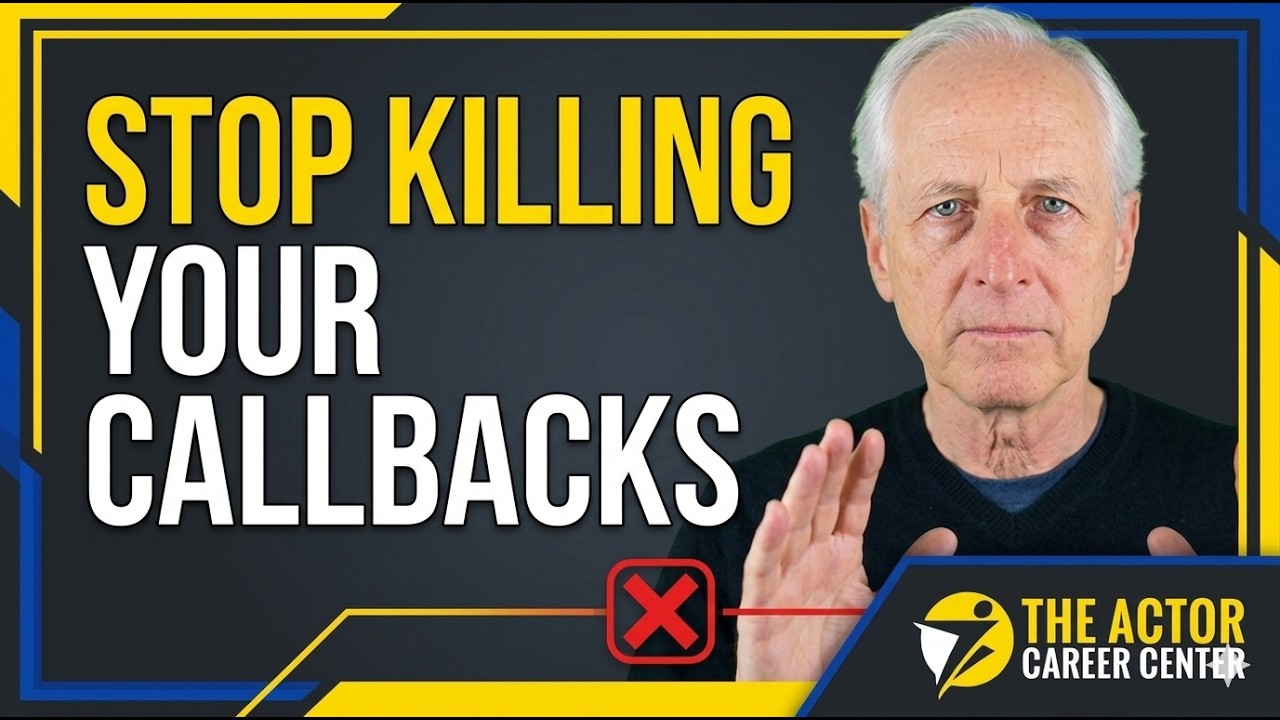
Aaron Marcus breaks down three callback mistakes actors make: changing your physical appearance, switching your wardrobe, or doing a different read than what got you the callback. Repeat what worked the first time, accept direction, and make small adjustments only when asked.
Chapters
In this video, I'm going to be sharing with you 3 big mistakes that actors make at callbacks. So watch this video until the end and you're going to learn 3 ways to help prepare and give yourself your best chance of having success at a callback. Okay, let's get started. Hi, I'm Aaron Marcus and welcome to the Acting and Modeling Quick Tips channel where I teach beginning Actors and models, how to break into the industry, and more experienced actors and models, how to have more success. I upload videos twice a month depending on my schedule. And if you haven't done this yet, make sure you hit the subscribe button, the bell, the notification button. That way, every time I upload a new video, you will be notified. And if you like the video, please give it a thumbs up. So in this video, I'm going to be talking about the 3 mistakes actors make at callbacks that really hurt their chances of booking a job. And the very first one is— oh, first let me just explain really quickly callback. So, um, actors don't always get callbacks. Um, it's not needed. Sometimes you do an audition and you get booked for the job. You know, it depends on the job, depends on the importance of the job, uh, the importance of the role. But if you get a callback, that means that the casting director most likely liked what you did. The director, maybe producers, could be execs— people liked what you did, decision makers. And now they're calling you back and they want you to read again. So that's what a callback is. And just, just remember, a number of people could be getting called back. So getting a callback, you are far from booking the job, but you're being considered, which is, you know, it's a nice feeling. But don't start spending the money yet because you are far from Getting booked. So the main thing to keep in mind, uh, for callbacks is this is not a time to let your ego get in the way, to show off. This is a time to do what you did at your initial audition because they liked what they saw. And so the first mistake that some actors make is they come in looking very different than their initial audition. And they maybe change hair color, completely changed hairstyle. And I have heard some, and I've spoken to some casting directors who said, yeah, this person came in for the callback, I didn't even recognize the person. And the client was saying, I don't even know who this person is. This is not who I saw at the initial audition. I really am not interested in it. So Don't make any big physical changes to yourself. Look the same. Okay, second mistake that actors make. Look, and this has nothing to do with superstition. This is a very specific idea that will be helpful to you. Wear the same clothes that you wore for your initial audition. And the reason for that is, look, Not only do you have to give a read that people like, but you also have to physically look right for the part. Hey, I know this might surprise you, but the chances of me getting booked as the, uh, head of a motorcycle gang is pretty slim. Now, I could be the accountant for the motorcycle gang, but let me just tell you, that's just not my look. So you physically have to look right for the role. And so if the wardrobe that you wore really fits the character, Then wear it again so that way when you go back to the callback, they are seeing the same person that they liked. Okay, third thing, and this is where you've got to check your ego at the door. This is not a time to show off and, and to present to everybody how talented you are and start reading in a very different way just to show them that you have this You have such a wide range of skills and you are such a talented actor that you can do so many different things. You sound so different than the— don't do that! They liked your audition, give it to them again. Read it with the same intentions as your initial audition. Now I understand we're humans, you know, we're not robots. You can't just plug in, well, I read it like a number 62 For the initial audition, so I'm going to plug in 62 and just repeat that. Look, I assume that you did some research. I assume that you spent some time thinking about your character. You know, what are you trying to get out of the scene? Are there any obstacles in the scene? Um, you know, what's going on with, you know, the other person in the scene? And so that's the way you want to go into your callback, reading it with the same intentions as your initial audition. So don't let this throw you in case this does happen to you, and, and there's a good chance it will, that you do the read and maybe the director or whoever is there making, you know, giving you some, some information asks you to read things differently. Now the initial thought for some actors is They hate what I do. They don't, they don't think I'm very good because now they want me to do something different than what I initially thought. Or, you know what, I just don't see my character— Get rid of all of that stuff. They're asking you to make adjustments, and it could be for a variety of reasons, and it has nothing to do with your skills, because if they didn't think that you were talented, you wouldn't be getting a callback. So What you do want to be thinking about is maybe— not even maybe— they know more about your character and the scene than you do. Because if you are reading, let's say, for a smaller role in a major project, chances are they're not sending you the entire script. They're sending you the sides, you know, a page, a couple pages, 3 pages, you know, maybe a few more. But They have so much more information than you do. So maybe what they are saying to you is, hey, look, we know a lot more about what's going on in this scene, and I realize you weren't given that information, so now I'm sharing it with you. So take this information, and I want you to do it a little bit differently based on the fact that now you've got additional info. Okay, so that's one reason, and of course you're going to do that. Another reason why they might ask you to read things differently And it has nothing to do with the fact that they have more information. It might be simply because— look, they might have loved what you did. They might be thinking, yeah, this is the person that we're going to cast. They just want to make sure that you are an actor who does have the skills to make adjustments, because it's not unusual on a set for you to do a read and maybe the director Might have a couple of suggestions for you. Maybe they just, they might even really like what you did and they're thinking, this is what we're probably going to use, but you know what? I want a couple of options. You know, you're not quite— let's just try it where you're not quite so angry, you know, this time. And so they just want to make sure that you do have those acting skills to do that. And that's it. So don't start freaking out. Don't start playing mind games with yourself. Oh, they don't like what I did. No, that means, look, if they had no interest, then they wouldn't be wasting their time. So it might just be they just want to make sure that you do have the skills to take notes and do something different, and that's it. So just to kind of sum it up, 3 mistakes that you won't make in the future. 1, physically look the same. 2, wear the same wardrobe. 3, Just present it, do your read the same way that you did at the initial audition, and go with any adjustments that they ask you for. Uh, really quickly, if you haven't done this yet— yeah, don't forget, hit the subscribe button, uh, the bell notification button, and give it a thumbs up if you like it. I'm giving you permission to share this throughout your social media platforms with your friends. Look, my whole goal Here is to create an acting and modeling family where people share information with each other. So if you've had any experiences at a callback, uh, that you can share with other people here, whether it was positive, whether it was negative, uh, something that might have surprised you, please leave it in, in the notes below, in the comments below, so that way we can all learn from each other. Anyhow, I'm Aaron Marcus. I'm I hope you found this helpful, and I can't wait to talk with you again soon. See ya.










